Welcome, friends! Just as we need a strong physical spine for good health, equally necessary is a healthy spiritual spine with good strong theology holding us up. Click the video below and let’s worship the Lord…
And, here is Psalm 99 put to song and performed by the Sons of Korah…
Psalm 99 by the Sons of Korah
May you be strengthened with all power according to God’s glorious might so that you may have great endurance and patience. Amen.
Our ideas of God take shape in the many ways we live our lives. A God who is always right, fair, just, and loving in everything he says and does is a God we can trust. A cranky god who is aloof and indifferent does not help anyone. Yet, with the one true God we can be assured of strong spiritual support for any and every situation. When we have as our ally a robust theology which informs how we think and gives shape to how we act, then we can step forward with confidence knowing God has our back.
Sound theology needs to be identified, nurtured, and expressed in daily life. The Old Testament psalms are pregnant with vigorous views of God, as well as being the Church’s prayer book. Each individual psalm invites us to see God in a new or fresh way and inspires us to pray. Using the psalms as boots-on-the-ground prayer provides a firm foundation from which to know, worship, and serve God.
Here is my own translation of Psalm 99, which is meant to capture the spirit of the text. I encourage you to pray it over slowly, several times, and with appropriate emotional flavor behind the words:
The LORD rules everything; let all people everywhere who live unjustly, shake in their boots!
God sits enthroned above all creation; let the earth rumble on its foundation!
The LORD is great among his people.
In fact, God is far above all people.
Let everyone, no matter who they are or where they are from, praise Your great and awesome name. God is holy!
Mighty Ruler, the lover of everything that is just and right,
You are the One who established what is fair and equitable.
You labored behind the scenes for causes which are just and right,
and brought harmonious relations to folks at odds with each other.
Magnify the LORD, our God!
Approach the Divine with great and mindful humility!
God is holy!
Godly people of old such as Moses and Aaron were among the Lord’s devout followers.
Those like Samuel were among the humble who called on God’s Name.
People from times long ago have cried out to the LORD and have gotten an answer.
God spoke to the ancient Israelites in a great pillar of cloud.
They sought to keep and entrust the divine rules given to them.
O LORD our God, you answered them.
You were a forgiving God to them,
yet, you also were the One who held them accountable when they slid off the rails.
Magnify the LORD our God!
Humble yourselves and worship at God’s holy mountain,
because no one is like the LORD our God, a holy Helper!
Let’s get some hearty divine beliefs under our belt with the help of Psalm 99 so that we can live by faith, hope, and love…
God is Universal
A healthy view of God enables us to live with confidence no matter the circumstances. There is no place we can go where God is not there already. The Lord is universal – not tied to any distinct location, culture, class, race, gender, ethnicity, or group of people. God reigns supreme as Lord of all, not just some. The Lord is everywhere:
Where could I go to get away from your spirit? Where could I go to escape your presence? If I went up to heaven, you would be there. If I went down to the grave, you would be there too! If I could fly on the wings of dawn, stopping to rest only on the far side of the ocean— even there your hand would guide me; even there your strong hand would hold me tight! If I said, “The darkness will definitely hide me; the light will become night around me,
even then the darkness isn’t too dark for you! Nighttime would shine bright as day, because darkness is the same as light to you! (Psalm 139:7-12, CEB)
God is not only our God but everyone’s God – which means you will find God amongst both Democrats and Republicans, upper class and lower class, black and white, American and Asian, in every nation of the world, and within all societies. No one group of people have the corner on God, for God is much too big for that – which also means God is not limited to looking just like an old white northern European heritage male Protestant minister.
God is Just
It is important to have a proper definition of biblical justice. In the way many use the word, it refers to punishing those who do wrong and deserve incarceration. Although this idea is included in the meaning, it is only a secondary understanding of justice. The primary essence of justice is ensuring everyone has what they need to thrive and flourish on this earth – that there are no obstacles to people realizing their full humanity in God’s image.
Conversely, injustice means someone, a group of people, or even a nation is withholding resources and blocking persons, either knowingly or unknowingly, from thriving in life. A punitive implication of justice comes into play here. Unjust authorities must be replaced or even punished for their gross negligence in failing to provide for the common good of all persons under their responsibility.
Throughout Holy Scripture God spotlights those who are underprivileged and under resourced through no fault of their own. Those who love justice seek to rise above ignorance; be non-judgmental; use power on behalf of others; and are vigilant to operate fairly and equitably in all things.
The reason aliens, strangers, widows, and orphans are oft mentioned in the Bible is because they were the most vulnerable people in the ancient world to unjust actions and policies. God acts on their behalf so they will experience a fair distribution of resources instead of retribution from others.
The Lord your God is God of gods and Lord of lords, the great, powerful, and awe-inspiring God. He never plays favorites and never takes a bribe. He makes sure orphans and widows receive justice. He loves foreigners and gives them food and clothes. So, you should love foreigners, because you were foreigners living in Egypt. (Deuteronomy 10:17-19, GW)
“You must defend those who are helpless and have no hope. Be fair and give justice to the poor and homeless.” (Proverbs 31:8-9, CEV)
“I want to see a mighty flood of justice, an endless river of righteous living.” (Amos 5:24, NLT)
God is Relational
The Lord graciously gives guidance. God has spoken in the past in answer to those who called upon the name of the Lord. God’s presence was with the Israelites in their desert sojourn. God provided laws and promises to help them. And it was all done with the intimacy of a father and mother to a beloved child.
The powerful, living Spirit of God is available to us today, as well. The fallen nature of this world and our own sin is overcome through the grace of forgiveness in Christ. Even Jesus himself closely identifies with us and offers prayers on our behalf:
Jesus looked toward heaven and prayed, “Father, the hour has come. Glorify your Son, that your Son may glorify you. For you granted him authority over all people that he might give eternal life to all those you have given him. Now this is eternal life: that they know you, the only true God, and Jesus Christ, whom you have sent. I have brought you glory on earth by finishing the work you gave me to do. And now, Father, glorify me in your presence with the glory I had with you before the world began. I have revealed you to those whom you gave me out of the world. They were yours; you gave them to me, and they have obeyed your word. Now they know that everything you have given me comes from you. For I gave them the words you gave me, and they accepted them. They knew with certainty that I came from you, and they believed that you sent me. I pray for them. I am not praying for the world, but for those you have given me, for they are yours. All I have is yours, and all you have is mine. And glory has come to me through them.” (John 17:1-10, NIV)
God is Holy
God is pure, set apart from injustice, wickedness, and sin. There are no impurities of mixed motives or malevolent plans with God. God’s holiness is the ground of the divine Being. In other words, the Lord does not simply act holy in all responses, plans, and works; the very essence and character of God is holiness. Therefore, God only acts consistent with this inherent personhood. Sacred words and actions come from the holy God.
And this is what engenders trust with the psalmist and caused him to acknowledge the great and wonderful help God gives. God’s holiness encompasses both divine transcendence and immanence, that is, the Lord is both far and near at the same time, all the time. And that theological understanding is of great worth to the worshiping and devout believer.
Each Sunday Christians all over the world gather and pray, “Our Father who art in heaven.” God is as near as a parent to a child and also reigns in heaven far above all – at the same time, all the time. God maintains a close and intimate relationship with humanity while also keeping a distance from injustice and unrighteousness.
Let us, along with the multitudes of heaven, proclaim God’s holiness:
“Holy, holy, holy is the Lord God Almighty, who was, and is, and is to come… You are worthy, our Lord and God, to receive glory and honor and power, for you created all things, and by your will they were created and have their being.” (Revelation 4:8, 11, NIV)
Our holy God lives forever in the highest heavens, and this is what he says: “Though I live high above in the holy place, I am here to help those who are humble and depend only on me.” (Isaiah 57:15, CEV)
God is our holy Helper. The Lord’s assistance is available, abundant, and awesome. So, let us take courage and pray with confidence and boldness to the God who listens and answers.
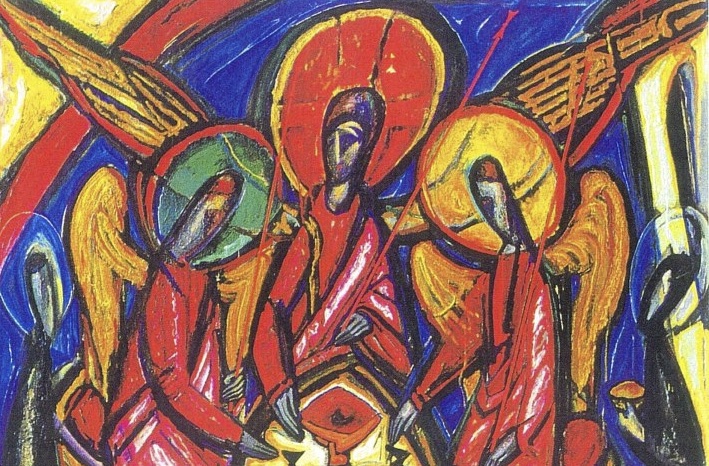
Trinity by Russian artist Alek Rapoport (1933-1997)
I wrote to the church, but Diotrephes, who loves to be first, will not welcome us. So, when I come, I will call attention to what he is doing, spreading malicious nonsense about us. Not satisfied with that, he even refuses to welcome other believers. He also stops those who want to do so and puts them out of the church.
Dear friends, do not imitate what is evil but what is good. Anyone who does what is good is from God. Anyone who does what is evil has not seen God. Demetrius is well spoken of by everyone—and even by the truth itself. We also speak well of him, and you know that our testimony is true. (NIV)
I believe in an egalitarian world. That is, humanity is meant to live, ideally, in equity with one another. Humility, meekness, and gentleness are to be the inner dispositions of a person’s life. These virtues work themselves out in being concerned for the common good of all, laboring toward just and righteous ways of living for everyone and sharing our lives as well as our resources with each other. In short, viewing one another as equals inevitably leads to gracious hospitality.
However, in a world of power disparities and privileged inequities are attitudes of seeking attention, a perceived need to always win and be first, and tight-fisted control of authority and money. The common good of all persons is scaled back to be the concern for the common good of some. There is a failure to regard the weak, poor, and vulnerable as legitimate members of the community.
The Apostle John wrote his short succinct letter in a concern that the church may be following a leader who was taking them down a bad path – a road leading to injustice where power and privilege remain with a few, and perhaps even one. John’s plainspoken exhortation was to judge rightly between what is good and bad, and then imitate the good while forsaking the bad.
Hospitality is the true litmus test between the good and the bad. An openness to the stranger, the immigrant, the migrant, the alien, the foreigner, the newcomer, and the outsider characterizes authentic fellowship. Being closed to such persons and having a xenophobic bent to others who are different is the mark of unwelcoming and inhospitable people. Hospitality serves others, whereas being inhospitable cajoles others to serve our needs.
Even Jesus, the Lord of all, did not come to this earth for people to serve him. He came to serve others and to give his life to save many people (Matthew 20:28; Mark 10:45; John 13:1-17). We are to imitate the loving service and radical hospitality of the Lord Jesus. He is our example. We are to imitate Christ.
We are to have both orthodoxy (right belief) and orthopraxy (right practice). Both go together like a hand in a glove. Good actions are to be the result of good and proper beliefs. The following are some thoughts about this nexus between belief and practice:
Hospitality (which literally means “love of the stranger”) is a way of life fundamental to orthodox Christianity, based in the person and work of Jesus.
God is hospitable and loves the outsider, welcoming them into the dance of the Trinity, and provides for them. Our human hospitality is to reflect this divine welcome.
Hospitality means extending to another a kindness typically reserved for family or friends.
The teaching of the New Testament emphasizes the practice of hospitality, i.e. Luke 14:12-14; Matthew 25:31-46.
The consistent witness of the Church in history is to lift and uphold Christian hospitality. For example, the Reformer John Calvin said, “Whatever person you meet who needs your aid, you have no reason to refuse to help them.” This was no mere theoretical advice for Calvin, whose ministry center of Geneva, Switzerland swelled with French Huguenot refugees fleeing persecution. Calvin, always the theologian, grounded his understanding of hospitality in the divine: “We should not regard what a person is and what they deserve but we should go higher – that it is God who has placed us in the world for such a purpose that we be united and joined together. God has impressed the divine image in us and has given us a common nature, which should incite us to provide one for the other.”
Hospitality is a practice which integrates both respect and care. St. John Chrysostom warned his congregation to show “excessive joy” when offering hospitality to avoid shaming the recipient of care.
Biblical hospitality does not need to know all the details of someone’s life before extending care. If Christ forgave and healed those who injured him, how could we neglect even a starving murderer?
True hospitality involves a face-to-face relationship of encouragement and respect – not just a distant giving of alms. Hospitable persons pay attention to others and share life with them.
The great twin concerns of hospitality are universalizing the neighbor and personalizing the stranger. One reason why many of the rich have little sympathy for the poor is because they seldom visit them. Hospitality depends on us recognizing our commonalities with strangers rather than our differences.
This is how we evaluate our hospitality: Did we see Christ in them? Did they see Christ in me?
Hospitable God:
Give us eyes to see the deepest needs of people.
Give us hearts full of love for our neighbors as well as for the strangers we meet.
Help us understand what it means to love others as we love ourselves.
Teach us to care in a way that strengthens those who are sick.
Fill us with generosity so we feed the hungry, clothe the naked, and give drink to the thirsty.
Let us be a healing balm to those who are weak and lonely and weary by offering our kindness to them.
May we remember to listen, smile, and offer a helping hand each time the opportunity presents itself. And may we conspire to create opportunities to do so.
Give us hearts of courage to risk loving our enemy.
Inspire us to go out of our way to include outsiders.
Help us to be welcoming and include all whom you send our way.
Remember your promise to me; it is my only hope. Your promise revives me; it comforts me in all my troubles. The proud hold me in utter contempt, but I do not turn away from your instructions. I meditate on your age-old regulations; O Lord, they comfort me. I become furious with the wicked, because they reject your instructions. Your decrees have been the theme of my songs wherever I have lived. I reflect at night on who you are, O Lord; therefore, I obey your instructions. This is how I spend my life: obeying your commandments. (NLT)
Insomnia happens to everyone, some more than others. We all have experienced the inability to sleep. Then, there are those persons who choose to arise in the middle of the night just to pray. Yes, monks do this, but there are common people who do, as well. In my own times of trying to get to sleep, I think about such persons. I especially and reflexively go to the psalms. Along with the psalmist, I reflect at night on the character and nature of the Lord.
The psalmist seems to be awake at night because he is frustrated and upset with people who both spurn wise instruction and direct their contempt at those trying to live according to God’s Law. Although insomnia might be the result of angry or unwanted feelings, maybe it is something else altogether. Perhaps the psalmist simply chose to be awake at night and do some theological reflection on God, others, and himself.
At various times in my life I have chosen to set my alarm for two o’clock in the morning to pray. I know it may sound crazy to some. Yet, this discipline has taught me something valuable: God is Lord over all chronological time and every season. And I am a servant of God, not master.
This nightly exercise of weaving my life around a set time of prayer has caused me to learn that I have spent far too much of my life trying to make time bend to my wishes. It is all really an illusion – that I can somehow control the clock. Time marches forward, seasons come and go, and we are a vapor which lasts only a moment.
Whether we find ourselves awake in the night because we cannot sleep, or intentionally choose to use the night for connecting with God, the wee hours of darkness afford us a unique opportunity to ponder the Lord’s promises and commands, attributes, and works.
The next time you find yourself awake at night, try avoiding the television and a zombie-like state of hoping for sleep. Try using the night-time for thinking about the Lord in ways you might not have considered during the day. Pray. Reflect. Consider. In doing so, you may find a blessing of light within the dark.
Keep watch, dear Lord, with those who work, or watch, or weep this night, and give your angels charge over those who sleep. Tend the sick, Lord Christ; give rest to the weary, bless the dying, soothe the suffering, pity the afflicted, shield the joyous; and all for your love’s sake. Amen.











 Rev. Tim Ehrhardt