Psalm 145 – Some Solid Robust Theology

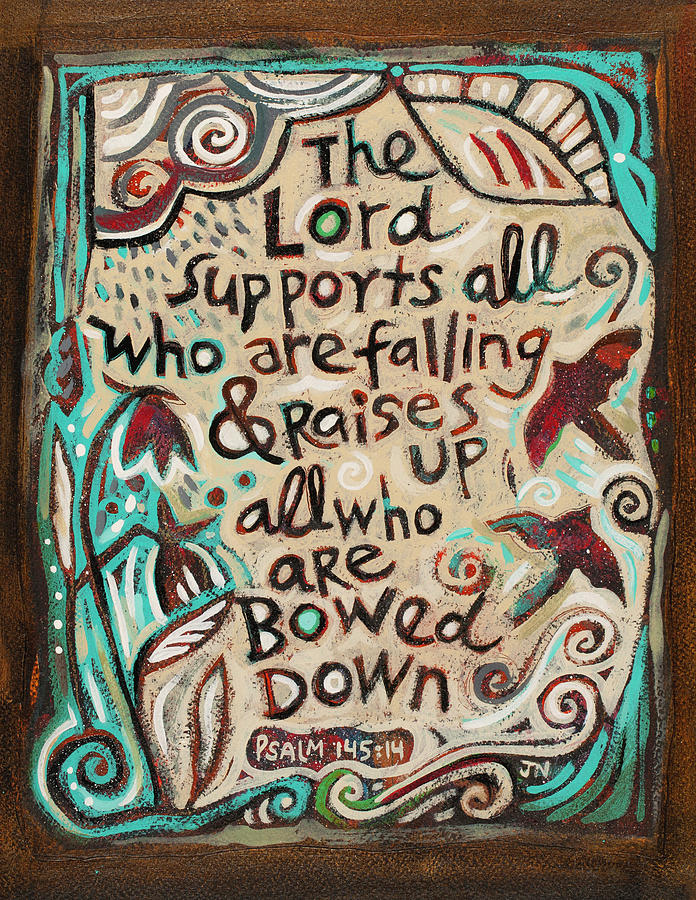
Psalm 145:14 by Jen Norton

I will praise you,
my God and King,
    and always honor your name.
I will praise you each day
    and always honor your name.
You are wonderful, Lord,
    and you deserve all praise,
because you are much greater
    than anyone can understand.

Each generation will announce
to the next
    your wonderful
    and powerful deeds.
I will keep thinking about
your marvelous glory
    and your mighty miracles.
Everyone will talk about
    your fearsome deeds,
    and I will tell all nations
    how great you are.
They will celebrate and sing
    about your matchless mercy
    and your power to save.

You are merciful, Lord!
    You are kind and patient
    and always loving.
You are good to everyone,
    and you take care
    of all your creation.

All creation will thank you,
    and your loyal people
    will praise you.
They will tell about
    your marvelous kingdom
    and your power.
Then everyone will know about
    the mighty things you do
    and your glorious kingdom.
Your kingdom will never end,
    and you will rule forever.

Our Lord, you keep your word
    and do everything you say.
When someone stumbles or falls,
    you give a helping hand.
Everyone depends on you,
and when the time is right,
    you provide them with food.
By your own hand
    you satisfy
    the desires of all who live.

Our Lord, everything you do
    is kind and thoughtful,
    and you are near to everyone
    whose prayers are sincere.
You satisfy the desires
    of all your worshipers,
    and you come to save them
    when they ask for help.
You take care of everyone
who loves you,
    but you destroy the wicked.

I will praise you, Lord,
    and everyone will respect
    your holy name forever. (Contemporary English Version)

These days, everywhere I go there is high anxiety, even downright fear. In my city, the highest murder rate in its history marked the past year. In the hospital for which I am the chaplain, the coronavirus with all its deathly strains is bringing grief and bereavement to many families. Within many churches, their future viability is in question, and parishioners wonder about the future.

When there seems to be no light at the end of the tunnel, with apprehension and stress as the very air we breathe, there is an angle to the whole situation the psalmist wants us to consider. We are to give weight and consideration to some solid robust theology.

Everyone has a theology. All persons have some sort of understanding of a god, G-d, or no god at all. In the hard circumstances of life, it might seem as if our theology isn’t serving us well. We may feel as if G-d is aloof, distant, or just plain disinterested. So, let’s pay attention to the psalmist. Notice his theology….

The Lord saves… is merciful… powerful… kind… patient… loving… and good. G-d keeps divine promises… helps… gives… provides… protects… and is near to those who humbly seek the divine. In short, the Lord cares for all creation and all creatures, including you and me, and tackles injustice like a hefty linebacker on a string-bean running back.

Yes, G-d deserves all praise, glory, and honor because standing behind all the anxiety of the age is a very large deity who acts with good purpose.

Let this psalm (and the entire psalter) buoy you up with good solid theology because the Lord is righteous in all dealings and is present to all who call for help. G-d hears. G-d responds. Perhaps neither according to our idea of timeliness nor to our expectation. Yet, deliverance is at hand, even if it comes in a form different than we were anticipating.

I am taking time to read today’s psalm several times over, to let it awash my soul with significant doses of truth and mercy. There are simply times when all of us need to remember and be reminded that there is a G-d in heaven who is willing and able, as well as a friend close at hand. 

True human satisfaction does not come through personal ingenuity or accumulation of more knowledge or more stuff.  Rather, our deepest desires and needs are fulfilled in the G-d who cares.

Anxiety, stress, fear, and apprehension don’t simply melt away. We, like the psalmist, need to practice the active verbs within the text: I will praise you… I will always honor your name… I will keep thinking about your marvelous glory and miracles… I will tell all nations how great you are… because the Lord saves and satisfies.

May that be your experience today, and every day.

Mighty G-d, you are both far and near, totally above us, yet close at hand.  Preserve me with your mighty power so that I might not fall into sin, nor be overcome by adversity. But in all I do direct me to the fulfilling of your purposes through Jesus Christ, my Lord.  Amen.

Psalm 90 – Of God and Humanity

Lord, you have been our help,
    generation after generation.
Before the mountains were born,
    before you birthed the earth and the inhabited world—
    from forever in the past
    to forever in the future, you are God.

You return people to dust,
    saying, “Go back, humans,”
    because in your perspective a thousand years
    are like yesterday past,
    like a short period during the night watch.
You sweep humans away like a dream,
    like grass that is renewed in the morning.
True, in the morning it thrives, renewed,
    but come evening it withers, all dried up.
Yes, we are wasting away because of your wrath;
    we are paralyzed with fear on account of your rage.
You put our sins right in front of you,
    set our hidden faults in the light from your face.
Yes, all our days slip away because of your fury;
    we finish up our years with a whimper.
We live at best to be seventy years old,
    maybe eighty, if we’re strong.
But their duration brings hard work and trouble
    because they go by so quickly.
    And then we fly off.
Who can comprehend the power of your anger?
    The honor that is due you corresponds to your wrath.
Teach us to number our days
    so we can have a wise heart.

Come back to us, Lord!
    Please, quick!
    Have some compassion for your servants!
Fill us full every morning with your faithful love
    so we can rejoice and celebrate our whole life long.
Make us happy for the same amount of time that you afflicted us—
    for the same number of years that we saw only trouble.
Let your acts be seen by your servants;
    let your glory be seen by their children.
Let the kindness of the Lord our God be over us.
    Make the work of our hands last.
    Make the work of our hands last! (Common English Bible)

The Bible is first and foremost a collection of books about God. Even though Scripture’s pages are filled with the fame and foibles of humans, nevertheless, the biblical drama unfolds because of the Lord. Holy Scripture is, indeed, a self-revelation of God.

There are times we get too focused on ourselves – our fears, inadequacies, weaknesses, failures – and lose sight of just how huge God really is. Today’s psalm helps reorient us back toward the grand Sovereign of the universe. There is a decidedly theistic worldview espoused and embedded in the psalm. It is a cosmology dominated by the immensity and largeness of a Creator God who is pictured as completely in control of all creation.

Let’s face it: Our lives are a weird and complex concoction of fear and joy that can combust at any time. We swing from high to low, and low to high. If we are on an even keel, its only because we are currently in the middle of swaying to one extreme or the other. Even introverts are familiar with this – it just happens to take place mostly inside their vast inner world, instead of on the outside for all to see.

So, we all need the grand vision of God in this psalm to anchor us through the unpredictable vicissitudes of life. Before the mountains were brought forth, or the earth was formed, from everlasting to everlasting the Lord is God. 

The transcendent God, although high and above everything in all creation, is not at all aloof from humanity; the Lord of the universe is also imminently close. God is near enough to know both our outward iniquities as well as our secret sins. Nothing gets by God. The Lord always knows the score.

The proper and appropriate response to such a God is to exclaim along with the psalmist to teach us to number our days so that we may get a heart of wisdom. Whenever we appropriate a biblical worldview, we learn to measure our days and live consistently moral lives with wholeness and integrity. 

This is why a regular regimen of the psalms is important to us, so that we will continually have before us the basic nature and character of God. And, as we do so, we cannot help but reflect God’s glory and contribute to human flourishing on this earth and the care of all creation.

Lord God, almighty and everlasting Father, we rejoice in your greatness and power, your gentleness and love, your mercy and justice. Enable us by your Spirit to honor you in our thoughts, words, and actions, and to serve you in every aspect of our lives, through Jesus Christ our Lord. Amen.

Psalm 113 – Shout Praises

“From Sunrise to Sunset Praise God” by Muha Rukab

Shout praises to the Lord!
Everyone who serves him,
    come and praise his name.

Let the name of the Lord
    be praised now and forever.
From dawn until sunset
    the name of the Lord
    deserves to be praised.
The Lord is far above
    all of the nations;
    he is more glorious
    than the heavens.

No one can compare
    with the Lord our God.
His throne is high above,
    and he looks down to see
    the heavens and the earth.
God lifts the poor and needy
    from dust and ashes,
    and he lets them take part
    in ruling his people.
When a wife has no children,
    he blesses her with some,
and she is happy.
    Shout praises to the Lord! (Contemporary English Version)

When my firstborn daughter was an infant, I was a busy seminarian as well as working a job. I had very little discretionary time on my hands. Yet, I could stand over the crib of my beautiful little bundle of a girl for long stretches of time without ever thinking about all my responsibilities. Whenever she awoke I spoke to her in that kind of baby talk that only a doting father can do. 

I imagine God looks at us in much the same way, as well as speaking and acting toward us in ways we can understand. Just as parents (hopefully) communicate on a level their kids can understand, so G-d condescends and stoops to our level in order to help us. 

The Lord is seated on high, looking down on the heavens and the earth. G-d looks at us with lovingkindness and seeks our best interests. The Lord notices the poor and acts justly on their behalf. G-d observes the needy and lifts them from their want to a place where they can thrive. The divine condescension of God is a beautiful thing because without it we would be like a helpless baby.

G-d, while being unknowable and unreachable in so many ways, has nevertheless communicated with humanity in a way people can understand and to which they can respond. The Lord has accommodated, or made allowance for, our language and general level of understanding.

The Lord, sovereign and high above us all, has chosen to stoop and coo over us here on earth. G-d’s love affectionately delights in us. The psalmist’s portrayal of G-d is not of some aloof Being who is bothered with humanity’s pestering. Rather, G-d sees, notices, and cares. We don’t need to do some sort of spiritual back flips to gain G-d’s attention. We already have it.

This psalm of praise to G-d celebrates how the Sovereign of the universe notices and acts. We are meant to remember the great deeds of G-d – both those things done in history, and the things done for us, personally. 

“Despite our earnest efforts, we couldn’t climb all the way up to God. So what did God do? In an amazing act of condescension, God climbed down to us and became one with us.”

Will Willimon

In Christianity, the concept of divine condescension and accommodation is given its supreme form in the person and work of Jesus Christ. By becoming human, Jesus accommodates himself to the human condition. Through his life, teaching, and ministry, Christ speaks as G-d, communicating sufficiently and effectively to humanity.

The redemptive events of Christ – his incarnation, holy life, death, resurrection, ascension, and glorification – are divine acts of grace, mercy, and love to all humanity. Praise and thanksgiving are the appropriate responses to such events done on our behalf.

This is one reason why the spiritual practice of journaling is such a good personal discipline because we then have a record of the ways in which G-d has acted on our behalf. When we look back and remember, we can praise the Lord all over again for lifting us from the ash heap. And this will fortify our spiritual mettle for the times when we need encouragement.

Keeping a gratitude journal and writing each day about at least one way the Lord has acted on your behalf, can bring encouragement, transformation, and joy to your life. I suggest you write for your own eyes only. This is between you and G-d. Therefore, you need not be concerned for correct spelling and grammar. It doesn’t even need to be legible, as long as you can read your own writing!

“Praise is the rehearsal of our eternal song. By grace we learn to sing, and in glory we continue to sing. What will some of you do when you get to heaven, if you go on grumbling all the way? Do not hope to get to heaven in that style. But now begin to bless the name of the Lord.”

Charles Spurgeon

What’s more, shouting our praises is not only appropriate but encouraged – even commanded. Shouting is both cathartic and fun. It builds emotional resilience and spiritual strength. Coupled with writing, shouting our praises has the effect of bringing spiritual growth and maturity to our lives.

We, of course, want to avoid shouting at others. Yet, we can take advantage of shouting while driving alone, out in the woods by ourselves, or even into a pillow. This isn’t weird. Shouting goes appropriately with praise and celebration.

In fact, it would be weird if there were no shouting. Try telling a sports fan watching their favorite team that they aren’t supposed to shout. Or just see what happens when a woman longing for children becomes pregnant for the first time.

Emotional expressions are expected whenever G-d shows up and accomplishes great deeds for us. To not do so is a sign of having spiders in your heart and garlic in your soul. It’s not right.

What are you thankful for today? Is there something in this day for which to praise the Lord, whether big or small? Will you give yourself permission to shout?

Accept, O Lord, our thanks and praise for all you have done for us. We thank you for the splendor of the whole creation, the beauty of this world, the wonder of life, and the mystery of love. We thank you for the blessing of family and friends, and the loving care which surrounds us on every side. We thank you for setting us at tasks which demand our best efforts and leading us to accomplishments which satisfy and delight us. We thank you also for those disappointments and failures that lead us to acknowledge our dependence on your mercy and grace.

Above all, we thank you for your Son, our Lord, Jesus Christ, the truth of his Word, the example of his life; his steadfast obedience, by which he overcame temptation; his dying, through which he overcame death; and his rising to life again, in which we are raised to new life. Grant us the gift of your Spirit so that we may know Christ and make him known; and through him, at all times and in all places, we may give thanks to you in and for all things. Amen.

Psalm 125 – Mountain Theology

Photo by Saulo Zayas on Pexels.com

Everyone who trusts the Lord
    is like Mount Zion
    that cannot be shaken
    and will stand forever.
Just as Jerusalem is protected
    by mountains on every side,
the Lord protects his people
    by holding them in his arms
    now and forever.
He won’t let the wicked
rule his people
    or lead them to do wrong.
Let’s ask the Lord to be kind
to everyone
    who is good
    and completely obeys him.

When the Lord punishes
    the wicked,
he will punish everyone else
who lives a crooked life.
    Pray for peace in Israel! (Contemporary English Version)

Psalms 120-134 comprise a collection of short songs of ascent meant to guide Jewish pilgrims on their communal trek up to the city of Jerusalem, and ultimately to the temple mount. 

Ascending to the Light by Alex Levin

The rhythm of the pious ancient Israelites centered round particular festivals, seasons, and Sabbath. Taking the annual pilgrimage to the Holy City was an especially anticipated time of year. This yearly cycle brought both increased faith and needed spiritual stability to the people. It reminded them that, like the mountains themselves, God cannot be moved. God will always be there.

Robust understandings of God are good solid mountain theology. Mountains make up about one-fifth of the world’s landscape and 12% of the world’s population live on them. They are more than imposing and impressive statues of rock. About 80% of our planet’s fresh water originates in the mountains.

So, when the psalmist likens God to a mountain, it is a reference not only to protection and strength; it is also pointing us to the source of life. With God, every need is met and satisfied.

On a mountain, Noah settled, Moses was given the law, Jesus preached and died – and the beans from my morning coffee were grown. I have everything I need in the mountainous God of all.

The most fundamental truths about God is consistency and constancy in the divine nature. God is forever present with people. 

If God seems or feels aloof or unconcerned, it is not that the Lord is avoiding us or is distracted with other important matters of running the universe. It simply means God chooses to reveal divine character and the divine will whenever the appropriate time ensue, for our benefit.

A mountain looks like it never moves. Yet the slow but steady rains, the creeping of tectonic plates, and undiscernible changes within the earth shift mountain ranges over time. The Lord is most certainly responding to us, our movements and changes, in a way we cannot perceive with the naked eye.

Our responsibility in the entire affair is to engage in consistent rhythms of spirituality which place us in a position to receive grace when God decides to give it. If we are still, we can feel the movements of grace enveloping us with life.

Perhaps we need to become adept at being spiritual mountain goats, using our wide cloven hooves of faith to negotiate the immense crags and rocks of God. After all, we will spend an eternity getting to know God and never exhaust the exploration.

Therefore, we must not despair but anticipate meeting with God, just as the Israelites of old looked forward and upward to their annual worship at the top of the mountain. The truth is that God surrounds people, even when we do not always perceive it to be so. 

The sturdiness of God is able to handle and bear the weight of our heaviest burdens.

Throw all your anxiety onto him because he cares about you. (1 Peter 5:7, CEB)

If we will but look up, there is abiding help for the most vexing of problems.
I raise my eyes toward the mountains.
    Where will my help come from?
My help comes from the Lord,
    the maker of heaven and earth.
God won’t let your foot slip.
    Your protector won’t fall asleep on the job. (Psalm 121:1-3, CEB)

There is peace and settled rest when we call upon the God who surrounds us.

I call out to the Lord,
    and he answers me from his holy mountain.

I lie down and sleep;
    I wake again because the Lord sustains me. (Psalm 3:4-5, NIV)

It is through trust that we become mountains ourselves – strong in faith and giving life to those around us.

Ever-present God, there is no place where I can go where you are not.  Help me to so intuit your presence that it bolsters my faith and resilience for daily life in Jesus Christ.  Amen.