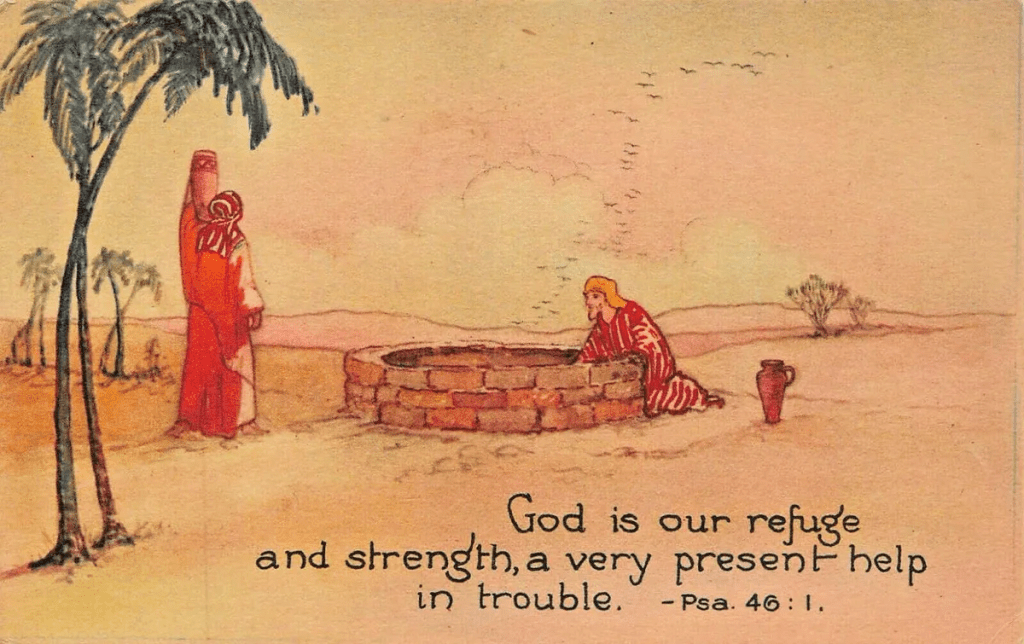
God Is Bigger (Psalm 46)

God is our refuge and strength,
    a very present help in trouble.
Therefore we will not fear, though the earth should change,
    though the mountains shake in the heart of the sea,
though its waters roar and foam,
    though the mountains tremble with its tumult.

There is a river whose streams make glad the city of God,
    the holy habitation of the Most High.
God is in the midst of the city; it shall not be moved;
    God will help it when the morning dawns.
The nations are in an uproar; the kingdoms totter;
    he utters his voice; the earth melts.
The Lord of hosts is with us;
    the God of Jacob is our refuge.

Come, behold the works of the Lord;
    see what desolations he has brought on the earth.
He makes wars cease to the end of the earth;
    he breaks the bow and shatters the spear;
    he burns the shields with fire.
“Be still, and know that I am God!
    I am exalted among the nations;
    I am exalted in the earth.”
The Lord of hosts is with us;
    the God of Jacob is our refuge. (New Revised Standard Version)

Fear is one of those things that we don’t get over simply by telling ourselves to not be afraid. In fact, that approach typically makes us even more fearful – namely, because we focus on the fear itself. But to cope and deal with fear, it requires a focus on something bigger than the fear.

God is bigger than the boogie man.
He’s bigger than Godzilla,
or the monsters on TV.
Oh, God is bigger than the boogie man.
And He’s watching out for you and me.

So, when I’m lying in my bed,
and the furniture starts creeping,
I’ll just laugh and say,
“Hey, cut that out!”
And get back to my sleeping.
‘Cause I know that God’s the biggest,
and He’s watching all the while.
So, when I get scared I’ll think of Him,
and close my eyes and smile.

God is bigger than the boogie man.
He’s bigger than Godzilla,
or the monsters on TV.
Oh, God is bigger than the boogie man.
And He’s watching out for you and me. – VeggieTales

Psalms and songs of trust in God help us focus on divine hugeness instead of human puniness.

Changing Circumstances

Even though people may find themselves in the dire straits of natural disasters, they can have confidence smack in the middle of all the crazy chaos. Whereas those who focus on their fear become ever more anxious and feel as if the world is out of control, the believer isn’t threatened when overwhelming circumstances occur.

We will not fear, because God – who created the world and its vast natural systems – stands above it all and is therefore able to establish order out of chaos. Just as we are certain that the sun will again rise in the morning, so too, we have full confidence that God shall rise over the darkness and bring light and warmth to all that is shadowy and cold.

Shaky Politics

The nations and their governments who rule with injustice and care nothing for religion, breathe-out their threats and posture themselves as supreme leaders. They, too, are chaotic forces. But God is far above them, as well as above the flood and the famine. The leader’s bellicose blustering sounds merely like a chattering chipmunk to God.

And like natural disasters, the uproar of the nations does damage; but national leaders cannot topple God. Instead, God will shake up the unjust nations, like a protein shake in a blender. When delusional leaders encounter the voice of God, they cower in fear – but God’s people don’t. The spiritual person’s foundation will not be shaken, whereas the would-be dictator will find himself without anyone to lead.

A Working God

God is always working, albeit most of the time behind the scenes. God’s dominion extends over everything and everyone. God can obliterate any and all threats because God is everywhere present.

Based on this view of God, all we as people need do is be still and know that the Lord is God. Like Jesus rebuking the waves and the sea, resulting in immediate stillness, so God’s word brings us stillness, calmness, and freedom from fear and anxiety.

God is with us. God is in control. God cares for us. There are a lot of things we don’t know – such as why we have to personally endure the natural disasters and the unnatural dictators – but we can know without a shadow of a doubt that the presence of God surrounds us, and the love of God squeezes us.

With a transcendent Being who commands the angelic hosts of heaven, our source of security comes not from within but from without. The Lord is a trustworthy God who is vigilant in watching over us.

Trusting the Lord

Armies, security systems, and protective coverings all have their needed purpose in human life. Yet, when we look to our ultimate protection – the kind that provides security of both body and soul – it is God’s presence that sustains our highest and greatest needs.

Perhaps you understand the psalm’s message, yet still find it difficult or untenable to place faith in such an ancient writing and an even older God. Maybe you much prefer to trust in something that isn’t so ethereal, something you can engage with your five senses.

It could be that you prefer a strong political leader, more and bigger weapons, higher and thicker walls of protection. You work hard to have as much money as possible to keep you safe from harm. You seek to gain as much influence in the form of earthly power and authority as you can.

The problem is, however, that none of this earthly posturing is going to protect you from what you fear the most. All that work is going to prove unreliable in the end.

God is the only sure defense. Ultimate power belongs to the Lord God almighty, creator of heaven and earth. Deliverance of body and soul does not ultimately come through the strength of the military, the economy, or any human ingenuity or hard work; for the Christian, it comes through the suffering, death, and resurrection of Jesus Christ.

Any inclination to place saving trust in personal resources, human institutions, or world might, will result in sure failure. They cannot remedy our fear, for nothing is able to match the power of God. Indeed, God is bigger than anyone and anything. We need the mighty fortress which is our God.

A mighty Fortress is our God
A Bulwark never failing
Our Helper He amid the flood
Of mortal ills prevailing

For still our ancient foe
Doth seek to work us woe
His craft and power are great
And armed with cruel and hate
On earth is not his equal

Did we in our own strength confide
Our striving would be losing
We’re not the right Man on our side
The Man of God’s own choosing
Dost ask who that may be?
Christ Jesus, it is He
Lord Sabaoth His Name
From age to age, the same
And He must win the battle

That word above all earthly powers
No, thanks to them, abideth
The Spirit and the gifts are ours
Through Him who with us sideth
Let goods and kindred go
This mortal life also
The body they may kill
God’s truth abideth still
His Kingdom is forever

Amen

What Is Your View of God? (Psalm 86)

Incline your ear, O Lord, and answer me,
    for I am poor and needy.
Preserve my life, for I am devoted to you;
    save your servant who trusts in you.
You are my God; be gracious to me, O Lord,
    for to you do I cry all day long.
Gladden the soul of your servant,
    for to you, O Lord, I lift up my soul.
For you, O Lord, are good and forgiving,
    abounding in steadfast love to all who call on you.
Give ear, O Lord, to my prayer;
    listen to my cry of supplication.
In the day of my trouble I call on you,
    for you will answer me.

There is none like you among the gods, O Lord,
    nor are there any works like yours.
All the nations you have made shall come
    and bow down before you, O Lord,
    and shall glorify your name.
For you are great and do wondrous things;
    you alone are God.
Teach me your way, O Lord,
    that I may walk in your truth;
    give me an undivided heart to revere your name.
I give thanks to you, O Lord my God, with my whole heart,
    and I will glorify your name forever.
For great is your steadfast love toward me;
    you have delivered my soul from the depths of Sheol.

O God, the insolent rise up against me;
    a band of ruffians seeks my life,
    and they do not set you before them.
But you, O Lord, are a God merciful and gracious,
    slow to anger and abounding in steadfast love and faithfulness.
Turn to me and be gracious to me;
    give your strength to your servant;
    save the child of your maidservant.
Show me a sign of your favor,
    so that those who hate me may see it and be put to shame,
    because you, Lord, have helped me and comforted me. (New Revised Standard Version)

The biblical psalms are first and foremost a collection of prayers. Spanning the scope of the human condition, and plumbing the depths of human emotion, we find that there are psalms for every sort of situation we may find ourselves in – whether the circumstance is good or bad.

In David’s particular case, he knew what it was like to have evil men hate him and pursue taking his life through no fault of his own. Although I have never faced adversity to such a degree as David did, I do know something about people who, to put it bluntly, just flat-out hate my guts. It feels awful, and it can be terribly draining emotionally and spiritually. Having disrespectful and rude people talk behind your back (and sometimes even to your face) is in direct contrast to who God is.

God is described by David as merciful and gracious, slow to anger, abounding in steadfast love, and faithful. Whereas insolent people objectify others and seek their own selfish agendas, God always acts in accord with a basic character of love and grace. 

Based upon the nature of just and benevolent God, we can choose to cry out, just like David did, to show us a sign of God’s favor. We can pray for God to provide us with some tangible communication of divine love in ways we can understand so that we can be helped and receive the kind of comfort we need through our adversity.

Be assured that with such a God, our pleas, cries, and tears will be noticed, affirmed, and answered. We can trust the sovereign Lord of all creation to address the insolence and injustice that exists around us and toward us.

All of this talk about adverse circumstances and unjust people, gets down to our view of God and our theological understanding of the basic Divine nature and purpose. 

For some people, God is up there, somewhere, like some white-bearded old guy who is aloof to what is going on down here – there is neither anything personal nor personable about him, at all. 

For others, God is a force which binds all things together. In this theology, God exists, but you are never quite sure how to connect – it’s like a crapshoot trying to get in touch with him. 

For yet others, God is perpetually perturbed about something; God has a bee in his bonnet, and it is apparently our job to figure out what he is so sullen and upset about all the time so that we can appease him in some way.

However, the psalmist David, sees God in wholly other ways than this. For David, God is personal, knowable, and reachable. David thought about God in ways which transcend either gendered or personality-type categories. 

Note the descriptions David provided: a willingness to forgive; an abiding, consistent, and steadfast presence of divine love; always having the time and desire to listen; possessing the power and ability to provide help and protection; being kind and merciful; not being easily angered; and extending needed comfort and consolation.

Now this is a God you can sink your teeth into – attentive, engaged, and anything but upset all the time. This is the reason why David has confidence to ask for deliverance, direction, and delight. Such a God is like a caring grandmother who seeks to always love and serve, and not a crotchety old curmudgeon who always seems bothered by everyone and everything.

If your theology and your view of God cannot support and bear the weight of life’s hardest circumstances, then you need a different view of God!

I invite you to see the God of David. Theology proper discerns the being, attributes, and works of God as fundamentally faithful and loving. This God has both the ability and the will to meet and satisfy your life’s greatest needs.

Great God of David, you are above all things and beside all things and with all things. You are uniquely positioned and powerful to walk with me through all the situations of my life. Thank you for sending the Son of David to make real your promises to me. Amen.

Fear vs. Faith (Numbers 13:1-2, 17-33; 14:1-9)

The Spies Return with Discordant Views, by Yoram Raanan

The Lord said to Moses, “Send some men to explore the land of Canaan, which I am giving to the Israelites. From each ancestral tribe send one of its leaders”…

When Moses sent them to explore Canaan, he said, “Go up through the Negev and on into the hill country. See what the land is like and whether the people who live there are strong or weak, few or many. What kind of land do they live in? Is it good or bad? What kind of towns do they live in? Are they unwalled or fortified? How is the soil? Is it fertile or poor? Are there trees in it or not? Do your best to bring back some of the fruit of the land.” (It was the season for the first ripe grapes.)

So they went up and explored the land from the Desert of Zin as far as Rehob, toward Lebo Hamath. They went up through the Negev and came to Hebron, where Ahiman, Sheshai and Talmai, the descendants of Anak, lived. (Hebron had been built seven years before Zoan in Egypt.) 

When they reached the Valley of Eshkol, they cut off a branch bearing a single cluster of grapes. Two of them carried it on a pole between them, along with some pomegranates and figs. That place was called the Valley of Eshkol because of the cluster of grapes the Israelites cut off there. At the end of forty days they returned from exploring the land.

They came back to Moses and Aaron and the whole Israelite community at Kadesh in the Desert of Paran. There they reported to them and to the whole assembly and showed them the fruit of the land. They gave Moses this account:

“We went into the land to which you sent us, and it does flow with milk and honey! Here is its fruit. But the people who live there are powerful, and the cities are fortified and very large. We even saw descendants of Anak there. The Amalekites live in the Negev; the Hittites, Jebusites and Amorites live in the hill country; and the Canaanites live near the sea and along the Jordan.”

Then Caleb silenced the people before Moses and said, “We should go up and take possession of the land, for we can certainly do it.”

But the men who had gone up with him said, “We can’t attack those people; they are stronger than we are.” And they spread among the Israelites a bad report about the land they had explored. They said, “The land we explored devours those living in it. All the people we saw there are of great size. We saw the Nephilim there (the descendants of Anak come from the Nephilim). We seemed like grasshoppers in our own eyes, and we looked the same to them.”

That night all the members of the community raised their voices and wept aloud. All the Israelites grumbled against Moses and Aaron, and the whole assembly said to them:

“If only we had died in Egypt! Or in this wilderness! Why is the Lord bringing us to this land only to let us fall by the sword? Our wives and children will be taken as plunder. Wouldn’t it be better for us to go back to Egypt?” And they said to each other, “We should choose a leader and go back to Egypt.”

Then Moses and Aaron fell face down in front of the whole Israelite assembly gathered there. Joshua son of Nun and Caleb son of Jephunneh, who were among those who had explored the land, tore their clothes and said to the entire Israelite assembly:

“The land we passed through and explored is exceedingly good. If the Lord is pleased with us, he will lead us into that land, a land flowing with milk and honey, and will give it to us. Only do not rebel against the Lord. And do not be afraid of the people of the land, because we will devour them. Their protection is gone, but the Lord is with us. Do not be afraid of them.” (New International Version)

“Pessimism has done infinitely more harm than atheism.”

Pierre Teilhard de Chardin

Fear can be debilitating. At its core, we fear either what we don’t know, or believe to be bad. For example, if I am convinced that my boss does not have my best interests at mind, then I will likely be afraid and hold back.

The majority of the ancient Israelites were paralyzed by fear because of the anxiety and fearfulness of those who came back from spying out the Promised Land. They had a low view of God. Yet Caleb, and only a few others, acknowledged that God is good for divine promises, and so, trusted the Lord completely in confidence, not fear.

If we view God as being angry all the time, then we will not use the incredible gifts given to us for fear of messing up and bringing divine wrath upon us. We will be plagued with uncertainty and only see giants in the land who we cannot begin to deal with.

Yet, if we commit ourselves to knowing God through seeking the divine will and trusting in divine promises, then we understand that God is gracious and generous, always having our backs. We live by faith, not by sight, and discern that giants in the land are really nothing more than gnats.

Fear is maybe the devil’s greatest tool to prevent God’s people from being productive and responsible in serving the church and the world. Beneath that fear are powerful feelings of inferiority, inadequacy, and a low view of self – which is really born of a low view of God. Being afraid wastes what impact a person could have for God, and waters-down life so that it’s ineffective.

Enjoy the Lord, and he will give what your heart asks.

Psalm 37:4, CEB

We are to enjoy the gracious and generous God; and in our enjoyment, the Lord places within us godly dreams that are a delight for God to fulfill. Our enjoyment of the Lord gives us the security and confidence to act upon those godly desires and wed them to divine promises from Holy Scripture.   

But put fear in the mix, and it dilutes and destroys everything. It makes you do nothing. And the fear is a result of not knowing the Lord, of not seeking God’s mind or will.

God had a grand vision and a big dream for the Israelites to enter the Promised Land. But ten of the twelve spies who came back after checking out the land were paralyzed by fear, feeling like grasshoppers next to the people in the land. 

Caleb and Joshua, however, had a different view of taking the land because they had a different view of God. They didn’t see giants – they saw a gracious and generous God who could easily take care of whoever might be in the land, and they wanted to act on the faith they had in a mighty and merciful God. 

The God of the other spies wasn’t big enough to handle the giants. Their low view of themselves as grasshoppers betrayed their low view of God.

“We wrap a lot of our fears in morbidly sanctified self-belittling.  We piously cover this self-despising and call it consecration and self-crucifixion.”

David Seamands

Too many people feel good about feeling bad – and then use those feelings to make spiritual excuses for not exploring what God promises, expects, commands, and dreams for them. 

It is high time for us to get into the world with our witness in a far greater way because we serve a God who sees giants as gnats; and we will, too, if we have a high view of God.

Yet, holding us back, is fear of criticism, of taking a risk, of going outside of the way we’ve always done it, and of what others may think or say. 

If you once dreamed something and you think your dream is dead because you destroyed it by your sins or bad habits, you are wrong. Dreams are destroyed by fear, by being tricked into thinking that we are nothing but grasshoppers and God doesn’t care, and so we do nothing.

Unfortunately, it appears the most common way of coping with feelings of fear, insecurity, and inferiority is by withdrawing from other people – because you cannot give yourself fully to your family, church, neighborhood, vocation, and the world without a healthy robust view of and relationship with God. 

Give God a chance to work in and through your life. May you step up and step out because you have a God behind you that is gracious and generous. Amen.

A Mighty Deliverance (Psalm 114)

Psalm 114:3, by Stushie Art

When the people of Israel left Egypt,
    when Jacob’s descendants left that foreign land,
Judah became the Lord’s holy people,
    Israel became his own possession.

The Red Sea looked and ran away;
    the Jordan River stopped flowing.
The mountains skipped like goats;
    the hills jumped around like lambs.

What happened, Sea, to make you run away?
    And you, O Jordan, why did you stop flowing?
You mountains, why did you skip like goats?
    You hills, why did you jump around like lambs?

Tremble, earth, at the Lord’s coming,
    at the presence of the God of Jacob,
who changes rocks into pools of water
    and solid cliffs into flowing springs. (Good News Translation)

I tend to use a lot of metaphors in my conversations with others. I like word pictures, analogies, and illustrations. Maybe that’s one reason I resonate with the Old Testament. The Hebrew mind revels in story, symbol, similitude, and even the occasional sarcasm.

The turn-of-phrase is something which connects well with me – which is why I like today’s psalm. The language is freighted with metonymy (using the name of one object or concept for that of another) and personification (using an animate characteristic for an inanimate object).

This psalm is a poetic response to the Jewish Passover and exodus out of slavery to freedom. It is a brief song of thanksgiving which nicely recounts the Israelite experience from Egypt to the Promised Land. At the behest of a mighty God, the Red Sea parted when the people left Egypt, and the Jordan River stopped its flowing when the people entered the Promised Land.

It’s a whole lot more powerful to say, “When the sea looked at God, it ran away,” than it is to say, “The Red Sea parted.” God is so mighty, so powerful, so large and sovereign that we must use the full extent of language to even begin to describe the wonderful works of the Lord. A big God with awesome capability needs some wordsmithing worthy of divine greatness.

Not only does the sea flee from its place, but the river also turns back, the mountains and hills shake and skip. To try and somehow capture the immensity of God, the psalmist used language which communicates that even inanimate objects come alive and fulfill the Lord’s bidding.

It is one thing to make a flat statement such as, “Put your trust in God,” and it is quite another matter to open up the tool of language and allow it to picture a divine Being so amazing that nothing nor anyone can possibly stand in such a Sovereign’s way. And this very same God works for us, and not against us.

The Lord God almighty, Creator of heaven and earth, has taken this formidable divine power and granted us a pinch of it – because that’s all we really need. Jesus, intimately familiar with his mighty heavenly Father, commented:

If your faith is as big as a mustard seed, you can say to this mulberry tree, “Dig yourself up and plant yourself in the ocean!” And the tree will obey you. (Luke 17:6, ERV)

For assuredly, I say to you, whoever says to this mountain, “Be removed and be cast into the sea,” and does not doubt in his heart, but believes that those things he says will be done, he will have whatever he says. (Mark 11:23, NKJV)

All of creation conspires together to participate in the great liberating and saving acts of God for God’s people. And if that wasn’t enough, we have been given the Holy Spirit to be with us forever – uprooting trees and moving mountains to accomplish the good and loving plan of God here on earth as it is always done in heaven.

Mighty God you invite us to be with you, to have a place near you. Your presence is joy, light, and comfort. Your nearness is holy, awesome, and wonderful. In the play of sunlight through rainbows, in the sounds of music and laughter, in the beauty of creation and the taste of bread and wine, your presence is known. Your saving presence surrounds us, whether we are fearful or joyful, laughing or crying.

You invite us, welcome us, forgive us and renew us with fresh hope and new life. You love us into your presence. We bless and thank you. We praise and adore you. We enjoy being with you, in the name, the spirit, and the presence of Jesus. Amen.