Two Ways of Living: Blessed or Cursed

Blessed is the one
    who does not walk in step with the wicked
or stand in the way that sinners take
    or sit in the company of mockers,
but whose delight is in the law of the Lord,
    and who meditates on his law, day and night.
That person is like a tree planted by streams of water,
    which yields its fruit in season
and whose leaf does not wither—
    whatever they do prospers.

Not so the wicked!
    They are like chaff
    that the wind blows away.
Therefore the wicked will not stand in the judgment,
    nor sinners in the assembly of the righteous.

For the Lord watches over the way of the righteous,
    but the way of the wicked leads to destruction. (Psalm 1:1-6, NIV)

The Righteous and the Wicked

This psalm presents two ways we can choose to shape our lives: the way of the righteous and the way of the wicked, blessed or cursed. The way of the righteous leads to human blessing, flourishing, and living. The way of the wicked leads to human cursing, degenerating, and dying.

Distinguishing between the righteous and the wicked is not always as easy as it looks. Only at the end of the age, when Judgment Day comes, will we know for certain the righteous and the wicked.

To discern the difference between the two, let’s refer to the Reformer, Martin Luther, to help us. You might be familiar with Luther’s 95 Theses posted on the door of the Wittenberg castle church, sparking the Reformation of Christianity. Less familiar is the theological meat of Luther’s reforming spirit, his Heidelberg Disputation of 1518, written the year following the 95 Theses.

Theology of the Cross and Theology of Glory

Like Psalm 1, Luther contrasts two opposing ways. He calls these two ways the theology of the cross and the theology of glory. The cross, as expressed by Luther, is God’s attack on human sin. It is the death of Christ which is central to Christianity. Therefore, one must embrace the cross and rely solely upon Christ’s finished work on the cross to handle human sin. It is through being crucified with Christ we find the way to human flourishing and life. In other words, righteousness is gained by grace through faith in Christ.

The theology of glory is the opposing way of the cross. It’s important to understand Luther because he has a key which helps us unlock Scripture by not walking in the way of the wicked, as expressed in Psalm 1. For Luther, the wicked person, and the vilest offender of God, is not the person who has done all kinds of readily observable outward sinning. You, perhaps like me, have an idea in your head of what the worst of sinners is like. My guess is that it probably has something to do with certain lifestyles or evil acts. 

“Good” Works?

Luther, however, insisted the worst of sinners are people who do good works. Specifically, the wicked person is one who has clean living and does nice things but does them disconnected from God by wanting others to see their good actions. Another way of putting it: The wicked person seeks to gain glory for themselves rather than give glory to God.

Our good works can be the greatest hindrance to righteousness and living the way of the cross. It is far too easy to place faith in our good works, done apart from God, rather than placing complete trust in Christ alone. It can be too easy, doing good things, for the primary purpose of having others observe our goodness, rather than do them out of the good soil of being planted in God’s Word. 

The remedy for sin is the cross, and the sinner lives life apart from that cross, trusting in self, so that people will give personal recognition, respect, and accolades.

“It is impossible for a person not to be puffed by his good works unless he has first been deflated and destroyed by suffering and evil until he knows that he is worthless and that his works are not his but God’s.”

Martin Luther

Delight, or Not

The answer to this problem of doing good works to gain glory for self is not to avoid good works, but to do them from the good soil of being planted in God’s law and connected to Christ’s vine. The psalmist uses the word “law” in referring to Scripture as a whole, to all the acquired wisdom about how life is supposed to be lived in God’s world.

People who yield juicy abundant fruit have immersed themselves in the law. Because they delight in God; secretly rise early to meditate on God’s Word; privately read the Bible’s message; and pray to put that message into practice. They will be blessed. 

The wicked are too busy to notice the law. They serve to be seen and desire public recognition for their charity and works. But those works will not stand in the Judgment. Jesus described them this way:

“You are like white-washed tombs, which look beautiful on the outside, but on the inside are full of dead men’s bones and everything unclean….  On the outside you appear to people as righteous, but on the inside, you are full of hypocrisy and wickedness.” (Matthew 23:27, NIV)

Which is Which?

Identifying the righteous and the wicked is not as simple as saying the wicked are “those people” out there, and the righteous people are in here. The truly righteous person delights in God through the law. They have the humble sense they could easily drift from God if not staying connected, rooted in Jesus, and grounded in the way of the cross. 

The wicked, in contrast, are like chaff – worthless. They are arrogant and annoying – wanting all the attention which God rightly deserves. When I was a kid, I always wore a mask during the corn harvest because of the chaff and corn dust. Every year, from the time I was seven years old, I had the job of taking the tractor out and hitching up the wagons of corn and bringing them back. Then, I unloaded the wagon of corn into the auger which sent it up and into the corn bin. The corn dust flew everywhere. It was annoying and could easily take over my lungs if I weren’t masked up.

The wicked have nothing of substance to contribute to God’s kingdom – they add no value to what is going on. In fact, they are a hindrance to the harvest of souls God is trying to accomplish. Conversely, the righteous do good works which sprout from rich Iowa-type soil, producing a harvest of righteousness. 

The righteous person takes the time to know God’s law; satisfies the needs of those who are not able to pay them back or give them proper recognition; and cultivates relationships with those they help. The righteous are relational.

Righteous Job

The biblical character, Job, is an example of a righteous person. Job did all kinds of good works. And he did them because of his close walk with God. Job persevered through intolerable suffering and grief because he knew God. Job assisted the needy; helped others no matter their situation; championed the less fortunate; and gave glory to God even amid terrible trouble. Job did not throw in the towel when his reputation, his family, and his wealth were completely taken away. Instead, he said:

“Naked I came from my mother’s womb, and naked I will depart. The Lord gave and the Lord has taken away; may the name of the Lord be praised.” In all this, Job did not sin by charging God with wrongdoing. (Job 1:21-22, NIV)

Generosity marks the righteous because God is generous. Grace defines the righteous because God is gracious. Gentleness is the way of the righteous because Christ is gentle. Spiritual prosperity is born of a righteous relationship with Jesus Christ. The Lord watches over the way of the righteous.

Injustice and Judgment

However, the wicked perish. There are sixteen prophetic books in the Old Testament, all given to a single message: Judgment is coming because of wickedness. And the wicked turn out to be some of God’s covenant people. That’s because they selectively did their good works to gain glory for themselves. And they withheld the good they could have done because it did not add any value to their reputation or personal goals. 

For example, prophesying to those who fasted so that others would see their spirituality, the prophet Isaiah communicated God’s message:

“Is not this the kind of fasting I have chosen:
to loosen the chains of injustice
    and untie the cords of the yoke,
to set the oppressed free
    and break every yoke?
Is it not to share your food with the hungry
    and to provide the poor wanderer with shelter—
when you see the naked, to clothe them,
    and not to turn away from your own flesh and blood? (Isaiah 58:6-7, NIV)

God desires genuine spiritual growth. That happens when we eschew a theology of glory, and embrace a theology of the cross, which delights in God and God’s law, meditating on it day and night.

A Choice

We always have a choice between the way of the righteous and the way of the wicked, to embrace a theology of the cross or a theology of glory. Here is how that choice is framed in the book of Deuteronomy when the ancient Israelites were about to enter the Promised Land:

See, I set before you today life and prosperity, death and destruction. For I command you today to love the Lord your God, to walk in obedience to him, and to keep his commands, decrees and laws; then you will live and increase, and the Lord your God will bless you in the land you are entering to possess….

I have set before you: life and death, blessings and curses. Now choose life, so that you and your children may live and that you may love the Lord your God, listen to his voice, and hold fast to him. For the Lord is your life, and he will give you many years in the land he swore to give to your fathers, Abraham, Isaac and Jacob.” (Deuteronomy 30:15-20, NIV)

The idolatry which can easily seduce us are our own good works done for a human audience who will recognize and affirm. Jesus said we must play to the audience of one:

But when you give to the needy, do not let your left hand know what your right hand is doing, so that your giving may be in secret. Then your Father, who sees what is done in secret, will reward you.” (Matthew 6:3-4, NIV)

Our daily choice must be to love God supremely and give God glory for everything good in our lives. Perhaps Christianity needs another Reformation – one in which we do not just uphold the authority of Scripture, but reform our habits by loving God through basic disciplines of Bible-reading and simple obedience; and by loving our neighbor through giving them time and attention, the gift of relationship and friendship.

What will you choose this day?

1 Peter 3:8-18 – How to Live in a Messed-Up World

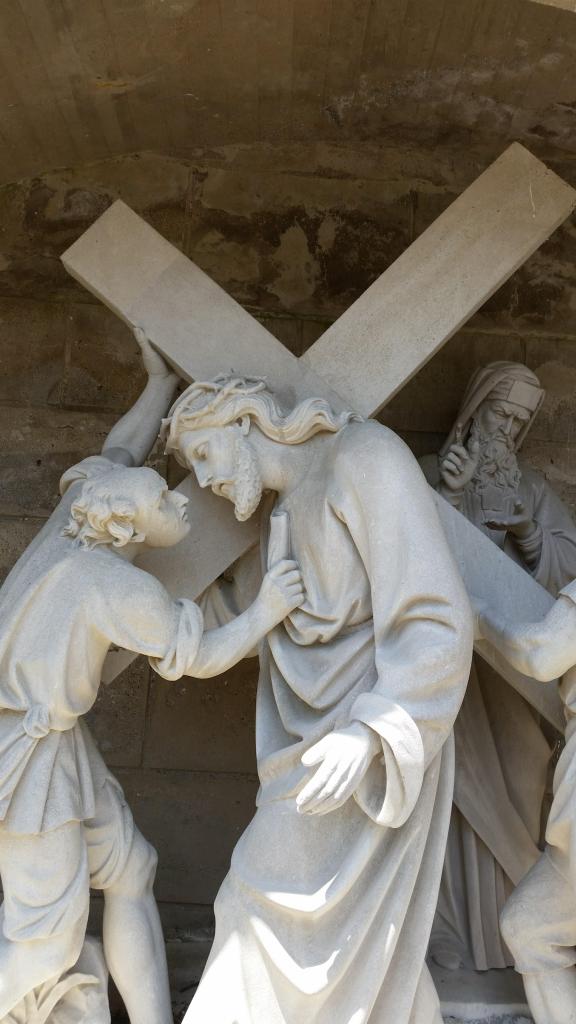
Stations of the Cross at Holy Hill, Hubertus, Wisconsin

Finally, all of you be of one mind, sympathetic, lovers of your fellow believers, compassionate, and modest in your opinion of yourselves. Do not pay back evil for evil or insult for insult. Instead, give blessing in return. You were called to do this so that you might inherit a blessing.

For those who want to love life
    and see good days
should keep their tongue from evil speaking
    and their lips from speaking lies.
They should shun evil and do good;
    seek peace and chase after it.
The Lord’s eyes are on the righteous
    and his ears are open to their prayers.
But the Lord cannot tolerate those who do evil.

Who will harm you if you are zealous for good? But happy are you, even if you suffer because of righteousness! Do not be terrified or upset by them. Instead, regard Christ the Lord as holy in your hearts. Whenever anyone asks you to speak of your hope, be ready to defend it. Yet do this with respectful humility, maintaining a good conscience. Act in this way so that those who malign your good lifestyle in Christ may be ashamed when they slander you. It is better to suffer for doing good (if this could possibly be God’s will) than for doing evil.

Christ himself suffered on account of sins, once for all, the righteous one on behalf of the unrighteous. He did this to bring you into the presence of God. Christ was put to death as a human but made alive by the Spirit. (CEB)

If there were a sign-up sheet for suffering, I am confident no one put their name to it. We like to avoid suffering. After all, it hurts! I would make a terrible masochist. I am not a high tolerance for pain kind of guy. I have no problem taking a Tylenol at the first sign of discomfort. Yet, I know there will be times when I am going to have to experience pain – physical, emotional, and spiritual – and there is no way around it. To live in this broken world is to experience suffering. To suffer as a Christian, however, is different because we are following the way of our Lord Jesus Christ.

The stark reality of the New Testament is that there must be suffering before glory. Just as Christ suffered, we ought to expect we will suffer as his followers. As Christians walk with Jesus during the season of Lent, they journey through the desert full of temptation and hard circumstances. At the end of the journey will be the glory of Easter, a celebration of the resurrection. Christian theology confidently practices hope based on the redemptive events of Christ’s cross and resurrection, suffering and glory.

Stations of the Cross at Holy Hill, Hubertus, Wisconsin

We are not above our Master. We, too, will suffer. The real question is whether we will suffer because of our own foolishness and selfishness, or because of our devotion to Christ in being kind, humble, and gracious.  When insults come our way, we avoid responding with insults of our own. Verbal cruelty is not the way of Christ. Anger, slander, gossip, lies, manipulative words, and belligerent bullying have absolutely no place in the kingdom of God for any reason. God takes a zero-tolerance policy toward hate speech.

Christians are to us their tongues exclusively for blessing, not cursing; for love, not hate; for truth, not lies; for building-up, not tearing-down; for proclaiming good news, not shame-laced bad news. If we suffer for being Christians in solidarity with our Lord, we shall receive blessing from God. But if we suffer for giving-in to retaliation and our base desires for revenge, then we will suffer the consequences of our own stupidity.

God has called us to bless the world, not condemn it. Christians are to be on the frontlines of the mobilizing others for mercy, leading the charge of spreading respect, civility, kindness, and the gospel. Jesus said that it is no problem to show love and respect to people we like. However, it is a whole other ballgame to do the same for those who treat us with disrespect and hate. Yet, God watches over all who obey him, and he listens to their prayers. God will handle the hate-filled person; judgment is for neither you nor me to dish out. Our task is to have a deep concern for humanity, both the ones we like and the ones we do not.

I encourage you to take some time today or in the next few days to read the epistle of 1 Peter slowly and carefully in one sitting. It is a short book. Pay attention to how the adversity of living in this fallen world gives Christians the opportunity, hope, and encouragement to live well. 

May it be so, to the glory of God.

Loving Lord Jesus, you suffered and died on my behalf.  It is a small thing for me to follow you and walk in the way of suffering. I know and have the confident expectation that blessing awaits. Keep me true to following you through all the adversity I must face in this fallen broken world. Even so, come Lord Jesus. Amen.

Isaiah 41:14-20 – For Such a Worm as I

Do not fear, you worm Jacob,
    you insect Israel!
I will help you, says the Lord;
    your Redeemer is the Holy One of Israel.
Now, I will make of you a threshing sledge,
    sharp, new, and having teeth;
you shall thresh the mountains and crush them,
    and you shall make the hills like chaff.
You shall winnow them and the wind shall carry them away,
    and the tempest shall scatter them.
Then you shall rejoice in the Lord;
    in the Holy One of Israel you shall glory.

When the poor and needy seek water,
    and there is none,
    and their tongue is parched with thirst,
I the Lord will answer them,
    I the God of Israel will not forsake them.
I will open rivers on the bare heights,
    and fountains in the midst of the valleys;
I will make the wilderness a pool of water,
    and the dry land springs of water.
I will put in the wilderness the cedar,
    the acacia, the myrtle, and the olive;
I will set in the desert the cypress,
    the plane and the pine together,
so that all may see and know,
    all may consider and understand,
that the hand of the Lord has done this,
    the Holy One of Israel has created it. (NRSV)

Each morning I rise and read God’s Holy Word. It is a discipline I have been doing for over forty years. In the past few years, I have begun reading more slowly and with greater contemplation – because the goal is not to check off having read some verses on a Bible reading plan. The aim is to connect meaningfully with God. The desired result is to hear the voice of the Lord, and to let the Scriptures do their incredible work in our hearts.

One of the ways I connect with Scripture, after having read the verses for the day several times, is to write it in my own words…

“My dear servant, there is no need whatsoever to worry yourself,

though others say about you,

            ‘That guy is nothing, only a wormy maggot!’

I am your holy God,

            who saves and protects you.

I’ll let you be like a big ol’ log

            covered with sharp spikes.

You will grind and crush

every mountain and hill in front of you

            until they turn to dust.

A strong wind will scatter the dust of unholy jerks

            in all directions.

Then you will celebrate

and praise me, your Lord,

            the holy God who watches your life.

When your financial budget no longer budges

and your bank accounts lie empty

            and you have no idea where to turn,

I, your Lord, and your God

will come to your rescue.

            I will not forget you.

I will make rivers of abundance flow

            on the desolate mountain peaks of your life.

I will send streams of life

to fill your empty valley of life’s tribulations.

Dry and barren places in your life

will flow with springs

            and become a lake of grace and goodness.

I will fill the parched desert areas of your needy life

            with all kinds of fruitful trees –

apple trees, olive trees, fig trees,

oak and walnut, elm and maple, fir, and pine,

like in the original garden,

all your needs will be met in and through me, your God.

Everyone will see this

            and know that I,

the holy Yahweh God whom you love and serve,

            created every bit of it.”

Whichever way we choose to view ourselves, as worm and insect, or as majestic person in the image of God, the spiritual reality continually before us is that the Lord will provide, bless, and care for us. We are the recipients of God’s gracious salvation. Although many modern hymnals do not include Isaac Watt’s, At the Cross, and if they do, the original words have been changed – it matters little. Because the action of deliverance belongs to God, and neither to you nor me. And even though we seem but lowly worms next to God, the Lord chooses to treat us with deference, accommodation, and care. Any low view of self is quickly eradicated in the face of such divine love.

Stanza 1:

Alas! and did my Savior bleed?

And did my Sov’reign die?

Would He devote that sacred head

For such a worm as I? 

Chorus:

At the cross, at the cross,

Where I first saw the light,

And the burden of my heart rolled away –

It was there by faith I received my sight,

And now I am happy all the day. 

By Isaac Watts (1674-1748) and published in 1707.

Hebrews 2:5-9 – For Everyone

Holy Hill Jesus
Jesus carrying his cross, from the Stations of the Cross at Holy Hill in Hubertus, Wisconsin.

It is not to angels that he [God] has subjected the world to come, about which we are speaking. But there is a place where someone has testified:

“What is mankind that you are mindful of them,
a son of man that you care for him?
 You made them a little lower than the angels;
you crowned them with glory and honor
     and put everything under their feet.”

In putting everything under them, God left nothing that is not subject to them. Yet at present we do not see everything subject to them. But we do see Jesus, who was made lower than the angels for a little while, now crowned with glory and honor because he suffered death, so that by the grace of God he might taste death for everyone. (NIV)

By Christmas eve of 1914, World War I had come to the point of trench warfare. On one point along the miles of trenches, there were the allied troops of French and Scots, and on the other side, the Germans. That night one Frenchman began singing Nuit Silencieuse (Silent Night). Eventually his comrades joined in. Much to their surprise, the Germans on the other side of the trench, recognizing the familiar tune, began singing in their native tongue, Stille Nacht, along with them. The Scots then joined in with their bagpipes. After the song, heads began to stick out from the trenches as both sides realized they had a common celebration in song.  This led to the white flags going up on both sides, and then the unthinkable happened. Both trenches, allied and axis powers, enemies of one another, left their holes in the ground and met in the middle, exchanging pictures, and communicating with each other.  The evening was capped off with the Scottish chaplain leading all the men together in a celebration of communion. The 2006 movie, Joyeux Noel, recounts the actual events.

Whenever we come together, expressed most highly for the Christian through the sacrament of communion, it puts our differences in their proper perspective – we all come together as one, not seeing each other as rich or poor, black or white, American or Asian, or anything else. The events of that Christmas eve in 1914, however, did not have a happy ending. The two sides found that, once the holiday had passed, they did not have the will to fight their new brothers. The top brass on each side were very upset and sent the Germans to the Russian front (and certain death); and, the Scottish chaplain was defrocked for his actions and sent home never to pastor again, letting us see in dramatic fashion that unity has a price.

Joyeux Noel
Scene from Joyeux Noel, 2006. A Scot, German, and Frenchman together on Christmas Eve on the western front of World War I.

The book of Hebrews was originally written (or preached) to encourage and exhort struggling Jewish Christians. The way the author of Hebrews did that was to point them squarely at Jesus. They were in danger of forgetting what the pioneer and champion of their salvation had done for them, and, what is more, they were in danger of reneging on their commitment to Christ. So, the entire book is dedicated to demonstrating and reminding discouraged believers that Jesus Christ is superior to everything, both in heaven and on earth.  Because of that truth, Jesus is worthy of our eternal devotion and remembrance.

Jesus is qualified to be our Savior and Lord. Every day and each minute of our lives are an opportunity for a fresh commitment to Jesus. The regular practice of Christian communion and consistent spiritual practices are meant to lead us into celebrating our Savior’s work. The worldwide communion of saints is celebrating with us in remembering and committing ourselves afresh to the lordship of Jesus Christ. A great victory has been won, not just in the trenches of human wars, but on the cross of Christ. This singular death on our behalf qualified Jesus to be our Savior from sin, once and for all.

Christ’s suffering qualified him to be our Savior.

Jesus suffered an inglorious and ignominious death. Yet, paradoxically, glory came through suffering. Jesus did not only suffer at his crucifixion; he experienced the full range of human suffering throughout his life.  He knew what it was like to face adversity and hardship. It is Christ’s suffering that helps us make sense of our own suffering. We can only truly be free from all that binds us by embracing that which makes us suffer. And because we live in a fallen world, we all personally suffer in some way. In addition, entire groups of people suffer – whether it is religious persecution, racial profiling, class warfare, or government oppression. This suffering is very much real, damaging, and dehumanizing which results in terrible living conditions and even death.

Maybe because of this reality, some tend to minimize their own suffering. After all, what is a harshly worded e-mail, trying to lose a few extra pounds, or an unexpected car repair compared to families devastated by COVID-19 and entire black neighborhoods in deathly peril?  It is all suffering none-the-less. It is good to keep our life situations in proper perspective; and, we must be careful to not tell God what he should and shouldn’t care about in this world.  If the only things that matter and qualify as hardship and difficulty is human trafficking, the terrors of war, or grinding poverty, then you will soon find yourself plastering a smile on your face and nodding over-enthusiastically whenever someone asks you how you are doing. Happy with-it Christians are insufferable, (pun intended).

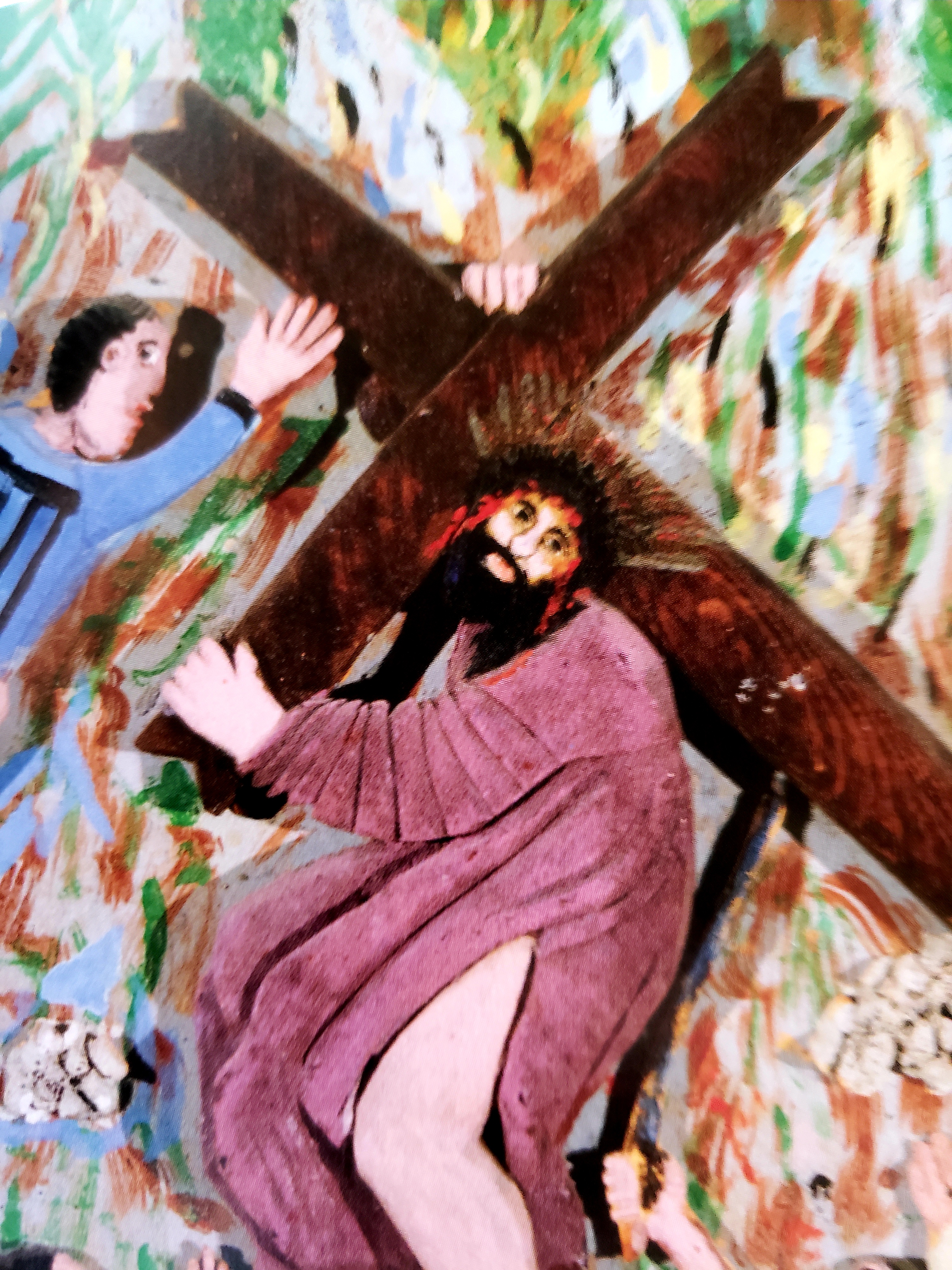
Christ Carrying the Cross
Christ Carrying the Cross by Elijah Pierce, 1892-1984.

It is our task to find commonality and solidarity with Jesus in our own personal and corporate suffering. An admission of weakness, trouble, hardship, or suffering is neither a lack of faith nor the unpardonable sin. We know there must be a Good Friday before there is an Easter. Identifying with the adversity of our brothers and sisters in Christ throughout this nation and the world can be transformed into suffering that has meaning and significance. Our temporary sufferings now will someday result in the glory of being with Christ forever.

Christ’s suffering qualified him to be our compassionate helper.

Through the death of Jesus on the cross we have victory over Satan and all his wicked spirits. I have heard more than one motivational speaker say: “If you could do one thing in your life and not be able to fail, what would it be?” The truth is, because of Christ’s atoning sacrifice, we have victory and can live our lives in confidence and commitment to Jesus. What is more, we know that temporary failures and failings are not the end of the story. We possess a union with Christ because of the cross. Jesus is our champion. He stands with us in our suffering and temptations.

Christian speaker, author, and professor emeritus, Tony Campolo, told a story about observing communion when he was a child: “Sitting with my parents at a Communion service when I was very young, perhaps six or seven years old, I became aware of a young woman in the pew in front of us who was sobbing and shaking. The minister had just finished reading the passage of Scripture written by Paul that says, ‘Whosoever shall eat the bread and drink the cup of the Lord unworthily, shall be guilty of the body and blood of the Lord’ (1 Corinthians 11:27). As the Communion plate with its small pieces of bread was passed to the crying woman before me, she waved it away and then lowered her head in despair. It was then that my Sicilian father leaned over her shoulder and, in his broken English, said sternly, ‘Take it, girl! It was meant for you. Do you hear me?’ She raised her head and nodded—and then she took the bread and ate it. I knew that at that moment a heavy burden was lifted from her heart and mind. Since then, I have always known that a church that could offer communion to hurting people was a special gift from God.”

In solidarity with all who suffer, along with your brothers and sisters who agonize throughout the world, we have the blessed opportunity of bringing our troubles to a gracious God – thus finding forgiveness and hope.  May your burdens be lifted, and may you know Christ, and him crucified, died, buried, risen, ascended, and coming again. For, precious one, he knows you because he tasted death for you – for everyone.

Merciful Lord help me to remember in these troubled times the cross you carried for my sake so that I may better carry mine and help others do the same. Since you tasted death that I might taste life, I forever belong to you and offer up all that I am and all I hope to be to the glory of Jesus Christ through the power of the Holy Spirit. Amen.