Evicting Complaints (Exodus 16:1-8)

On the fifteenth day of the second month after the Israelites had escaped from Egypt, they left Elim and started through the western edge of the Sinai Desert in the direction of Mount Sinai. There in the desert they started complaining to Moses and Aaron, “We wish the Lord had killed us in Egypt. When we lived there, we could at least sit down and eat all the bread and meat we wanted. But you have brought us out here into this desert, where we are going to starve.”

The Lord said to Moses, “I will send bread down from heaven like rain. Tell the people to go out each day and gather only enough for that day. That’s how I will see if they obey me. But on the sixth day of each week they must gather and cook twice as much.”

Moses and Aaron told the people, “This evening you will know that the Lord was the one who rescued you from Egypt. And in the morning you will see his glorious power, because he has heard your complaints against him. Why should you grumble to us? Who are we?”

Then Moses continued, “You will know it is the Lord when he gives you meat each evening and more than enough bread each morning. He is really the one you are complaining about, not us—we are nobodies—but the Lord has heard your complaints.” (Contemporary English Version)

Every person on planet earth knows what a complaint is. That’s because we’ve all complained about something and we’ve all been the brunt of someone else’s complaining. To handle grumblers, we need to first deal with our own complaining spirit. 

Early in the book of Genesis, Adam and Eve disobeyed God. That caused their attitudes to change. Whereas their original reflex responses in the Garden of Eden were to enjoy God and be open, their automatic emotional reflexes after the fall were to hide, blame, and guard themselves. 

Adam’s first response to God after his disobedience was to point the finger at Eve: “The woman you put here with me – she gave me some fruit from the tree, and I ate it.”  And Eve’s initial reflex attitude was to shift the blame, as well: “The serpent deceived me, and I ate” (Genesis 3).

Ever since, people have had an automatic attitude of blaming, quarreling, and complaining. The heart drifts toward complaint as if by some gravitational pull because grumbling seems a reasonable response to disappointing events.
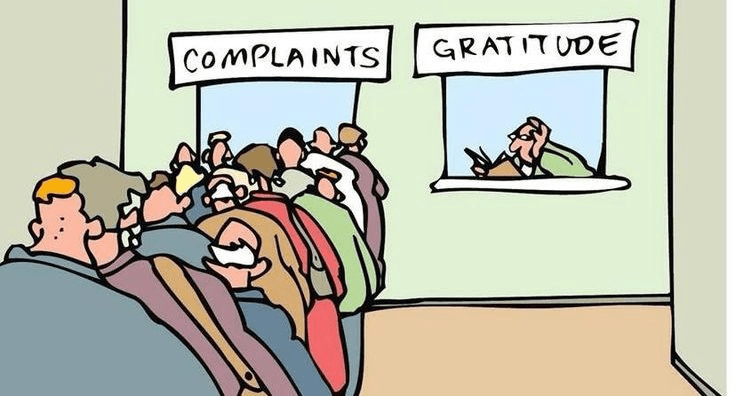
Generally, complaints show up as an uninvited guest. You return home from a frustrating day to discover that complaint has moved into your guest room, unpacked its luggage, started a load of laundry, and is rooting through your fridge.

Even as you work to evict complaint—as you move its bags to the curb and change the locks on your doors—it somehow crawls back into the guest room window. Complaint is highly resistant to eviction. 

Before you know it, over time, complaint becomes familiar, even right. With every struggle, we become like the Israelites murmuring in the desert (Exodus 16-17). Although God wants to prepare our faith for works of service in the world, we are hunkered down with complaint, watching TV together, and grumbling through every show and each conversation.

We can discourage complaint’s residency in our lives by inviting another guest to move in with us. That new guest is a prayerful attitude of trust and gratitude. When we choose to trust God and give thanks in the face of deep disappointment, complaint has less space to maneuver.

While attempting to unpack for an extended stay, complaint discovers that trust and gratitude have taken all the drawers in the guest room and already occupy the empty seat at the supper table. Faith and gratitude evict complaint because faith and a grumbling spirit are not able to live in the same house together. One inevitably pushes the other one out.

The ancient Israelites experienced a miraculous deliverance from harsh slavery in Egypt. The Lord parted the Red Sea so that they could walk across on dry ground and escape the Egyptian army’s pursuit. It’s easy to praise God when great things happen, and the Israelites had a whopper of a praise and worship service after that deliverance. Yet it’s quite another thing to praise and trust God when trouble happens – and when it keeps happening over and over again. 

Immediately after the praise and worship, Moses led the people into the desert. There was no water. God deliberately led the people into a difficult situation to test their faith. The Israelites quickly forgot the blessings and began grumbling about their situation. 

Their reflex response was to complain and ignore God’s direct commands. Maybe they did so because they spent four-hundred years of slavery in Egypt, and complaint had made such a home with them that it was second nature to murmur about their situation.

I keep a small c-clamp in my office to remind me that I am not in control, but God is. It isn’t my job to hold the universe together. The c-clamp also reminds me that I need to keep a clamp on my tongue when it comes to grumbling and complaining. Sins of the tongue are some of the most dominant forms of disobedience to God throughout Holy Scripture. 

All kinds of animals, birds, reptiles, and sea creatures can be tamed and have been tamed. But our tongues get out of control. They are restless and evil, and always spreading deadly poison. (James 3:7-8, CEV)

I wonder, can any of us go 24 hours without complaining about something or someone? 

Those who cannot answer “yes” must recognize that’s a real problem. If you cannot go 24 hours without drinking liquor, you are addicted to alcohol. And if you cannot go 24 hours without grumbling about something or someone, then you have lost control over your tongue and you are addicted to murmuring and have an adulterous relationship with complaint.

We must invite everlasting life to take up permanent residence. We need to evict the squatter of complaint. 

God is with us. Difficult circumstances, trouble, hard situations, problem people, and the seeming impossibility that things will not change doesn’t mean God moved out of your house. Instead, it’s evidence that the Lord wants us to exercise our faith.

Let God do it.

O God:
Give us all strength to live another day without grumbling, arguing, or complaining;
Let us not lose faith in other people and withdraw from them, or you, out of spite;
Keep our hearts tender in spite of the ingratitude, treachery, or meanness around us;
Help us to maintain purity of heart, and to live in faith and confidence, so that failure cannot dishearten us;
Open wide our spiritual eyes so that we may see the good in all things;
Inspire us with the spirit of joy and gladness;
and make us worthy and competent servants to suffering souls;

Some Wise Warnings (Proverbs 6:6-23)

Go to the ant, you sluggard!
    Consider her ways and be wise.
Which, having no guide,
    overseer, or ruler,
provides her bread in the summer,
    and gathers her food in the harvest.

How long will you sleep, O sluggard?
    When will you arise out of your sleep?
Yet a little sleep, a little slumber,
    a little folding of the hands to sleep—
so will your poverty come upon you like a stalker,
    and your need as an armed man.

A wayward person, a wicked man,
    walks with a perverse mouth.
    He winks with his eyes,
    he signals with his feet,
    he motions with his fingers;
    perversity is in his heart,
    he devises mischief continually, he sows discord.
Therefore his calamity will come suddenly;
    in a moment he will be broken without remedy.

These six things the Lord hates,
    yes, seven are an abomination to him:
        a proud look,
        a lying tongue,
        and hands that shed innocent blood,
        a heart that devises wicked imaginations,
        feet that are swift in running to mischief,
        a false witness who speaks lies,
        and he who sows discord among brethren.

My son, keep your father’s commandment,
    and do not forsake the instruction of your mother.
Bind them continually upon your heart,
    and tie them around your neck.
When you go, they will lead you;
    when you sleep, they will keep you;
    and when you awake, they will speak with you.
For the commandment is a lamp, and the law is light;
    and reproofs of instruction are the way of life. (Modern English Version)

A proverb is a short, pithy statement of experiential truth. In life, all things being equal, there are some predictable consequences to each decision and action we take.

To make idle, wicked, or adulterous decisions will result in disastrous outcomes – and the proverbial writer wants to help us steer clear of calamity. So, we have some sound and sage instruction which is meant for us to realize contentment and fulfillment in life and avoid the pitfalls of laziness, evil, and infidelity.

The Sluggard

We may typically think of the sluggard as a lazy person who just doesn’t want to work. That’s true, yet it runs even deeper and broader than that. A sluggard is someone always looking for the easy way out. Instead of persevering and being diligent in accomplishing large projects and demanding responsibilities, the sluggard tries to use their ingenuity to get the job done quickly.

The student who wants to take shortcuts, and doesn’t do the busywork of citing sources, or doing their due diligence in research, is a sluggard. The worker who cuts corners in order to move to another job they’d rather do, is a sluggard. The spouse who hastily buys some cheap flowers for their loved one from a street vendor, without even getting out of the car, is a sluggard. The minister who cuts and pastes some information from Google the night before teaching a lesson, is a sluggard.

And the results will likely be quite predictable: an “F” on the term paper; a punitive citation from the building inspector; the disappointment and anger from a wife; and the rebuke from a church. There’s no one to blame. All these sluggards will be out of a job and poverty will cozy up to them sooner than later.

What to do? Get some humility. Bend down and look at the busy ants. They work steadily, consistently, and carefully – and never lack.

The Wicked

The truly evil person enjoys creating chaos and upsetting folks through running their mouth off like a canon.

They get a kick out of poking the bear, sticking a hornets’ nest, and stirring the pot. And their chief means of doing it is their tongue. Damaging words are thrown about. Gaslighting, arguing, backbiting, slandering, and lying are the tools of their trade.

The wicked person might get what they want, in the short term; but in the long term, their end is sure. Brokenness and calamity will eventually catch up to them. They, like the sluggard, will have no one to blame for the consequences which overtake them; the ire of God will consume them.

What to do? Repent! Do a complete 180-degree turn from hubris to humility, lying to honesty, violent speech to encouraging words, disunity to harmony, separating to connecting, and from selfish behavior to working for the common good.

The Adulterer

The adulterer is one who is unfaithful. They make commitments and renege on them. The classic adulterer is one who cheats on their spouse and breaks their vow of marriage. Yet, there are various sorts of adultery that happen in this old fallen world.

The spiritual adulterer says they are committed to God, yet keep up a moonlighting affair with the world. The mental adulterer might never sleep with another, yet is committing deviant acts in their mind with others. The emotional adulterer gives a smooth line, yet is only trying to manipulate another into something the other person doesn’t want to do.

What to do? Come back to what you learned in childhood. Most parents, even if they fail to live up to their own instruction for their children, want what’s best for their kids. To nearly every adulterer, we can say, “I know your mama taught you better than that!”

Conclusion

An idle life, an evil tongue, and adulterous behavior will ultimately result in disaster, if left unchecked. The compiler of Proverbs is checking-in with us, making sure that we keep in sync with the good and beautiful way to live; and letting us know that the alternative to right living is some very calamitous consequences.

So, what will you choose?

Blessed and almighty God, take me to the place where I am saved from my pride and arrogance; where Christ’s humility becomes center-stage in my life; and where I’m lifting up clean hands and a pure heart in prayer. God and Parent of all, I bend my knee to receive truth; and I open my ears to receive counsel, and my heart to receive wisdom. Amen.

James 3:1-12 – Taming the Tongue

Not many of you should become teachers, my fellow believers, because you know that we who teach will be judged more strictly. We all stumble in many ways. Anyone who is never at fault in what they say is perfect, able to keep their whole body in check.

When we put bits into the mouths of horses to make them obey us, we can turn the whole animal. Or take ships as an example. Although they are so large and are driven by strong winds, they are steered by a very small rudder wherever the pilot wants to go. Likewise, the tongue is a small part of the body, but it makes great boasts. Consider what a great forest is set on fire by a small spark. The tongue also is a fire, a world of evil among the parts of the body. It corrupts the whole body, sets the whole course of one’s life on fire, and is itself set on fire by hell.

All kinds of animals, birds, reptiles and sea creatures are being tamed and have been tamed by mankind, but no human being can tame the tongue. It is a restless evil, full of deadly poison.

With the tongue we praise our Lord and Father, and with it we curse human beings, who have been made in God’s likeness. Out of the same mouth come praise and cursing. My brothers and sisters, this should not be. Can both fresh water and saltwater flow from the same spring? My brothers and sisters, can a fig tree bear olives, or a grapevine bear figs? Neither can a salt spring produce fresh water. (New International Version)

Words and speech are the most powerful tools we have in the Christian life. And the tongue is the means of forming the words and using the speech God gives us.

The problem is, we may too often underestimate the importance and the great power of the tongue to effect both good and evil. We might not believe that our particular words carry much weight.

Yet, in reality, our words are very powerful.  In fact, what we say with our tongues is either the vehicle of praise to God, or the ruin of another person. We must measure our words because the tongue is a beast to control and tame. 

The tongue is so powerful that it determines the direction of a person’s life.

The horse is a strong animal, and the strength of a horse must be respected at all times. Yet, a small woman, even a young girl who knows what she is doing with a bridle and a bit, can make a horse do whatever she wants. Ships can be massive and carry thousands of people and huge amounts of cargo. Yet, it is controlled and directed by the rudder – a very small piece of the ship.  In our own day, we know the devastating power of a very small handgun trigger which can literally snuff out a life in an instant.

Likewise, the tongue is quite small among the parts of the body. Yet, it sets the course of a person’s life and has the power to determine its destiny.  A rider who does not know how to handle a horse is in trouble.  An undisciplined pilot of a ship is in danger of shipwreck.  A gun owner loose with gun safety is a danger to others. And the loose, unbridled, untrained and undisciplined tongue is on a one way course to destruction.

The tongue is so powerful that it can destroy another person.

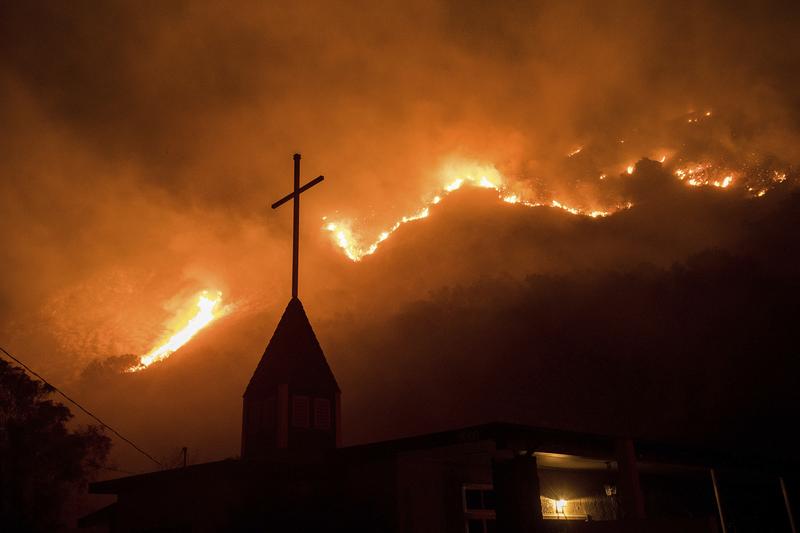
Like fire, the tongue has an awesome potential for harm. The great Chicago fire of 1871, one of the costliest disasters of the nineteenth-century, killed three hundred people and destroyed seventeen-thousand buildings.  All the destruction was started by Mrs. O’Leary’s cow kicking over a lantern in a barn. 

The Yellowstone National Park fire of 1988 burned for several months and completely destroyed nearly 800,000 acres of the park.  At the peak of the fire there were 9,000 firefighters battling the blaze. All the devastation was caused by one quick flash of lightning.

The largest fire in American history occurred in 1871 and began in northern Wisconsin. The fire created its own wind system and turned into a tornado, moving into the Upper Peninsula of Michigan. By the time it was over, 3.7 million acres were scorched with 2,500 people left dead. All the destruction was likely caused by a small meteorite.

Whenever we underestimate the power of our speech and allow a stray word to fly off the tongue, the spark has the potential to start a huge conflagration of evil. A firestorm of destruction can be set off with just a few uncontrolled words. 

Through gossip (saying something behind somebody’s back that you would not say to their face), flattery (saying something to someone’s face that you would not say behind their back), negative criticism, sarcastic humor, boasting, and a host of evil words, the tongue has the immense power to destroy life.  It is speech fueled and spread by Hell itself.

The tongue is so powerful that it cannot be tamed.

Animals can be tamed, even crocodiles.  I once took my oldest daughter to the circus, when she was a small girl, and watched as a guy had a trained crocodile open its mouth and stuck his head inside the crazy reptile! 

Yet, no one can tame the tongue. It is like a tarantula, biting its victim with paralyzing venom so that the arachnid can eat its prey alive. The untamed and uncontrolled tongue is like a poisonous spider which spreads its verbal venom, paralyzing other people and sucking the life out of them.

The Apostle James paints a hopeless picture because he wants to drive us to the grace of God for help. We cannot tame the tongue – but God can. When we begin to see the true nature of our speech, it reveals something of ourselves.

The tongue is so powerful that it exposes the duplicity of the heart.

Whatever comes out of our mouths reveals what is on the inside of our lives. If we can grasp the truth of this, I believe it could transform the way people talk to one another. Even more metaphors to communicate the point….

Salt water and fresh water cannot both come from the same spring. A fig tree cannot bear olives, and a grapevine is not going to produce figs. And whatever comes out of the mouth reveals the source. Evil words come from an evil source; good words come from a good source. 

A pattern of negative condescending speech is drawing from a well, pumping up words from the depths of Hell. Conversely, a continuous stream of helpful words that encourage and build up others, draws its nourishment from God’s Word.

Conclusion

The following are four ways to help bring the tongue under control:

  • Train your tongue for good. Speech is a skill to be developed. When starting an exercise regimen, we are deliberately training our bodies for health. When dieting, we are saying “yes” to certain foods, and “no” to others. The tongue needs to be trained to express gratitude, good news, and grace. And one of the best ways to do it is through speaking Scripture out loud in a daily regular regimen. Consider going on a fast from talking and seek only to be silent and listen for a specified amount of time.

Do not waste time arguing over godless ideas and old wives’ tales. Instead, train yourself to be godly. “Physical training is good, but training for godliness is much better, promising benefits in this life and in the life to come.” (1 Timothy 4:7-8, NLT)

Solid food is for the mature, for those whose faculties have been trained by practice to distinguish good from evil. (Hebrews 5:14, NRSV)

  • Read a chapter of Proverbs each day for a month. There are thirty one chapters in Proverbs, one for each day of the month. Pay attention to the power of words. Notice the difference between the speech of a wise person and the words of a fool – and take to heart the consequences of both approaches. 

You will say the wrong thing
    if you talk too much—
    so be sensible and watch
    what you say. (Proverbs 10:19, CEV)

Careless words stab like a sword,
    but wise words bring healing. (Proverbs 12:18, NCV)

  • Build friendships with people who are positive and encouraging. If a negative person keeps being negative, even after you have warned them more than once about it, you likely need a new relationship. 

Warn a quarrelsome person once or twice, but then be done with him. It’s obvious that such a person is out of line, rebellious against God. By persisting in divisiveness, he cuts himself off.  (Titus 3:10-11, MSG)

  • Listen and learn before speaking. A judgmental spirit often comes from misinterpreting another person’s words and/or actions. We can too often jump to conclusions about something or someone with only partial information and without the whole story.

Love never gives up.
Love cares more for others than for self.
Love doesn’t want what it doesn’t have.
Love doesn’t strut,
Doesn’t have a swelled head,
Doesn’t force itself on others,
Isn’t always “me first,”
Doesn’t fly off the handle,
Doesn’t keep score of the sins of others,
Doesn’t revel when others grovel,
Takes pleasure in the flowering of truth,
Puts up with anything,
Trusts God always,
Always looks for the best,
Never looks back,
But keeps going to the end. (1 Corinthians 13:4-7, MSG)

Right and Just God, teach us to speak wisely. Let us avoid useless thoughts and useless conversations. Help us to speak often of you. Grant that our words may never hurt others but always bring comfort to those in sorrow, and guidance to those in need. Take our tongues and make them yours. Take our minds and make them instruments of your goodness and a channel of truth. May you help us to use both words and silence in redemptive ways, through Jesus Christ our Redeemer. Amen.

Ephesians 4:17-5:2 – Living in Truth

truth

So, I tell you this, and insist on it in the Lord, that you must no longer live as the Gentiles do, in the futility of their thinking. They are darkened in their understanding and separated from the life of God because of the ignorance that is in them due to the hardening of their hearts. Having lost all sensitivity, they have given themselves over to sensuality to indulge in every kind of impurity, and they are full of greed.

That, however, is not the way of life you learned when you heard about Christ and were taught in him in accordance with the truth that is in Jesus. You were taught, with regard to your former way of life, to put off your old self, which is being corrupted by its deceitful desires; to be made new in the attitude of your minds; and to put on the new self, created to be like God in true righteousness and holiness.

Therefore, each of you must put off falsehood and speak truthfully to your neighbor, for we are all members of one body. “In your anger do not sin.” Do not let the sun go down while you are still angry, and do not give the devil a foothold. Anyone who has been stealing must steal no longer, but must work, doing something useful with their own hands, that they may have something to share with those in need.

Do not let any unwholesome talk come out of your mouths, but only what is helpful for building others up according to their needs, that it may benefit those who listen. And do not grieve the Holy Spirit of God, with whom you were sealed for the day of redemption. Get rid of all bitterness, rage, and anger, brawling and slander, along with every form of malice. Be kind and compassionate to one another, forgiving each other, just as in Christ God forgave you. Follow God’s example, therefore, as dearly loved children and walk in the way of love, just as Christ loved us and gave himself up for us as a fragrant offering and sacrifice to God. (NIV)

Okay, a collective confession from the get-go: We know today’s New Testament lesson is the proper way to live. There’s no need to convince you that we must live and speak the truth in love, avoid angry tirades, keep a lid on our wagging tongues, keep bitterness out of our hearts, forgive others, and be compassionate to people. So, what is the real issue? Why, despite knowing better, do we as people have such a doggone hard time following God’s example of holy speech, pure words, and radical forgiveness?

If there was a simple answer/solution to the acerbic tongues of people, it would be easy to avoid using our words like a hot knife through butter and toast others with subtle digs and cranky words. Simply telling ourselves (or others) to stop their bellyaching is only a manifestation of our own belligerent spirit running amok. No, we need a solid practical approach to those nagging white lies we keep putting out there and the bending of truth to suit our own selfish purposes. Neither sheer willpower nor hackneyed homebrewed prescriptions will get the job done.

When we go to the doctor, we want them to be honest with us about our true condition and health.  If we have a clean bill of health, we are glad for that truth.  If, however, we have something wrong, we want to know what it is and how to deal with it. Doctors who avoid the truth so to not make us feel bad or hurt our feelings are performing malpractice, not healing. We need a solid diagnosis and prognosis framed in a caring way. Trying to grow spiritually without hearing the truth about ourselves from a spiritual doctor is like trying to do heart surgery on yourself.

The truth will set us free. Yet, before it will free us, it will make us uncomfortable. We all have a real need to hear the truth spoken in love and wrap our heads and hearts around it. Truth is: People are to be open, honest, and real with each other because we belong to one another. We are to stop being dishonest, and start being truthful.

truth cross

What is truth?

The Christian tradition teaches that Jesus is the way, the truth, and the life. Life together is to be shaped around the person and work of Christ.  Since Christians share a common confession of Jesus together, we are to share a common life together. That life is to revolve around the truth of Jesus. That means we will put off non-Christian ways of relating to each other and put on a Christian way of relating to each other.  We will speak truthfully because we belong to each other – we are responsible for one another.  Just as Jesus so closely identified with us in his life, death, and resurrection, so we are to so closely identify with each other that we take responsibility for each other.  My problems are your problems – your issues are my issues. This is a stance of connection, not division.

We are to put off lying and put on truth. Too often, we are in the habit of pretending and being plastic.  Pretending we are okay when we are not, or even acting like life is hard when it is not is an untruthful presentation – it is a lie. Secrecy and deception are tools of Satan, not God. Therefore, we must put off the bad habit of pretension, and put on the good habit of speaking truthfully to each other.

Why do we not speak truth?

Habits of lying come from the enemy of our souls who whispers in our ears that being truthful and transparent is too traumatic – we can’t do it. Buying into that snake oil thinking believes we cannot be open, honest, real, vulnerable, and genuine because it is not worth the risk. We become convinced that we will be rejected, lose face with others, or be a victim of gossip.  In other words, we let shame take the steering wheel instead of speaking truthfully to one another.  So, we avoid the truth and, so, end up avoiding others.

Why are we to speak truth?

We speak truth because we are responsible to one another. We are not meant to hide in the shadows but to step into the light and forsake all fakery and be truthful.  When Ananias and Sapphira lied to the Apostle Peter, they were judged severely because they betrayed the community (Acts 5:1-11). Lying undermines and erodes true community.

truth 2

How do we speak truth?

We speak truthfully by making and keeping promises to each other because that is what God does with us.  Faith communities which love truth will make a safe place for the awkwardness of confession, forgiveness, and healing.  There must be assurance that members will not abandon one another as they reveal their sins and weaknesses and fumble forward toward maturity and holiness.  Truthful communities are sacred spaces of encouragement and hospitality where we are safe to be real.  No one should ever have to suffer in silence, cry alone, or wonder whether they will be forsaken.  We must have a refreshing openness with each other since we belong to one another.  The late author and psychologist, Lewis Smedes, said in his book The Power of Promises:

“Yes, somewhere people still make and keep promises. They choose not to quit when the going gets rough because they promised once to see it through. They stick to lost causes. They hold on to a love grown cold. They stay with people who have become pains in the neck. They still dare to make promises and care enough to keep the promises they make. I want to say to you that if you have a ship you will not desert, if you have people you will not forsake, if you have causes you will not abandon, then you are like God.  What a marvelous thing a promise is! When a person makes a promise, she reaches out into an unpredictable future and makes one thing predictable: she will be there even when being there costs her more than she wants to pay. When a person makes a promise, he stretches himself out into circumstances that no one can control and controls at least one thing: he will be there no matter what the circumstances turn out to be. With one simple word of promise, a person creates an island of certainty in a sea of uncertainty.”

Where do we go from here with truth?

I harbor no delusions: Being transparent and real is scary. Yet, if we are to be the true humanity we are deigned to be by our Creator, we will speak truthfully and not put up a false front.  We will neither hide nor hurl.  We will neither pretend everything is okay when it is not, nor project our problems onto others using untruthful accusations. We will do the hard work of learning to communicate by speaking the truth in love.

There are two tendencies that may plague us going forward: complacency and mediocrity. When it comes to relationships, we are too easily satisfied with a minimum amount of effort, words, and commitment.  We need to make and keep promises to God and to each other; live into our baptisms; and, renew our covenant of care and commitment to each other.  This means we will allow God to invade our hearts; we will let our mouths say what needs to be said and be open enough to let others in.

Some folks have putrid spiritual abscesses from either hiding the truth or hurling truth without love.  Spiritual healing comes through spiritual surgery. God the Father sent God the Son to die on a cruel cross for all our unhealthy ways of relating to each other – and together sent God the Holy Spirit, the Spirit of Truth, to form a new community of believers around truth.

Putting off and putting on – that is the prescription for realizing truthful speech and life. It is not easy. It is hard as hell. And it takes us all as a human community to do it. Sometimes things are messy before there is order and peace. That is the price of authenticity and truth – and that is okay.

Lord God Almighty, the Creator of all that is good and true, help me so to put aside falsehood and put on truthful living and speaking that love and compassion shine in and through me to the glory of Jesus Christ, your Son, my Savior, who with you and the Holy Spirit live and reign forever together in a Holy Trinity of Truth. Amen.