Jeremiah 7:1-15 – Holding People Accountable

The prophet Jeremiah, Basilica of St Vitalis, Ravenna, Italy—Photo by mountainpix

The word that came to Jeremiah from the Lord: Stand in the gate of the Lord’s house, and proclaim there this word, and say, Hear the word of the Lord, all you people of Judah, you who enter these gates to worship the Lord. Thus says the Lord of hosts, the God of Israel: Amend your ways and your doings and let me dwell with you in this place. Do not trust in these deceptive words: “This is the temple of the Lord, the temple of the Lord, the temple of the Lord.”

For if you truly amend your ways and your doings, if you truly act justly one with another, if you do not oppress the alien, the orphan, and the widow or shed innocent blood in this place, and if you do not go after other gods to your own hurt, then I will dwell with you in this place, in the land that I gave to your ancestors forever and ever.

Here you are, trusting in deceptive words to no avail. Will you steal, murder, commit adultery, swear falsely, make offerings to Baal, and go after other gods that you have not known and then come and stand before me in this house, which is called by my name, and say, “We are safe!”—only to go on doing all these abominations? Has this house, which is called by my name, become a den of robbers in your sight? I, too, am watching, says the Lord. Go now to my place that was in Shiloh, where I made my name dwell at first, and see what I did to it for the wickedness of my people Israel. 

And now, because you have done all these things, says the Lord, and when I spoke to you persistently, you did not listen, and when I called you, you did not answer, therefore I will do to the house that is called by my name, in which you trust, and to the place that I gave to you and to your ancestors just what I did to Shiloh. And I will cast you out of my sight, just as I cast out all your kinsfolk, all the offspring of Ephraim. (New Revised Standard Version)

One of the dangers of the religious life is slipping into the view that possessing a certain thing protects us from all harm – sort of like a talisman or rabbit’s foot.

Today’s Old Testament lesson is a classic example of succumbing to just such a danger. The ancient Jews in Jerusalem, in the days of the prophet Jeremiah, sincerely believed that because they had God’s temple in their city that this would protect them from any kind of attack from the outside. 

What is more, since they viewed the temple as an incredibly powerful good-luck-charm, the people thought that they could do whatever they wanted; they were covered and protected. So, they had no sense of accountability to the holy God whose temple overlooked Jerusalem and saw all of their unjust ways.
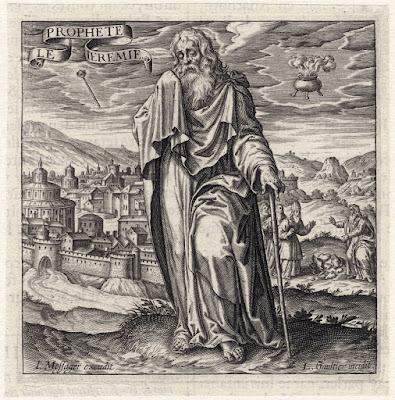
An engraving of the prophet Jeremiah by Léonard Gaultier (1561-1641)

Separated by a few millennia, we might see the folly with this magical type of thinking. Yet, it is just as easy for us to slip into the same mentality. 

Whenever we Americans think that our nation is so great that no one will ever take us over; or when we sincerely believe that because we are a missionary-sending nation that God will protect us; or when we buy into the notion that we can live however we want, but God would never judge us!; after all, we aren’t as bad as other nations!; well, then, we have come under the same condemnation as the Jews of old, we need to hear God’s Word for us today.

Jeremiah’s message was uncompromising. He clearly let the people know that while they have been living their hedonistic lives, God has been trying to talk them. But the people refused to listen. The prophet insisted that having the temple in the city is not some inoculation from keeping enemies at bay.

The prophet Jeremiah asserted that the people must change their ways, start living right, and be fair and honest with each other. They need to stop taking advantage of foreigners, orphans, and widows. They cannot kill innocent people and worship other gods, then turn around and invoke the temple as God’s presence and sanction on their security.

Justice is the responsibility of everyone; there are no favorites with God. The Lord does not favor particular people, ethnicities, or nations above others. Because one is an American, or not, makes no difference. Race and gender don’t come into view.

The sovereign God will hold all people culpable for their violent speech and behavior, no matter who they are or where they are from. Oppression, injustice, and spiritual gerrymandering will be dealt with by Judge Jesus, for both Jew and Gentile, man and woman, Westerner and Easterner, young and old.

For whom God has given much, much will be required. The Lord holds all people accountable for their actions.

Holy God, you still speak today through your Holy Word. Help me to listen well and pay attention to what you are saying so that I might honor you through humility and obedience for the sake of Jesus. Amen.

Luke 19:45-48 – Jesus Cleans House

A bronze panel of Jesus chasing the merchants from the Temple by Lorenzo Ghiberti (1378-1455)

When Jesus entered the temple courts, he began to drive out those who were selling. “It is written,” he said to them, “‘My house will be a house of prayer’; but you have made it ‘a den of robbers.’”

Every day he was teaching at the temple. But the chief priests, the teachers of the law and the leaders among the people were trying to kill him. Yet they could not find any way to do it, because all the people hung on his words. (New International Version)

Jesus seems a bit like an actor in an old western movie. He’s the sheriff who drifts into town, sizes up the situation, shoots up the bad guys, defends the women and children, and cleans up the town. 

It’s a side to Jesus that might surprise some.

Jesus is no simple one-dimensional person, as if he’s always calm and picking dandelions. Christ is fully human and fully God – a complex person full of both human and divine anger. Today’s Gospel lesson reminds us that Jesus defies stereotyping, and that we need to see a fuller profile of who he is, and what he is up to.

Jesus is not only the merciful servant who graciously heals at the temple; but he is also a mighty judge who is intolerant of unjust systems and cleans house. 

Because Jesus is superior to everything, he is not some Being that we can domesticate for our own personal use. He did not come to this earth as some sort of spiritual vitamin supplement, or to be on call 24/7 in order to bail us out when we need it, or help us get ahead in life.

Instead, zeal for his Father’s house consumes Jesus. (John 2:13-17)

Jesus driving the merchants out of the Temple by Raymond Balze (1818-1909)

Christ sought to please the Father. Jesus oversees what the church and Christians are supposed to be. 

It’s our task to conform to Christ, and not the other way around. 

That happens whenever we let Jesus be the sheriff who drives out our sin, and, at the same time, the town doctor who brings the needed healing to our lives. 

Jesus cleaned house by attacking the system he saw operating.

It was Passover, the time when all pious Israelites made the pilgrimage to Jerusalem. Cattle, sheep, and doves were used for sacrifices. And the only place where those sacrifices were made was at the Temple in Jerusalem.  This meant that anyone wanting to worship God from outside of Jerusalem would have to do some traveling. 

Over time, a system was set up: Vendors established kiosks which lined the Temple courts; and they sold animals for the required sacrifices, as a matter of convenience. 

Since there were thousands of folks who came from a long way, often from outside of Israel, they brought their foreign currency with them, and it could be exchanged at the tables set up by money-changers.

Perhaps that all sounds practical. A little capitalism which provides a service for the people doesn’t seem all bad. So, what’s the problem? 

Jesus didn’t have a problem with capitalism per se; his problem with the whole system is that it should not even exist – these guys should not be in the Temple, at all! 

Jesus attacked the system and made a western movie scene out of it because the vendors and money-changers, even if using sound business practices (which they weren’t) should not even be there. For Jesus, it trivialized the Temple and took away from its intended purpose as a house of prayer for all nations.

Here’s how the system was supposed to work:

Coming to the Temple from outside of Jerusalem was never intended to be easy or convenient.

Making the pilgrimage to Jerusalem was supposed to be difficult. For the past year, since the last Passover, a family raised a newborn lamb in their house. Parents and children all took part in caring for it.

Then, when it was time, they all journeyed to Jerusalem together, taking turns carrying the year old lamb over their shoulders. Everyone knew what was coming. Their precious lamb, now a cherished part of the family, would be given in sacrifice at the Temple.

It was all a very powerful reminder of sin’s cost and how terrible it truly is.

Entering Jerusalem with no animal, and only money to buy one, is a cheap facsimile of real worship.

It misses the entire point of the system. It hinders people from genuinely connecting with God through prayer.  And Jesus will not put up with it – to the point of violently driving the whole system out of the Temple.

Jesus didn’t mess around with the sinful system. He didn’t politely ask the money-changers to move their tables somewhere else; he didn’t strike a deal with those selling animals to market them at cost. No. Instead, he went all town sheriff on them because the whole system was a blasphemous act against the right and true worship of God.

It has been the sin of the Church, through the centuries, to find ways of doing ministry and worship by not actually doing it (e.g., selling indulgences). 

We might feel good by simply attending a worship service, or offering some obligatory prayers, and giving money without having done anything to meaningfully connect with God. Our devotion may not be toward bringing something of ourselves to sacrifice by using our spiritual gifts and laying our lives down for others. 

It’s really a heart issue. For example, we might rightly give to missionaries or mission projects. Yet, if we give without any thought to doing missions ourselves and being missional people, then we are in grave need of having a clean house by overturning the tables in our hearts. 

17th century Ethiopian depiction of Christ cleansing the Temple

Jesus cleaning house was not an end in itself; he did it so that the Temple could be used for its intended purpose: A house of prayer. A place of healing. A gathering of collective praise to God.

Whenever an existing system is challenged, there will be those who push back because they benefit from the way things are.

The religious leaders were incensed by Christ’s systemic change. The behavior of Jesus challenged their authority, and they were angry about losing some of their power – not to mention jealous and envious that the people hung on his every word.

Jealousy rots the bones. Envy and selfish ambition accompany every evil practice and are behind every evil system. (Proverbs 14:30; James 3:14-16)

The real culprit behind the Temple system, as well as our own conflicts and disagreements is our selfish anger, our abject jealousy that someone else is receiving something which should be mine, and our insidious envy of wanting what another has.

Jesus knew he would upset and anger the religious leaders. But he cared enough about the proper place of worship that he attacked the contrived Temple system that fed on obscuring what real sacrifice was. Christ was willing to take on the establishment and reestablish a house of prayer for all people.

The way for us has been made clear through the death of Christ. Jesus has removed the old system and replaced it with the new. (Hebrews 8:13)

Therefore, we ought to be a beacon of hope for all who are coming to God and desire to offer their sacrifice of service or praise. We must eliminate any system, rule, or practice that eviscerates true worship.

May we follow the Lord Jesus by being active and proactive in making the way clear for others to come to God. And the first step to doing so is by having God clean house on our own hearts.

It’s what a good deputy sheriff would do.

Create in me a clean heart, O God,
    and put a new and right spirit within me.

The sacrifice acceptable to God is a broken spirit;
    a broken and contrite heart, O God, you will not despise. Amen.

Psalm 74 – A Devastating Loss

Our God, why have you
    completely rejected us?
Why are you so angry
    with the ones you care for?
Remember the people
    you rescued long ago,
the tribe you chose
    for your very own.

Think of Mount Zion,
    your home;
walk over to the temple
left in ruins forever
    by those who hate us.

Your enemies roared like lions
    in your holy temple,
and they have placed
    their banners there.
It looks like a forest
    chopped to pieces.
They used axes and hatchets
    to smash the carvings.
They burned down your temple
    and badly disgraced it.
They said to themselves,
    “We’ll crush them!”
Then they burned each one
of your meeting places
    all over the country.
There are no more miracles
    and no more prophets.
Who knows how long
    it will be like this?

Our God, how much longer
    will our enemies sneer?
Won’t they ever stop
    insulting you?
Why don’t you punish them?
    Why are you holding back?

Our God and King,
you have ruled
    since ancient times;
you have won victories
    everywhere on this earth.
By your power you made a path
    through the sea,
and you smashed the heads
    of sea monsters.
You crushed the heads
    of the monster Leviathan,
then fed him to wild creatures
    in the desert.
You opened the ground
for streams and springs
    and dried up mighty rivers.
You rule the day and the night,
and you put the moon
    and the sun in place.
You made summer and winter
    and gave them to the earth.

Remember your enemies, Lord!
They foolishly sneer
    and won’t respect you.
You treat us like pet doves,
    but they mistreat us.
Don’t keep forgetting us
and letting us be fed
    to those wild animals.
Remember the agreement
    you made with us.
Violent enemies are hiding
in every dark corner
    of the earth.
Don’t disappoint those in need
    or make them turn from you,
but help the poor and homeless
    to shout your praises.
Do something, God!
    Defend yourself.
Remember how those fools
    sneer at you all day long.
Don’t forget the loud shouts
    of your enemies. (Contemporary English Version)

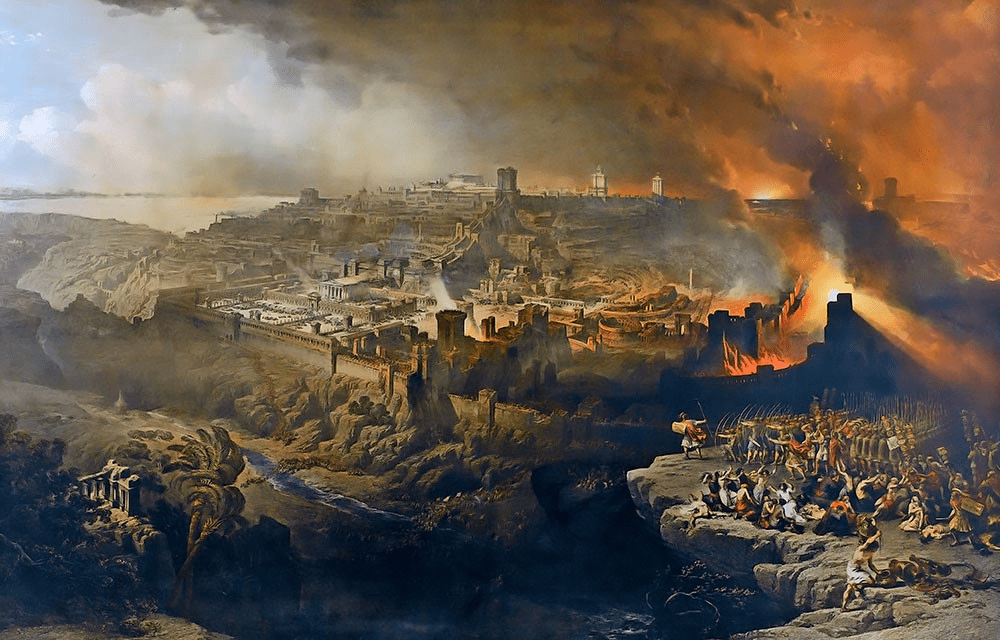
God’s temple was violated. The center and symbol of Jewish worship, culture, and life was gone.

Although we know that nothing lasts forever, that doesn’t mean we are always okay with it.

Asaph, the psalmist, was definitely not okay with the temple’s destruction. It was more than the loss of a building. For Asaph and his people, Jerusalem and the temple were the glue which held the world together.

They lost their center of being. And it was devastating to them.

Everyone and every society has their center, those values and practices which makes them a people. We all need a public center that defines who we are and what we are about. There must be a gravity that holds us to our place and doesn’t allow us to stray into oblivion and nothingness.

The central core of the people was eviscerated. So, today’s psalm is a lament for Jerusalem. It is a painful emotional and spiritual cry which goes well beyond bricks and mortar and the mere physical.

The ruin of the temple, Asaph complains, is the ruin of their God. Yes, it was the Babylonians who came and did the destroying and the de-centering. But it was God’s temple. God is the One responsible. It was God’s action. So, Asaph contends with God and comes at him with full challenge.

Asaph appealed to the Lord much like we do today. “Hey, God, remember how things were back there. It was good, right!? Now look at everything. It’s a mess.” The language is all meant to persuade God that things are so bad, that they are completely intolerable; thus, the Lord should do something about it.

God is bigger than the temple. So, therefore, God can and should restore the temple and make things right again, Asaph reasons. He sounds much like a person in the throes of grief, desperately trying to bargain with God to get things back to the way they were.

Point by point, the psalmist gives a sort of play-by-play to God about the awful situation and what happened. These guys who came and did their dirty work are ultimately your enemies, God, not just ours. So, take notice and act!

Remember the good old days, God, when you performed mighty acts of power against formidable foes, Asaph insisted. Against all odds, the Lord came through for the people… But now… there’s nothing. No divine action. The Babylonians came to Jerusalem, destroyed the city and temple, and got away with it.

Like a person experiencing extreme dizziness, Asaph and the people had a terrible spiritual vertigo which left them unable to get their balance and find their center.

Along with Asaph, in our horrible grief, we not only appeal to God, but we also insist, even tell God exactly what he must do, as if we were the Creator and Yahweh the creature. “Listen, Mr. Almighty God, you made a covenant with us and now you’re reneging on it with all this ridiculous silence and inaction.”

Yet, Asaph really knows better. He knows that, although the temple and the city are important as visible structures, the invisible God transcends all the tangible things we hold so tightly to.

We live in a day and age when all our religious structures are being dismantled, destroyed, done away with. Few persons now look to an institutional and visible building or system for their spirituality and worship.

And, although many believers may lament the changes and the disappearance of churches and religion, there still remains an invisible God to whom we can address – the very same God whom Asaph addressed all those millennia ago.

We are not, therefore, reduced to despair. In the end, it isn’t about buildings, ministries, programs, budgets, or church attendance – it’s about the source of life and hope in the absence of past knowable structures. It is a naked faith in the God who is there.

Lord Jesus Christ, by your patience in suffering you hallowed earthly pain and gave us the example of obedience to your Father’s will: Be near me in my time of weakness and pain; sustain me by your grace so that my strength and courage may not fail; heal me according to you will; and help me always to believe that what happens to me here is of little account if you hold me in eternal life, my Lord and my God. Ame