The Grace of Redemption and Gratitude (Exodus 37:1-16)

Bezalel made the ark of acacia wood—two and a half cubits long, a cubit and a half wide, and a cubit and a half high. He overlaid it with pure gold, both inside and out, and made a gold molding around it. He cast four gold rings for it and fastened them to its four feet, with two rings on one side and two rings on the other. Then he made poles of acacia wood and overlaid them with gold. And he inserted the poles into the rings on the sides of the ark to carry it.

He made the atonement cover of pure gold—two and a half cubits long and a cubit and a half wide. Then he made two cherubim out of hammered gold at the ends of the cover. He made one cherub on one end and the second cherub on the other; at the two ends he made them of one piece with the cover. The cherubim had their wings spread upward, overshadowing the cover with them. The cherubim faced each other, looking toward the cover.

They made the table of acacia wood—two cubits long, a cubit wide and a cubit and a half high. Then they overlaid it with pure gold and made a gold molding around it. They also made around it a rim a handbreadth wide and put a gold molding on the rim. They cast four gold rings for the table and fastened them to the four corners, where the four legs were. The rings were put close to the rim to hold the poles used in carrying the table. The poles for carrying the table were made of acacia wood and were overlaid with gold. And they made from pure gold the articles for the table—its plates and dishes and bowls and its pitchers for the pouring out of drink offerings. (New International Version)

This section is, for the most part, a mirror image of Exodus 25:23-40 – which provides meticulous instructions from God on how to build the Ark of the Covenant and the Table that goes with it.

The purpose of this section in Holy Scripture is to give a detailed report that everything the Lord instructed Moses to do, was obediently done, down to every last detail.

This was of upmost importance to the biblical writer, because half-obedience is really not obedience, at all. And there needs to be obedience in order to realize blessing.

God had a purpose with ancient Israel to establish them as God’s people, with God dwelling amongst them. The way this would happen was by means of all the specific prescriptions for the Tabernacle with its worship implements.

Foremost amongst those worship implements was the Ark and the Table, simply because that was the place of meeting with God – and even more specifically – the place of redemption.

The Tabernacle was built, then erected and put into place, just as it was described by God to Moses. And that is the point. The Lord does not change. There was no Plan B or altering the agenda as things went along, because human sin and people’s foibles mucked up everything. No, that’s not how it went down.

Nothing detracts or sidelines God from accomplishing divine purposes – especially when it comes to redeeming people and coming alongside them.

Just because the Israelites disastrously made an idol in the form of a golden calf, and worshiped it as if it were God, did not mean God’s plan failed.

In fact, the Lord made the plan even better by showing exceeding grace in not wiping out the entire lot of them – but instead used the situation to demonstrate steadfast love and accomplish the divine purpose of redemption.

No matter how you slice or dice it, it always comes out as grace.

My hope is that you can see that through all of the details of worship implements and Tabernacle protocol, God bent over backwards to be with the people.

God is holy. God is absolute purity and light. That holiness and purity would incinerate us in a nanosecond if we didn’t have things in place to help us be with God. That was what the Ark and the Table helped to do for Israel.

There are times in Holy Scripture when things get repeated. Repetition, according to many scholars, communicates emphasis. The repeated details of the Ark and the Table, as well as all the other articles associated with worship, communicate the heart of God in wanting us to have access to the divine. In other words, its repeated because it’s important.

Access, redemption, worship, and mercy are all important for the believer. We learn from today’s seemingly mundane verses that:

  • Sin must be addressed in order to have access to God
  • A way has been made for us to be with God
  • We are enabled and empowered to approach God
  • We have received the mercy of redemption from God
  • We are to therefore give mercy to others through table fellowship and forgiveness
  • And we are to give thanks and have gratitude in our hearts to God

Listening to the instructions of God, obeying them, and enjoying them is at the heart of good religion. May it be so, to the glory of God.

Accept, O Lord, our thanks and praise for all that you have
done for us. We thank you for the splendor of the whole
creation, for the beauty of this world, for the wonder of life,
and for the mystery of love.

We thank you for the blessing of family and friends, and for
the loving care which surrounds us on every side.

We thank you for setting us at tasks which demand our best
efforts, and for leading us to accomplishments which satisfy
and delight us.

We thank you also for those disappointments and failures
that lead us to acknowledge our dependence on you alone.

Above all, we thank you for your Son Jesus Christ; for the
truth of his Word and the example of his life; for his steadfast
obedience, by which he overcame temptation; for his dying,
through which he overcame death; and for his rising to life
again, in which we are raised to the life of your kingdom.

Grant us the gift of your Spirit, that we may know him and
make him known; and through him, at all times and in all
places, may give thanks to you in all things. Amen.

Wednesday of Holy Week (John 13:21-32)

The Lord’s Supper, by Rubem Zevallos Técnica

After saying this Jesus was troubled in spirit and declared, “Very truly, I tell you, one of you will betray me.” The disciples looked at one another, uncertain of whom he was speaking. One of his disciples—the one whom Jesus loved—was reclining close to his heart; Simon Peter therefore motioned to him to ask Jesus of whom he was speaking. So while reclining next to Jesus, he asked him, “Lord, who is it?” 

Jesus answered, “It is the one to whom I give this piece of bread when I have dipped it in the dish.” So when he had dipped the piece of bread, he gave it to Judas son of Simon Iscariot. After he received the piece of bread, Satan entered into him. Jesus said to him, “Do quickly what you are going to do.” 

Now no one knew why he said this to him. Some thought that, because Judas had the common purse, Jesus was telling him, “Buy what we need for the festival,” or that he should give something to the poor. So, after receiving the piece of bread, he immediately went out. And it was night.

When he had gone out, Jesus said, “Now the Son of Man has been glorified, and God has been glorified in him. If God has been glorified in him, God will also glorify him in himself and will glorify him at once. (New Revised Standard Version)

In some Christian traditions, Wednesday of Holy Week is known as “Spy Wednesday.” It’s a reference to Judas Iscariot, and recalls his betrayal of Jesus to the religious authorities. Historically, the association of Wednesday with this betrayal of Jesus led to Wednesdays being observed as fast days in the church, a tradition still observed by some. 

Jesus was gathered with his disciples for the meal we know as the “Last Supper.” Jesus had just taken a towel and a bowl of water and washed the feet of those gathered with him. Peter, predictably, protested to Christ doing such a thing. Yet, Jesus told Peter that if there’s no foot washing, there’s no Christ. 

The Lord Jesus then went on to say that not all the disciples are clean. Christ knew he was about to be betrayed. Since Judas was there with the other disciples, that meant Jesus knelt to wash his feet, as well. Hence, the heightened reason why Jesus was so troubled in the moment.

The clueless men didn’t know what or who in the world Jesus was talking about. Nobody around the table suspected Judas as a betrayer. That’s how much Judas was a part of the group. He was trusted enough to be the purse holder who handled the common money account.

It appears that only Jesus and Judas know what’s going on when Judas is handed the piece of bread; then Jesus told him to do quickly what he must do. Sadly and unfortunately, Judas made his own free and deliberate choice, without any coercion – except perhaps with some satanic nudging.

The Last Supper, by Unknown artist, c.1400 C.E.

To betray the Son of God seems unthinkable. What could ever motivate a person to sell out Jesus? What reasoning is there behind such a foul decision? Why would anyone choose to be a turncoat toward an innocent man?

Although we may be interested in answers to such questions, and even though I myself have my own thoughts about the matter, the Apostle John gives us no motive for the decision of Judas. He simply did what he did, with no other comment than that.

With Judas out of the room, Jesus began speaking of glory – of the glorious relationship between the Father and the Son, and the divine love which comes tumbling out on Christ’s followers. And the divine choice is for love.

We also have a choice. We can choose to be self-aware, to be attentive to our emotions, to recognize the consequences of behaviors and choices, to avoid unhealthy and harmful patterns of living. These choices help us to have love tumble out of us when it’s needed.

Faith can, and ought, to play a leading role in life. It is when folks refuse to listen to their conscience and ignore their gut feelings, that questionable decision-making of the head and heart can take over.

There’s a lot that’s out of our control. Yet, we always have the choice of self-control concerning our words and actions. Things like kindness, empathy, and love are within our ability to choose. And we are always free to live into our spiritual identity as loved by Jesus and belonging to God.

It’s hard, though. Making such choices in the face of such betrayal. Christ was troubled in his spirit, not because of his upcoming humiliation and torture, but because he knew that one in his inner circle would betray him.

A mosaic of The Last Supper, in Monreale Cathedral, Palermo, Sicily, Italy

If you have ever had someone very close turn on you, then you well understand why this troubled Jesus and wounded him more than a physical cross. It is terribly disheartening to know that someone is not who they seem.

Remember, Jesus chose Judas as a disciple. And Judas chose to follow Jesus. As such, Judas was privy to all of Christ’s private explanations of parables and events. Judas was entrusted with the money; he knew everything on the event itinerary.

In other words, Judas was trusted to be a faithful follower. But instead, he sold out Jesus. It really must have been weird for Judas when Jesus brought up the matter before everyone – that he was going to be betrayed by one of them.

An outright naming of the scoundrel, however, was not the purpose of Christ’s raising the issue. This was no mystery game to be played around the table. A simple sharing of bread and wine was the only tip Jesus gave as to who it was. John caught on to what was happening, at least later, if not at the time.

The symbolism happening was packed with meaning. Bread, wine, and sharing them together symbolized the blood about to be spilled; a body about to be broken. And, ironically, Judas is the one who set it in motion. He did his part in making the blood flow and breaking the body.

There is, however, for the Christian, even more going on than that. These very symbols have become for us reminders of radical grace and forgiveness. The elements become the means of gathering together to remember and partake of that original event.

So, when Judas left to enact his betrayal, Jesus spoke not of the bad apple in the bushel, but of God’s glory. For it is soon to be revealed. And none of it will really be about Judas. It is now about demonstrating the purpose of God, the heart of Jesus, and the power of the Spirit.

Creator of the universe, you made the world in beauty, and restore all things in glory through the victory of Jesus Christ. We pray that, wherever your image is still disfigured by selfishness, greed, and betrayal, the new creation in Jesus Christ may appear in justice, love, and peace, to the glory of your name. Amen.

Monday of Holy Week (John 12:1-11)

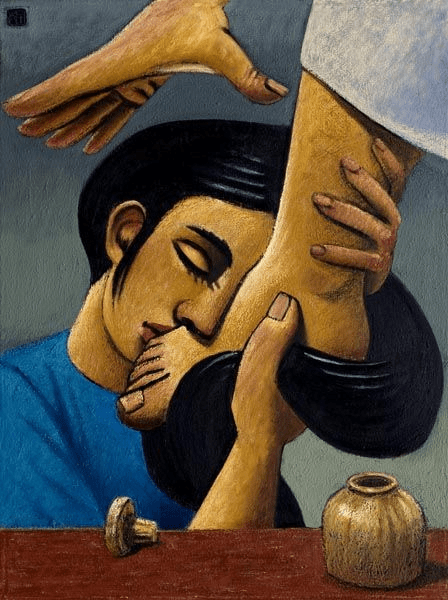
Mary Anoints the Feet of Jesus, by Wayne Forte

Six days before the Passover Jesus came to Bethany, the home of Lazarus, whom he had raised from the dead. There they gave a dinner for him. Martha served, and Lazarus was one of those reclining with him. Mary took a pound of costly perfume made of pure nard, anointed Jesus’s feet, and wiped them with her hair. The house was filled with the fragrance of the perfume. 

But Judas Iscariot, one of his disciples (the one who was about to betray him), said, “Why was this perfume not sold for three hundred denarii and the money given to the poor?” (He said this not because he cared about the poor but because he was a thief; he kept the common purse and used to steal what was put into it.) 

Jesus said, “Leave her alone. She bought it so that she might keep it for the day of my burial. You always have the poor with you, but you do not always have me.”

When the great crowd of the Jews learned that he was there, they came not only because of Jesus but also to see Lazarus, whom he had raised from the dead. So the chief priests planned to put Lazarus to death as well, since it was on account of him that many of the Jews were deserting and were believing in Jesus. (New Revised Standard Version)

Sharing a meal around a table is much more than just eating some food together. There is the chance to look one another in the eye. An opportunity is afforded to truly see one another and find acceptance. The conditions are ripe for receiving the blessing of blessings.

Please notice with me that on this last week of Christ’s earthly life and ministry, the people who are around the table with Jesus. He shares his cup with his disciples, including both women and men. Mary and Martha are there, along with Peter, James, and John, and, of course, Judas Iscariot, as well.

Jesus, those various people, and others, had the great privilege of looking into the eyes of Jesus, and having Jesus look directly into theirs. It appears, however, that not everyone took advantage of this situation. But Mary did. She evidences having looked into the face of Jesus, and having Jesus gaze into her eyes with divine love.

To look, to see, to gaze, is to connect. To look away and not see, is to disconnect. It is the difference between acceptance and rejection. Jesus looked as long as he could at the friend he loved.

Let us never forget that the presence of God needs to be experienced – not just in the mind, nor even only in the heart – but as a feeling in every cell of the body.

Christ’s divine gaze communicated more than words ever could. Mary knew she belonged with God, and became convinced she was accepted and loved. So, she did what a person who has been touched with the eyes does: Mary responded with the most heartfelt devotion she could, with what she had at the time.

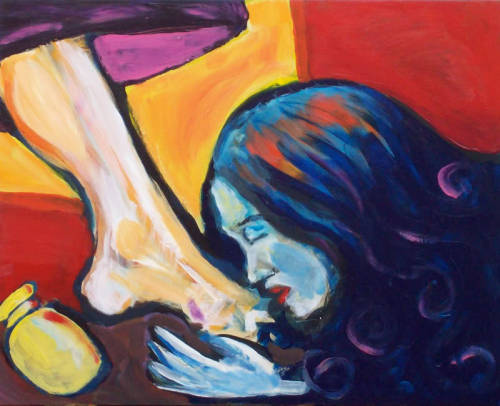
Mary Anointing the Feet of Jesus, by David Finley

Mary anointed the feet of Jesus with expensive perfume by using her own hair to apply it. She shared in the presence and in the love of Christ.

This really ought to make complete sense to the one reading this story whose life has been seen and touched by Jesus. For through such divine love, we become a witness in testifying to the light, much like John the Baptist. The one devoted to Jesus understands that they are not even worthy to untie the thong of Christ’s sandal.

Women never touch a rabbi. Yet, long ago in the town of Bethany in Judea, a woman was worthy to do even more than untie a sandal – Mary was permitted to anoint Christ’s feet. The house became filled not only with the fragrance of the perfume, but also with the aroma of Mary’s witness to us of Jesus and his incredible work in her life as a disciple.

In considering such a story on this Monday of Holy Week, it’s easy to focus on what Mary did, how much it truly cost her, and even on the pathetic and judgmental reaction of Judas to it all. Yet, here we see, if we are looking, what Jesus does for Mary.

The love of Jesus turned Mary into a witness. Jesus lifted her up, even above all the men. And that is what Christ continually did for the lowly, the outcast, the ostracized, the poor. For to them belongs the dominion of God.

Through a simple heartfelt response to Christ’s love, we are filled with the aroma of God, experience a cup of blessing, and see the light of Jesus for us. What’s more, the world’s judgmental spirit is undone. Judas is silenced, along with all of our petty selfish agendas.

Mary directs us to Jesus, and to all those who were previously unseen, unloved, and rejected. Mercy simultaneously puts away the judgmental spirit so it is not seen, while bringing the poor in spirit into the light of God’s grace and love.

Merciful and loving God, Your name is glorified even in the anguish of your Son’s death. Grant us the courage to receive your anointed servant who embodies a wisdom and love that is foolishness to the world. Empower us in witness so that all the world may recognize in the scandal of the cross the mystery of reconciliation. Amen.

All Saints Day (Psalm 34:1-10, 22)

I will praise the Lord at all times;
my mouth will continually praise him.
I will boast in the Lord;
let the oppressed hear and rejoice.
Magnify the Lord with me.
Let us praise his name together.
I sought the Lord’s help and he answered me;
he delivered me from all my fears.
Look to him and be radiant;
do not let your faces be ashamed.
This oppressed man cried out and the Lord heard;
he saved him from all his troubles.
The angel of the Lord camps around
the Lord’s loyal followers and delivers them.
Taste and see that the Lord is good.
How blessed is the one who takes shelter in him.
Fear the Lord, you chosen people of his,
for those who fear him lack nothing.
Even young lions sometimes lack food and are hungry,
but those who seek the Lord lack no good thing…

The Lord rescues his servants;
all who take shelter in him escape punishment. (New English Translation)

In all times and every place throughout history God has specialized in taking imperfect and broken people and transforming their lives. On the Christian Calendar, November 1 is the day each year to remember the saints who have gone before us. This day is meant to be an intentional way of not forgetting the people, friends, and family – as well as long-dead historical saints – who made a significant impact in our spiritual lives.

All Saints Day is more than a focus on extraordinary persons; it highlights the work of ordinary Christians who faithfully lived their lives. We give thanks for the gift of how they lived their faith every day. We also remember that all believers in Jesus are united and connected through the cross.

Remembering is a prominent theme in Holy Scripture. Over one-hundred times we are told to remember God’s covenant and actions on behalf of people; to remember the needy and those less fortunate; and to remember the important people who influenced us in our journey of faith.

Remember your leaders, who spoke the word of God to you.  Consider the outcome of their way of life and imitate their faith. (Hebrews 13:7, NIV)

We are to be inspired now in the present with the actions of faithful saints of the past. They serve as a model of faithfulness, so that we will persevere in our Christian lives and not give up. Through biblical stories of very human persons being used of God, as well as reading biographies of godly people, we can gain motivation for patience and perseverance until Jesus returns.

Who were the people in your life that went out of their way to communicate God’s love to you with both words and actions? Who were those persons who labored behind the scenes in prayer so that you and others would know Jesus? 

If any of those persons are still around, and you know where they are, remember them. Drop them a note. Express to them a simple thank you for their influence in your life. You will not only encourage that person – it will help you remember and re-engage with something in your life you may have forgotten or have just taken for granted for too long.

We are not to live our Christian lives in isolation from others, as if we do not need them. You and I are here today because someone influenced us in the way of Jesus. And we will continue to persevere and thrive in the faith when we remember those who have gone before us and allow those here in the present to journey with us along this road of faith.

Today is all about remembrance. We remember answered prayer and salvation. We recollect the people who gave us the life-giving gospel message in both word and deed. We remember the death of Christ and recall that he said he is coming back.

The psalmist recalled his rescue and pulled it forward into the present so that all God’s worshipers could taste and see that the Lord is good. This is exactly what the Apostle Peter did for a church which needed to recall and remember the mighty acts of God:

Like newborn babies, crave pure spiritual milk, so that by it you may grow up in your salvation, now that you have tasted that the Lord is good. As you come to him, the living Stone—rejected by humans but chosen by God and precious to him—you also, like living stones, are being built into a spiritual house to be a holy priesthood, offering spiritual sacrifices acceptable to God through Jesus Christ. (1 Peter 2:2-5, NIV)

Our memories are accessed through symbols and with taste and sight. God uses symbols to reveal himself to us.  For example, when God wanted to show us the ugliness of sin and the cost of forgiveness, the Lord told the Israelites to kill an animal and sprinkle its blood on their clothing and on the altar.

That sounds awful. Yet, worshipers never walked away from the experience scratching their heads and wondering what it was all about. That’s because they encountered and tasted the drama of sin and redemption. Their senses saw it, felt it, smelled it, and tasted the meat from it. 

Symbols have power. We cannot know God with only our minds; we’re more than brains on a stick. People need ordinary events, like shared meals, that include symbols and rituals. 

Every year faithful Jews gather to remember and re-enact the Passover – the story of how they were enslaved in Egypt, oppressed by Pharaoh, and set free by God.  To this day pious Jews still remember the Passover by eating and drinking together and telling stories.

We need both words and sacraments. Therefore, holidays like Thanksgiving and Christmas involve both verbal expressions of gratitude and love, and particular actions of love in giving gifts and sharing food. Together, it all connects us to God, to one another, and to a history of God’s people. 

Jesus met his disciples in the Upper Room to celebrate Passover together. Jesus energized their time together by filling it with words and symbols of love and redemption. Christ told the disciples about his upcoming death and acted symbolically. “Take and eat – this is my body….  Take this cup – drink from it, all of you.” (Luke 22:7-20)

Rather than sitting around, analyzing the bread, and discussing the wine’s vintage, the disciples ate and drank.  They tasted real food and drink. They also tasted real spiritual food. It’s one thing to speak of God’s presence, and it’s another thing to experience that presence through an ordinary shared ritual of bread and cup.

God is good. Jesus is our Emmanuel, God with us. Christ is present with us through our ritual of fellowship and food. When the sixteenth-century Reformer John Calvin was asked how Jesus is present to us at the Lord’s Supper he explained: “Now if anyone asks me how this takes place I shall not be ashamed to confess that it is a secret too lofty for either the mind to comprehend or my words to declare….  I rather experience it than understand it.”

The taste of bread reminds us of the incarnation of Christ, and Christ’s humiliation and death. The taste of drinking the cup reminds us of the sacrifice of Christ, the drops of blood which Jesus sweated in Gethsemane, and the beatings, floggings, nails, and crown of thorns that caused the bleeding.

Tasting the bread and cup when we celebrate communion reminds us that our sins are forgiven, we are united to Christ, and we are united together. 

There are historical events which are just that. Then, there are past actions which linger with continual results into the present. The incarnation, life, death, resurrection, ascension, and glorification of the Lord Jesus are past redemptive events which continue to exert powerful force into the here and now.

Saints throughout church history have moved the message of Christ along and demonstrated for us that the past lives in the person of Jesus Christ.

Along with them, we proclaim that Christ has died, Christ has risen, Christ is coming again. And God has something planned for those who have gone before us, along with us, so that together we will experience the perfect righteousness of Christ forever. (Hebrews 11:39-40)

We are encouraged through word and sacrament to proclaim the good news of Jesus Christ until he comes again. Let us respond to God’s wooing invitation to eat and drink, to taste and see that the Lord is good through faith, hope, and love. Let us find in God our refuge and strength, our ever-present help.

Soli Deo Gloria