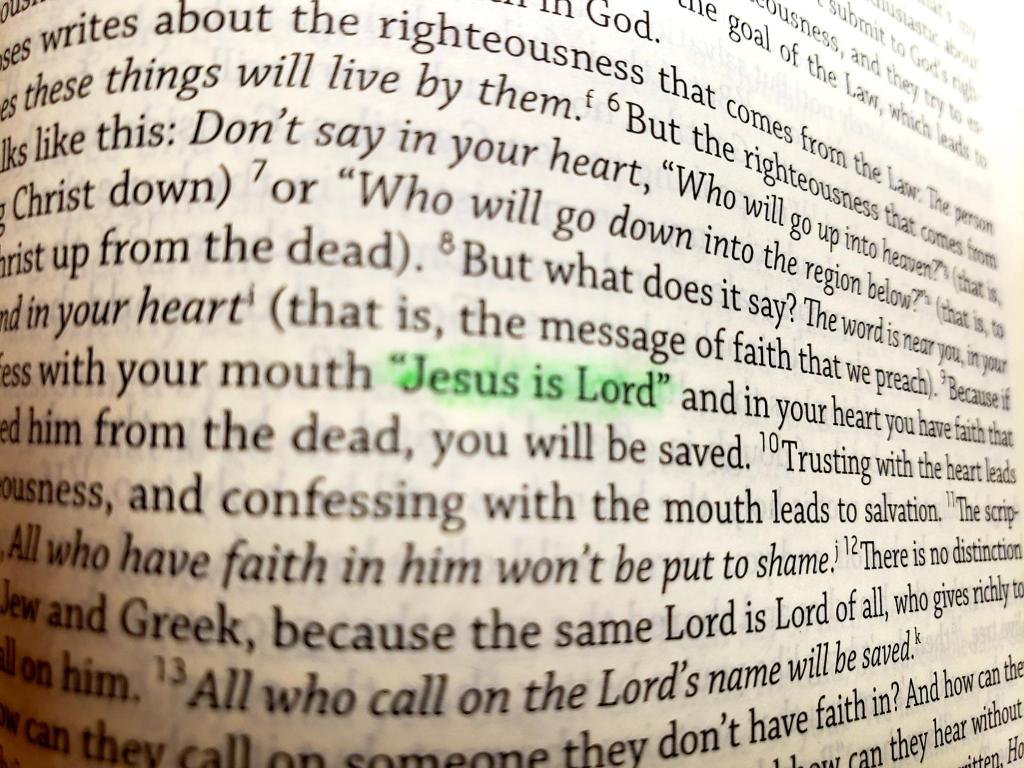
Romans 10:8b-13 – Believe and Confess

“The word is near you; it is in your mouth and in your heart,” that is, the message concerning faith that we proclaim: If you declare with your mouth, “Jesus is Lord,” and believe in your heart that God raised him from the dead, you will be saved. For it is with your heart that you believe and are justified, and it is with your mouth that you profess your faith and are saved. As Scripture says, “Anyone who believes in him will never be put to shame. ”For there is no difference between Jew and Gentile—the same Lord is Lord of all and richly blesses all who call on him, for, “Everyone who calls on the name of the Lord will be saved.” (New International Version)

Confess with the Mouth

John Wesley (1703-1791) was an Oxford don who became an Anglican priest. He had all the intellectual tools to rightly handle the intricacies of theology and teach the Bible. Yet, when he first started out, there was no heart behind it. 

On a voyage across the Atlantic to America, Wesley spent much of the time on the ship with a group of German pietists – men and women who had a heart behind their practice of Christianity. The Germans deeply impressed Wesley, and he realized there was something important missing from his own religion. 

The ship encountered a storm and Wesley was afraid for his life. But the German believers seemed unfazed, having a heart-faith that John could not explain. He wanted what they had. Wesley was fearful and found little comfort in his religion. So, he confessed to one of them his growing misery and decision to give up the ministry. One of the Pietists advised, “Preach faith till you have it. And then, because you have it, you will preach faith.”

John Wesley acted on the advice. He led a prisoner to Christ by preaching faith in Christ alone for forgiveness of sins. He was astonished. Here was a man transformed instantly. Wesley cried out, “Lord, help my unbelief!” However, he still felt dull inside and little motivation even to pray for his own salvation. 

Statue of John Wesley as a young preacher, by Adam Carr, located in Melbourne, Australia

Having returned back to England, Wesley was in a church service listening to Romans expounded by the preacher. He recalled the experience years later: “While he was describing the change which God works in the heart through faith in Christ, I felt my heart strangely warmed. I felt I did trust in Christ, Christ alone for salvation; and an assurance was given me that He had taken away my sins, even mine, and saved me from the law of sin and death.”

Believe with the Heart

Simply uttering the words with our mouths, “Jesus is Lord,” by itself does not create deliverance and salvation. The heart needs to be involved. Yet, we must also consider the reality that only focusing on the heart, without having the mouth involved, is an insufficient faith. Christian belief has a solid objective real historical base from which our hearts can tether themselves. Christian confession affirms that Jesus is, indeed, risen from death and is Lord of all, having secured salvation for us through his shed blood on the cross.

Consider two hypothetical men at the time of the Passover in Egypt: Eleazar Ben Macaroni and Yakov Yarmulke. Eleazar and Yakov are talking together on the night the angel of death is about to pass through Egypt and the firstborn son in every family would be killed – that is, unless the blood from a sacrificial lamb was over the door of the house so that the angel would “pass over” the house and no one would be killed. 

Passover Angel of Death, by Arthur Hacker (1858-1919)

Yakov says to Eleazar, “Can you believe all that has been happening around here?  It’s all very scary!  All of those plagues, the disaster around us, and now this night!”  Eleazar asks, “Well, haven’t you put the blood over the door?”  “Yes, I’ve done all that – but it all is still disturbing.  My heart is troubled.  What do think will happen?” “Will we be okay?” asks Yakov nervously.  Eleazar responds, “I trust in the promises of God; let the angel come!”

So, when the angel of death came, which house do you suppose lost his firstborn son: Eleazar ben Macaroni, or Yakov Yarmulke?  The answer: neither of them. The angel of death did not come to either man’s house because deliverance is determined by the blood of the lamb and not by the quality or intensity of faith of the person. 

“For me His precious blood he shed – for me His life He gave. I need no other argument, I need no other plea; it is enough that Jesus died, and that he died for me.”

My Faith Has Found a Resting Place, hymn by Eliza Edmunds Hewitt (1851-1920)

If we only focus on the heart, our hearts will condemn us. We need to say the words of our faith, to confess them with our mouths, repeatedly, again and again, until we believe them. We are not to wait for our hearts to feel like having faith and living for God, because our hearts can be desperately wicked, and they will keep deceiving us. The heart needs to be informed by God’s Word and accept the words of Holy Scripture by faith:

“If we confess our sins, he is faithful and just to forgive us our sins, and to purify us from all unrighteousness.” (1 John 1:9, NIV)

Have the Heart and Mouth Work Together

We need both a right confession with our mouths and a right confession in our hearts for saving faith. When the heart receives grace, and the mouth expresses the beauty of faith – when heart and mouth work in concert with each other – something beautiful and gracious happens: 

“Everyone who calls on the name of the Lord will be saved.”

Romans 10:13

When Holy Scripture says “everyone,” it means “everyone.” All who cry out to God with their mouths, from a heart desiring God, will be saved. It does not matter whether that call is melodious, sweet, and in tune; or whether the call is a jumbled off-key joyful noise. It makes no difference; both will be saved. 

Only uttering the right words like some magical incantation does not save us. Only sincerity of heart does not save us. One does not achieve salvation through self-effort or trying to be worthy. No one is saved by finding the right combination of words in prayer or having a nice feeling.

Calling on the name of the Lord with both mouth and heart, trusting in the redemptive events of Jesus Christ, is what saves us.

Whether Jew or Gentile, rich or poor, American or Arab, famous or infamous, it is no matter – because salvation isn’t dependent on our looks, our past, or our zeal in doing good works. Salvation is completely from God and freely given to all who call upon the name of the Lord.

Make No Room for Shame

What’s more, all who trust in Jesus Christ will never be put to shame. In ancient Roman society, nearly three-fourths of all the people in the Empire were slaves to the other one-fourth. It was a culture built around the concept of honor and shame. It was shameful to be a slave, and honorable to be privileged, wealthy, and influential with a good Roman pedigree and citizenship. It was beneath such people to interact with those who served them because dealing with shameful people would make them shameful, as well.

Jesus forsook his honorable position in order to hob-nob with us rabble. He became one of us to save us and lift us up with him.

“For you know the grace of our Lord Jesus Christ, that though he was rich, yet for your sakes he became poor, so that you, through his poverty, might become rich.” 

2 Corinthians 8:9, NIV

Jesus embraced the shame of the cross. Therefore, we need never live in a state of shame ever again. Our hearts need not condemn us. Jesus has already taken care of shame, once for all.

“Let us fix our eyes on Jesus, the author and perfecter of our faith, who for the joy set before him endured the cross, scorning its shame, and sat down at the right hand of the throne of God.  Consider him who endured such opposition from sinful men, so that you will not grow weary and lose heart.” (Hebrews 12:2-3, NIV)

Put a Focus on Lent

The season of Lent lets us know we are neither brains-on-a-stick nor walking-headless-hearts. We have both heart and mouth, both deep feeling and real intellectual knowledge. Together, they form belief and confession. Lent is an invitation to prepare our hearts for Christ’s passion and resurrection. It includes an examination of our hearts so that we can deepen our piety and devotion to Jesus. And it incorporates confession of Jesus with the mouth.

The good news is this: Jesus is Savior and Lord; he has risen from death; and there is forgiveness of sins and deliverance from guilt and shame through is cross. When all is said and done, people need the Lord.

“I have not come to call the righteous, but sinners,” said Jesus. (Matthew 9:13)

Repentance involves both heart and mouth. And Lent is just the season for it, to turn from everything we have previously been living for other than Jesus. It’s an opportunity to start afresh with new life in Christ. It’s enough to make old John Wesley smile from the grave.

Have mercy on me, O God, according to your unfailing love; according to your great compassion blot out my transgressions. Wash away all my iniquity and cleanse me from my sin. 

Create in me a pure heart, O God, and renew a steadfast spirit within me. Restore to me the joy of your salvation and grant me a willing spirit, to sustain me.

Save me from guilt and shame and my tongue will sing of your righteousness. Open my lips, and my mouth will declare your praise. You do not delight in sacrifice, or I would bring it; you do not take pleasure in burnt offerings. The sacrifices of God are a broken spirit; a broken a contrite heart, O God, you will not despise. Amen.


Exodus 35:1-29 – Real Worship Isn’t Boring

Gathering to Build the Temple by Yoram Raanan

Moses gathered together the whole Israelite community and said to them: These are the things that the Lord has commanded you to do:

Do your work for six days, but the seventh day should be holy to you, a Sabbath of complete rest for the Lord. Whoever does any work on the Sabbath will be put to death. Don’t start a fire in any of your homes on the Sabbath day.

Moses said to the whole Israelite community, This is what the Lord has commanded: Collect gift offerings for the Lord from all of you. Whoever freely wants to give should bring the Lord’s gift offerings: gold, silver, and copper; blue, purple, and deep red yarns; fine linen; goats’ hair; rams’ skins dyed red; beaded leather; acacia wood; the oil for the light; spices for the anointing oil and for the sweet-smelling incense; gemstones; and gems for setting in the priest’s vest and in the priest’s chest pendant.

All of you who are skilled in crafts should come forward and make everything that the Lord has commanded: the dwelling, its tent and its covering, its clasps, its boards, its bars, its posts, and its bases, the chest with its poles and its cover, the veil for a screen, the table with its poles and all its equipment, the bread of the presence, the lampstand for light with its equipment and its lamps, the oil for the light, the incense altar with its poles, the anointing oil and the sweet-smelling incense, the entrance screen for the dwelling’s entrance, the altar for entirely burned offerings with its copper grate, its poles, and all its equipment, the washbasin with its stand, the courtyard’s drapes, its posts, and its bases, and the screen for the courtyard gate, the dwelling’s tent pegs and the courtyard’s tent pegs, and their cords, the woven clothing for ministering in the sanctuary, and the holy clothes for Aaron the priest and his sons for their service as priests.

The whole Israelite community left Moses. Everyone who was excited and eager to participate brought the Lord’s gift offerings to be used for building the meeting tent and all its furnishings and for the holy clothes. Both men and women came forward. Everyone who was eager to participate brought pins, earrings, rings, and necklaces, all sorts of gold objects. Everyone raised an uplifted offering of gold to the Lord. And everyone who had blue or purple or deep red yarn or fine linen or goats’ hair or rams’ skins dyed red or beaded leather brought them. Everyone who could make a gift offering of silver or copper brought it as the Lord’s gift offering. Everyone who had acacia wood that could be used in any kind of building work brought it. All the skilled women spun cloth with their hands and brought what they had spun in blue and purple and deep red yarns and fine linen. All the women who were eager to use their skill spun the goats’ hair. The chiefs brought gemstones and gems to be set in the priest’s vest and the chest pendant, spices and oil for light and for the anointing oil, and for the sweet-smelling incense. All the Israelite men and women who were eager to contribute something for the work that the Lord had commanded Moses to do brought it as a spontaneous gift to the Lord. (Common English Bible)

At first glance, today’s Old Testament lesson might seem a bit tedious, perhaps even boring. After all, being informed of all the details on the furnishings for building the tabernacle (the Ark of the Covenant, the utensils for worship and sacrifice, and the tent that houses it all) appears like some ancient engineer wrote it. It’s just downright laborious. 

But that’s the point. It took a great deal of planning, effort, and commitment to realize it all. Although Moses received the instructions and revelation from God on the mountain, he still had to communicate it to the people and solicit their help.

There is a wonderful synergy here, between God and the people, a kind of divine/human cooperative, a spiritual rhythm of revelation and response. 

The contributions and the work were done by people whose hearts were stirred to give of their resources and their labor. The people freely offered their things and themselves in order to realize the tabernacle’s construction. 

The epicenter of worship is a divine dialogue between us and God. That is, God speaks, and the people respond. God reveals the divine will, and the people’s hearts are stirred. 

Whenever worship becomes a mere duty and drudgery, it is cheapened. Worship that degenerates into mere obligation becomes dull and flat. Duty without delight is boring. Such worship has no impact or effect on us.

Contemporary problems of Christian worship are typically viewed as liturgical issues. Many modern worshipers disparage particular prayers, Scriptures, or readings said every week as being vain repetition. The Lord’s Table may be celebrated only occasionally, so as to not lose something of it’s specialness.

Yet, none of us looks down at eating every day, praying multiple times in a day, and using the same daily phrases of greeting and saying good-bye to others. We don’t create new shoe stores which have no shoelaces because tying our shoes every day is so boring and pedantic.

The real issue is us – not the form of worship. It’s about our own hearts. The ancient Israelites gave of their time and resources in worship because they wanted to, not because they had to. They weren’t looking to be highly entertained, emotionally captivated, or mentally stimulated. The people simply wanted to please their God and to truly connect with the Lord.

Worship isn’t a monologue. It’s not a one-way communication in which we, the people, passively sit and soak-in what’s in front of us. Worship is work. It’s active. It’s participative. And it’s a process which involves some tedious and sometimes slow patient effort. 

Moses and God’s people were genuinely enthused to participate in what God was calling them to do. Worship that comes from willing hearts is a beautiful thing, because encountering God and being stirred within by a Divine call is a wonderful and mystical thing – and it isn’t boring.

Gracious God, just as you laid it upon the hearts of people long ago to participate in the work of worship, so impress my heart with your mission in this world.  I give you my life along with my possessions so that my entire self will be dedicated to the worship of Jesus Christ. Amen.

Mark 11:12-14, 20-24 – Believing Prayer

The next day, after leaving Bethany, Jesus was hungry. From far away, he noticed a fig tree in leaf, so he went to see if he could find anything on it. When he came to it, he found nothing except leaves, since it wasn’t the season for figs. So, he said to it, “No one will ever again eat your fruit!” His disciples heard this.

Early in the morning, as Jesus and his disciples were walking along, they saw the fig tree withered from the root up. Peter remembered and said to Jesus, “Rabbi, look how the fig tree you cursed has dried up.”

Jesus responded to them, “Have faith in God!I assure you that whoever says to this mountain, ‘Be lifted up and thrown into the sea’—and doesn’t waver but believes that what is said will really happen—it will happen. Therefore, I say to you, whatever you pray and ask for, believe that you will receive it, and it will be so for you. (Common English Bible)

A pastor once had a kitten stuck up in a tree, and it would not come down. The tree was not sturdy enough to climb, so the pastor decided that if he tied a rope to his car and drove until the tree bent down, he could then reach up and get the kitten. As he moved just a little too far, the rope broke. The tree snapped upright, and the kitten instantly sailed through the air and out of sight.

He felt just terrible and walked all over the neighborhood asking people if they had seen a little kitten. Nobody had and finally he prayed, “Lord, I commit this kitten to your keeping,” and then went about his business.

A few days later, he was at the grocery store and met one of his parishioners. In her shopping cart he was amazed to see cat food. The pastor knew the parishioner did not like cats, so he asked her why she was buying cat food.

She replied, “For years I have been refusing to buy my little girl a cat even though she has been begging for one. Finally, I told her that if God gives you a cat, I’ll let you keep it.  I watched my child go out into the yard, get on her knees and ask God for a cat. Then, a kitten suddenly came flying out of the blue sky with its paws spread out and landed right in front of her. Of course, I had to let her keep the kitten because it came from God!”

God wants us to pray! Yet, prayer does not happen apart from faith because to pray is to believe God is good and answers prayer. Prayerlessness is a sign of faithlessness. A person of little faith prays only a little. A person full of faith is always praying.

“God desires of us nothing more ardently than that we ask many and great things of him, and he is displeased of we do not confidently ask and entreat.”

Martin Luther

For Jesus, simply exhorting the disciples to pray was insufficient; they needed a deep change of heart. 

God calls us to transformation. Deep and lasting change must take place below the surface of our lives. Real change comes from the inside-out. It is the root of a person’s life, the heart, that must change – and not just the outward behavior.

In our Gospel lesson for today, Jesus got up early and was on his way to Jerusalem. He was hungry and wanted some breakfast, so he approached a fig tree. Figs were known back in Christ’s day as the poor man’s food. Fig trees were everywhere. Approaching a certain fig tree, Jesus found one that appeared leafy and well, yet had no figs. 

Jesus chose to use this tree as a teachable moment for his disciples. He cursed the tree and immediately the whole tree withered. So, why did Jesus curse the tree? Because it looked good on the outside but was really already dead on the inside. 

The tree had everything a tree needed: branches, leaves, and a trunk. Everything, that is, except fruit. The tree was to serve as an illustration for the disciples of believing prayer. The tree looked fine, and had the promise of fruit, but none was to be found. Jesus is looking for faith in his followers. 

In the prophet Jeremiah’s day, the nation of Judah had enjoyed a long stretch of prosperity and good circumstances. By all outward appearances they were doing fine. Temple attendance was at its peak and everyone was offering their sacrifices. Yet, something wasn’t right.

“I will take away their harvest,
declares the Lord.
    There will be no grapes on the vine.
There will be no figs on the tree,
    and their leaves will wither.
What I have given them
    will be taken from them.” (Jeremiah 8:13, NIV)

God pronounced a curse on Judah because, although conditions seemed fine on the outside, the people were trusting in their own abilities. But God was looking for fruit, not nice leaves. The Lord wants believing prayer, born of a faith that is confident in the goodness of God. 

God is looking for faith in us, as well. A faith not in paychecks, bank accounts, or the market economy, and not religiously in lots of outward forms of success, but a faith in God alone.

Jesus didn’t use the withering tree as an illustration of judgment but of believing prayer. Our words and prayers can have the immediate effect of changing the world. We can even speak to a mountain, and it will have to move, if we tell it to. 

Nobody probably goes around talking to mountains. Yet, all of us go around talking to ourselves about mountain-like problems. The power that levels mountains is prayer and words that speak confidence and boldness.  If you believe, you will receive whatever you ask for in prayer.

“Any concern too small to be turned into a prayer is too small to be made into a burden.”

Corrie Ten Boom

Doubt typically stands in the way of prayer – not doubt in yourself, because you don’t answer your own prayers. Doubt as an obstacles to faith is the questioning of God’s inherent goodness. We are not to have faith in faith itself, but in the actual person of God. (James 1:5-8) 

Everyone has made a difficult prayer request, mustering-up all the faith they can, and then are disappointed when it doesn’t happen. The unstable person vacillates when this happens, doubting whether God is really good or not. However, the person of faith believes God answers prayer, and if the prayer is not answered, we trust God knows the score and will answer according to gracious timing and good purposes.

Maybe you have even talked to yourself as a Job-like friend saying that you didn’t have enough faith and that is why your prayer was not answered. Yet, Christian faith isn’t a matter of being optimistic or of sending $19.95 to some hack preacher who promises to give you the secret of answered prayer, along with a free gold cross. 

We simply don’t know what God’s will is in every situation. However, we do know what God’s will is for a lot of things. For example, God is not willing that any should perish but all be brought to eternal life. So, we can pray with confidence for someone’s deliverance. And we can be bold about trusting in God’s promises.

We have every right, based in our union with Jesus Christ as redeemed persons, to ask God confidently and boldly for the removal of mountains. We possess authority in Christ to do so. Therefore, we do not need to offer tepid, milquetoast, mumbling prayers with sighs and hunched shoulders. 

Who knows? Maybe a kitten will show up.

Almighty and everlasting God, you made the universe with all its marvelous order, its atoms, worlds, and galaxies, and the infinite complexity of living creatures: Grant that, as we probe the mysteries of your creation, we may come to know you more truly, and more surely fulfill our role in your eternal purpose; in the name of Jesus Christ our Lord. Amen.

Psalm 39 – Being Honest with God

I promised I would watch my steps
    so as not to sin with my tongue;
    promised to keep my mouth shut
    as long as the wicked were in my presence.
So I was completely quiet, silent.
    I kept my peace, but it did no good.
    My pain got worse.
My heart got hot inside me;
    while stewing over it, the fire burned.
Then I spoke out with my tongue:
    “Let me know my end, Lord.
    How many days do I have left?
    I want to know how brief my time is.”
You’ve made my days so short;
    my lifetime is like nothing in your eyes.
        Yes, a human life is nothing but a puff of air! Selah

Yes, people wander around like shadows;
    yes, they hustle and bustle, but pointlessly;
        they don’t even know who will get the wealth they’ve amassed.
So now, Lord, what should I be waiting for?
        My hope is set on you.
Deliver me from all my sins;
    don’t make me some foolish person’s joke.
I am completely silent; I won’t open my mouth
    because you have acted.
Get this plague of yours off me!
    I’m being destroyed by the blows from your fist.
You discipline people for their sin, punishing them;
    like a moth, you ruin what they treasure.
        Yes, a human life is just a puff of air! Selah

Hear my prayer, Lord!
    Listen closely to my cry for help!
Please don’t ignore my tears!
    I’m just a foreigner—
        an immigrant staying with you,
        just like all my ancestors were.
Look away from me
    so I can be happy again
    before I pass away and am gone. (Common English Bible)

God is big. The Lord is big enough to hear whatever is on our hearts. It really does no one any good to have pretense with God. The psalmist initially thought he had to hold back in speaking with God:  He was silent and held his peace with God. However, his distress grew worse.

The psalmist, David, finally opened up. He went on to speak openly and honestly to God, with flavorful expression, about what was really on his heart and mind.

Sometimes we may mistakenly believe we need to be guarded with God – that somehow we should treat the Lord of the universe like we do with other people – coy, hesitant, keeping a respectable distance in conversation.  Maybe that ought to occasionally happen with other people, but it is silly to approach God in such a manner. With God, we ought to be brutally honest about how we are really doing and how we are actually feeling. 

If we desire to move mountains and have God work powerfully in and through us, then we need to acknowledge and admit there is a mountain smack in front of our faces.

I’m quite sure God has heard it all from people in the long millennia of human existence. The Lord isn’t going to be surprised by any of our thoughts and words. So, why hide them? 

It may be a radical thought for some that we can say anything to God and express our deepest emotions to the Lord who desires to listen. God wants to help us journey in this pilgrimage of faith we are on. For that to happen, we must be up front about our current location and how we are doing.

Like everything in life, honesty is a skill to be developed and utilized. Being honest with ourselves and the Lord involves the following:

Acknowledging both the good and the bad.

Shying away from the shadowy places of our hearts will never resolve the icky-ness we may feel inside. Neither will peace come only by focusing on our screw-ups and bad traits. There is both bad and good within us all, and so, we need to hold them both together, recognizing the tension. The better we accept this reality, the sooner we can walk the path of faith with patience and confidence. Both prayers of confession and praise help us keep the good and the bad in mind.

Giving some time and space, daily, to reflect.

Debrief with yourself about your day or events within the day. What did you do well? What could you have improved? Is there anything you will do differently next time? How might you engraft this kind of reflection into your daily prayers?

Admitting your mistakes and when you need help.

Only a person who admits their mistakes can learn from them and correct them. This is a necessary part of spiritual growth and development. Faith cannot be properly formed if we don’t face up to our own reality. Blaming others only causes us to take the focus off our own needs. Failure and admitting need is to be human. Asking for assistance requires humility and courage – qualities we all possess if we will access them.

Paying attention to your emotions.

David, the psalmist, did it. He was aware of his emotions, acknowledged them, and expressed them to God. Our feelings are not some necessary evil. Rather, they are important to our faith and well-being. All emotions exist as signs for us to pay attention to something, whatever it is.

Listening to the gut.

You and I can learn the difference between an impulsive reaction and an intuitive response. The gut level instinct we possess is our conscience giving us insight. Avoiding this important epistemic ally usually results in a lack of self-awareness and poor decision-making. However, listening to the spiritual whispers within can serve us well.

Reading a psalm every day.

The psalms are emotional. They are also, obviously, biblical. Therefore, emotions are godly. A daily regimen of reading at least one psalm out loud can have the effect of bringing our mind, spirit, and emotions into alignment so that they are not disparate parts inside us.

God of the Ages, you are above all and know all things. Hear my prayer, O Lord, and give ear to my cry; hold not your peace at my tears.  I am a sojourner with you, a guest, like all my forefathers. Look away from me, that I may smile again, before I depart and am no more!  My hope is in you; without your abiding presence I am nothing. Maranatha, come, Lord Jesus. Amen.