Get Rid of Sin (1 Corinthians 6:1-11)

The Apostle Paul at his Desk, by Rembrandt, 1657

When any of you has a grievance against another, do you dare to take it to court before the unrighteous, instead of taking it before the saints? Do you not know that the saints will judge the world? And if the world is to be judged by you, are you incompetent to try trivial cases? Do you not know that we are to judge angels, to say nothing of ordinary matters? If you have ordinary cases, then, do you appoint as judges those who have no standing in the church? I say this to your shame. Can it be that there is no one person wise enough to decide between brothers and sisters? Instead, brothers and sisters go to court against one another, and this before the unbelievers.

In fact, to have lawsuits at all with one another is already a defeat for you. Why not rather be wronged? Why not rather be defrauded? But you yourselves wrong and defraud—and brothers and sisters at that.

Do you not know that wrongdoers will not inherit the kingdom of God? Do not be deceived! The sexually immoral, idolaters, adulterers, male prostitutes, men who engage in illicit sex, thieves, the greedy, drunkards, revilers, swindlers—none of these will inherit the kingdom of God. And this is what some of you used to be. But you were washed, you were sanctified, you were justified in the name of the Lord Jesus Christ and in the Spirit of our God. (New Revised Standard Version)

The one constant which every Church and each Christian will have to deal with until Jesus returns is the ever-present reality of sin

“Sin” isn’t a word that is much used anymore, even among many Christians. This is both good and bad. It’s good in the sense that we have expanded our vocabulary to better understand the concept and reality; and it’s bad because we sometimes label something as different than what it really is.

The Apostle Paul’s letter to the Corinthian Church confronts the presence of sin within the congregation. The reason why the letter is so long is that Paul painstakingly deals with every sin that had taken root in the community.
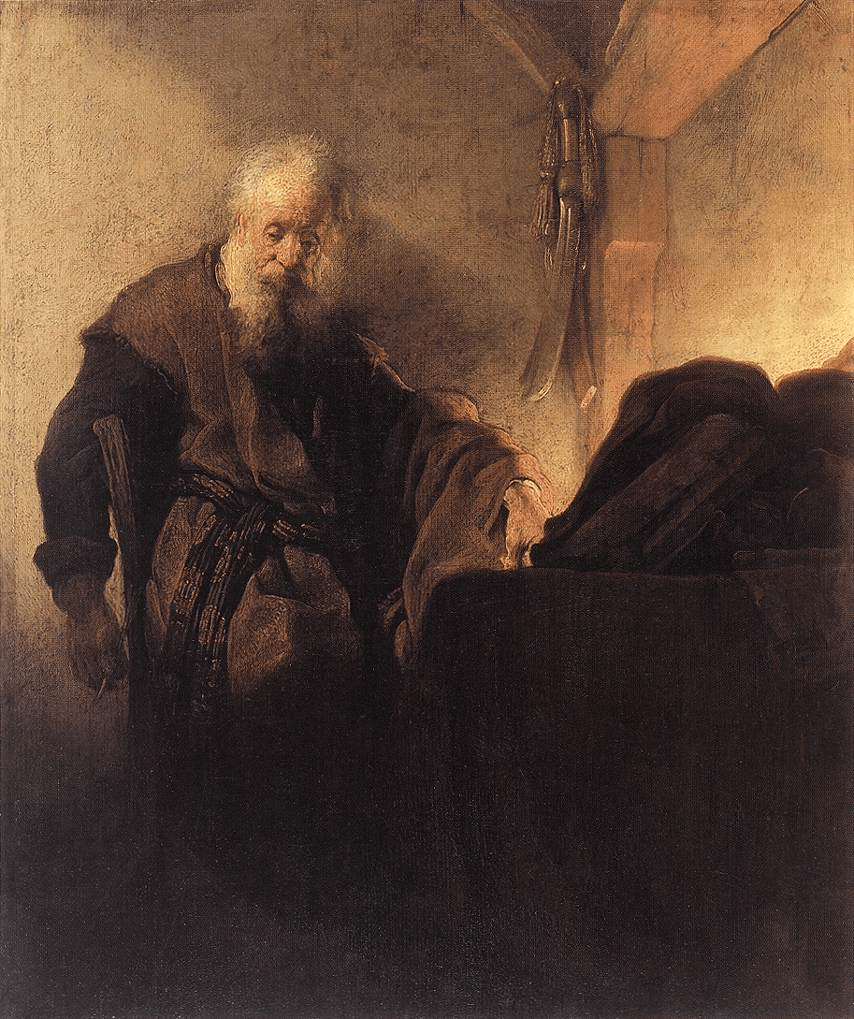
St. Paul at His Writing Desk by Rembrandt, 1630

In our New Testament lesson for today, Paul mentions some of those sins, especially tackling the unhealthy way the Christians were dealing with their internal strained relations of each other. One of the ways sin manifests itself is through confronting another’s sin with our own sin. Yeah, it gets complicated pretty quickly when that happens.

In other words, we too often try to meet a legitimate need through illegitimate means. That sort of practice is at the core of many a sinful attitude and action.

So then, there were those in the Corinthian Church who had legitimate grievances but sought to rectify the situation using secular means to handle a sacred need. Instead of focusing on restoration and relationship, utilizing the spiritual implements of gentleness and humility, they gave into the temptation for retribution through unrighteous persons who would level judgment.

None of this is intended for Christians to avoid the established court systems of the land. Rather, it is a warning not to punch somebody in the face when they slap you on the cheek. Seeking punishment isn’t the way of Christ. Reconciliation and restoration has been achieved through the cross of Christ – and Paul expected the Church to live as a new community based in mutual encouragement and accountability.

Paul clearly saw the shadowy places of the human heart and understood that light needed to come to those hidden areas. And he wasn’t about to sit back and let bitterness spread like gangrene in the Body of Christ.

Sin is both things we do (1 John 3:4), as well as things we leave undone (James 4:17). Sin is both the breaking of God’s commands, and the lack of conforming to the teachings of Jesus. 

Christians throughout the ages have generally understood that the Ten Commandments (Exodus 20:1-17) and Christ’s law of love (Luke 10:27) constitute a brief summary of God’s holy and moral instruction for humanity.  This is all based in the character of God as a holy and loving Being. 

Sin, then, may be defined as anything in a person which does not express, or is contrary to, the basic character of God. All sin, whether in our actions or inactions, is rooted in an attitude and activity of self-centeredness, of thinking about ourselves as the center of the universe, rather than God. 

The Apostle Paul, by Rembrandt, 1633

The consequence of this sin brings about an obsession with lust (1 John 8:34; Galatians 5:16); a broken relationship with God (Romans 3:23; Galatians 5:17); bondage to Satan (1 Timothy 3:6-7; 2 Timothy 2:26); death (Romans 6:23; 8:6); hardening of the heart (Hebrews 3:13); and deception (1 Corinthians 3:18; James 1:22, 26) just to a name a few.

This means that we are guilty of transgressing basic morality; we fail to live into being ethically virtuous people on any sort of consistent basis. Yes, I know this all sounds like a total Debbie-Downer. Well, actually, it’s total depravity. But being depraved doesn’t mean we are never capable of doing good; it just means that sin has profoundly touched everything in our lives, without exception.

The ironic paradox is that experiencing true joy and satisfaction comes through knowing how great our sin is. We live above sin by being set free from it through the grace of God in Jesus Christ. 

In order to be redeemed from sin, a provision must be made – and sin has been dealt with, once and for all, through the person and work of Jesus. Christ is our representative, taking our place with the retribution we deserved (Galatians 4:4-5; Ephesians 2:5-6; Colossians 2:9-15; Hebrews 2:17-18; 1 John 2:1).

Jesus Christ is our ultimate substitute (Romans 5:8); which resulted in our redemption (Galatians 5:13); which resulted in his sacrifice for sin satisfying all justice (Romans 3:25); which resulted in our reconciliation to God (Romans 5:10). 

Therefore the believer in Jesus is forgiven of sin because Christ’s sacrifice is sufficient to deal with all the effects, consequences, and origin of sin. The sin issue has been handled decisively and definitively; the Christian is now complete in Christ (Colossians 2:10).

Sin is awful. It ruins relationships and destroys everything it touches. Sin leaves terrible consequences in its wake and a bad aftertaste. Yet, sin does not have the last word; grace does. 

Christ’s crucifixion and resurrection is the decisive blow to sin’s power. The Church is built on this foundation of grace and reconciliation between God and people. Anything less is neither Christian nor a Church but a country club of people plotting to get back at others while eating tartlets and talking gossip. 

The bad news is that sin is really bad; but the good news is that Christ is really good, and overcomes the worst that sin can throw at him. Thank you, Jesus. Amen.

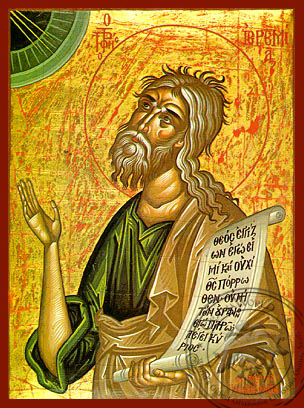
Heartfelt Prayer (Lamentations 5:1-22)

Orthodox icon of Jeremiah praying

O Lord, reflect on what has happened to us;
consider and look at our disgrace.

Our inheritance is turned over to strangers;
foreigners now occupy our homes.

We have become fatherless orphans;
our mothers have become widows.

We must pay money for our own water;
we must buy our own wood at a steep price.

We are pursued—they are breathing down our necks;
we are weary and have no rest.

We have submitted to Egypt and Assyria
in order to buy food to eat.

Our forefathers sinned and are dead,
but we suffer their punishment.

Slaves rule over us;
there is no one to rescue us from their power.

At the risk of our lives, we get our food
because robbers lurk in the wilderness.

Our skin is as hot as an oven
due to a fever from hunger.

They raped women in Zion,
virgins in the towns of Judah.

Princes were hung by their hands;
elders were mistreated.

The young men perform menial labor;
boys stagger from their labor.

The elders are gone from the city gate;
the young men have stopped playing their music.

Our hearts no longer have any joy;
our dancing is turned to mourning.

The crown has fallen from our head;
woe to us, for we have sinned!

Because of this, our hearts are sick;
because of these things, we can hardly see through our tears.

For wild animals are prowling over Mount Zion,
which lies desolate.

But you, O Lord, reign forever;
your throne endures from generation to generation.

Why do you keep on forgetting us?
Why do you forsake us so long?

Bring us back to yourself, O Lord, so that we may return to you;
renew our life as in days before,
unless you have utterly rejected us
and are angry with us beyond measure. (New English Translation)

“’Knock and it shall be opened.’ But does knocking mean hammering and kicking the door like a maniac?”

C.S. Lewis, A Grief Observed

Prayer is not about getting the right words strung together in a correct formula in a perfect disposition of the heart. Rather, prayer is conversation and a dialogue with God. 

Sometimes prayer looks a lot more like a triage unit in a hospital than it does a steeple on a church. Prayer often looks like desperation more than it does praise. 

God is a Being that we can tell the truth about what is really going on in our lives. Prayer isn’t prayer when we just tell God what we think God wants to hear.

“Prayer is not asking. It is a longing of the soul. It is daily admission of one’s weakness. It is better in prayer to have a heart without words than words without a heart.”

Mahatma Gandhi

The biblical book of Lamentations is the prophet Jeremiah’s extended prayer of grief, lament, complaint, and raw feeling. His hometown of Jerusalem was decimated by the invading Babylonian army. Thousands of people were taken out of the city and into exile. The ones left, including Jeremiah, were beside themselves with anger, grief, sadness, and fear.

We hear his cry to God, not worrying about whether it is appropriate language or not. Jeremiah’s words and phrases to God were heartfelt and real:

“We’re worn out and without any rest.”

“All the joy is gone from our hearts.” 

“We are heartsick.”

“We can hardly see through our tears.”

“Why do you keep forgetting us, God?”
“Lord, why dump us and leave us like this?

“Give us a fresh start, for God’s sake!”

Jeremiah was not concerned about how he looked or sounded, and not afraid to express his real thoughts and feelings.

Every thought and feeling is a valid entry into prayer. It is of utmost importance that we pray what is actually inside of us and not what we believe God would like to hear from us. 

The Lord doesn’t like pretense and posturing; God wants the real us. 

Plastic words and phony speeches are an affront to God. We must pray precisely what is on our minds and in our hearts – unfiltered, if need be. No matter the headache or the heartache, we only need to pray, without any concern for doing it perfectly.

“Suffering forces us to change.
We don’t like change and most of the time we fear it and fight it.
We like to remain in emotionally familiar places
even through sometimes those places are not healthy for us.
On occasion, the suffering is so great that we have to give up.
We surrender the old and begin anew.
Often it is the pain we experience that leads us, not only to a different life,
but a richer and more rewarding one.” Dennis Wholey

Gracious God, sometimes I feel like I have to have it all together to even speak to you. Yet you already know my heart better than I know it myself. Forgive my constant hiding from you and accept my heartfelt prayer to you for grace and help, through Jesus Christ my Savior and Lord. Amen.

The Heart of Giving (Luke 20:45-21:4)

As all the people were listening, Jesus said to his disciples, “Beware of the experts in the law. They like walking around in long robes, and they love elaborate greetings in the marketplaces and the best seats in the synagogues and the places of honor at banquets. They devour widows’ property, and as a show make long prayers. They will receive a more severe punishment.”

Jesus looked up and saw the rich putting their gifts into the offering box. He also saw a poor widow put in two small copper coins. He said, “I tell you the truth, this poor widow has put in more than all of them.For they all offered their gifts out of their wealth. But she, out of her poverty, put in everything she had to live on.” (New English Translation)

Holy Scripture is replete with contrasting characters. A common teaching device of the ancient world, as well as Jesus, was to make clear narrative contrasts between different persons or groups. In the telling of the story, it would be evident that one is virtuous and the other not. In contemporary terms, we refer to such characters in a story as the protagonist and the antagonist.

It is abundantly clear, in today’s Gospel lesson, who is the godly virtuous person and who is not. Jesus is the one who illumined the contrast because it was not evident to the crowd of people.

You often cannot tell a fake by the external appearance. 

A pious religious person on the outside may not necessarily be a genuine Christ follower on the inside. And, conversely, a poor, old, bedraggled person may seem unimpressive on the outside, yet has a lush garden for a soul on the inside.

The religious experts in Christ’s day liked to do things for a show, for the attention. They were important and respected people, desiring and enjoying the accolades of others. They lived to be noticed. 

In reality, however, it was all a façade, a carnival sideshow. The outside and the inside were incongruent to each other. Their very selves were fragmented, not integrated; disparate, not synced together. The false self, displayed for others, hid a darkened true self underneath.

But Jesus saw them inside-and-out. He named the hypocrisy and condemned it.

There is a marked contrast between the rich and respected religious experts and the poor overlooked widow. Whereas the rich men put a wad of money in the temple offering for everyone to see, the impoverished widow put barely anything in. Yet, it was everything she had to give. 

The widow’s outward giving and inward disposition were perfectly matched. She gave everything out of the abundance of her heart. There was integrity, congruence, and a complete synthesis of the inner and outer person.

And Jesus saw her, inside-and-out. He named the genuineness and affirmed it.

The kingdom of God is not a matter of outward eating and drinking and ostentatious displays of spirituality; it is rather a matter of inner righteousness, peace, and joy in the Holy Spirit. (Romans 14:17)

We are to beware of those who do things for a show – who try and appear pious, while on the inside, they only have self-serving agendas. For the hypocrite, giving is more like a business transaction; I give money – you give respect and attention.

Remember that the person who plants few seeds will have a small crop; the one who plants many seeds will have a large crop. You should each give, then, as you have decided, not with regret or out of a sense of duty; for God loves the one who gives gladly. (2 Corinthians 9:6-7, GNT)

But giving is not designed by God to be done so people will admire and see what wonderful Christians we are, or so that others will know that we have done our proper duty. 

If our motive for giving is for others to admire us, then we will likely receive exactly what we want – and nothing more. There will be no reward from God because God isn’t even in the picture.

“Be careful not to practice your righteousness in front of others to be seen by them. If you do, you will have no reward from your Father in heaven.

“So, when you give to the needy, do not announce it with trumpets, as the hypocrites do in the synagogues and on the streets, to be honored by others. Truly I tell you, they have received their reward in full. But when you give to the needy, do not let your left hand know what your right hand is doing, so that your giving may be in secret. Then your Father, who sees what is done in secret, will reward you. (Matthew 6:1-4, NIV)

Giving is important and, I believe, needs to happen much more than it does. And there is also much more to the act of giving than placing money in an offering plate, supporting humanitarian causes, or donating resources; it involves the heart and the motives behind it. 

If I give because I want people to see how generous and benevolent I am; or to gain attention and approval; or to let people know how they need to act or change; then I have ceased to truly give. 

If I give away everything that I have and hand over my own body to feel good about what I’ve done but I don’t have love, I receive no benefit whatsoever.

1 Corinthians 13:3, CEB

Let’s call it something else: “The Me Show.” Tuning into “The Me Show” is not good. Giving is not supposed to be a circus with me in the center ring of the big top. Instead, giving is to be a heartfelt, genuine connection with both God and our fellow humanity. If it isn’t this, then we are spiritual clowns who think we need to perform more than we need to steward our God-given resources.

Yet, if we will but aim for the heart, the hands will follow with sincere generosity and grace.

Loving God, my heart longs to worship you with everything I possess. Transform me from the inside-out so that all my thoughts and motives may humbly express my words and actions, to the glory of Jesus Christ your Son, our Lord, who with you and the Holy Spirit are One God, now and forever. Amen.

Luke 19:45-48 – Jesus Cleans House

A bronze panel of Jesus chasing the merchants from the Temple by Lorenzo Ghiberti (1378-1455)

When Jesus entered the temple courts, he began to drive out those who were selling. “It is written,” he said to them, “‘My house will be a house of prayer’; but you have made it ‘a den of robbers.’”

Every day he was teaching at the temple. But the chief priests, the teachers of the law and the leaders among the people were trying to kill him. Yet they could not find any way to do it, because all the people hung on his words. (New International Version)

Jesus seems a bit like an actor in an old western movie. He’s the sheriff who drifts into town, sizes up the situation, shoots up the bad guys, defends the women and children, and cleans up the town. 

It’s a side to Jesus that might surprise some.

Jesus is no simple one-dimensional person, as if he’s always calm and picking dandelions. Christ is fully human and fully God – a complex person full of both human and divine anger. Today’s Gospel lesson reminds us that Jesus defies stereotyping, and that we need to see a fuller profile of who he is, and what he is up to.

Jesus is not only the merciful servant who graciously heals at the temple; but he is also a mighty judge who is intolerant of unjust systems and cleans house. 

Because Jesus is superior to everything, he is not some Being that we can domesticate for our own personal use. He did not come to this earth as some sort of spiritual vitamin supplement, or to be on call 24/7 in order to bail us out when we need it, or help us get ahead in life.

Instead, zeal for his Father’s house consumes Jesus. (John 2:13-17)

Jesus driving the merchants out of the Temple by Raymond Balze (1818-1909)

Christ sought to please the Father. Jesus oversees what the church and Christians are supposed to be. 

It’s our task to conform to Christ, and not the other way around. 

That happens whenever we let Jesus be the sheriff who drives out our sin, and, at the same time, the town doctor who brings the needed healing to our lives. 

Jesus cleaned house by attacking the system he saw operating.

It was Passover, the time when all pious Israelites made the pilgrimage to Jerusalem. Cattle, sheep, and doves were used for sacrifices. And the only place where those sacrifices were made was at the Temple in Jerusalem.  This meant that anyone wanting to worship God from outside of Jerusalem would have to do some traveling. 

Over time, a system was set up: Vendors established kiosks which lined the Temple courts; and they sold animals for the required sacrifices, as a matter of convenience. 

Since there were thousands of folks who came from a long way, often from outside of Israel, they brought their foreign currency with them, and it could be exchanged at the tables set up by money-changers.

Perhaps that all sounds practical. A little capitalism which provides a service for the people doesn’t seem all bad. So, what’s the problem? 

Jesus didn’t have a problem with capitalism per se; his problem with the whole system is that it should not even exist – these guys should not be in the Temple, at all! 

Jesus attacked the system and made a western movie scene out of it because the vendors and money-changers, even if using sound business practices (which they weren’t) should not even be there. For Jesus, it trivialized the Temple and took away from its intended purpose as a house of prayer for all nations.

Here’s how the system was supposed to work:

Coming to the Temple from outside of Jerusalem was never intended to be easy or convenient.

Making the pilgrimage to Jerusalem was supposed to be difficult. For the past year, since the last Passover, a family raised a newborn lamb in their house. Parents and children all took part in caring for it.

Then, when it was time, they all journeyed to Jerusalem together, taking turns carrying the year old lamb over their shoulders. Everyone knew what was coming. Their precious lamb, now a cherished part of the family, would be given in sacrifice at the Temple.

It was all a very powerful reminder of sin’s cost and how terrible it truly is.

Entering Jerusalem with no animal, and only money to buy one, is a cheap facsimile of real worship.

It misses the entire point of the system. It hinders people from genuinely connecting with God through prayer.  And Jesus will not put up with it – to the point of violently driving the whole system out of the Temple.

Jesus didn’t mess around with the sinful system. He didn’t politely ask the money-changers to move their tables somewhere else; he didn’t strike a deal with those selling animals to market them at cost. No. Instead, he went all town sheriff on them because the whole system was a blasphemous act against the right and true worship of God.

It has been the sin of the Church, through the centuries, to find ways of doing ministry and worship by not actually doing it (e.g., selling indulgences). 

We might feel good by simply attending a worship service, or offering some obligatory prayers, and giving money without having done anything to meaningfully connect with God. Our devotion may not be toward bringing something of ourselves to sacrifice by using our spiritual gifts and laying our lives down for others. 

It’s really a heart issue. For example, we might rightly give to missionaries or mission projects. Yet, if we give without any thought to doing missions ourselves and being missional people, then we are in grave need of having a clean house by overturning the tables in our hearts. 

17th century Ethiopian depiction of Christ cleansing the Temple

Jesus cleaning house was not an end in itself; he did it so that the Temple could be used for its intended purpose: A house of prayer. A place of healing. A gathering of collective praise to God.

Whenever an existing system is challenged, there will be those who push back because they benefit from the way things are.

The religious leaders were incensed by Christ’s systemic change. The behavior of Jesus challenged their authority, and they were angry about losing some of their power – not to mention jealous and envious that the people hung on his every word.

Jealousy rots the bones. Envy and selfish ambition accompany every evil practice and are behind every evil system. (Proverbs 14:30; James 3:14-16)

The real culprit behind the Temple system, as well as our own conflicts and disagreements is our selfish anger, our abject jealousy that someone else is receiving something which should be mine, and our insidious envy of wanting what another has.

Jesus knew he would upset and anger the religious leaders. But he cared enough about the proper place of worship that he attacked the contrived Temple system that fed on obscuring what real sacrifice was. Christ was willing to take on the establishment and reestablish a house of prayer for all people.

The way for us has been made clear through the death of Christ. Jesus has removed the old system and replaced it with the new. (Hebrews 8:13)

Therefore, we ought to be a beacon of hope for all who are coming to God and desire to offer their sacrifice of service or praise. We must eliminate any system, rule, or practice that eviscerates true worship.

May we follow the Lord Jesus by being active and proactive in making the way clear for others to come to God. And the first step to doing so is by having God clean house on our own hearts.

It’s what a good deputy sheriff would do.

Create in me a clean heart, O God,
    and put a new and right spirit within me.

The sacrifice acceptable to God is a broken spirit;
    a broken and contrite heart, O God, you will not despise. Amen.