Don’t Lose Heart (2 Corinthians 4:1-12)

Therefore, since through God’s mercy we have this ministry, we do not lose heart. Rather, we have renounced secret and shameful ways; we do not use deception, nor do we distort the word of God. On the contrary, by setting forth the truth plainly we commend ourselves to everyone’s conscience in the sight of God. And even if our gospel is veiled, it is veiled to those who are perishing. The god of this age has blinded the minds of unbelievers, so that they cannot see the light of the gospel that displays the glory of Christ, who is the image of God. 

For what we preach is not ourselves, but Jesus Christ as Lord, and ourselves as your servants for Jesus’ sake. For God, who said, “Let light shine out of darkness,” made his light shine in our hearts to give us the light of the knowledge of God’s glory displayed in the face of Christ.

But we have this treasure in jars of clay to show that this all-surpassing power is from God and not from us. We are hard pressed on every side, but not crushed; perplexed, but not in despair; persecuted, but not abandoned; struck down, but not destroyed. We always carry around in our body the death of Jesus, so that the life of Jesus may also be revealed in our body. 

For we who are alive are always being given over to death for Jesus’ sake, so that his life may also be revealed in our mortal body. So then, death is at work in us, but life is at work in you. (New International Version)

We all face times of adversity and seasons of life which stretch our faith and press the limits of what we can handle. 

You will find no promise within Holy Scripture that believers will avoid trouble. In fact, it’s just the opposite. Jesus promised that those who follow him will experience trouble. (John 15:18-20; 1 John 3:13; 2 Timothy 2:12) 

The pressures of life can sometimes be so overwhelming that we may lose heart. We might blame ourselves for the adversity we’re experiencing and wish things were different. Or we may blame others for our troubles and believe that if they would just get their act together, all would be well with my soul. 

Yet, no matter the source or nature of the problem, believers need a point of focus to direct their troubled hearts. We all need to be reminded of the grace we possess in Jesus Christ.

The resurrection of Jesus from the dead is both a spiritual and a physical reality. If we believe this truth in our hearts we will be raised both spiritually and physically (Romans 10:9-10). This faith in Christ gives shape to the hope that, although we might be experiencing the effects of mortality and the fall of humanity, we are, at the same time, being spiritually renewed day by day. 

The same afflictions that cause our bodies to degenerate and dispirit us are the means to achieving a glorious, resurrected existence (2 Corinthians 4:13-18). There cannot be the glory of spiritual and bodily resurrection without a shameful death. The way of Jesus was to absorb the shame of the world’s violent ways on the cross so that we might be raised with him in his resurrection. 

However, this victory through Christ’s cross and resurrection does not mean that the church will never experience difficulty in this present life. In fact, daily spiritual renewal can and does happen through adverse circumstances. 

There must be suffering before glory, both for Jesus and for us. Just because we have spiritual deliverance, does not mean we are inoculated from daily stress and pressure. That’s because it’s the troubles of this life that teach us to trust God; it is the adversity which weans us from all that we have previously trusted upon to cope with those troubles. All of this begs several questions for each believer and every church: 

  • Do we give inordinate attention to either the tangibly physical or the intangible spiritual? 
  • How does the gospel impact us today? 
  • How do we interpret our earthly troubles? 
  • What place does faith in God have in our daily decisions? 
  • As we become older, are we being renewed in Christ? 
  • Does the Lord’s Table, as a tangible sign and seal of our intangible faith, shape our hope?

We must learn to embrace our troubles as the means of growing our faith. And the first step to this is by acknowledging those troubles. There is no accepting, coping, and transcending difficult circumstances apart from this awareness. Troubles only have power over us for ill if we ignore them or put up a false front to hide them. 

We do not want you to be uninformed, brothers and sisters, about the troubles we experienced in the province of Asia. We were under great pressure, far beyond our ability to endure, so that we despaired of life itself. Indeed, we felt we had received the sentence of death. But this happened that we might not rely on ourselves but on God, who raises the dead. (2 Corinthians 1:8-9, NIV)

The Apostle Paul wasn’t asking anything of the believers that he himself hadn’t already faced. Paul’s Christian experience sometimes resulted in beatings, stoning and shipwreck, hunger and poverty, danger and trouble, not to mention all the pressures of his concern for all the churches he established. Yet, through it all, Paul was transparent and named his troubles so he could apply the poultice of God’s grace to his afflictions. 

It is our brokenness, and not the pretension of having it all together, that shows the grace of God to others.

Over and over again, Paul described his life and ministry in apparent paradoxes: strength in weakness; glory through shame; life through death; riches through poverty. Although we experience the fallen nature of the world, God bends each situation for divine purposes so that what seems to be our downfall becomes the means to our spiritual renewal. 

Every church is inherently paradoxical, a strange amalgam of victory and defeat, faith and doubt, full of sorrow and joy. So, let us then embrace this reality and allow God to use whatever means to shape believers in Jesus for good and benevolent purposes. 

May it be so, to the glory of God.

Out of the Slimy Pit (Psalm 40:1-11)

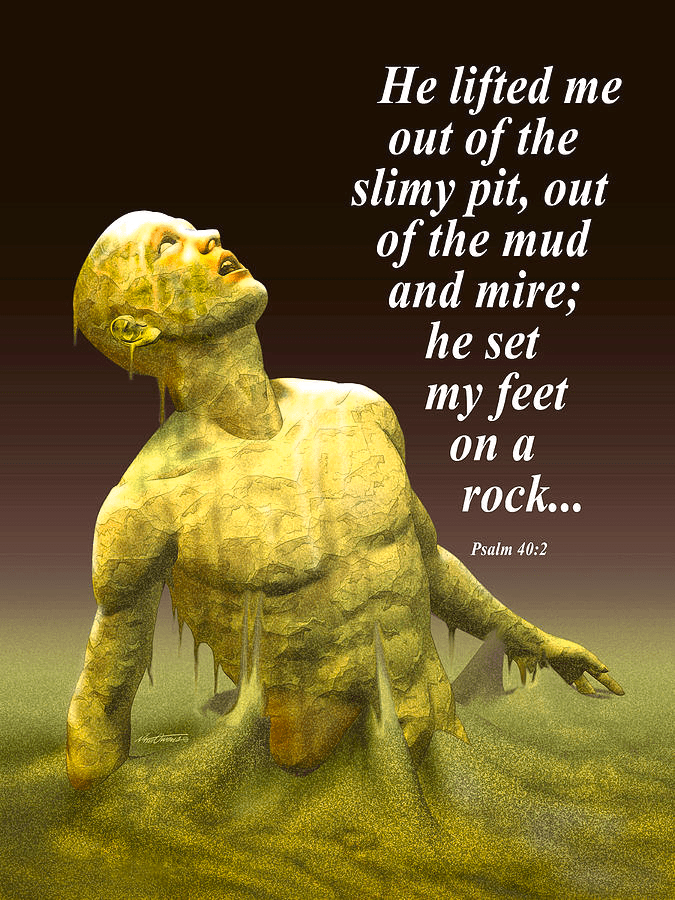
He Lifted Me by Nate Owens

I put all my hope in the Lord.
    He leaned down to me;
    he listened to my cry for help.
He lifted me out of the pit of death,
    out of the mud and filth,
    and set my feet on solid rock.
        He steadied my legs.
He put a new song in my mouth,
    a song of praise for our God.
Many people will learn of this and be amazed;
    they will trust the Lord.
Those who put their trust in the Lord,
    who pay no attention to the proud
    or to those who follow lies,
    are truly happy!

You, Lord my God!
    You’ve done so many things—
    your wonderful deeds and your plans for us—
        no one can compare with you!
    If I were to proclaim and talk about all of them,
        they would be too numerous to count!
You don’t relish sacrifices or offerings;
    you don’t require entirely burned offerings or compensation offerings—
    but you have given me ears!
So I said, “Here I come!
    I’m inscribed in the written scroll.
    I want to do your will, my God.
    Your Instruction is deep within me.”
I’ve told the good news of your righteousness
    in the great assembly.
    I didn’t hold anything back—
        as you well know, Lord!
I didn’t keep your righteousness only to myself.
    I declared your faithfulness and your salvation.
I didn’t hide your loyal love and trustworthiness
    from the great assembly.

So now you, Lord—
    don’t hold back any of your compassion from me.
Let your loyal love and faithfulness always protect me. (Common English Bible)

Every follower of the Lord has a powerful story of God’s grace in lifting them out of a slimy pit experience. 

We live in a profoundly broken world; and no one is exempt from its effects upon us. Whether physical problems, emotional trials, or relational hardships, there is always something going on in our lives – with the added pull toward trusting in things other than God. 

The temptation to say unjust words and do unjust actions is always over-promised and under-delivered. 

It’s easy to get sucked-in to poor decisions and be stuck in an empty hole with seemingly no way out. We often find ourselves slipping into a slimy pit because of our own bad decisions, as well as by no fault of our own. 

Living in a fallen world means that we inevitably experience troubles and hardships.

So, what do we do if we find ourselves in a slimy pit?

Look for Hope

David, the psalmist, waited patiently for the Lord. With great expectation, he fully anticipated God to act on his behalf. The sort of patience he practiced was an intense waiting – a waiting filled with longing and expectant hope, a patience that kept looking and praying and seeking.

The reason believers in Jesus keep hoping beyond hope is that we know that God is ultimately the One who delivers from the pit. 

But what if you have been looking for deliverance from the slimy pit experience and you have not seen it come to pass? 

Expectantly expect God to act. Wait patiently. Do not give up. Keep praying and watching. Like the father in the story of the prodigal son, keep looking out the window, waiting for the son to return, and picture the deliverance coming – because our waiting is not in vain.

flickr.com/photos/joshtinpowers

The psalmist, David, was eventually delivered. The Lord leaned down to him. God listened and lifted him. The Lord God set him on a firm place to stand and put a new song in his mouth. 

This was not only a personal matter for David; it was also an occasion that other people needed to know about.

Look for God

We all must finally come to the end of ourselves and look up. Whenever the deliverance doesn’t come quickly, we may look to other people or things to give us the freedom we long for. It’s easy to become impatient and begin searching for answers in everything else but God. 

Yet, if we will let patient hope have its way, we are blessed when we trust in the Lord.

In all my years of churchgoing as a kid, I had never read my Bible. But God was gracious to me. I remembered all those sermons I heard about Jesus. I gained a newfound sense of my own inner darkness, as well as the desire to read God’s Word. And God saved me. 

My circumstances did not change, but I did. My loneliness turned to joy; my aimlessness turned into purpose; and my selfishness became a deep concern for others. My heart had been black, and what God did to change it was nothing less than miraculous.

Look Within

The person who looks for hope and seeks God is also a person who looks into their own heart and there finds the attitude which God will bless. 

Blessing does not come from great sacrifice, but by syncing one’s heart with the heart of God. 

The Lord cares little about how much money or stuff you have, or how many sacrifices were made for God; that’s because God wants your heart, your mind, your will, and your emotions. In other words, God wants you! 

And God desires you because the Lord made you with a heart that beats for the same things God cares about: justice, mercy, and humility.

If you and I will but look within at the very spirit God has put within us, we shall find resources beyond what we can ask or think.

Look to Bless Others

We possess more than a personal faith which is to benefit ourselves; we also have an equal responsibility to bless the community with our experiences of what God has done in our lives. 

The telling of stories about what God has done for us is a necessary part of building up the church and helping others move forward in faith, hope, and love.

The psalmist proclaimed his testimony in the great assembly, that is, publicly. This isn’t about standing behind a microphone in front of lots of people; it’s about being so touched by God that we cannot keep our mouths shut about the Lord’s deliverance on our behalf.

So, let’s not shelve the idea of giving testimony to others as if it were only for pastors, missionaries, or other very religious people. 

When a person decides to play hockey in -20 degrees below zero weather, we might think that person is a little crazy;  but, hey, we reason, if they love hockey that much, more power to them. 

We must not think about Christianity in the same way, that if a person is passionate about Jesus and desires to tell others about what God has done for them, more power to them; just don’t expect me to go out in the cold and do that because it isn’t my thing. 

Christianity is a life, not a hobby; it’s about humble service, and not a means to look respectable; it cannot be reduced to a few practices, such as church attendance or putting money in an offering plate.

Christianity is a relationship with God through Jesus. Try looking at marriage as simply showing up for supper and paying the bills and see how far that gets you.

Look to Get Lost to Get Found

We may become obsessed with getting out of our slimy pit of illness, infirmity, pain, adversity, hardship, or discord. If that happens, we will likely lose our proper focus.

Instead, get lost in the wonder of God. The Lord does wondrous things when we are immersed in God’s wonders.

“Any of you who try to save the life you have will lose it. But you who give up your life for me will find true life.” Jesus (Matthew 16:25, ERV)

New life comes from a change of heart, not a change of circumstances. Wherever there is a firm reliance on God; a glad obedience to God; and a readiness to give testimony to God’s actions, then we are living into the spirit of today’s psalm.

Lamb of God, who takes away the sins of the world, have mercy on us.
Lamb of God, who takes away the sins of the world, grant us your peace. Amen.

The Heart of Words (Matthew 12:33-37)

A good tree produces good fruit, and a bad tree produces bad fruit. You can tell what a tree is like by the fruit it produces. You are a bunch of evil snakes, so how can you say anything good? Your words show what is in your hearts. Good people bring good things out of their hearts, but evil people bring evil things out of their hearts. I promise you on the day of judgment, everyone will have to account for every careless word they have spoken. On that day they will be told they are either innocent or guilty because of the things they have said. (Contemporary English Version)

Words are important. They have meaning and power.

Our speech is the outward demonstration of what is really within the heart. There really isn’t any room to believe that a constant stream of gossip, backbiting, slander, and negative comments is anything but coming from a heart of evil. The person who speaks such words is not a loving, gracious, merciful person. Conversely, the person who continually encourages, uplifts, and seeks to be positive, reflects a deep heart of love for others.

Therefore, simply altering our speech when we’re around particular people is not the point; and it does no good. That kind of talking only breeds hypocrisy and is two-faced. Instead, the place to aim is the heart because that’s where the words come from. And the way to truly renovate a heart is to sub-contract the project to Jesus.

The people we typically hang-out with the most are the people that most influence our attitudes and our speech. 

So, if we spend copious amounts of time with Jesus, it’s inevitable that our hearts will become more like his heart, and thus, our words will be in alignment with the words and ways of Christ. Be rooted in Christ and the fruit of the tree will demonstrate it.

I always find public confessions on TV to be a rather disingenuous affair. Typically, celebrity apologies only take shape when one has been caught saying something and are called on the carpet. Then, when the apology comes, it’s predictably odd and incongruent, with the person saying something to the tune of, “I’m sorry if I hurt anybody by what I said. Saying that really wasn’t me. I’m not really like that.”

Well, apparently you are. It came out of your mouth. Jesus said that out of the overflow of the heart the mouth speaks. The words we say out loud betray what is truly inside us.

Jesus used the metaphor of a tree to illustrate his point. If the roots, the trunk, and the branches are good and healthy, then you can be sure the tree will produce good healthy fruit. However, if the tree is diseased, or infested with insects and rotting from the inside out, then no one can expect anything other than bad fruit, not fit to consume.

If the fruit is bad, the tree is bad. If the words are hateful, sarcastic, passive-aggressive, manipulative, conniving, racist, hurtful, ignorant, mean, unjust, foolish, and either subtly or overtly abusive, then the person has a dark heart and is need of redemption, not excuses.

Conversely, if the words are affirming, encouraging, loving, compassionate, gentle, caring, direct, helpful, peaceful, kind, giving hope and life, then there is a good heart behind it.

Yes, bad hearts can parrot good words. However, those words are not genuine but mere rote recitations to achieve some sort of personal agenda. And, of course, good people will occasionally say dumb or hurtful words. In such times, let it be a reminder that we all have some shadowy places within our hearts – and that we must depend on God’s grace to enlighten those dark spaces.

Let’s observe patterns, rather than focusing on isolated events where either good or bad words were said. A consistent pattern of invalidating another’s experiences or feelings; intimidating or threatening others; dismissing or discounting someone’s input; or being unnecessarily blunt, are all major red flags pointing to a severe heart issue.

Evil exists in the world. And if we are not vigilant to the power of language, wickedness can easily smack us upside the head when we aren’t looking.

The heart cannot be concealed forever. Eventually, the virtuous person will be shown as such by the stream of gracious speech which pours forth from the heart, as if it were living water for others to drink and enjoy. Their words reflect their good character.

The wicked person, however, cannot keep the bad words down. Those vile words sit in the soul, poisoning and making the person ill. Then, all of a sudden, the evil words come up and out with a great vomitous heave and spew impurity and unholiness all over the innocent. Their words betray their foolish and poor character.

Every tree that does not bear good fruit will be cut down and thrown into the fire. The wicked heart will not be able to speak ill of others with impunity forever. They will be called to account for their abusive words, whether overtly violent, or subtly undermining.

The righteous heart, however, shall experience divine pleasure and reward, as if the careful construction of helpful and building up words wins first-prize at the great heavenly fair.

The good person loves and does not hate. They are so far from harming anyone that they even pray and wish well for their enemies. They pray for blessings on those who curse them. There is an honest striving to speak good words to everyone, regardless of who they are.

The upright heart thinks the best of everyone and holds nothing over someone else’s head. Such a good heart condemns no one, leaving all judgment to God alone. It is patient with the most exasperating of people, praying they might come to their senses and become spiritually healthy.

The righteous are able to use their speech to admonish their neighbor with care and affection. They freely forgive, happily give, liberally encourage, and use their tongue to speak words of life. Indeed, their speech is wise, humble, full of grace, and above all, loving.

Almighty God, to you all hearts are open, all desires known, and from you no secrets are hid: Cleanse the thoughts of our hearts by the inspiration of your Holy Spirit so that we may perfectly love you, and worthily magnify your holy Name; through Christ our Lord. Amen.

Spiritual Renewal (Isaiah 30:19-26)

People of Zion, who live in Jerusalem, you will weep no more. How gracious he will be when you cry for help! As soon as he hears, he will answer you. Although the Lord gives you the bread of adversity and the water of affliction, your teachers will be hidden no more; with your own eyes you will see them. Whether you turn to the right or to the left, your ears will hear a voice behind you, saying, “This is the way; walk in it.” Then you will desecrate your idols overlaid with silver and your images covered with gold; you will throw them away like a menstrual cloth and say to them, “Away with you!”

He will also send you rain for the seed you sow in the ground, and the food that comes from the land will be rich and plentiful. In that day your cattle will graze in broad meadows. The oxen and donkeys that work the soil will eat fodder and mash, spread out with fork and shovel. In the day of great slaughter, when the towers fall, streams of water will flow on every high mountain and every lofty hill. The moon will shine like the sun, and the sunlight will be seven times brighter, like the light of seven full days, when the Lord binds up the bruises of his people and heals the wounds he inflicted. (New International Version)

Better days are ahead.

In this time of year, there are many people who simply don’t have to think twice about purchasing and giving gifts for Christmas. They have blessings, both material and spiritual. And they can always identify other persons who are in much more need than them. Some of them may even believe that those in need are in that position because of unwise individual choices. 

But we must maintain a focus on our own lives. We need to recognize the maladies of our hearts. The state of our lives is as important, and is just as real and needy, as someone else’s life who is in more humble circumstances. 

There are specific conditions in our lives that leave us in bondage and in need of restoration, renewal, and revitalization, just like all kinds of other people. 

Being a vital part of a local church does not automatically immune one from having serious needs. And having a good steady income doesn’t inoculate one from need or privation.

We must not suppress those realities and needs, but instead, name the conditions which are packed away in a closet of our heart deep inside us – such things as the love of possessions and money; broken relationships; old grudges; hidden addictions; domestic violence; denial of depression; secret affairs; cutting; fear; anger; greed; hatred; and much more. 

Outward smiles and small talk conversations may hide the truth from others, but they do nothing to hide from a God for whom everything is laid bare.

The good news is not just something for someone else who has “obvious” needs; the gospel must touch our lives and bring us freedom.

Only then can we pass on the good news to the legion of social ills that make our world sick. There are people all around us who need spiritual, emotional, and material help. Yet, we will not have eyes to see them, or have hearts to help, if we are stuffing our own burdens so deep within that we are blind to others.

Far too many Christians, especially the church-going kind, have become expert emotional stuffers and deniers of need. 

We may believe “those other people” need ministries of justice and help. But the truth is: Many of us are one paycheck, one prodigal kid, one mental health diagnosis, one serious illness, one drink, one affair, or one bad decision away from being one of “those people” – the people we typically identify as in need – the ones that bad things happen to – the ones we do not want next door to us.

We may not yet be vulnerable enough to admit our situation; and so, we keep practicing the denial of our spiritual poverty. 

What to do? Turn from the things that have caused us to be in poverty and be prisoners (not just secretly!) and hope in the Lord’s restorative grace. God takes all sorts of seemingly impossible situations of destruction and death, creating fresh new growth in the form of a little green sprout. 

God will rebuild our ruined souls; restore the places of our lives that have been devastated; and renew the places that have not seen renewal for generations. 

It begins with you and me allowing the justice of God to work within us, not just others. 

If we want comfort, we need to mourn. If we desire joy, then there needs to be some lamenting of a dire situation. If we hope for an oak of righteousness, there must be a confession of despair. For there to be a resurrection, there has to be a death.

What is your real situation and the true realities of your life that need to be named? 

Where will you go to address those needs and truths? 

Will you keep stuffing them, or will you become able to voice your inner personal needs? 

How might you be vulnerable enough to allow others to minister grace to your needy soul?

Let us have a vision of Jesus coming into our lives and replacing a tattered hat of grief with a crown of beauty. 

Let us picture the Lord placing on us a garment of praise to replace our stinky clothes of grumbling. 

Let us allow our lives to display the grace of God in Christ because we have been profoundly touched by the justice of God. 

Let us herald the coming of the Christ child as the hope of us all.

Soli Deo Gloria