Have Spiritual Eyes to See (1 Peter 1:8-12)

You love him, although you have not seen him, and you believe in him, although you do not now see him. So you rejoice with a great and glorious joy which words cannot express, because you are receiving the salvation of your souls, which is the purpose of your faith in him.

It was concerning this salvation that the prophets made careful search and investigation, and they prophesied about this gift which God would give you. They tried to find out when the time would be and how it would come. This was the time to which Christ’s Spirit in them was pointing, in predicting the sufferings that Christ would have to endure and the glory that would follow. 

God revealed to these prophets that their work was not for their own benefit, but for yours, as they spoke about those things which you have now heard from the messengers who announced the Good News by the power of the Holy Spirit sent from heaven. These are things which even the angels would like to understand. (Good News Translation)

No less real than our actual physical eyes are our spiritual eyes – which enable us to see things invisible to our physical eyesight. Faith is the glasses that bring those things into focus.

To have faith is to be sure of the things we hope for, to be certain of the things we cannot see. (Hebrews 11:1, GNT)

Our life is a matter of faith, not of sight.

(2 Corinthians 5:7, GNT)

Faith creates the conditions for love. Cold dispassionate ideas and thoughts are just that; but faith gives us sight to see the true nature and meaning of love. Faith enables us to see Jesus Christ, who is Love incarnate.

This spiritual sight, made possible by faith, and bringing Christ into focus, is the basis for joy and the foundation of hope. It is more than joy; it’s joy unspeakable, beyond words, greater than the vocal chords can produce. It’s the sort of joy that takes your breath away.

Joy elevates us and brings us face to face with the glory of heaven. And once we have experienced this, our contentment is solely in Christ, and we have no need for anything the world offers. This is what it means to be saved.

Salvation always involves two equal and important facets: deliverance from something, so that we may attach to something else.

For the believer, with spiritual eyes to see in faith, we are saved from all the snake oil promises and allurements of the world; we are delivered from the weight of guilt and shame we carry; and we are snatched from the flames of hell and the machinations of the devil to ensnare us in evil.

The deliverance comes so that we can then connect with goodness, truth, justice, integrity, wholeness – with the love of God in Jesus Christ. Experiencing this wondrous spiritual fruit leads to a pure confession of faith:

But all those things that I might count as profit I now reckon as loss for Christ’s sake. Not only those things; I reckon everything as complete loss for the sake of what is so much more valuable, the knowledge of Christ Jesus my Lord. For his sake I have thrown everything away; I consider it all as mere garbage, so that I may gain Christ and be completely united with him. (Philippians 3:7-9, GNT)

I am neither a Christian because I was raised in cultural Christianity, nor because it was all I knew at the time. Rather, I am a Christian – a follower of Jesus Christ – because I was given a great gift of faith and saw divine love given for me, even though I deserved none of it.

So, my heart fully and forever belongs to Christ. It is a life worth living, a life of faith, hope, and love. No matter the hardship, adversity, or crud which happens to me on this earth, I am thoroughly surrounded by God’s grace, peace, and love.

And if I have to explain it to you, you probably don’t have it. That’s because it takes a different sort of eyesight, a countercultural set of ears, and a new meaning of touch, smell, and taste.

This sort of deliverance from sin, death, and hell, and into a great inheritance of faith, is so incredible that the ancient prophets, and the even older angels, longed to know what this salvation truly is.

And what they foretold, and believers now know, is that the cross is the way to victory; death is the passage to life; suffering is the road to glory.

Therefore, our present afflictions need not discourage nor debilitate us, as though we were miserable without any hope. Even more, it is through these very troubles that we are blessed.

No matter the evil thrown our way, there is always glory attached to it. If we must suffer, let us do so in the same spirit as Christ suffered:

My dear friends, do not be surprised at the painful test you are suffering, as though something unusual were happening to you. Rather be glad that you are sharing Christ’s sufferings, so that you may be full of joy when his glory is revealed. 

Happy are you if you are insulted because you are Christ’s followers; this means that the glorious Spirit, the Spirit of God, is resting on you. If you suffer, it must not be because you are a murderer or a thief or a criminal or a meddler in other people’s affairs. However, if you suffer because you are a Christian, don’t be ashamed of it, but thank God that you bear Christ’s name. (1 Peter 4:12-16, GNT)

Allow your spiritual eyes to confirm the truth, and to behold the living Christ.

“Why are you alarmed? Why are these doubts coming up in your minds? Look at my hands and my feet, and see that it is I myself.” Jesus (Luke 24:38-39, GNT)

May you know Christ, and him crucified, risen, and coming again. And may you know the hope of glory, indescribable joy, and everlasting love. May you know salvation.

Against Hate (Genesis 4:1-16)

Cain and Abel by Keith Vaughan, 1946

Adam slept with Eve his wife. She conceived and had Cain. She said, “I’ve gotten a man, with God’s help!”

Then she had another baby, Abel. Abel was a herdsman and Cain a farmer.

Time passed. Cain brought an offering to God from the produce of his farm. Abel also brought an offering, but from the firstborn animals of his herd, choice cuts of meat. God liked Abel and his offering, but Cain and his offering didn’t get his approval. Cain lost his temper and went into a sulk.

God spoke to Cain: “Why this tantrum? Why the sulking? If you do well, won’t you be accepted? And if you don’t do well, sin is lying in wait for you, ready to pounce; it’s out to get you, you’ve got to master it.”

Cain had words with his brother. They were out in the field; Cain came at Abel his brother and killed him.

God said to Cain, “Where is Abel your brother?”

He said, “How should I know? Am I his babysitter?”

God said, “What have you done! The voice of your brother’s blood is calling to me from the ground. From now on you’ll get nothing but curses from this ground; you’ll be driven from this ground that has opened its arms to receive the blood of your murdered brother. You’ll farm this ground, but it will no longer give you its best. You’ll be a homeless wanderer on Earth.”

Cain said to God, “My punishment is too much. I can’t take it! You’ve thrown me off the land and I can never again face you. I’m a homeless wanderer on Earth and whoever finds me will kill me.”

God told him, “No. Anyone who kills Cain will pay for it seven times over.” God put a mark on Cain to protect him so that no one who met him would kill him.

Cain left the presence of God and lived in No-Man’s-Land, east of Eden. (The Message)

For this is the message you heard from the beginning: We should love one another. Do not be like Cain, who belonged to the evil one and murdered his brother. And why did he murder him? Because his own actions were evil and his brother’s were righteous.

1 John 3:11-12, NIV

Despite being brothers, Cain and Abel couldn’t have been any more different.

Abel became a shepherd. He took the absolute best of his flock and made it an offering, with the intent of giving God an appropriate gift. The Lord was pleased and approved of Abel’s actions because they demonstrated a good attitude and a sensitive heart. Abel’s belief and practice worked together.

Cain became a farmer. He cobbled together some of the leftovers from his vegetable harvest and gave them a nonchalant toss to God. The Lord did not look favorably on Cain’s actions because they evidenced a bad attitude and a hard heart. As a result, Cain became sullen, upset, and angry. His emotions reflected his actions. Cain didn’t listen to God. Instead, he let hate takeover and killed his brother.

God sets faithful people apart to demonstrate love and to be the hope of the world. God’s people reflect their divine image when lives are changed for the better; hatreds are overcome; failures are forgiven; grace melts hard hearts; selfishness is diminished; and compassion grows into blessing others – not hating them.

Humanity was created for love, not hate.

We know that we have transferred from death to life, because we love the brothers and sisters. The person who does not love remains in death. (1 John 3:14, CEB)

Love is the distinguishing mark of the spiritual person and the follower of Christ. The person with hate has so many barnacles built up on their underside that they cannot move through the water of life with any joy or fulfillment. What’s more, they drag down the rest of the fleet that seeks to move in concert together in love.

Everyone who hates a brother or sister is a murderer, and you know that no murderers have eternal life in them. (1 John 3:15, NCV)

Yes, we ought to love – which means we also should not put up with hate. You and I are under no obligation whatsoever to listen to hateful speech and allow hateful actions. That’s because people are meant to be a reflection of God’s loving and healing acceptance of people. 

Love doesn’t let others spew hate in front of you, no matter who they are. Maybe you could respond to hateful words by saying, “Sounds to me like you need to let God pressure-wash some barnacles off your heart.”

If someone chronically complains to you, and there is never any love behind what they say, then there is hate behind it. In such a case, the person needs deliverance from the Evil One.

Every institution and organization on God’s good earth must have a zero-tolerance policy toward hate, and a 100% commitment to love. 

God has not called us to hate anyone, but to love. And God’s people are only the hope of the world when they love others. 

The world will know that there is a God in heaven, and a Christ in the church, when people within local congregations love one another, when particular Christian denominations go out of their way to bless others, and when the love of Jesus compels them to drip grace on the most unlovely of people. Indeed, they will know we are Christians by our love.

Cain is Exhibit A of modeling the way of hatred and death. He separated himself from his brother, Abel, in every way possible – relationally, emotionally, mentally, and finally, physically through outright killing of the body.

The message from Holy Scripture is: Do not be like Cain. Be like Abel. Love others. Do not hate them. Live for others. Die to self. Avoid violent speech and actions. Don’t be a murderer.

Lord Jesus Christ, through your death on the cross you disarmed the powers of evil. Help us, we pray you, to enter into your victory and to stand in your authority against all evil. Send forth your light and your truth. Bring to light the deeds of darkness and let plans of violence and murder be revealed. By the power of your Holy Spirit, convict those who have allowed their minds to be dominated by evil. Lead them to repentance so that they may receive new life and rejoice in your forgiving love. Amen.

Be Merciful (Jonah 4:1-11)

Jonah was really upset and angry. So he prayed:

Our Lord, I knew from the very beginning that you wouldn’t destroy Nineveh. That’s why I left my own country and headed for Spain. You are a kind and merciful God, and you are very patient. You always show love, and you don’t like to punish anyone.

Now let me die! I’d be better off dead.

The Lord replied, “What right do you have to be angry?”

Jonah then left through the east gate of the city and made a shelter to protect himself from the sun. He sat under the shelter, waiting to see what would happen to Nineveh.

The Lord made a vine grow up to shade Jonah’s head and protect him from the sun. Jonah was very happy to have the vine, but early the next morning the Lord sent a worm to chew on the vine, and the vine dried up. During the day the Lord sent a scorching wind, and the sun beat down on Jonah’s head, making him feel faint. Jonah was ready to die, and he shouted, “I wish I were dead!”

But the Lord asked, “Jonah, do you have the right to be angry about the vine?”

“Yes, I do,” he answered, “and I’m angry enough to die.”

But the Lord said:

You are concerned about a vine that you did not plant or take care of, a vine that grew up in one night and died the next. In that city of Nineveh there are more than 120,000 people who cannot tell right from wrong, and many cattle are also there. Don’t you think I should be concerned about that big city? (Contemporary English Version)

Fear and anger go hand in hand. The fear of what sort of evil might happen often leads a person toward angry vitriol, even violence.

I once dealt with a woman who was so upset with her husband that she was literally shaking with anger. There was a time when her husband had been abusive, but thankfully, he gave his life to God, changed, and became a loving person. 

The thing that was so upsetting for the wife is that God saved her husband without punishing him for all the abuse he had dished out. She wanted some divine payback! The woman was actually furious about God showing grace and compassion.

This is not a novel or new experience. In the ancient world, the Assyrians were notorious for their brutality toward conquered peoples. They thought up forms of torture as a creative past-time. It was a violent culture, full of inhumane practices, and soldiers who were the scourge of the Middle East.

The violent ways of the Assyrians caught the notice of God. Divine judgment was hanging over the capital of the Assyrian Empire, Nineveh. So, God told the prophet Jonah to go and give the powerful empire a message of impending doom. (Jonah 1:2)

Jonah did not immediately obey God. However, he eventually went to Nineveh (after the infamous being in the belly of a great fish for three days and nights). The result was a great repentance of sin from the Assyrian people. 

The entire city turned from their evil ways. God saw this mass repentance and relented from sending disaster. Instead of destroying the city, with all its inhabitants and animals, the Lord was merciful and spared them. After all, God delights in seeing humility and the courage to admit evil and turn from it.

But Jonah had a serious problem with God’s grace toward the Assyrians. He was so upset and angry about the whole affair, that he wanted to die. Jonah was actually annoyed and greatly displeased by God’s goodness. Jonah wanted justice; he was looking for judgment. The last thing he wanted was divine mercy toward the very people who were experts at killing Jews. 

Yet, we must come to grips with the reality that God’s grace is so massive that it even extends to some of the most evil people in history. And Jonah wanted no part of that sort of theology.

God asked Jonah twice, “Do you have a right to be angry?” Jonah wanted destruction and pay-back for all the sin of the Assyrians. But God searches our hearts and exposes our expectations. Often, when those expectations do not happen, we are disappointed and become angry, even livid over the lack of retribution from God.

God wanted Jonah to share the same heart of mercy. And God still desires God’s people to have a heart that has grace and compassion, even in the face of terrible evil. Sometimes, God calls us to do what we least want to do in order to reveal what is really in our own hearts.  

Hating people to the point of wanting nothing but destruction upon them does nothing to bring about the righteous life that God desires. In Christian understandings, the blood of Jesus Christ has the power to bring healing and hope, even to the worst of sinners.

Whenever our fears turn to anger and we believe that God should bomb evil people off the face of the earth… or if we think our neighbors might be harboring ill-intent just because they are of a different race, ethnicity, or religion… or if we harbor bitterness because of real evil present in this world and want at least a little payback; then, we are no better than Jonah.

We end up looking just as ridiculous as Jonah, sitting at the edge of the city, pouting like a little kid.

Let’s grow up and rise above the current rancor that exists in so many places. Be concerned for the billions of people on this earth who need a merciful divine intervention and the grace of repentance that leads to new life. 

Pray for your enemies. Do good works for those who oppose you. Gain a bigger for the nations of the world. Remember what is really important in life. 

Any fool can rant and rave with anger against another; but the wise and gracious follower of God patiently and carefully prays and acts in ways that brings mercy and grace to others.

Merciful God, your presence of love in this world is truly amazing. Despite the real existence of evil on this earth, your grace cuts through it all and has the last word. Work in my life in such a way that fear is done away with and sinful anger vanishes, to be replaced with the love of Jesus Christ. Amen.

Lynching, Lusting, Liquidating, and Lying (Matthew 5:21-37)

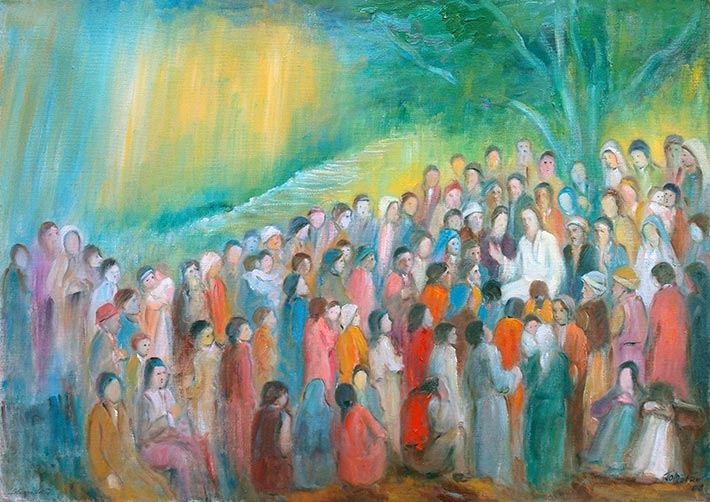
A Bengali depiction of Christ’s Sermon on the Mount

“You have heard that it was said to the people long ago, ‘You shall not murder, and anyone who murders will be subject to judgment.’ But I tell you that anyone who is angry with a brother or sister will be subject to judgment. Again, anyone who says to a brother or sister, ‘Raca,’ is answerable to the court. And anyone who says, ‘You fool!’ will be in danger of the fire of hell.

“Therefore, if you are offering your gift at the altar and there remember that your brother or sister has something against you, leave your gift there in front of the altar. First go and be reconciled to them; then come and offer your gift.

“Settle matters quickly with your adversary who is taking you to court. Do it while you are still together on the way, or your adversary may hand you over to the judge, and the judge may hand you over to the officer, and you may be thrown into prison. Truly I tell you; you will not get out until you have paid the last penny.

“You have heard that it was said, ‘You shall not commit adultery.’ But I tell you that anyone who looks at a woman lustfully has already committed adultery with her in his heart. If your right eye causes you to stumble, gouge it out and throw it away. It is better for you to lose one part of your body than for your whole body to be thrown into hell. And if your right hand causes you to stumble, cut it off and throw it away. It is better for you to lose one part of your body than for your whole body to go into hell.

“It has been said, ‘Anyone who divorces his wife must give her a certificate of divorce.’ But I tell you that anyone who divorces his wife, except for sexual immorality, makes her the victim of adultery, and anyone who marries a divorced woman commits adultery.

“Again, you have heard that it was said to the people long ago, ‘Do not break your oath, but fulfill to the Lord the vows you have made.’ But I tell you, do not swear an oath at all: either by heaven, for it is God’s throne; or by the earth, for it is his footstool; or by Jerusalem, for it is the city of the Great King. And do not swear by your head, for you cannot make even one hair white or black. All you need to say is simply ‘Yes’ or ‘No’; anything beyond this comes from the evil one. (New International Version)

Christ’s Sermon on the Mount by Joseph Matar

Relationships are important to God (and us!); we need one another because we are created in the image of a relational God. So, God wants us to have good relations with each other.

Murder, adultery, divorce, and oaths all have to do with interpersonal relations. These are topics from the Ten Commandments (6, 7, 9, and 10) that Jesus wanted to uphold.

Murder

Just because no blood is spilled doesn’t mean a killing hasn’t taken place. At the heart of the killing is angry contempt – which makes us all mass-murderers. The sort of anger Jesus refers to is nursing a grudge that morphs into hatred. It’s the deliberate decision to let anger sit in the pit of the gut and slow cook into deep resentment. Once that resentment is well done, murder becomes the meal.

Name-calling is the outward expression of resentful grudge bearing. “Raca” is an “airhead.” It means to be empty or stupid. The word “fool” is literally a “moron” – one who lacks both brains and morality. Both names hurt deeply, which is the expressed aim of the name caller. To have our intelligence and character questioned, cuts to the heart.

Jesus insists that harboring internal resentment comes out in external name-calling, verbally lynching people without a trial. Whenever we string a person up, divine judgment is coming to town. 

No one has a right to nurse a grudge. Repaying hatred with hatred is a highway to the grave. If you have ever wished someone dead, hated anyone, or belittled another; then, you have assassinated that person in your heart and are under the judgment of a holy God.

So, what to do in overcoming the resentment? Seek reconciliation immediately. Jesus used two illustrations to illumine the need for reconciliation with others when there are sour relations: an example of worship and an example with the court.

If you are worshiping, and remember that someone else is nursing a grudge against you, it is your responsibility to go and make things right. The Lord does not want to talk to anyone who won’t talk to their sister or brother.

Forgive us our debts, as we also have forgiven our debtors… For if you forgive other people when they sin against you, your heavenly Father will also forgive you. But if you do not forgive others their sins, your Father will not forgive your sins. (Matthew 6:12, 14-15, NIV)

None of this is meant to minimize the hurt or trauma that has taken place. Many people have faced hell in the shape of a human. Yet, because Jesus takes your hurt seriously, he calls for forgiveness and reconciliation. Without it, the pain unnecessarily continues and there is no healing.

In the illustration of court, we are to settle matters quickly and make things right so that judgment won’t happen. Let’s avoid living with the regret of vengeance because of destroying someone’s life. Forgiveness and reconciliation are always options on the table.

See to it that no one falls short of the grace of God and that no bitter root grows up to cause trouble and defile many.

Hebrews 12:15, NIV

Adultery

Adultery has its origins in mental sexual activity with another person. Jesus is not against normal gender attraction, nor sex itself (which is a gift of God). Rather, Jesus condemns the leering upon another with sexual fantasy. All adulterous relationships and inappropriate sexual relations start with the “look.”

“Lust” is to intensely desire something, to seek mastery over another. The reason people stare, and lust, is not because of the other person’s manner or dress; it’s because they already have an adulterous heart.

Managing adultery with a band aid is like trying to contain a nuclear meltdown with some duct tape; it’s an amputation we need. Jesus leaves no room to think it’s okay to lust in the heart because “I’m not hurting anybody.” Mental adultery demeans and degrades women.

Our lustful desires are powerful; yet God’s grace is more powerful. There’s no need to be burdened with shame and guilt when the cross of Christ has already taken care of it. There is a multi-billion dollar industry of pornography because our hearts are black. Now is the time for forgiveness, grace, and healing in Jesus Christ.

Sermon on the Mount by Jorge Cocco Santiago

Divorce

Today in America, more than one-third of all adults have experienced divorce. Jesus condemns the cavalier divorce, the thought of having a better spouse, even though there is no marital unfaithfulness. This is yet another form of mental adultery which believes someone else can better meet my needs. 

Jesus makes provision for divorce to occur in certain circumstances. Yet, he doesn’t bend to liquidating a marriage over unhappiness with what God has joined together. The intent of Old Testament legislation on divorce is to avoid a casual stance toward marriage (Deuteronomy 24:1-4). Over the centuries, people found creative ways of getting around the law. Although a divorce may be legal, it might not be ethical. Jesus wanted divorce practiced with concern for the woman, so that her rights and needs were considered.

For most of human history, if a husband did not like his wife (e.g. for continually burning his supper) he could divorce her. Jesus, however, insisted divorce must not happen because of a hard time getting along; or don’t love your spouse anymore; or that your spouse keeps irritating you. 

Being frustrated or unhappy are not biblical grounds for divorce. The answer to most marital problems does not lie in a new spouse, but in the hard work of identifying the idols of our hearts, overthrowing them, and re-connecting.

Christ sought to defend women who are victims. In biblical times, if a wife was given a certificate of divorce, she had four options: 1) return to her family of origin; 2) become a beggar; 3) become a prostitute to make ends meet; or, 4) marry again, which was extremely difficult to do. 

In reality, divorce is a legal testimony verifying that a separation has already occurred. It’s a recognition that disunity and division is already present, that a terrible break already happened, damaging the people involved.   

If God found it necessary to divorce his own covenant people, then it’s inevitable that divorce will happen among couples (Jeremiah 3:1-8). So, let’s be discerning in how we handle each individual situation of marital difficulty.

Oaths

“I swear on a stack of Bibles I won’t…” “I will, if I get around to it….” These are a few of the caveats we give when making a promise or oath. Oaths communicate our level or ability of getting something done, or not.

That’s fine. What isn’t fine is making excuses or false promises with no intention of doing what you say you will do. Jesus takes all that extraneous language out. Say “yes” or “no” and then follow through; if you don’t, you’re a liar.

We often lie because we don’t want to do something to begin with. “Yes” and “no” are clear boundary words. Boundaries define where I end and someone else begins, leading me to a sense of ownership. Knowing what I am to take and not take responsibility for gives me freedom.

Jesus wants us to clarify our values; make wise decisions; identify what we will accept and reject; and follow through on what we say we will do, period.

Murder, adultery, divorce, and oaths are all related. They have to do with how we relate to others, especially those closest to us and to God. We are to live responsibly by keeping our hearts large and soft.