Develop a Virtuous Ethic (Matthew 7:15-20)

“Beware of false prophets who come disguised as harmless sheep but are really vicious wolves. You can identify them by their fruit, that is, by the way they act. Can you pick grapes from thornbushes, or figs from thistles? A good tree produces good fruit, and a bad tree produces bad fruit. A good tree can’t produce bad fruit, and a bad tree can’t produce good fruit. So every tree that does not produce good fruit is chopped down and thrown into the fire. Yes, just as you can identify a tree by its fruit, so you can identify people by their actions.” (New Living Translation)

God has always been concerned for ethical virtue. And Jesus was always careful to take that ethic and help others identify it and apply it.

Virtuous ethics was well-known in the ancient world, especially thanks to the Greeks and Aristotle – who espoused that a person’s character is the determinative factor in discerning the extent to which that person is a good person.

For Aristotle, ethics includes moral virtues such as courage, temperance, compassion, generosity, honesty, and justice. The person in whom these moral virtues are to be found as steadfast dispositions can be relied on to exhibit a good character, and therefore, is able to make morally correct actions in moral decision-making situations.

For Jesus, religious legalism was a clear outward sign of the lack of inward moral virtue. Bad religion was a result of bad character. Therefore, everyone ought to beware of the religious leaders who exhibited stifling religious legalism.

Nothing can choke the heart and soul out of a person’s true spirituality, and hinder the development of virtue, like the legalist who teaches a precise extra-biblical list of do’s and don’ts.

For many folks, it seems easier to live by the list than to pursue the harder road of developing the character qualities needed for a solid and virtuous religious ethic. Christian discipleship involves growing into spiritual maturity and allowing a seasoned character to shape how we make decisions. 

To do so, we must patiently and consistently follow in the way of Jesus, which is the way of grace and of life.

Today’s Gospel lesson is Christ’s conclusion to his Sermon on the Mount. It is a sermon that sets forth the values of God’s kingdom and devalues the core of legalistic thought. 

I define legalism as a compulsion to spell out, in great detail, how everyone is to live a godly life; purposely going beyond the stated commands of Holy Scripture so that all persons can know exactly what they are supposed to do in any situation.

The problem with this approach to the Christian life is that godliness is merely an outward expression of our ability to hold to the list. It really has nothing to do with cultivating a virtuous ethic of life.

“Do not do what they do, for they do not practice what they preach. They tie up heavy, cumbersome loads and put them on other people’s shoulders, but they themselves are not willing to lift a finger to move them. Everything they do is done for people to see.”

Jesus on the legalist (Matthew 23:3-5, NIV)

The legalistic way of life and religion feeds human pride and boasting; it goes against the inner heart values of humility and meekness in Christ’s Beatitudes. The teaching of Jesus ends up getting lost in trying to do everything right or perfect.

Jesus, through the Sermon on the Mount, led the crowd to a point of decision, letting them know they are at a crossroads. There are two alternatives: Choose the way of life as expressed in Christ’s teaching, or else choose the way of destruction through the legalistic list. In order to press the crowd toward the necessity of choosing wisely, Jesus used metaphors to make his point.

False teaching in the form of legalism is like a wolf in sheep’s clothing. Be wary of people who seem pious and sincere, yet who do not quite pass the smell test. After all, Satan himself, the Apostle Paul once said, masquerades as an angel of light, appearing righteous, yet, is intent on deceiving many. (2 Corinthians 11:13-15)

So, how do we recognize a wolf who spiritually and emotionally devours people, and has no intention of helping but harming? Look at the fruit of the tree. 

Jesus is the good tree. Christ advocates for a searching of the heart. This leads to the result of righteous fruit. The bad tree is also seen by its fruit. Anyone who fails to live the Beatitudes of Jesus will be seen by the rotten fruit of boasting and pride.

False teachers tend to believe they are above others. After all, they are experts at keeping the list of do’s and don’ts! Yet, a false disciple will always be shown by their profound lack of grace, gentleness, and genuine humility. They inevitably advocate for holding to their brand of religion and keeping the unscriptural list. The absence of true righteousness and justice in their lives eventually results in their being cut down and thrown into the fire.

For Jesus, there is no riding the fence between the two alternatives presented – and it is a matter for him of life and death. The way of Jesus leads to life, good fruit, entrance into the kingdom of heaven, and stability. The other alternative ends in destruction, bad fruit and fire, exclusion from the kingdom, and being ruined.

The sobering reality of Christ’s teaching is that many people can be deceived with a devil’s bargain: “Take the nice handy legalistic list and you will become godly. Here are twelve principles to change your life. Follow these rules, pray this prayer, give your money to this, and all will be well.” It is, however, a highway to the grave.

The false teacher proclaims himself a “fruit inspector” and then goes on to judge everyone by his own contrived legalistic list. So then, there is a need to repent of religious lists, political agendas, and teachings which ignore and demean Christ’s Sermon on the Mount.

One of the telltale signs of holding to a conjured list is when we are not honest with one another about our struggles. The bald fact of list-living is that we cannot fulfill it. So, when we know we are not measuring up to the list, the temptation is to keep up appearances as if we are doing just fine. 

List-living eschews showing any weakness or imperfection:

  • I cannot admit my sin to anyone because the list pronounces me a failure if I do. 
  • I cannot enter a deep and prolonged grief over my loss because the list says I need to stay strong. 
  • I cannot profess my doubts about God because the list says if I doubt, I am not a real Christian.

My response and recommendation to legalistic list-living is this: To hell with the list! 

Instead, give praise to Jesus Christ who has given us the way of grace! For it is grace which transforms hearts, turns lives around, and provides genuine joy and satisfaction. If grace is not the answer, we are not asking the right question. The tree of life has an abundant supply of gracious fruit.

The greatest anti-legalistic prayer we can pray is the tried and true ancient prayer of the Church: “Lord Jesus Christ, Son of God, have mercy on me a sinner.”


Restoring True Religion (Micah 1:1-5)

The word of the Lord that came to Micah of Moresheth during the reigns of Jotham, Ahaz and Hezekiah, kings of Judah—the vision he saw concerning Samaria and Jerusalem.

Hear, you peoples, all of you,
    listen, earth and all who live in it,
that the Sovereign Lord may bear witness against you,
    the Lord from his holy temple.

Look! The Lord is coming from his dwelling place;
    he comes down and treads on the heights of the earth.
The mountains melt beneath him
    and the valleys split apart,
like wax before the fire,
    like water rushing down a slope.
All this is because of Jacob’s transgression,
    because of the sins of the people of Israel.
What is Jacob’s transgression?
    Is it not Samaria?
What is Judah’s high place?
    Is it not Jerusalem? (New International Version)

What is true religion?

Divine union with God is the whole point of religion.

In saying that, you may have reacted reflexively or viscerally. That’s because it’s likely that your experience of religion has been anything but a mystical and wondrous connection with the Lord. The religious trappings, that you perhaps grew up with, were anything but helpful in knowing God.

That is both unfortunate and sad. In the absence of genuine unity with God, moralism diabolically worms its way into religion to replace spiritual practices of helpful connection, with legalistic rules of unhelpful separation.

Religion gets a bad rap. That’s likely because how we may typically think about it is really no religion, at all. True religion has a singular aim: how to connect us with the divine, that is, how to make one out of two. If we have to keep overcoming man-made obstacles in order to connect with God, this is irreligious, not religious.

How ought we to understand sin?

As a little test to this, as you read today’s Old Testament lesson from the prophet Micah, did you assume that the sins of Israel had to do with disobeying the rules, of breaking the law, of immoral worship? Or did you wonder if the sins of the people had to do with all the ways they created distance and separation between themselves and God?

The word of the Lord to the prophet Micah was not speech directed against the usual supposed devils of secularism or scientism. Instead, God was deeply concerned about the things that widened the gap between God and the people.

A divine/human union, a loving relationship between the Lord and people, an intimate knowing of one another, has always been at the heart of God’s understanding of religion. Anything less is demonic. God desires a mutual knowing and seeing, and not setting up altars which block the connection.

“The eye through which I see God is the same eye through which God sees me; my eye and God’s eye are one eye, one seeing, one knowing, one love.”

Meister Eckhart

Have we become separated?

Israel had lost their connection with God, and so, were no longer participating with the Lord in the divine/human cooperative of love. And God was not letting this happen without a clarion call to come back to the relationship.

The language of coming down from heaven and melting things is a reference to eliminating all the obstacles that stand in the way to true religion. The Lord will cataclysmically level everything in order to smooth the way between God and God’s people.

The capital cities, Samaria of Israel and Jerusalem in Judah, were the offenders in creating the blockage. Their high places of worship will be leveled to pave the road for unhindered fellowship; and a renewed and restored religion, based upon social justice for all, economic equity, and inclusive practices.

The severed connection with God became the fodder for all sorts of unjust thoughts and actions.

Woe to those who plan iniquity,
    to those who plot evil on their beds!
At morning’s light they carry it out
    because it is in their power to do it.
They covet fields and seize them,
    and houses, and take them.
They defraud people of their homes,
    they rob them of their inheritance.

Shall I acquit someone with dishonest scales,
    with a bag of false weights?
Your rich people are violent;
    your inhabitants are liars
    and their tongues speak deceitfully. (Micah 2:1-2; 6:11-12, NIV)

Idolatry, in the guise of alternative forms of worship, is sinful in the sense that it’s humanity’s attempt at having their ultimate needs met outside of the religion given to them. Religion must be a conduit for enabling us to spiritually connect with the Lord. Establishing practices which marginalize God put people at risk of becoming feral worshipers who run about doing everything but discovering their true selves and the one true God.

It is time for us to recognize and celebrate that we are connected to each other by a power greater than all of us, and that our connection to God and each other is grounded in love and compassion.

How do I make a spiritual connection?

There are three dimensions to the spirit: the head (thoughts), the heart (emotions), and the gut (actions).  Each dimension is meant to work together in alignment so that we can move forward toward healing, health, wholeness, integrity, peace, and relationship.

  • The Head deals with questions such as, “Who am I? What is the meaning of life? Who is God?”
  • The Heart considers our emotional selves by asking,“What am I feeling? What is my view of God? How do I give and receive love?”
  • The Gut taps into the embedded image of God within us by contemplating, “What is the good life? To whom will I show compassion? Will I listen to myself and others?”

My friends, we have 15 prophetic books in the Bible because this problem of messed up religion has become an awful impediment to genuine spirituality. It was not only a problem all those millennia ago; it’s still an issue today.

So, let’s take a serious reading of the prophet Micah, and his prophetic biblical companions; and let us restore and renew true religion among ourselves, so that humanity can become the just and good people we were always destined to be by our Creator.

Almighty God our heavenly Father, guide the nations of the world into the way of justice and truth, and establish among them peace, which is the fruit of righteousness, so that they may become the kingdom of our Lord and Savior Jesus Christ. Amen.

The Struggle Within (Romans 7:15-25)

I do not understand what I do. For what I want to do I do not do, but what I hate I do. And if I do what I do not want to do, I agree that the law is good. As it is, it is no longer I myself who do it, but it is sin living in me. For I know that good itself does not dwell in me, that is, in my sinful nature. For I have the desire to do what is good, but I cannot carry it out. For I do not do the good I want to do, but the evil I do not want to do—this I keep on doing. Now if I do what I do not want to do, it is no longer I who do it, but it is sin living in me that does it.

So I find this law at work: Although I want to do good, evil is right there with me. For in my inner being I delight in God’s law; but I see another law at work in me, waging war against the law of my mind and making me a prisoner of the law of sin at work within me. What a wretched man I am! Who will rescue me from this body that is subject to death? Thanks be to God, who delivers me through Jesus Christ our Lord! So then, I myself in my mind am a slave to God’s law, but in my sinful nature a slave to the law of sin. (New International Version)

We can relate to the Apostle Paul. We, along with him, have said to ourselves many times, “I don’t understand why I act the way I do. I don’t do what I know is right. I do the things I hate.” 

Paul’s experience of uneasiness, his existential angst because of the struggle within, is a timeless description of our common human condition. There are times we seem completely unable to follow our conscience and do what’s right. It can be maddening, even to the point of experiencing a continual low-level discouragement or depression which underlies almost everything we do.

The prescription for dealing with this mental, emotional, and spiritual malady does not include the law. That’s right. Putting our willpower and effort into obeying commands gets us nowhere. Even if we obey laws and rules and commands for a time, our efforts eventually break down. We fail to do what we want, and end up doing just the opposite.

In all fairness, the law is good, not bad; it just doesn’t have the capacity to transform us. The law’s purpose is to show us how bad off we really are in this world, to give us an awareness of our true condition, so that we will seek help. 

We humans are a bundle of contradictions, doing good, then bad, and flip-flopping back and forth – all with great frustration. In such a miserable condition, what then shall we do? Who will help us? Is there anyone to save us from our plight?

Sheer willpower and obedience will not help us; it won’t work. It will only give us a false hope. Any success in using willpower only deludes one into believing they have the answer… until they yet fall again into the pit of their own inner darkness. But the good news is that there is a Savior, a Redeemer, a Rescuer who has the will and the power to deliver us from our predicament.

The grace of God in Christ is the operative power that changes lives, not the law. Freedom from the tyranny of our “should’s” and our misplaced desires comes from Christ’s forgiveness through the cross. 

Like a lover enamored with his beloved, our desires become oriented toward Jesus for his indescribable gift to us. That is the strength of grace. Transformation is relational; it is found in a person, not a program. And the only person and relationship which has the ability to change us is, I believe with all my heart and mind, the Lord Jesus Christ.

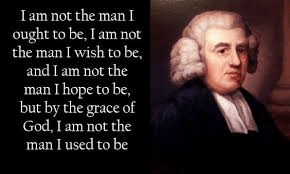
Why? Because I myself have been transformed and changed by such a relationship with Christ. I, along with the hymn writer John Newton, can say, “I once was lost but now am found, was blind but now I see.”

“Self-help” for all the good it really can do, is in many ways an oxymoron. We need a Savior to help us, and we need a community of people who encourage us. And even if we can do it ourselves today, that may not (and eventually will not) be true of us tomorrow. None of you got this far in life on your own – and you will continue to need God and others going forward.

Love must be completely sincere. Hate what is evil, hold on to what is good.Love one another warmly as Christians, and be eager to show respect for one another. Work hard and do not be lazy. Serve the Lord with a heart full of devotion. Let your hope keep you joyful, be patient in your troubles, and pray at all times. Share your belongings with your needy fellow Christians, and open your homes to strangers. (Romans 12:9-13, GNT)

We have an incredible capacity for good and vast internal resources within us. And yet, we too often lack awareness of this reality, for which we can tap into. When it comes to an outright metamorphosis, we need a new heart – and we can no more simply decide to change our lives any more than we can perform heart transplant surgery on ourselves.

People need the Lord.

Whenever the foundation of a house is about to crumble, it won’t do to rearrange the living room furniture and do a bit of spruce up painting. We deceive ourselves if we believe that all our efforts at landscaping the property and having a great curb appeal will do the trick. If the foundation crumbles, and the house implodes, all efforts at curb appeal won’t matter.

Jesus is our cornerstone. Without him, we are at risk, about to fall and without hope. With him, true restoration and renewal happens. And then, when the house is repaired and in order, we set about the task of being good stewards and maintaining and caring for the wonderful changes which were made.

Freedom from a dilapidated soul and misplaced energies to consistent times of peace and contentment, calmness and confidence, satisfaction and settled peace, comes by growing ever closer to the Savior who exudes all those qualities, and more. For the Lord not only saves and delivers; he also sanctifies and encourages.

In Christ, the uneasiness and unsettling experience – the existential angst – becomes a thing of the past because of the grace of merciful deliverance and continual help.

Saving God, I thank you for delivering me from sin, death, and hell through your Son, the Lord Jesus. May your Holy Spirit apply the work of grace to my life every day so that I can realize practical freedom from all that is damaging and destructive in my soul. Amen.

How Jesus Prayed (John 17:1-11)

After Jesus said this, he looked toward heaven and prayed:

“Father, the hour has come. Glorify your Son, that your Son may glorify you. For you granted him authority over all people that he might give eternal life to all those you have given him. Now this is eternal life: that they know you, the only true God, and Jesus Christ, whom you have sent. I have brought you glory on earth by finishing the work you gave me to do. And now, Father, glorify me in your presence with the glory I had with you before the world began.

“I have revealed you to those whom you gave me out of the world. They were yours; you gave them to me and they have obeyed your word. Now they know that everything you have given me comes from you. For I gave them the words you gave me and they accepted them. They knew with certainty that I came from you, and they believed that you sent me. I pray for them. I am not praying for the world, but for those you have given me, for they are yours. 

All I have is yours, and all you have is mine. And glory has come to me through them. I will remain in the world no longer, but they are still in the world, and I am coming to you. Holy Father, protect them by the power of your name, the name you gave me, so that they may be one as we are one.” (New International Version)

Prayer can be described in many ways. Yet, at it’s heart, prayer is simply talking to God. Jesus had taught his disciples early in his ministry about how to pray (The Lord’s Prayer). Now he demonstrates the way to pray, also revealing the heart of God in the process. Our prayers reflect our values and what is truly in our hearts. As Jesus offers his petitions to the Father, let’s notice what they are, and so, align our own hearts with the heart of God.

First Petition: Glorify God

Jesus prayed that he himself would be glorified, so that then he might turn right around and glorify the Father in heaven. This is a great lesson for all who pray – that we seek to receive in order to give.

All of life is dependent upon rhythms of receiving and giving. We breathe in and breathe out in a consistent flow. If that doesn’t happen, we have major health issues. Jesus promised that he would send the Spirit of God to help us breathe spiritually.

And so, it’s important that we routinely inhale the Holy Spirit so that we may exhale the virtues of love, joy, peace, patience, kindness, goodness, faithfulness, gentleness, and self-control for the benefit of the church and the blessing of the world.

Please never forget that we are stewards of the grace given to us by God. That means our purpose is not for avarice (to hoard the spiritual resources so generously given to us) but to receive, so that we can give. And God’s grace is inexhaustible; we shall never run out of offering peace and reconciliation to the world. That, my friends, is how we glorify God and show God’s Name as holy. (Matthew 6:9)

Two Groups and Three Givings

            Jesus mentions two groups: The Father and Son; and the World and Church. And he prays that the Father will give in three distinct ways:

  1. The Father gave the Son authority over all humanity. Jesus truly has the whole world in his hands. And when the Son has a hold of people, there’s no snatching them out. Jesus is not a hired hand; he is the hand of God. Since Jesus is in charge, we can be fully confident that every single member of the human race will be treated with respect in this life and with fairness on Judgment Day.
  2. The Father has given Jesus a second group of people out of the whole of humanity: the Church. Both the World and the Church are in Christ’s hands. Jesus has other sheep who are not yet in the fold. He is presently, by means of the Holy Spirit, gathering them into his divine sheep pen. There are two groups and three givings; but there is only One Shepherd and one Flock. And this one Flock of Christ is to be a kingdom of priests to serve the interests of the entire world. (1 Peter 2:9-10)
  3. The Church has been given the gift of Jesus by the Father. The Flock has received life – abundant and everlasting life. This by no means implies that we are in some sort of holding pattern until Christ returns to take us to be with him. Rather, now we are to be busy giving the world the gift of grace we ourselves have received. Life – real life, true life – is to know the Father and the Son.

God is glorified when we take up the mission given to us by Jesus:

  • We are called by God for a reason: to do justice, to love mercy, and to walk humbly with our God (Micah 6:8)
  • We are given a purpose of bearing witness to what God has done for us in Christ Jesus (Acts 1:8)
  • We are commissioned to make disciples from all nations, all ethnicities, and every sort of people (Matthew 28:19)
  • We are commanded to do it all through love of God and neighbor (Mark 12:28-31)

Second Petition: Protect the Church

Why does Jesus pray for our protection? So that we might be one as the Father and Son are one – and will not fragment and be scattered without any relation to each other.

Here are a couple of simple observations: this prayer of Jesus is not yet answered; and if Jesus can have unanswered prayer for two thousand years, maybe we ought to cut ourselves (and others!) a bit of slack on not getting our own prayers answered.

When we consider the Church throughout the world, we see that various Christian traditions just plain don’t like each other, and even accuse one another of not being Christians at all! And, what’s more, a chunk of the Church seems to be abusive.

Whether it’s Roman Catholicism and the sad story of the priest sexual abuse, or the steady stream of stories about Protestant Evangelical pastors who do the same and use their authority for personal and selfish advantage, there is plenty of awful crud out there.

And what the world sees, far too often, is a profound lack of grace – which brings us back to what we need to be doing to begin with: receiving grace so that we can give it to others. If this is not at the heart of our prayers (and apparently isn’t for many Christians) then we ought not be surprised whenever the world wants nothing to do with Christianity.

Unity is important to Jesus; it ought to be important to us. We need to work at it and work toward it. As God is One, so are God’s people to be one.

Unity does not mean:

  • one cultural expression (i.e. American)
  • the same personality (i.e. extroverted)
  • Christendom (i.e. the Church holding political power)

Unity does involve:

  1. being one in our basic mindset (humble, merciful, holy, peaceful)
  2. being one in purpose (glorifying God)

Therefore if you have any encouragement from being united with Christ, if any comfort from his love, if any common sharing in the Spirit, if any tenderness and compassion, then make my joy complete by being like-minded, having the same love, being one in spirit and of one mind. Do nothing out of selfish ambition or vain conceit. Rather, in humility value others above yourselves, not looking to your own interests but each of you to the interests of the others. In your relationships with one another, have the same mindset as Christ Jesus. (Philippians 2:1-5, NIV)

The Church, the people of God, are to be protected and kept safe from fragmenting into mere special interest groups who only care about their particular pet convictions or projects. Instead, we are to take a step back and see the big forest of Christianity and appreciate all the various trees within it. The Gospel of Jesus Christ is preserved and secured whenever we keep this unity of Christ in the middle of everything, and let go of everything else as being a test of Christian unity (e.g. personal convictions, church dogma and confessional statements).

Conclusion

So, what does this all mean for us? Pray. Talk to God. And talk to God about the same things that Jesus prayed about while he was here on this earth. We might discover that many of the issues we care about will resolve themselves if we simply pray as Jesus has modeled for us.

O God, the Father of our Lord Jesus Christ, our only Savior, the Prince of Peace: Give us grace to set aside and let go of all dissension and division in Christ’s Church. Take away all hatred and prejudice, and everything that hinders us from unity and harmony.

As there is but one Body, and one Spirit, and one hope of our calling, one Lord, one faith, one baptism, one God and Father of us all; so may all your people be of one heart, and of one soul, united in one holy bond of truth and peace, and of faith and love, with one mind and one mouth glorifying you, through Jesus Christ our Lord. Amen.