

“But…!”

The righteous cry out, and the Lord hears them;
    he delivers them from all their troubles.
The Lord is close to the brokenhearted
    and saves those who are crushed in spirit. (Psalm 34:17-18, NIV)

“…you nullify the word of God for the sake of your tradition.” Jesus (Matthew 15:6)

In talking with other so-called “Christians” who don’t live in Minneapolis or Minnesota about events in my home of the Twin Cities, I have found a disturbing trend among many of them.

Those who support the Trump administration and I.C.E. agent activity – of whom I personally know several – typically begin their responses to me with saying things such as: “Well, I don’t condone all of the tactics of I.C.E., but…”

Then they drone on, giving an apologetic for the murders and violence in Minnesota by blaming the protesters and/or the local leadership, all the while referring to them as “rioters.”

In the last several years, I have personally attempted to remove the word “but” from my vocabulary as much as possible. The reason I do this is that:

The use of “but” in a sentence is a way of invalidating everything that was said in the first part of the statement.

I would conjecture that the reason for even making a prefacing comment before using the word “but” is to try and soften what the person really wants to say and emphasize. In other words, it’s a way of trying to appear somewhat empathetic or compassionate, so that the other person will listen. That’s why I try and no longer use the word “but.”

In the past couple of years, I’ve even began calling out people who use this type of tactic with the word “but.” Instead of getting into an argumentative discussion (which is nearly always what happens when the “but” language is employed), I simply respond to the person, “No ‘buts’ in the urinal,” and ask them to reframe their statement without using the word.

I grew up in the era before public smoking bans. When I was a little kid, I remember smokers being everywhere in public, including restaurants. Typically, there was cigarette smoke just about everywhere – which also created a problem with cigarette butts.

Men’s public bathrooms were notorious for having cigarette butts in the urinals. Public places that had chronic problems with this practice would often put signs above the urinals stating, “NO BUTTS IN THE URINAL.”

Those signs always made me laugh hilariously because, well, I was a little boy and I took the message quite literally. After all, I was in a bathroom! (Even to this day, I laugh out loud anytime I see a sign while driving past a business which says, “Parking In Rear”).

I hope you get my point, as uncouth as it may be. There is no place for using the word “but” in a discussion with anyone, if you intend on simply invalidating what another has said or believes.

So, I have a real problem with the disingenuousness and attempted manipulation of much of the use of the word “but” with “Christians” whose intent is to invalidate my thought and practice of speaking and writing against the presence of I.C.E. in Minnesota, protesting their violence and perpetual lies, and constantly agitating for people to speak and act humanely.

Out of all the Old Testament prophets, perhaps Jeremiah had the worst problem with the “but” people. After all, such persons have always existed throughout history.

The prophet Jeremiah spoke out and against the popular notion that one could worship God and offer the proper sacrifices, but at the same time, do whatever the heck you want to do – including worship of other gods, and giving the shaft to the needy through terrible injustices.

“‘Hear the word of the Lord, all you people of Judah who come through these gates to worship the Lord. This is what the Lord Almighty, the God of Israel, says: Reform your ways and your actions, and I will let you live in this place. Do not trust in deceptive words and say, “This is the temple of the Lord, the temple of the Lord, the temple of the Lord!” If you really change your ways and your actions and deal with each other justly, if you do not oppress the foreigner, the fatherless or the widow and do not shed innocent blood in this place, and if you do not follow other gods to your own harm, then I will let you live in this place, in the land I gave your ancestors for ever and ever. But look, you are trusting in deceptive words that are worthless.” (Jeremiah 7:2-8, NIV)

According to the present Trump administration, the prophet Jeremiah would be labeled as a “domestic terrorist” for speaking out against the powers that be, and for prophesying judgment upon them for lying words and sacrilegious ways. He would receive that moniker because, in their understanding, he would be getting in the way of the kingdom’s operations.

As for me, because I have supposedly impeded I.C.E. operations in my own community through both word and action (according to their definition), I and my compassionate peace-loving family fits their understanding of “domestic terrorists,” even though we have done everything according to our limited abilities to practice de-escalation tactics, provide spiritual care to protesters and immigrants, and uphold the words and ways of Jesus, of whom we seek to follow with all our heart, soul, mind, and strength.

It is high time to dispense with the word “but” in our speech, and embrace the word “and.” I have a few suggestive examples:

“Even though we do not agree, I am sorry this has happened, and I grieve with you over these recent tragic deaths.”

“Although we are at loggerheads with each other, I too, believe that human life is sacred, and I will work toward peace and harmony in my community.”

“Yes, we disagree about many things, and I am here to listen and to seek to understand what you believe and why it is important to you.”

And tell me more about that…”

And I care about what happens to all of us in this world.”

And I love you, despite the fact we aren’t on the same page about this.”

These are statements I long to hear people of faith say to each other… I’m still waiting… and so I’m still presently living with profound sadness in a world in which it is imperative that Christians put love where love is not.

Grant, O God, that your holy and life-giving Spirit may so move every human heart – especially those in Minneapolis who are both resident and non-resident – so that barriers which divide us may crumble, suspicions disappear, and hatreds cease; that our divisions being healed, we may live in justice and peace; through Jesus Christ our Lord. Amen.

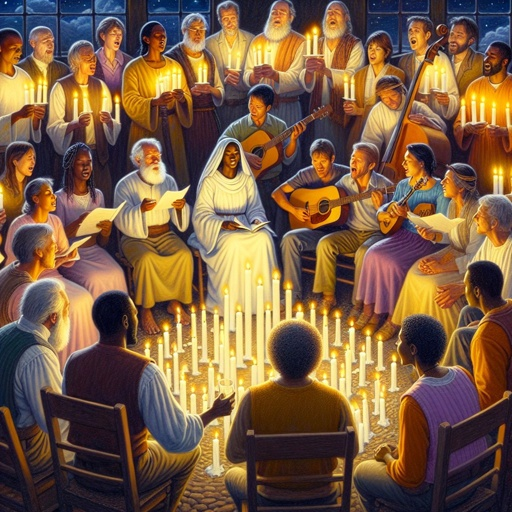
Sing Psalms and Hymns and Spiritual Songs to One Another (Ephesians 5:15-20)

By Bible Art

Be careful, then, how you live, not as unwise people but as wise, making the most of the time, because the days are evil. So do not be foolish, but understand what the will of the Lord is. Do not get drunk with wine, for that is debauchery, but be filled with the Spirit, as you sing psalms and hymns and spiritual songs to one another, singing and making melody to the Lord in your hearts, giving thanks to God the Father at all times and for everything in the name of our Lord Jesus Christ. (New Revised Standard Version)

It’s unlikely I need to tell anyone that the days are evil. The world is upside-down and topsy-turvy with injustice, waywardness, and narrow partisanship. In fact, there is a lot of similarity to the Apostle Paul’s time. Maybe that’s why Paul exhorted the church not to drown their sorrows in a bottle of spirits, but to be filled with the Spirit.

Perhaps, because of the times we live in, you don’t feel much like singing. You might not be finding much in your life right now to sing about. Yet, maybe singing is the very thing we need.

An inebriated person says and does things that they would not typically say or do when they’re sober. The Apostle’s point about being filled with the Spirit is that, instead of doing and saying foolishness, we are to be so filled with God that we do and say wisdom that we wouldn’t typically do and say, if not filled with God. 

Without the fullness of God’s Spirit, we end up mumbling, not singing; worrying, not making music in our hearts; complaining and arguing, not giving thanks. Half-filled Christians can only practice a half-hearted Christianity. And they’re only half-baked in their service and devotion to Christ.

Why sing? 

Because singing is part of being filled with the Spirit of God. Singing happens when we experience God’s overflowing grace in our lives through the blessings of being chosen, adopted, and redeemed into God’s new community. (Ephesians 1:3-11)

Music is powerful. It’s not only a means of expressing praise and commitment to Christ and each other, it is also a powerful means of remembering.

For example, when we first teach kids the alphabet, we teach it in a song. Trying to teach letters in a rote fashion doesn’t work well for pre-school kids. But words set to music is why we can still remember words from old TV shows, because those words were set to a catchy tune (alas, the lyrical theme from Gilligan’s Island will forever be in my head).  Music is why an Alzheimer’s patient doesn’t remember her daughter’s name, yet can flawlessly sing all four verses of Amazing Grace.

Singing is an offering and a sacrifice of praise to God (Hebrews 13:15). And singing is also a vehicle whereby we are taught, encouraged, and built up in the community of believers. We sing to God, one another, and even to ourselves.

Christian music, then, is to be both a means of praising God and a practice of encouraging each other. We accomplish this through singing psalms, hymns, and spiritual songs.

Sing Psalms

The word “psalm” helps us rightly think of the biblical book of Psalms. Singing the psalms is an ancient practice, going all the way back to the Israelites singing psalms in the temple and synagogue. The early church maintained this practice, especially as a means of being faithful to praying without ceasing. 

However, over time, medieval congregations began neglecting the practice. In fact, European congregations eventually gave up most singing altogether. Almost all the singing was done by church choirs and professional musicians employed by the king (there was no separation of church and state) to write, compose, and perform in worship services. 

Five-hundred years ago, during the Reformation, Martin Luther reinstituted congregational singing. He gave music back to the people. One of the results of this change was putting the book of psalms to song – the Psalter.  For many Protestant denominations, the Psalter became the primary means of singing. The Psalter chiefly set prayers to song. It was both a means of expressing prayer to God and learning Scripture.

Singing Hymns

There have always been hymns in the church. Yet, it was not until the Reformation that hymns began to be written and sung by congregations. For the Reformers, hymns were used to teach sound doctrine and theology, as well as a means of confessing the faith together

A mighty fortress is our God,
a bulwark never failing;
our helper he, amid the flood
of mortal ills prevailing.
For still our ancient foe
does seek to work us woe;
his craft and power are great,
and armed with cruel hate,
on earth is not his equal. (Martin Luther, 1529)

Singing Spiritual Songs

Spiritual songs are the present day equivalent of praise and worship choruses, or what some refer to as contemporary songs. These are songs purposefully designed to be emotional expressions of praise to God and to give powerful testimony for what God has done or is doing.

Remember When You Sing…

  • Psalms are used to pray and learn Scripture.
  • Hymns are used to teach us sound doctrine and confess the faith together.  
  • Spiritual songs are an important way of expressing praise to God and being encouraged in the faith. 

Therefore, church music is to serve as both a revelation from God, and as a response from God’s people.

There are two important deductions from the Apostle Paul’s exhortation:

  1. A variety of songs is inferred and expected
  2. Their use is commanded

The reason worship style seems always to be a controversial topic is because everyone has their personal preferences. And yet, if we are to be faithful to today’s New Testament lesson, we will do more than focus on what I want. 

Truth be told, we are selfish people when it comes to music. We want what we want, and we don’t care what somebody else wants. And we’ll persist in that self-absorbed spirit until somebody calls us on it… That somebody is the Apostle Paul. Scripture calls us to encompass psalms, hymns, and spiritual songs – all three of them – in our worship.

I have an old friend who is an accomplished church musician and worship pastor. I once asked him how I can lead a worship service among such a variety of preferences concerning music. He answered my question with a question:

“How highly do people, including and especially your musicians, value the unity of the church? Do they love each other so much that they can allow for a wider range of style, and do so without vocally complaining about it?”

My friend went on to say, “When I arrived at one church as their pastor, some people were in a rather bad habit of saying very openly, ‘Oh I hate that song,’ or, ‘If I hear this song one more time I’m walking out.’ What I tried to do was teach people that this is not the most loving or mature approach; and it does little to build up the rest of the Body of Christ.”

If a group of people are being faithful to Scripture, and doing their best musically, then – if the music seems lifeless, dull, or strange to us – the real issue isn’t style but our hearts.    

A heart filled with the Spirit of God will speak to others using the Psalter, time-honored hymns, and fresh new contemporary songs. The result is believers built up in the faith.

Gracious God, give us grace to take to heart the great dangers we are in by our unhappy divisions about all kinds of things, including music. Take away all hatred and prejudice, and whatever else may hinder us from godly union and harmony, so that as there is but one body and one Spirit, one hope of our calling, one Lord, one faith, one baptism, one God and Father of us all, we may from this time forward be all of one heart and of one soul, united in one holy bond of peace; and may with one mind and one mouth glorify you, through Jesus Christ our Lord. Amen.

How Do You Want To Be Remembered?

Someday when I am dead and buried, I would be fine with my gravestone stating, “He was humble and wise.” For I have always sought (however imperfectly) to embrace and live a life characterized by poverty of spirit, largeness of heart, and a sage mind.

Yet, most of all, I’d like to be remembered by the phrase, “He loved God.” The Great Command of Jesus to love God and each other is something I pray and seek in my daily life. And I hope that at the end of my earthly life, the love of God within me has made the world a better place.

In saying this, it means I forsake a lot of other ambitions to be remembered by. I don’t really care if I am remembered for any other virtues or abilities other than love, humility, and wisdom.

For the times that I have unknowingly pursued other things above what is of concern to my Lord Jesus, I admit and renounce those things. Because that is what humility and love does. And it’s the wisest thing a person could do.

That is in direct contrast and opposition to worldly ambitions for wealth and financial resources, power and authority, attention and greatness. Such desires arise from pride, not humility. With arrogance, ignorance and hate are not far behind.

Such virtue is itself the good life. And it is not out of touch for any of us. For Christ himself repeatedly told and reminded his disciples that the kingdom of God is near, so near as to be within us.

“The time has come, and God’s kingdom is near. Change the way you think and act, and believe the Good News.” (Mark 1:15, God’s Word Translation)

“The Kingdom of God is near you now.” (Luke 10:9, New Living Translation)

And we are told to make God’s kingdom a priority. We are to humble ourselves before God and seek the reign of God and the values of how God operates, rather than putting all our equity into material possessions.

“Seek first the kingdom of God and his righteousness, and all these things (material resources) will be given to you as well.” (Matthew 6:33, New International Version)

The super-rich of this world have a super difficult time ever humbling themselves to anyone, including God, because they can so easily rely upon their vast earthly resources.

“Truly I tell you, it will be hard for a rich person to enter the kingdom of heaven. Again I tell you: It is easier for a camel to go through the eye of a needle than for someone who is rich to enter the kingdom of God.” (Matthew 19:23-24, New Revised Standard Version)

God’s kingdom is not something that is so far out of touch for us, or way out there somewhere, as if we could not, and therefore need not, pay much attention to it. No, it is much closer than any of us realize.

You and I have the light within us. For some people (maybe most people) this light has diminished to a tiny little flame or spark. They themselves either cannot or will not perceive there is something right and good that exists down deep in this soul created in the image and likeness of God.

Phrases such as “Let us rely upon our better angels,” and “Get in touch with our nobler instincts,” are more modern ways of expressing that there is inherent worth within us that we can tap into. It doesn’t even take a Christian or a religious person to recognize this reality.

We really do have a higher self, a conscience containing a moral compass, a given benevolent nature, altruistic impulses, and a compassionate side to us. Will we seek this part of ourselves? Will we tap into it? Will we allow it to come out into the world in order to bless it, not curse it?

Yet, as we know all too well, we also a have within us a depraved part which wants to rule over others and acquire as much wealth and power as possible. As with most things, we ourselves are a paradoxical conundrum of competing desires.

How do you want to be remembered? We can pursue the kingdom of God within us, or we can seek the kingdoms of this world outside of us. It’s your choice. But you will need help, if going after such things as humility, wisdom, and love as your way of life – not only help from God, but also help from others.

“Ask, and it will be given to you; search, and you will find; knock, and the door will be opened for you. For everyone who asks receives, and everyone who searches finds, and for everyone who knocks, the door will be opened. Is there anyone among you who, if your child asked for bread, would give a stone? Or if the child asked for a fish, would give a snake? If you, then, who are evil, know how to give good gifts to your children, how much more will your Father in heaven give good things to those who ask him!

“In everything do to others as you would have them do to you, for this is the Law and the Prophets. (Matthew 7:7-12, New Revised Standard Version)

What is true of you, that you would like engraved on your gravestone? How do you want to be remembered? That’s what we need in this world, for this time and for this place.

His Resurrection Is Ours

The Resurrection, by Andrea Mantegna, c.1458 C.E.

The story of Christianity, the very heart and essence of the religion, is a tale of transformation from all the obstacles, impediments, and barriers which confine or cripple. The person and work of Jesus accomplished this. In his earthly ministry, Christ continually called people to transformative change into the reality of God’s gracious and benevolent realm.

“I have come to give the good life, a life that overflows with beauty and harmony.”

Jesus (John 10:10, First Nations Version)

Christ’s resurrection made possible our own transformative new life. This is both exciting and scary. Resurrection is frightening because it’s a call to live a life without any of the walls which have defined us and/or imprisoned us.

The massive stone covering the tomb of Jesus Christ was rolled away. He walked out of the grave by the power of resurrection. The cave of death was changed into the place of liberation.

That place is a powerful image of moving aside any and all obstacles to our own faith and freedom. The prison doors have been opened. Our self-contrived inner prisons, as well as the unjust shackles placed upon us, have dropped away.

As a result, those who have been exiled, excommunicated, and treated as expendable are visited by the luminous healing presence of God’s great liberating force: resurrection.

All of these words may either seem strange and/or compelling. If this is the case, it is a sad situation. Because it’s quite necessary that we become familiar with such language. Unfortunately, the gap between the world we are presently living in, and the world our hearts yearn to know, is quickly coming to an unsustainable place of high stress.

There is now a profound disconnect between the love deep inside us, and the way in which we are living our day-to-day lives on this earth. The issue has become so great as to warrant the need for resurrection.

And I am not simply addressing Christians. In his earthly ministry, Jesus was not only talking to his own Jewish people; he came for the whole world. Jesus is for everyone – whether we acknowledge him according to Christian dogma and doctrine, or not.

The evil gaslighting sort of person wants you to believe that you are alone, bereft of any help – that somehow you need to assert yourself aggressively into the dog-eat-dog world. Wickedness always looks to chaos and war as the path to gaining the life one wants.

But Jesus is the bridge to another kind of thinking, another sort of life. He is the guide to the greatest power which exists in the world: Love. And Love is why resurrection is a reality.

Although we suffer from systemic evil and all kinds of structural “ism’s” in this world, our shackles and chains have been largely forged by ourselves, through spiritual ignorance and misunderstandings of who we are and why we are here.

Resurrection opens us to new life. It provides identity, purpose, and passion to live the good life. Even though we live in this world below, our answers to living in the here-and-now are found in the world above.

All of us have experienced walking a dark path in life. But now it is high time to walk away from uncontrolled emotions and evil ways. There are plenty of lying spirits who intend on deceiving you and I for their own selfish purposes. Instead, we can refuse and resist such evil.

We can live in ways that represent the good, the right, and the just. We can experience living a resurrected life. Let us choose the pure path of the new person in Christ, the person you and I were created to be.

The telltale signs of the person living into resurrection are a deep feeling for the pain of others, kindness, humility of heart, a gentle spirit, and long-suffering patience with others. Such persons wear forgiveness like a well-worn pair of jeans.

This is the path of resurrection, the way of unity, peace, and harmony. And these qualities will always guide us and inform us in helpful and sacred ways.

Our current global decline comes from an accumulation of greed and sheer lovelessness. But the possibility of rebirth, of resurrection, rises from our deep universal yearning for the good and the true. It comes from our radical willingness to change and live a different counter-cultural life.

Resurrection does not occur because of lofty thoughts; it comes from a humble, and contrite heart which yearns for a better and more sacred existence.

Only until we find our present life on this world as intolerable with its injustice and persistent carelessness, will we see that we must put love where love is not.

The great lesson of resurrection is that Love makes all things right.

May resurrection move from being merely a theological concept, to a powerful reality that permeates and fills your life with meaning, power, and love. Amen.