Are You Looking for Healing? (Mark 3:7-12)

Jesus departed with his disciples to the sea, and a great multitude from Galilee followed him; hearing all that he was doing, they came to him in great numbers from Judea, Jerusalem, Idumea, beyond the Jordan, and the region around Tyre and Sidon. He told his disciples to have a boat ready for him because of the crowd, so that they would not crush him, for he had cured many, so that all who had diseases pressed upon him to touch him. Whenever the unclean spirits saw him, they fell down before him and shouted, “You are the Son of God!” But he sternly ordered them not to make him known. (New Revised Standard Version)

A man’s shriveled hand was restored in full view of all the public. From then on, throngs of people came to check out what was happening. Jesus was well into his earthly ministry and created quite a buzz amongst everyone in Palestine. The ancient paparazzi even started following him around.

There were more fans rushing to see Jesus than Swiftys at a sighting of Taylor Swift. Like having the limousine ready after a concert to get away from the huge crowds, so Jesus instructed his disciples to have a boat ready for him in order to avoid the great crush of people.

Christ’s reputation of curing the sick and infirmed had reached such a critical mass that thousands were determined to at least touch him and experience long-awaited healing. And, really, you can’t really blame them, can you?

Maybe you’ve never experienced debilitating chronic pain – day after day not being able to get away from it’s awful effects in both body and soul. Or perhaps you have no idea what it’s like to live with depression constantly dogging you, just waiting to take a bite out of your life and devour you like some piece of meat.

A lot of people know what it’s like to live with infirmities that they don’t want and didn’t ask for. And they’ve tried everything to either get rid of it, or cope with it, somehow.

In fact, there are so many such persons living on planet earth, that when they had a snowball’s chance at getting to Jesus, they dropped everything and took it – going after him and not caring one bit if they themselves got crushed from all the other people trying to get help.

That, my friend, is how many people there are with great physical, mental, emotional, and spiritual needs on this planet.

We could go the route of playing arm chair observer and criticize the great crowd of people for being nothing but a bunch of fans who wanted to see the latest fad in Jesus. But, if you get up close with boots-on-the-ground, you will see a different picture: thousands of people looking for hope, health, and wholeness, wanting to be “normal” like everyone else.

The problem? Normal is nothing more than a social construct. For the infirmed, it’s likely not going to happen. For those believing they’re normal, in truth, they have a profound lack of awareness to their own great need.

No, we’re all abnormal; all of us are disordered, or diseased, or distressed in some sort of way. It turns out that we all need Jesus; some of us just know it much more profoundly than others.

Jesus was not only about to be crushed from physical bodies pressing in on him; he was going to be crushed by the sheer weight of the world’s tremendous need for healing.

But he was pierced for our transgressions,
    he was crushed for our iniquities;
the punishment that brought us peace was on him,
    and by his wounds we are healed.
We all, like sheep, have gone astray,
    each of us has turned to our own way;
and the Lord has laid on him
    the iniquity of us all. (Isaiah 53:5-6, NIV)

At this point in Christ’s ministry, a significant shift began. Rather than entering a synagogue and speaking only to Jews, Jesus started addressing Gentiles, as well. In fact, the crowds wanting to see him came not only from exclusively Jewish locations, but also from other places.

This ministry of Christ raised the attention of the demonic realm. It was a major threat to the demons’ influence on people. Identifying him as the Son of God and calling Jesus out by that name was a way for the demons to reassert their power and try to get some leverage. Names are actually a big deal. Which is why, for example, Jesus once asked a demoniac in the cemetery what his name is.

That’s one way a name is powerful. Yet, when it comes to you and me, the fact that Jesus knows your name, and my name, is a mighty thing in a very different way. Rather than having demons making the Son of God known, Christ grants us the authority to make the name of Jesus known throughout the world.

Even though the redemptive events of Jesus happened two thousand years ago, great crowds of people still come to Jesus, clamoring for but a touch of his grace. And the forces of darkness are still hanging around, knowing that their time is short.

Yes, there is still healing and wholeness to be found in Jesus, even today. And even though there remain some forces of darkness in opposition to it, the victory has already been achieved.

O God the Father, whose will for us and for all your people is health and salvation,

Have mercy on us.

O God the Son, who came that we might have life and have it in abundance,

Have mercy on us.

O God the Holy Spirit, whose indwelling makes our bodies the temples of your presence,

Have mercy on us.

O Triune God, we pray you to hear us, and that you will grant your grace to all who stand in need of healing both of body and spirit, and lead them to look with confidence in you;

We beseech you to hear us, O Lord.

That you will grant patience and perseverance to all who are disabled by injury or illness, and increase their courage,

We beseech you to hear us, O Lord.

That you will grant peace to all who are troubled by confusion or pain, and set their minds at rest,

We beseech you to hear us, O Lord.

That you will grant relief from suffering to all sick children, and give them a sure sense of your tender love and care,

We beseech you to hear us, O Lord.

That you will grant rest to all whose increasing years bring weariness, distress, or loneliness, and give them the abiding comfort of your presence,

We beseech you to hear us, O Lord.

That you will grant confidence to all about to undergo surgery or difficult procedures, and keep them free from fear,

We beseech you to hear us, O Lord.

That you will grant purpose to the church as it seeks to carry on Christ’s ministry of healing to suffering humanity, and keep it always true to the gospel of Christ,

We beseech you to hear us, O Lord.

That you will grant skill and compassion to doctors, nurses, technicians, aides, and all who are called to  practice medical arts, and make strong their dedication to help others,

We beseech you to hear us, O Lord.

That you will grant to all people the refreshment of quiet sleep and joy of resting in your everlasting arms, that we may rejoice in your care while we are on earth, and in the world to come, have eternal life.

We beseech you to hear us, O Lord.

O God, who in Jesus Christ called us out of darkness into your marvelous light; enable us always to declare your wonderful deeds, thank you for your steadfast love, and praise your with heart, soul, mind, and strength, now and forever.

Amen, and amen.

Lord, Have Mercy (Mark 10:46-52)

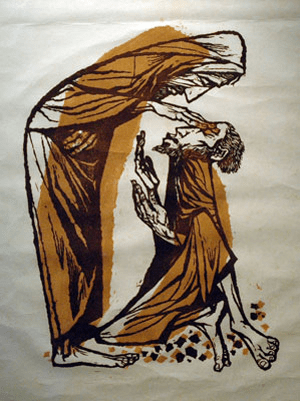
“Christ Healing the Blind Man” by Robert Hodgell

Then they came to Jericho. As Jesus, his disciples, and many people were leaving Jericho, a blind beggar named Bartimaeus, son of Timaeus, was sitting by the road. When he heard that Jesus from Nazareth was passing by, he began to shout, “Jesus, Son of David, have mercy on me!”

The people told him to be quiet. But he shouted even louder, “Son of David, have mercy on me!”

Jesus stopped and said, “Call him!” They called the blind man and told him, “Cheer up! Get up! He’s calling you.” The blind man threw off his coat, jumped up, and went to Jesus.

Jesus asked him, “What do you want me to do for you?”

The blind man said, “Teacher, I want to see again.”

Jesus told him, “Go, your faith has made you well.”

At once he could see again, and he followed Jesus on the road. (God’s Word Translation)

“I’d like to live my life so close to the bottom that when the system collapses I don’t have far to fall.” Dorothy Day

This is one of my very favorite stories in the entirety of Holy Scripture. And I will tell you why….

Because Jesus listens with ears of mercy

Jesus was headed to Jerusalem and had a lot on his mind and his heart. He knew what was coming, that his passion and death awaited him. No one would fault Jesus for not hearing a blind man shouting. But Jesus was listening so that he might hear someone just like the needy blind man. Rather than being distracted and lost in his head, Jesus was just the opposite – being attentive and aware of the humble folk right in front of him.

The Lord is always and continually listening for honesty and vulnerability. His ears of mercy are specially tuned, even today, for those who cry out to him from a place of genuine openness and humility.

Because Jesus speaks with words of mercy

Once Jesus listened, he responded by asking a question. I am impressed with Jesus throughout the Gospels. Christ gave people the gift of choice. He acknowledged people and respected them by not simply and indiscriminately healing, as if he were some fix-it guy. Jesus Christ bestowed on the lowliest of people the human dignity of choice by empowering them to answer a question.

Whereas everyone around Bartimaeus was looking down on him, both literally and figuratively, Jesus granted him the gift of dignity and basic human kindness – which are gifts we can all bestow on one another.

Because Jesus pays attention with a divine appointment of mercy

Our Lord took the time to heal blind Bartimaeus. Jesus could have simply healed him without even stopping his journey. He could have just waved his hand and the man would be healed. What’s more, Jesus could have even started a healing factory where everyone with a need got healed: bring ‘em in, move ‘em out, and keep the line moving!

Jesus was doing more than giving sight; he was giving a man the blessing of time and personal attention. The Gospel is never impersonal, which is why we ought to resist being non-relational in ministry to others. Christian ministry isn’t simply about meeting a need; it’s about blessing other people with the gift of relationship.

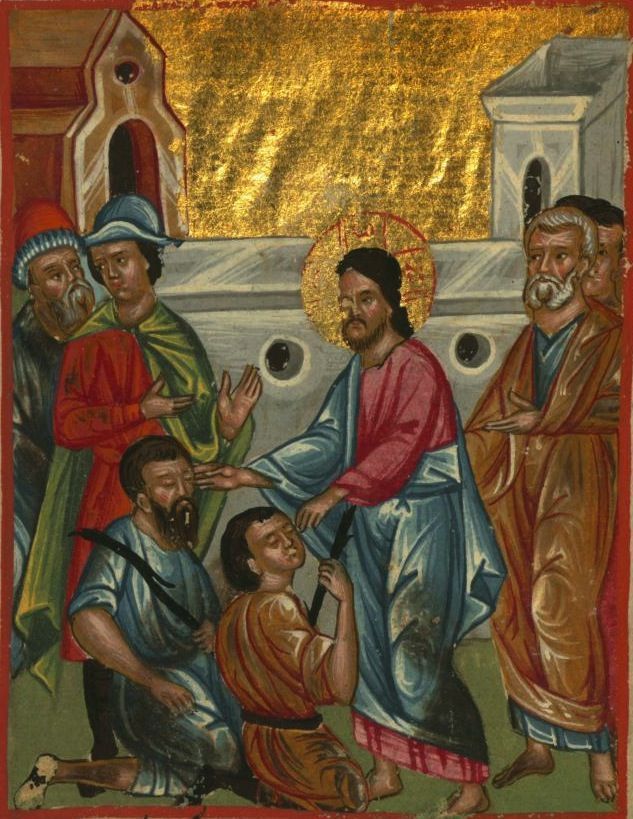
Coptic Church icon of Christ healing the blind man

Because Jesus reaches out with the touch of mercy

Jesus touched the man’s eyes (included in Matthew 20:29-34). He didn’t have to do that. The Lord of all most certainly could have healed without touching. In fact, it most likely may have been downright gross. A lot of people had eye diseases with runny pussy eyes in the ancient world.

Because the blind man didn’t listen to the crowd

I really love that! Maybe it’s the rebel in me. I just believe it is such a beautiful thing whenever someone refuses to be shamed by another and embraces their need. That is exactly what the blind man did. He not only refused to give-in to peer pressure, but he also responded to them by shouting all the louder. May his tribe increase!

Blind Bartimaeus teaches us that, when we know Love is there, we can freely acknowledge our needs, our wants, and our pain. With Jesus, who is Love incarnate, it doesn’t matter what anyone else thinks around us; there is no pretense, no propping up a false self to present for others to see. The true self is able to express what is really on the inside.

Because the blind man could actually see

In truth, Bartimaeus already had sight – not physical sight but spiritual eyes which could see better than anyone else in the crowd. One of the great ironies throughout the Gospels is that the sighted crowd seems to never see who Jesus really is, while blind folk see Christ clearly for who he is: the Son of David, the rightful king, the Savior of all.

It matters not how much faith one possesses; but it very much matters in whom that faith is placed. A thimble-full of faith is enough to move mountains, whereas a water tower full of misplaced faith in someone else cannot even provide a single glass of refreshment.

Because the blind man followed Jesus

Throughout the healing ministry of Jesus, there were plenty of persons who simply walked away and went about their lives after receiving what they desired. Yet, Bartimaeus, now given the gift of physical sight, immediately started following Jesus on the road.

This account feels a lot like my own testimony of experiencing the love of God in Christ and not ever wanting to leave it. So, I’ve been following Jesus for over forty years, still profoundly grateful in my heart for the One who loves and heals.

Because one lowly non-descript blind man made a difference

I don’t think Bartimaeus ever set out to change the world. And yet, he did. Here we are reading his testimony all these millennia later. One person, becoming a simple follower of Jesus and living a life of discipleship, changes a crowd from being a group of shushing church ladies to a robust throng of worshipers.

One individual makes a difference. Don’t let anyone tell you otherwise.

Lord Jesus Christ, Son of God, have mercy on me, a sinner.

Lord Jesus Christ, Son of David, heal me, a broken person.

Lord Jesus Christ, Son of Man, help me, a lost and lonely individual.

Lord have mercy, Christ have mercy, Lord have mercy on my love-starved soul and grant me your peace.

Amen.

Luke 11:29-32 – Going Against the Crowd

As the crowds increased, Jesus said, “This is a wicked generation. It asks for a sign, but none will be given it except the sign of Jonah. For as Jonah was a sign to the Ninevites, so also will the Son of Man be to this generation. The Queen of the South will rise at the judgment with the people of this generation and condemn them, for she came from the ends of the earth to listen to Solomon’s wisdom; and now something greater than Solomon is here. The men of Nineveh will stand up at the judgment with this generation and condemn it, for they repented at the preaching of Jonah; and now something greater than Jonah is here. (New International Version)

Just when we think we might have a handle on Jesus as the meek and gentle Savior we get a picture of Jesus behaving badly. When the crowds begin increasing we might expect Jesus to be pleased. After all, we might reason, Jesus can reach more people, have a wider influence, and greater impact with a crowd. It’s good for kingdom business. 

But Jesus isn’t down for all the people following him around. He opens his mouth and tells them they are an evil generation. 

“The crowds” continually get a bad rap throughout the New Testament Gospels. That’s because Jesus isn’t much of a crowd kind of guy. Although he loved people deeply, the Lord Jesus typically had some hard words for the masses.

“It’s better to walk alone than with a crowd going in the wrong direction.” 

Mahatma Gandhi

Maybe it would help if we used the word “mob.” This is likely the more nuanced understanding of “crowds.” It’s the herd mentality which tends to rub Jesus the wrong way, that is, doing something without understanding why you’re doing it, just because other people are doing it. A mob of people acting in concert never ends well, which is why Christ confronts the crowd.

Jesus chided the people who were looking for a cool miracle, a clear sign of his power, and nice clean lines of spiritual authority. Christ didn’t give it to them. Instead, Jesus let the mob know they have ample opportunity to accept him – yet they aren’t doing a dang thing to move in that direction.

Sometimes, we might so desperately want to make Jesus as Joe Cool so that others will follow him. If only Jesus will heal this person in a big audacious miraculous way, we wrongheadedly think, lots of people will believe. 

Or, if only Jesus will compassionately and powerfully perform some grand universal sign that nobody can miss, we believe, the world will have to take notice and put their trust in God. 

However, that’s not how Jesus rolls. Christ simply pointed people back to characters in the Old Testament. Jesus insists that if people won’t take notice of what they already have, they are not going to be swayed with a shiny new miraculous sign from heaven.

Jesus defies any stereotype we might try and corral him with. And that’s as it ought to be – since Jesus is the rightful and sovereign King. 

So, this is why we need a steady daily stream of God’s Word to help ground us into the ways of Jesus. The more we allow the Scriptures to shape our spirituality, the more our lives will be formed into the likeness of Jesus. 

Spiritual growth and maturity is a process. It is often slow. There are not a lot of bells and whistles to it. On most days, there is not a lot of drama – just the pedantic plodding of a faithful believer trying to make sense of living the Christian life. 

And those are the people I think Jesus most likes to hang-out with.

“A man who wants to lead the orchestra must turn his back on the crowd.” 

Max Lucado

The popular thing isn’t always the right or best thing. Rather than being a lemming which ends up running off a cliff, we have other options, especially when it comes to thinking spiritually and theologically about things:

  1. Stop and think. It’s easy to go through a typical day on autopilot and do things out of habit. The best way to avoid this is to consciously stop and think about why you’re doing something or holding tightly to a particular belief. Does what I’m doing jive with the words and ways of Jesus? Why am I believing or living in this way? What is my purpose?
  2. Take the necessary time to make sound decisions. Avoid copying other people and taking shortcuts. Instead, pray, consult, collaborate, seek wisdom, and make a deliberate and well-thought decision based in the ethics of God’s kingdom. Am I doing my due diligence with properly searching the Scriptures and praying before I act? Have I interacted with some trusted and sage people?
  3. Be willing to stand out from the crowd. If what you believe and the way you need to live your life makes you stick out, well then, it makes you stick out. Giving up your power by letting others make decisions for you isn’t going to end well. To be a faithful followers of Jesus, we will likely have to go against some social norms and stand out as individual believers.

Astounding God, you sometimes shake us out our pre-conceived notions about you and invite us to see Jesus from a different viewpoint. Help me to see Jesus so that I might more fully embrace him and walk in his ways and in the strength of the Spirit. Amen.

Matthew 20:29-34 – The Irony of the Gospel

As Jesus and his disciples were leaving Jericho, a large crowd followed him. Two blind men were sitting by the roadside, and when they heard that Jesus was going by, they shouted, “Lord, Son of David, have mercy on us!”

The crowd rebuked them and told them to be quiet, but they shouted all the louder, “Lord, Son of David, have mercy on us!”

Jesus stopped and called them. “What do you want me to do for you?” he asked.

“Lord,” they answered, “we want our sight.”

Jesus had compassion on them and touched their eyes. Immediately they received their sight and followed him. (New International Version)

“Irony” is a term used to describe when an outcome of an event is contrary or different from what is expected.  Here are a few examples: The firehouse burnt down. The police officer got arrested. When I was a little kid, my family doctor’s name was (and I’m not kidding) Dr. Fail. And he smoked like a chimney in his doctor office.

There is an ironic lesson in today’s Gospel lesson: A crowd of people with 20/20 vision are spiritually blind. 

The great need of the crowd is the same need of the two physically blind men: They both needed their eyes opened to Jesus and to what God was doing around them.

Just so you know, Matthew tends not to use the term “crowd” in a favorable way. He views the crowd as a mass of people who are mostly lost, but the crowd themselves tend to think they are just fine. 

Jesus was on his way to Jerusalem, anticipating his passion and death. And we know that it is the crowd that will be the ones who eventually cry to have him crucified. 

Two blind men are marvelously and miraculously healed by Jesus. Ironically, the crowd remained unchanged and in the dark.

First Irony: A large crowd follows Jesus to Jerusalem, but only a few (2, in fact) are actually his followers. 

Throughout Christ’s earthly ministry, all kinds of people followed Jesus for all kinds of reasons. Some wanted to bask in the latest celebrity buzz that Jesus generated. Others wanted to see all the cool stuff he does, like healing people. Some were just plain curious. And a few were interested in being like Jesus by showing selfless compassion. 

Jesus wants genuine, authentic, real disciples who will follow his teaching, and not follow the crowd.

Many people desire to conform, to not stand out, and go with the flow. That’s great if the crowd is godly. Yet many, if not most, crowds of people are not godly. In the Old Testament, a few unruly complainers got the Israelites all stirred up and the result was the making of a golden calf with a complete turning away from the God of Israel. (Exodus 32:1-35)

Second Irony: Out of the massive crowd, it is two blind men that actually see Jesus for who he is, the Son of David.

Spiritual blindness afflicted the crowd. The blind men, however, discern it is Messiah Jesus coming near them. That’s why they go against the crowd by shouting out to him. They don’t care how they look. It doesn’t matter to them that they stick out like a sore thumb. 

Jesus often avoided big crowds. Most of his earthly life occurred away from the centers of power and influence.  Christ constantly swam upstream of the prevailing notions of righteousness. Jesus didn’t cow-tow to the crowd, but paid attention to the powerless and those without influence. 

The Lord Jesus didn’t “work the crowd” as the means of establishing God’s kingdom. He didn’t cozy-up to the rich and powerful. He wanted to avoid celebrity status. Jesus showed extraordinary love to two lowly overlooked people. He used his immense power for the powerless.

Third Irony 3: The ones following Jesus were the ones trying to keep the two needy blind men from Jesus.

One of the most ironic things about church is that sometimes Christ’s own followers are the greatest obstacle to others following Jesus. 

I can just picture a group of ladies shushing the two blind men: “Don’t bother Jesus, he is such a busy man. He has important work to do.” And I can imagine some men standing next to the two blind men and nudging them for shouting at Jesus saying, “Just stop, man, you’re embarrassing yourselves.” 

But the two men won’t stop. They shout all the louder. True and genuine faith is two blind men crying out in desperation for Jesus to help them. 

And Jesus asks a beautiful question: “What do you want me to do for you?” They answered, “We want our sight.” So, Jesus showed compassion and gave them their sight. It’s all rather simple and straightforward. Not only do the two men not listen to the crowd – Jesus doesn’t either. Christ mercifully heals despite what the crowd is saying.

I wonder: Why is it so hard for us to simply ask for what we want?… 

Maybe because we don’t want to buck the crowd, don’t want to look different, or don’t want to admit our need in front of others, we just stick to superficial conversations and insist everything is okey-dokey when it isn’t. 

A crowd of people may not be able to see others because they don’t even see themselves and their place in this world. Perhaps there is a plank in our own eye hindering us from seeing a speck in another’s eye. (Matthew 7:3-5)

It is the pure in heart who will see God (Matthew 5:8). As for the crowd, though seeing, they do not see (Matthew 13:13). If we are concerned about how we will be seen by others, it is likely we will not be seen by God. And we will miss Jesus when he walks by, right in front of us.

Jesus was attentive to the two blind men out of all the people in the crowd because he was listening for them.

Once Jesus listened, he took the time to heal the two men. Jesus could have simply healed them without even stopping. He could have started a healing factory where everyone with a need just got healed, as if they were on some divine conveyor belt to be fixed.

However, Jesus was doing more than giving sight; he was giving the blessing of time and personal response. The gospel is never impersonal, which is why we ought to resist being non-relational in ministry to others. It isn’t about simply meeting a need; it is about blessing other people. And that takes the time of relating to a person.

Jesus, furthermore, touched the men’s eyes. He didn’t have to do that. Christ could have healed without touching. In fact, it may have been gross. Many people had eye diseases with runny pussy eyes in the ancient world. 

Listening, taking time to be personal, and physically touching is how Jesus blessed people. So, we have the dual privilege and opportunity of receiving blessing from Jesus and giving that same blessing to others.

May the God of hope fill you with joy as you seek to bless others in the name of Jesus. Amen.