
Acts 2:1-21 – The Day of Pentecost

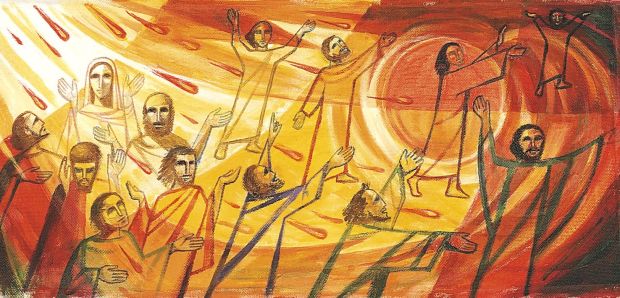
When Pentecost Day arrived, they were all together in one place. Suddenly a sound from heaven like the howling of a fierce wind filled the entire house where they were sitting. They saw what seemed to be individual flames of fire alighting on each one of them. They were all filled with the Holy Spirit and began to speak in other languages as the Spirit enabled them to speak.

There were pious Jews from every nation under heaven living in Jerusalem. When they heard this sound, a crowd gathered. They were mystified because everyone heard them speaking in their native languages. They were surprised and amazed, saying, “Look, aren’t all the people who are speaking Galileans, every one of them? How then can each of us hear them speaking in our native language? Parthians, Medes, and Elamites; as well as residents of Mesopotamia, Judea, and Cappadocia, Pontus and Asia, Phrygia and Pamphylia, Egypt and the regions of Libya bordering Cyrene; and visitors from Rome (both Jews and converts to Judaism), Cretans and Arabs—we hear them declaring the mighty works of God in our own languages!” They were all surprised and bewildered. Some asked each other, “What does this mean?” Others jeered at them, saying, “They’re full of new wine!”

Peter stood with the other eleven apostles. He raised his voice and declared, “Judeans and everyone living in Jerusalem! Know this! Listen carefully to my words! These people aren’t drunk, as you suspect; after all, it’s only nine o’clock in the morning! Rather, this is what was spoken through the prophet Joel:

In the last days, God says,
I will pour out my Spirit on all people.
    Your sons and daughters will prophesy.
    Your young will see visions.
    Your elders will dream dreams.
    Even upon my servants, men and women,
        I will pour out my Spirit in those days,
        and they will prophesy.
I will cause wonders to occur in the heavens above
    and signs on the earth below,
        blood and fire and a cloud of smoke.
The sun will be changed into darkness,
    and the moon will be changed into blood,
        before the great and spectacular day of the Lord comes.
And everyone who calls on the name of the Lord will be saved. (Common English Bible)
The Holy Spirit is the distinguishing mark of the believer in Jesus Christ.

Therefore, since the Spirit is given, the main responsibility of Christians is to receive. 

Christianity is distinctive in this sense – it is primarily a religion of receiving. The Christian life is lived by the power of the Holy Spirit, and not in our own strength. The function of faith is to receive what grace offers. 

We are saved and sanctified by grace alone through faith. God lives in and through us by means of the Spirit. The miraculous and the supernatural cannot, obviously, be done by any human person.  It can, however, be accomplished through the power of the Holy Spirit.

People tend to put a lot of pressure on themselves to be a certain way and to do certain things. The result? Tiredness. Discouragement. Imbalance. Lots of giving. Little receiving.

Christianity is not chiefly about giving but receiving. The Christian life is about putting oneself in a position to receive through prayer and humility. In Christianity, the opposite of receiving is not giving – it’s pride. 

Maybe this kind of talk makes you uncomfortable. I’m not talking about being passive or lazy. I’m highlighting the need of receiving grace from God by means of the Holy Spirit. Then, the Spirit to work in and through us. 

Jesus said we would do greater works than even he himself with the advent of the Spirit! (John 14:12-14)

The question then becomes: Will we let God be God? Will we allow the Spirit to do work in us?
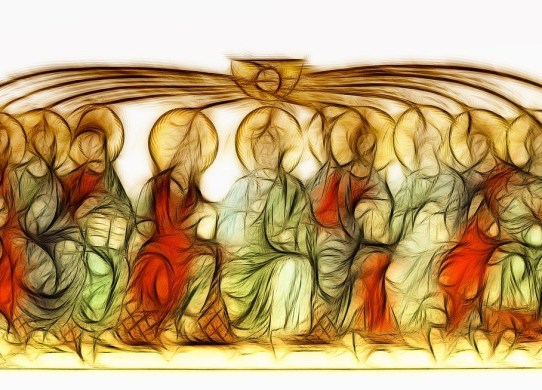
The Spirit is elsewhere described in Holy Scripture as a gentle presence, an encourager, counselor, and comforter. Yet, not here at Pentecost – the Spirit is portrayed like a violent wind and an unusual fire.

The Holy Spirit on the Day of Pentecost was not some gentleman caller entering politely when invited. Instead, the Spirit appears more like a drunken sailor who bursts into the room and causes a big ruckus. There’s nothing subtle about the Spirit at Pentecost. The Spirit is electric, bombastic, and volcanic, causing a huge scene and upheaving the status quo.

Because of Pentecost, Christians are marked and defined by God’s Spirit living within them and being full of the Spirit. God wants to pour out the Spirit on all kinds of people to overflowing so that what comes out of them is “prophecy.” 

The prophet Joel and the Apostle Peter do not intend the word “prophecy” to mean predicting the future. Rather, they are referring to inspired speech coming from a heart overflowing with the Spirit. 

Just as an inebriated person says and does things they would not typically say or do because they are filled with alcohol, so the person filled with God’s Spirit says things and does things they would not typically say or do because their inspiration and courage come as a result of God within them.

Thus, we must cast off the unholy spirits of inebriation and receive the Holy Spirit of God.

Descent of the Holy Spirit at Pentecost mosaic by Anna Wyner

God sobered-up the little band of Christ followers from learners to practitioners, sending them into the world with a mission.

Being on a mission from God is not really about ability; it’s about being filled and sent. 

First time parents may read and learn all they can about parenting before their child is born. Yet, when that little bundle comes into the world, and the hospital puts this kid in your arms and sends you out, you feel inadequate for the task. Parenting becomes a kind of supernatural affair where you pray and learn on the fly, finding out that you need something beyond yourself to get anywhere in raising this screaming, pooping, sleeping person who depends completely on you for everything. 

God sends us into the world to make disciples. And we may feel very inadequate for the task. However, this has more to do with receiving the Spirit. The Spirit comes looking to turn our lives upside-down with new life in Jesus Christ. 

Pentecost means that the Spirit came to shake things up and accomplish among God’s people what they could never do on their own.

Everyone who calls on the name of the Lord will be saved. 

The Church in the New Testament was not a country club for people to simply enjoy the perks of membership.  The community of the redeemed, the Church, is actually more like a place where the people seem drunk because they are all talking with inspired speech from the Holy Spirit. 

Maybe we don’t need to be saved in the sense that we have already called on the name of the Lord concerning forgiveness in Christ. Yet, maybe we need to call on the name of the Lord to be delivered from our misguided attempts to see the Christian life as a pleasant affair.

Perhaps we need deliverance from disordered priorities and misguided loves. We may need to be saved from ourselves so that we are open to the Holy Spirit with palms up receiving from God whatever it is the Spirit wants to do in and through us, rather than telling God how we think things ought to go. 

Prayer, then, is more about receiving the Spirit and God’s purposes for us rather than giving God an earful and expecting the Lord to bless our plans.

Pentecost is the launching pad of the church’s mission – it was explosive because the Spirit is a kind of wild man who fills people up to overflowing so that what comes out of them is inspired speech and missional actions.

If a language barrier cannot stop the Spirit from operating, then how much more can God transform us and use us in the lives of those around us?

Joel’s prophecy, quoted by Peter, is only partially fulfilled. Events have been set in motion by Pentecost for the complete fulfillment of God’s justice. So, there’s some urgency for people to fill their vacuous souls with the grace freely offered to them in Christ.

The outpouring of the Spirit is a sign: The end is near. And the generous giving of the Spirit is inclusive – there is room for all kinds of people. Through the Spirit, God saves all who call on the name of the Lord.

Today is not just another day on the calendar. It is the Day of Pentecost! 

Just as marriages occasionally need a spark and a fire and a fresh wind, so we need the Holy Spirit to breathe on us, comfort us, and inspire us.

May we be filled with the Spirit as we anticipate what our God will do now, and in the years to come.

Spirit of the living God, through the reading and proclamation of the Word, may you refresh our spirits, reshape our desires, recreate our hearts, and reform our ways so that we will shine with your enduring glory, through Jesus Christ, our risen and ascended Lord. Amen. 

Revelation 1:9-20 – I Am Fully Alive

Notre Dame Cathedral Basilica in Ottawa, Canada

I, John, your brother and companion in the suffering and kingdom and patient endurance that are ours in Jesus, was on the island of Patmos because of the word of God and the testimony of Jesus. On the Lord’s Day I was in the Spirit, and I heard behind me a loud voice like a trumpet, which said: “Write on a scroll what you see and send it to the seven churches: to Ephesus, Smyrna, Pergamum, Thyatira, Sardis, Philadelphia and Laodicea.”

I turned around to see the voice that was speaking to me. And when I turned I saw seven golden lampstands, and among the lampstands was someone like a son of man, dressed in a robe reaching down to his feet and with a golden sash around his chest. The hair on his head was white like wool, as white as snow, and his eyes were like blazing fire. His feet were like bronze glowing in a furnace, and his voice was like the sound of rushing waters. In his right hand he held seven stars, and coming out of his mouth was a sharp, double-edged sword. His face was like the sun shining in all its brilliance.

When I saw him, I fell at his feet as though dead. Then he placed his right hand on me and said: “Do not be afraid. I am the First and the Last. I am the Living One; I was dead, and now look, I am alive for ever and ever! And I hold the keys of death and Hades.

“Write, therefore, what you have seen, what is now and what will take place later. The mystery of the seven stars that you saw in my right hand and of the seven golden lampstands is this: The seven stars are the angels of the seven churches, and the seven lampstands are the seven churches. (New International Version)

“Let every man and woman count himself immortal. Let him catch the revelation of Jesus in his resurrection. Let him say not merely, ‘Christ is risen,’ but ‘I shall rise.’”

Phillips Brooks (1835-1893)

Easter Sunday may have come and gone, but the church remains in the season called “Eastertide,” which extends forty days until celebrating Christ’s ascension to heaven. This means that Easter is not just a one day affair; it is a joyous time of focusing on new life and exulting in the resurrected Lord. 

The Apostle John had a vision of the resurrected Jesus in his glory. Although John was quivering in his sandals, the Lord assured him that he need not be afraid. Christ is not dead but living.

Jesus is alive! Since Christ is risen, God’s people are united with him in his resurrection. That means the church is alive. Yes, the church is a-l-i-v-e, alive! 

The term “dead church” gets bantered around quite a bit these days. But that is really an oxymoron; a genuine Christ redeemed Body of believers cannot possibly be dead; they are alive! 

If a church is dead, it is not a church. It could be a country club, a benevolent organization, and even a moral institution, but a church is not a church if it is dead because Jesus is alive, and his Body is anything but dead.

Christians have life in Jesus Christ. We are alive forevermore because Jesus will never again die. So, then, we are to live as vigorous and vibrant believers. 

What things will you do differently since you know you cannot die? 

How will the knowledge of your eternal alive-ness impact you today and every day? 

The truth is: We have been raised with Christ to new life; we cannot die because death no longer has mastery over us. We can now live by faith in the Son of God who loved us and gave himself for us.

Just as Christ was raised from the dead through the glory of the Father, we too may live a new life.

For if we have been united with him in a death like his, we will certainly also be united with him in a resurrection like his. For we know that our old self was crucified with him so that the body ruled by sin might be done away with, that we should no longer be slaves to sin—because anyone who has died has been set free from sin.

Now if we died with Christ, we believe that we will also live with him. For we know that since Christ was raised from the dead, he cannot die again; death no longer has mastery over him. The death he died, he died to sin once for all; but the life he lives, he lives to God.

In the same way, count yourselves dead to sin but alive to God in Christ Jesus. (Romans 6:4-11, NIV)

“The glory of God is a person fully alive, and the life of a person is the vision of God.”

St. Irenaeus (130-202, C.E.)

Humanity’s alive-ness is what most fully displays the glory of God on this earth. Christ living within the believer is a powerful and potent manifestation of God’s goodness.

Whereas we may think that great miracles are the best sign of God’s presence and power in the world, the truth is that being full alive, and living into the new life we possess, is a bright light which shows the way of transformation to a fallen planet in the vice grip of sin, death, and hell.

God’s generosity, wisdom, and love are supremely viewed with the changed life of an individual. Living life to the full in this post-resurrection era, influences how we treat one another because we nobly honor our fellow humanity as people bearing the divine image of God.

We, therefore, in our alive-ness, seek to understand one another because we know that each person around us is worth understanding. Our being fully alive moves us to cultivate a virtuous life, knowing that a life well-lived is the best witness to God’s glory.

Believers raised with Christ are filled with joy, realizing that living is in itself a great good. We hope to carry this joy into the world and bear witness to the beauty of each human life.

O God, as people fully alive, make us bold in love, courageous in hope, and whole in faith. May the blessing of God almighty – Father, Son, and Spirit – be upon the Church everywhere, today and always, through Christ our risen Lord. Amen.

Romans 15:1-6 – The Responsibility of the Powerful

We who are powerful need to be patient with the weakness of those who don’t have power, and not please ourselves. Each of us should please our neighbors for their good in order to build them up. Christ didn’t please himself, but, as it is written, The insults of those who insulted you fell on me. Whatever was written in the past was written for our instruction so that we could have hope through endurance and through the encouragement of the scriptures. May the God of endurance and encouragement give you the same attitude toward each other, similar to Christ Jesus’ attitude. That way you can glorify the God and Father of our Lord Jesus Christ together with one voice. (Common English Bible)

“With great power comes great responsibility.”

Stan Lee

Within the ancient church in Rome there existed people of Jewish descent as well as non-Jews (Gentiles) who had come to embrace Christ. These two groups had vastly different backgrounds and experiences. Now they found themselves within one church, with only their shared commitment to Jesus.

Getting along was downright hard. It took a great deal of work for them to understand one another. Throughout the Apostle Paul’s letter to the believers in Rome, he consistently went back and forth, addressing both groups.

Frankly, Paul was most difficult on his fellow Jews. He took them to task. In his view, the Jewish believers had a responsibility to set a tone of Christian equality and fairness. Since the Jewish people have such a rich spiritual history as God’s people, it was Paul’s admonition they use their power on behalf of the non-Jewish Gentiles.

There were some Jewish believers who believed it best that the non-Jewish believers become religiously Jewish. They thought that Gentiles, with no background whatsoever in Old Testament belief and practice, would need to be like them in order to become good Christians.

Paul passionately believed otherwise. The Jewish position of privilege was to be used to encourage and help, not criticize and make things more difficult for non-Jewish persons. Jesus, a Jew himself, did this during his life and ministry on earth.

It came down to a belief of whether Jews ought to hold positions of power within the church, or that power should be shared. As it still is today, it was then with the Jewish people: They have carried an inordinate burden of the world’s sin upon their shoulders. Paul wanted them to continue this special calling – not taking advantage of an opportunity to be on top – but embracing their call for the sake of Christ’s gospel.

Whether Jew or Gentile, all together were to make every effort to do what leads to peace and the encouragement of one another. Those with power were to make room at the table (and Table!) for those without power.

The ideal which Paul so adamantly struggled for was unity – to have both Jew and Gentile together as sisters and brothers in the faith. There was never to be two churches – one Jewish and one Gentile. Christ’s death had abolished all barriers to unity. Now, everyone must come together and re-orient their lives around the good news of new life in Christ. (Ephesians 2:11-22)

Since Jesus closely identified with others, now we, his followers, are to demonstrate a genuine spirit of care and welfare for all people. This is a new family relationship which did not exist before Christ. God, however, has adopted all kinds of non-Jewish people into the family. So, we have responsibilities to get along with each other.

It must always begin with those who possess the power and privilege. They have the first responsibility to initiate an egalitarian society. The onus is on the powerful to ensure that a fully inclusive Christian ethic is established and maintained. We are to welcome others just as Christ welcomed us.

The Christian ethic of welcoming, encouraging, and including is helped by being mindful of the following:

  • Listen more. Talk less. A particular temptation for those with power is to make decisions without consulting or collaborating. Basic human respect comes from listening – neither interrupting nor overtalking. The less powerful folks need to be heard. Give them a seat at the table and honor them with your ears.

People who listen when they are corrected will live, but those who will not admit that they are wrong are in danger. (Proverbs 10:17, GNT)

  • Be curious. Respect another’s contribution. Be welcoming and open, whether or not you agree. Seek understanding rather than always trying to be understood. “Tell me more.” “Help me understand.” And “I’d like some clarification…” are all simple phrases of healthy curiosity which invites others to talk.

The people in Berea were more open-minded than those in Thessalonica. They were so glad to hear the message Paul told them. They studied the Scriptures every day to make sure that what they heard was really true. (Acts 17:11, ERV)

  • Don’t assume. Not everyone has had the same experiences. We don’t all know the same things. Take the posture of a learner. Be something of an anthropologist, seeking to discover rather than superimpose what you already believe on a different group of people.

Don’t fool yourselves! If any of you think you are wise in the things of this world, you will have to become foolish before you can be truly wise. (1 Corinthians 3:18, CEV)

  • Be aware of your own biases. We all have them. It takes some work to uncover our prejudices as well as our privileges.

I solemnly command you in the presence of God and Christ Jesus and the highest angels to obey these instructions without taking sides or showing favoritism to anyone. (1 Timothy 5:21, NLT)

  • Embrace empathy. We all know how it feels to be excluded, left out, and even shamed about something. Let’s use our own experiences to realize what others might be going through. Looking down on another, or dismissing them in some way, is not the way of our Lord.

Laugh with your happy friends when they’re happy; share tears when they’re down. Get along with each other; don’t be stuck-up. Make friends with nobodies; don’t be the great somebody. (Romans 12:15-16, MSG)

  • Focus on connection, not fear. In many groups and in many places, the “other,” the one who is different, is looked upon with suspicion as someone who might upset existing societal norms or steal something we have. Seeking to establish connection with others mitigates fear and anxious feelings.

As many of you as were baptized into Christ have clothed yourselves with Christ. There is no longer Jew or Greek, there is no longer slave or free, there is no longer male and female; for all of you are one in Christ Jesus. (Galatians 3:27-28, NRSV)

  • Be patient with others. People need our gentleness and our humble help, not our judgment and exasperation. Treat others the way you’d like to be treated.

Be humble and gentle in every way. Be patient with each other and lovingly accept each other. (Ephesians 4:2, GW)

“So in everything, do to others what you would have them do to you, for this sums up the Law and the Prophets.”

Jesus (Matthew 7:12, NIV)

That about sums up exactly what Paul intended to say. Now go and do likewise.

O God, in accepting one another wholeheartedly, fully, and completely, we accept you. Fill us then with love and let us be bound together with love as we live our lives, united in this one spirit which makes you present in the world, and which makes you witness to the ultimate reality that is love. Love has overcome. Love is victorious. You are Love. Amen.

Ephesians 4:17-24 – Stop Being Stupid

As a follower of the Lord, I order you to stop living like stupid, godless people. Their minds are in the dark, and they are stubborn and ignorant and have missed out on the life that comes from God. They no longer have any feelings about what is right, and they are so greedy that they do all kinds of indecent things.

But that isn’t what you were taught about Jesus Christ. He is the truth, and you heard about him and learned about him. You were told that your foolish desires will destroy you and that you must give up your old way of life with all its bad habits. Let the Spirit change your way of thinking and make you into a new person. You were created to be like God, and so you must please him and be truly holy. (Contemporary English Version)

“Nothing in all the world is more dangerous than sincere ignorance and conscientious stupidity.”

Martin Luther King, Jr.

Why in the world are some people stupid and godless?

I’m sure if you asked that question to a dozen people you might get a dozen different responses.

According to the Apostle Paul, it comes from a disconnection from truth. And biblically, since the very character of G-d is truth, then ignorance and a closed heart also result from estrangement from G-d.

The Christian tradition teaches that Jesus is the way, the truth, and the life. Life together is to be shaped around the person and work of Christ. Since Christians share a common confession of Jesus, we are to share a common life together. That life is to revolve around the truth of Jesus. That means we will put off non-Christian ways of relating to each other and put on a Christian way of relating to each other. 

We will, then, speak truthfully and live honestly, because we belong to each other – we are responsible for one another. Just as Jesus so closely identified with us in his life, death, and resurrection, so we are to so closely identify with each other that we take responsibility for each other. My problems are your problems – your issues are my issues. This is a stance of connection, not division.

When believers are firmly moored to Christ and to Christian community, then, with the enablement of the Holy Spirit, they are able to forsake the old life with its unhealthy routines of living and embrace a new life with good healthy habits of daily life.

Some people continually struggle to overcome bad habits. In part, it’s because they are living a half-truth life. They might be connected to Jesus as Truth yet remain stubborn about staying disconnected from Christ’s Church.

One never realizes sustainable holiness over time apart from Christian community. In other words, real lasting change comes from both the truth of Christ and the truth of Christ’s Church.

“No one can have God as his father who does not have the Church as his mother.”

St. Cyprian (c.210-258 C.E.) and St. Augustine (354-430 C.E)

The magisterial Reformer, John Calvin, upheld the ancient teaching of the Church:

“The Church is our mother, inasmuch as God has committed to her the kind office of bringing us up in the faith. This method of education is not to be despised…. She has the milk and the food by which she continually nourishes her offspring. This is why the Church is called the mother of believers. And certainly, the one who refuses to be a child of the Church desires in vain to have God as Father.”

John Calvin

This is a consistent understanding throughout Christian history. That’s because the ancient church fathers (and mothers!) knew people are hard-wired for community and, what is more, truth is located not only in the Head of Christ but also in the Body of Christ. Decapitating head from body is to sever the truth in half. They have always been meant to go together as one.

To know the truth intellectually and cerebrally is only half of personal transformation. There also must be a bodily living of the truth – and to do that takes the Body of Christ. Life in Christ is life together as Christians.

Just as it was not our choice to be born into our biological family, so we are born again into a spiritual family, the Church. And just as that crazy uncle, obnoxious cousin, bossy big sister, as well as the entire family system can be difficult in our biological family, so it is the same in our spiritual family. We can choose to be estranged from them, but this in no way diminishes the truth that we need family and community.

Yes, both biological family and spiritual family can be (and are) toxic for many people. I am not suggesting we passively submit to abuse and allow ourselves to remain in abusive relationships. What I am saying is that doing away with community altogether is an awfully bad idea.

As much as I, in the past, have wished to run away and live alone in the woods with only bears and raccoons as my friends, I didn’t do it, mainly because I knew better. I knew I needed a supportive community of redeemed people if I was every going to truly honor G-d and experience becoming holy as G-d is holy.

If we want to participate in the life of G-d, it comes with community.

It is, therefore, necessary to hold one another accountable, as well as help each other to be truly holy. We need to embrace the teachings of the New Testament toward one another: Love one another (John 13:34); Be devoted to one another (Romans 12:10); Encourage one another (1 Thessalonians 5:11); Exhort one another (Hebrews 3:13); Confess your sins to one another (James 5:16); along with dozens of other “one another” references.

A lack of self-awareness, empathy, and understanding comes from being disconnected from community. Yet, when we wise up to embrace the truth of Christ and Christ’s Church, we aren’t fooled by evil, and we discover the strength of life together in the Spirit.

Grant, Almighty God, that all who confess your Name may be united in your truth, live together in your love, and reveal your glory in the world. Guide the people of all nations in the ways of justice and peace; that we may honor one another and serve the common good. And guide us to live together as countercultural models of goodness and reconciliation, in our neighborhoods and beyond, through Jesus Christ our Lord. Amen.
