Believing Hearts vs. Poisoned Minds (Acts 14:1-7)

A Roman bridge between Iconium and Pisidian Antioch

The same thing occurred in Iconium, where Paul and Barnabas went into the Jewish synagogue and spoke in such a way that a great number of both Jews and Greeks became believers. But the unbelieving Jews stirred up the gentiles and poisoned their minds against the brothers. So they remained for a long time speaking boldly for the Lord, who testified to the word of his grace by granting signs and wonders to be done through them. 

But the residents of the city were divided: some sided with the Jews, and some with the apostles. And when an attempt was made by both gentiles and Jews, with their rulers, to mistreat them and to stone them, the apostles learned of it and fled to Lystra and Derbe, cities of Lycaonia, and to the surrounding region, and there they continued proclaiming the good news. (New Revised Standard Version)

The typical approach of the Apostles Paul and Barnabas was to enter a city and find the local Jewish synagogue. But their missionary efforts went well beyond attempting to reach fellow Jews; they also had the mind and heart to include non-Jewish persons, Gentiles, in the fledgling Church.

As a result of this apostolic ministry, a number of both Jews and Gentiles believed the message of God’s grace and became followers of Jesus. Thus, two ancient enemies came together to form one new society. Old animosities and prejudices came down. Jew and Gentile began worshiping together and embracing the words and ways of Jesus.

Yet, at the same time, there were also many Jews who refused to believe. Just as the new believers united together in faith, so the unbelievers banded together for a different purpose: to stir up the Gentiles by infecting their minds against this new union of people, centered around a common confession of Christ.

The unbelievers started a slander campaign against Paul and Barnabas, sowing mistrust and suspicion amongst the people in the street. But the sinful propaganda didn’t deter the apostles from spending considerable time in the city of Iconium and speaking confidently about the good news of Jesus.

What’s more, the message was confirmed by a demonstration of spiritual power. Paul and Barnabas were enabled by God to do many miraculous wonders in the city. This helped the gospel and the authority of the apostles to be established with the people.

The dynamic of belief and unbelief, cut right down the middle of the city. The people became divided and polarized. Some sided with the Apostles Paul and Barnabas, persuaded by their arguments and convinced by their actions; and others sided with the unbelieving Jews, having listened to their slanderous accusations and looking at the apostles as a threat to their existing society.

The climate in the city of Iconium became ripe for violence. Relations between believers and unbelievers deteriorated into planning harm against the new Christians. Even the city officials were becoming sympathizers with the planners to rid the city of the apostles once and for all. In other words, for Paul and Barnabas to remain in the city meant that they would likely get stoned and left for dead.

So, the apostles got out of Dodge and went to the cities of Lystra and Derbe. At least they could keep proclaiming the good news of grace to other people and avoid getting killed.

This story gets at a practical reality for many people of faith: How do people maintain their religious convictions and commitments in an environment that views them as harmful to society?

To be sure, not every person of faith faces this. But others around the world face it every day. And then there are perhaps the majority of the faithful, who sometimes find themselves in places and positions in which slander is rife and verbal violence abounds. What is a person of faith to do?

Not every situation is the same, so each circumstance will take some wisdom in handling it. Nevertheless, the following are some aspects to consider in dealing with the unbelief of others and the harmful effects it can bring:

  1. Persevere in your spiritual confidence. Paul and Barnabas did not cower in fear, but kept up their missionary efforts. The words of gossip and attitudes of hostility around them didn’t slow them down one bit. In fact, in other situations, the apostles who actually experienced harm, chose to view it as a privilege to suffer in the same sort of way Jesus did.
  2. Know when to walk away. Boldness doesn’t necessarily mean that one throws caution to the wind and simply keeps going, no matter the consequences. Paul and Barnabas knew when to leave the city and go somewhere else. They realized the shelf life of their ministry in Iconium was at an end. Neither one of them bemoaned the situation, but instead, looked ahead to the opportunity of gospel proclamation in other cities.
  3. Trust God in all things. Whenever we are slandered, or others actually make plans of harm against us, our initial desire may be to get them before they get us; or to fight back using the same tools of violence that were done against us. Paul and Barnabas did no such thing. Believers have spiritual tools of use that unbelievers don’t possess. So, use them. Pray for those who mistreat you. And let God handle the judgment end of things.

If Christians keep focusing on the words and ways of Jesus, they will consistently practice humility, not pride; confession of faith, not calling out in anger; meekness, not aggressiveness; righteousness, not wrongdoing; mercy, not judgment; purity, not dirty politics; and peacemaking, not war-mongering.

May it be so, to the glory of God. Amen.

Christ and Culture (Revelation 2:12-17)

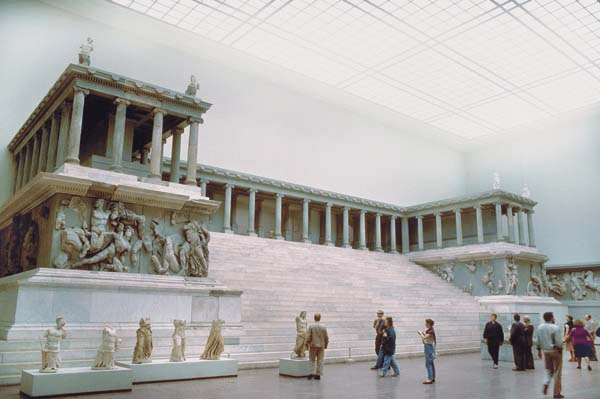
The Altar of Pergamum is considered one of the greatest surviving monuments from antiquity, now located in the Pergamum Museum, Berlin, Germany

“To the angel of the church in Pergamum write:

These are the words of him who has the sharp, double-edged sword. I know where you live—where Satan has his throne. Yet you remain true to my name. You did not renounce your faith in me, not even in the days of Antipas, my faithful witness, who was put to death in your city—where Satan lives.

Nevertheless, I have a few things against you: There are some among you who hold to the teaching of Balaam, who taught Balak to entice the Israelites to sin so that they ate food sacrificed to idols and committed sexual immorality. Likewise, you also have those who hold to the teaching of the Nicolaitans. Repent therefore! Otherwise, I will soon come to you and will fight against them with the sword of my mouth.

Whoever has ears, let them hear what the Spirit says to the churches. To the one who is victorious, I will give some of the hidden manna. I will also give that person a white stone with a new name written on it, known only to the one who receives it. (New International Version)

I’ve lived in one or two places in my life that I might have secretly described as the city where Satan lives. Jesus, however, in words to an ancient church, put it out there that they were living in such a place.

We aren’t told why Jesus described the city of Pergamum that way. Many ancient and important places typically had a prominent temple to some Greek god or goddess. In Pergamum, there existed a temple to Asclepius, the god of healing, symbolized by a snake – which isn’t exactly a positive icon in the worship of God.

The bad names didn’t stop there. Balaam is mentioned. He was a foreigner to Israel who is associated with false prophecy and leading worshipers of God astray. Balaam was blamed for the people’s idolatry and immorality before entering the Promised Land. (Numbers 31:16)

“Probably the greatest tragedy of the church throughout its long and checkered history has been its constant tendency to conform to the prevailing culture instead of developing a Christian counter-culture.”

John R.W. Stott

The name “Nicolaitans” is likely a Greek form of saying “Balaamites.” Thus, they are one in the same thing. It seems that Jesus was pointing a finger directly at particular religious practices consistent with the tradition of Balaam, namely, eating food sacrificed to idols and committing sexual immorality.

Idols and temples and eating were a hot button issue in the earliest church. All the places that churches were established, there were a significant number of Gentile converts from Greek religion to following Christ and worshiping God. And it was anything but a nice easy clean break from the old to the new.

I would surmise that the Balaamites and Nicolaitans are a group of Christian converts from paganism who were embracing a more syncretistic religion, and urging others to do the same – to maintain and engraft some of the Roman values and Greek religious practices so that the church would become more socially accepted and economically viable. Perhaps, they may have reasoned, there would be less persecution and things would generally go better for everyone.

“Some Christians want enough of Christ to be identified with him but not enough to be seriously inconvenienced.”

D.A. Carson

Whereas the Apostle Paul had a more nuanced understanding of the relationship between the church and the culture, the communication to the church at Pergamum was a definitive statement that Nicolaitans are immoral idolaters and the only thing to do in such a case is for them (not the entire congregation as a whole) to repent, stop the syncretism, and start devoting themselves completely to the worship of God alone.

Jesus himself was advocating for a firm refusal in trying to achieve respectability, to make compromises in religious practice. It certainly appears that, at least in the case of Pergamum’s converts, there was to be absolutely no connection with the old religion – not even with eating any meat or anything else that came from the pagan temple.

The Greek god Asclepius was connected with medicine and healing. So, why would this be such a problem for the fledgling church? Why would the city of Pergamum be labeled as the place where Satan lives?

Pergamum was a prominent city. It’s Greek culture, cultural and social traditions, and religious center represented the pinnacle of pagan society. This perhaps explains in part why early Christians viewed the place as a bastion of the devil.

Antipas, the Christian Bishop of Pergamum, is said to have been martyred there at the end of the first century, C.E. – which is around the time when many scholars believe the Book of Revelation was composed.

Whatever was actually going on at the time, there were most certainly significant tensions between the Christian and pagan communities which existed in the ancient city of Pergamum. Avoiding persecution, even death, may have been foremost in the minds of the Nicolaitans – who wanted accommodations with paganism that went too far, even for Jesus.

“Christ claims no man purely as a natural being, but always as one who has become human in a culture; who is not only in culture, but into whom culture has penetrated.”

H. Richard Niebuhr

It’s always been a difficult thing for Christians of every historical age to know how to deal with being in a society that is of a different culture and religion. And every generation of believers need to struggle through and reaffirm what Christian faith looks like wherever they live in this world, and in whatever cultural context they find themselves within.

In the letter to the church at ancient Pergamum, we perhaps find some guidance in Christ’s affirmation of holding onto Christian faith and keeping up a public profession of fidelity to him; and in Christ’s denunciation of diluting that Christian faith with too much accommodation to pagan culture.

Not every believer is going to agree in how to practically proceed with such matters. Yet these are issues worth having constructive conversations about, rather than simply digging into an established personal trench and, from there, lobbing unhelpful volleys of words at those who disagree.

Almighty God and Father of our Lord Jesus Christ, you are a jealous God who will not accept any attachment to other gods. I affirm you as the Most High God, and you will not give your honor or acclaim to idols. Please help us your people to avoid putting anything or anybody above or below you. Amen.

A Great Number of People Believe (Acts 11:19-26)

Now those who had been scattered by the persecution that broke out when Stephen was killed traveled as far as Phoenicia, Cyprus and Antioch, spreading the word only among Jews. Some of them, however, men from Cyprus and Cyrene, went to Antioch and began to speak to Greeks also, telling them the good news about the Lord Jesus. The Lord’s hand was with them, and a great number of people believed and turned to the Lord.

News of this reached the church in Jerusalem, and they sent Barnabas to Antioch. When he arrived and saw what the grace of God had done, he was glad and encouraged them all to remain true to the Lord with all their hearts. He was a good man, full of the Holy Spirit and faith, and a great number of people were brought to the Lord.

Then Barnabas went to Tarsus to look for Saul, and when he found him, he brought him to Antioch. So for a whole year Barnabas and Saul met with the church and taught great numbers of people. The disciples were called Christians first at Antioch. (New International Version)

The earliest of believers in Jesus Christ were Jews. Jewish converts to Christianity were not typically received well amongst their families, communities, and culture. So, when Stephen, one of those converts, retold Jewish history emphasizing a stubborn lack of awareness amongst their ancestors – and then connected it with present day attitudes – a full fledged persecution of Christians broke out.

As a result, the Church – located almost exclusively in Jerusalem – was scattered throughout Judea and across the Roman Empire in a Christian diaspora. In Christ’s ascension, he told the disciples that they would be witnesses beginning at Jerusalem, and then to Judea and outside the Middle East. Little did the small band of believers know, at the time, how that plan would come about.

As it turns out, although life was hard being a Christian refugee in a strange location, the believers spread the good news of Jesus wherever they went. Thus, gospel seeds were planted all across the land.

There is no place we can go where God is not already there.

And so, the displaced Christians discovered God was with them in their sojourning. Their faithful proclamation of good news was the impetus to bringing about many more converts to Jesus Christ.

What was happening in Judea and the Empire came back to the church leaders in Jerusalem. They then, smartly, sent one of their own, Barnabas, to Antioch in order to check out the scene and bring the new believers some encouragement. Since Barnabas was the consummate encourager, the church was emboldened, with even more converts entering into faith in Christ.

Barnabas, as an encourager, had the knack for knowing what he could do and not do; he also knew someone who could supply what he couldn’t do. He was so sure that Saul (Paul) was the right person for the job that he went to Tarsus – which was about 400 miles from Antioch – in order to find him and get him to the new believers as soon as possible. The result was an explosion of fresh converts coming to faith and into the church.

It’s no coincidence that the man with the biggest heart in the church is described in today’s text as a good man who was filled with the Holy Spirit. The Spirit is the One who makes all the difference with the growth of Christianity and the establishment of the Church.

Barnabas could see the evidence of God’s grace in the city of Antioch because he was filled to the full, with God’s own Spirit. He observed people with changed lives; an incredibly diverse and connected international community of believers; and so, encouraged them all in this good work brought about by the Spirit of God.

More and more people were added to the fellowship because of the robust spiritual dynamic that took place. This was not a matter of people using slick marketing strategies to make the name of Jesus Christ known; instead, the adding was all God. The Lord added to the Lord, and not people adding people to the Church. In other words, God is both the subject and the object, the source and the goal, of all good Christian ministry.

Then, when the Lord connected Barnabas together with Saul (Paul) who was also filled with the Holy Spirit and many spiritual gifts from God, the result was nothing less than large numbers of persons coming to faith in Christ and being added to the Church.

The believers in Antioch were so chatty about their faith that the first reference of being called “Christians” were to these converted Jewish believers in Jesus. Even though the moniker of “Christian” was probably a term of derision and meant to mock the Antiochene Church, it stuck, and was held up proudly by the believers. They were completely okay with being called “little Christ’s.”

After all, since they were truly Christ-centered in all they did, it was a fitting title for the fledging and growing Church. It clearly identified them as the people who serve and follow Christ. We, too, these many centuries later, have the very same Spirit of God that they did – and therefore, the same opportunity to speak of Jesus and see the Holy Spirit do the work of adding to the Church.

We pray, almighty God, that all who confess your Name may
be united in your truth, live together in your love, and reveal
your glory in the world.

Guide people everywhere, and of all the nations, in the
ways of justice and peace; that we may honor one another
and serve the common good.

Give us all a reverence for the earth as your own creation,
that we may use its resources rightly in the service of others
and to your honor and glory.

Bless all whose lives are closely linked with ours, and grant
that we may serve Christ in them, and love one another as he
loves us.

Comfort and heal all those who suffer in body, mind, or
spirit; give them courage and hope in their troubles, and
bring them the joy of your salvation.

Lord, in your mercy, hear our prayer. Amen.

Family Dynamics (Matthew 12:46-50)

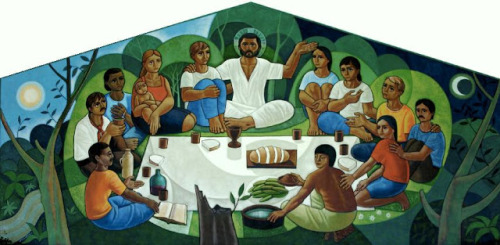
En la Cena ecológica del Reino (At the Ecological Kingdom Dinner) by Spanish artist Cerezo Barredo

While Jesus was speaking to the crowds, his mother and brothers stood outside trying to speak with him.Someone said to him, “Look, your mother and brothers are outside wanting to speak with you.”

Jesus replied, “Who is my mother? Who are my brothers?” He stretched out his hand toward his disciples and said, “Look, here are my mother and my brothers. Whoever does the will of my Father who is in heaven is my brother, sister, and mother.” (Common English Bible)

Jesus obviously did not get the cultural memo that blood is thicker than water.

When his own blood family were waiting outside for him, Jesus used the occasion to speak of what makes up a true follower of God. Christ boldly asserted that his true family is made up of people who do God’s will. By saying this, Jesus brought the point home that the kingdom of God turns on obedience.

Rather than merely confessing a belief, or appealing to a family heritage of faith, Jesus said that a genuine believer in God is one who listens to God’s words and then promptly obeys them. Therefore:

A Christian is defined by allegiance to Jesus, and not by having a certain bloodline. 

Identity determines activity. For example, if I identify myself primarily as…

  • a worker at my job, my activity will show it – I will spend long hours at my labor, and will do whatever it takes to please my boss and gain promotions.
  • an athlete, I will spend long hours honing my skills, and do whatever it takes to please the coach and to win.
  • a spouse and a parent, I will focus most of my attention on my family and seek to please them in all things. 

But if my identity is first and foremost as a Christian, I will seek to please Jesus. With my identity in Christ:

  • I will view my job as an opportunity to express the ethics of God’s kingdom, as a calling from God, and as a means for God to transform me for his glory.
  • I will view athletics as means to glorify God, and not as an end in and of itself but as a special gift for God to teach me about the importance of community and working together. 
  • I will view my kids as belonging to God and I will steward the trust of children given me by doing whatever it takes to teach and train them in the way of Jesus. I will thank God for my family and not confuse them with being God by idolizing them.

Jesus was inside a house, with his family on the outside. So, why were the family members of Jesus not inside the house sitting at his feet, taking the posture of a disciple?

The disciple Matthew wanted to communicate more than physical distance between Jesus and his physical family – being “outside” was meant to convey the posture of Christ’s family as spiritually distant, skeptical of him, and indecisive about who he was and what he was up to. The disciple Mark made this spiritual and emotional distance clear:

Jesus entered a house. A crowd gathered again so that it was impossible for him and his followers even to eat. When his family heard what was happening, they came to take control of him. They were saying, “He’s out of his mind!” (Mark 3:20-21, CEB)

Christ’s earthly family were not looking for Jesus to give them warm-fuzzies and have a big family hug. They were there to essentially say to him, “Cut it out, Jesus, because you’re acting like a nut-cake and embarrassing us all!”

Jesus was saying that identifying only with a biological family leads to only pleasing that family. However, identifying with Jesus leads to a radical form of following God that seeks to please him instead of submitting to family practices, mores, and beliefs which are inconsistent with the kingdom of God. 

Ethiopian Orthodox Church depiction of Christ and his disciples

For the Christian, the church is the family of God, and we are to act consistent with being in such a family.  We are to pursue God’s will, serve one another, and adopt outsiders into our family. The church is a family, not a restaurant. When we go to a restaurant, we either like the food and the service, or not. If the experience was unpleasant, we might complain to the waitress and may or may not come back. Try doing that with your mother and see where it gets you! 

As a biological family, we are committed to each other. There is no complaining about mom because of dad’s wrath. Instead, we are expected to clear our plates and put them in the dishwasher, to sweep the floor and clean the table, and to work together for the benefit of the entire family. In the same way, following Jesus means being committed to his family, the church.

Priority is to be given in doing God’s will, regardless of blood, because obedience to Christ identifies us as being in the family of God. Our actions and the way we live points to what we honestly believe and where our commitments truly lie. 

The first step of God’s desire for us is quality focused time in sitting at Christ’s feet and listening to him, because this is at the heart of all Christian discipleship. We can only do God’s will if we have clearly heard it; and we can only hear God’s will by taking the time to be at the feet of Jesus. 

Both listening and doing are necessary. Listening without engaging the world is a failure of mission; and doing without first listening leads to misguided acts and eventual burn-out. Allow Jesus to call the shots and let him instruct us so that we can live wisely and obediently. 

Jesus did not devalue blood relatives as irrelevant. Rather, the kingdom of God seeks to restore and redeem all things, including family. Both church and family are important. The relationships within each are to be nurtured.

The family of Jesus, the church, is important because Christ suffered and died for her. So, we are to be committed to the church, love the church, and serve the church because we are family. If we have a good grasp of this, we will make decisions based in what we believe God’s will is, instead of whether a relative will get upset, or not. 

We need to persistently pray for spiritually lost family members, and those whom we are estranged from. Most families have at least a few toxic persons in their orbit. Here is how we might pray for them:

  • That God will arrange divine appointments between them and others who love Jesus.
  • That God will draw them to the mercy of Christ.
  • That God will hinder the devil’s schemes against them.
  • That they will understand and respond to the good news of God’s grace.

O God, you made us in your own image and redeemed us through Jesus your Son: Look with compassion on the whole human family; take away the arrogance and hatred which infect our hearts; break down the walls that separate us; unite us in bonds of love; and work through our struggle and confusion to accomplish your purposes on earth; that, in your good time, all nations and races may serve you in harmony around your heavenly throne; through Jesus Christ our Lord. Amen.