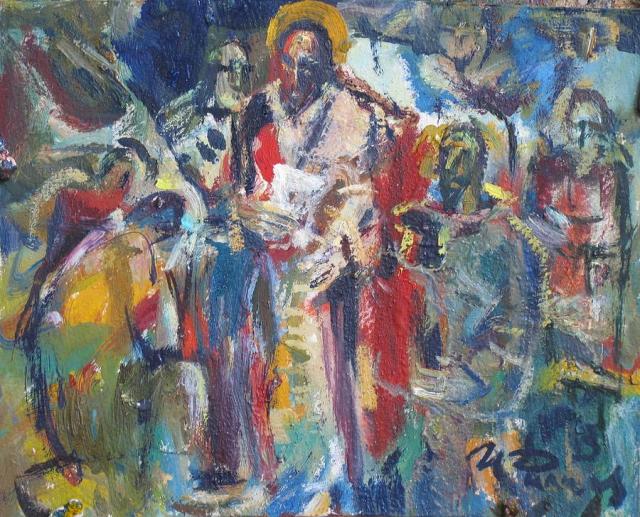
The Call (Psalm 118:1-2, 19-29)

Call to Worship, by Darrell Black

Confess Yahweh, because he is good,

            because his commitment is permanent.

Yisrael is pleased to say,

            “His commitment is permanent”…

Open the faithful gateways to me;

            when I come through them, I shall confess Yahweh.

This is Yahweh’s gateway;

            faithful people come through it.

I will confess you because you answered me

            and became deliverance for me.

The stone that the builders spurned

            became the head cornerstone.

This came about from Yahweh;

            it’s been extraordinary in our eyes.

This was the day that Yahweh made;

            so that we would celebrate and rejoice in it.

Oh, Yahweh, will you deliver us, please?

            oh, Yahweh enable us to succeed, please.

Blessed be the one who comes in Yahweh’s name;

            we are blessing you from Yahweh’s house.

Yahweh is God; he has shone light to us

– tie the festal offering with cords to the horns of the altar.

You are my God and I will confess you;

            my God, I will exalt you.

Confess Yahweh, because he is good,

            because his commitment is permanent.

(The First Testament, A New Translation by John Goldingay)

This psalm is the last of the Hallel (praise) psalms (Psalms 113-118) used at the Passover meal. It includes a summons for the entire community to praise God; an individual thanksgiving to the Lord; and a communal speech.

The Call to Confession

We are invited and called upon to recognize and confess Yahweh’s enduring steadfast love, which is a lasting and permanent commitment toward God’s people. Why? Because it is through a tenacious love that never gives up that brings healing, wholeness, and health to the community. Our relatedness to God makes all the difference in life.

“The unrelated human being lacks wholeness, for he can achieve wholeness only through the soul, and the soul cannot exist without its other side, which is always found in a ‘You.’ Wholeness is a combination of I and You, and these show themselves to be parts of a transcendent unity.”

Carl Jung, The Psychology of Transference

When it comes to healing – whether it be physical, emotional, or spiritual – love must be involved. The need for healing implies brokenness. And love is relational. Therefore, in order to experience the wholeness of healing, there needs to be another.

Love extended to one who requires mercy creates the opportunity to see light in the other, and to feel it in your own. And that energy brings the healing wholeness of both body and soul.

Every divine/human encounter, and each gracious intervention of God to people, is the chance to bring wholeness through the power of love by means of relationship. Communal worship affords us the opportunity to experience the steadfast love and commitment of God – as well as to steward that love well, for others who need it.

The Call to Thanksgiving

Everyone is on board for thanksgiving, right? Well, not so much. Like most things, it’s complicated. On the one hand, we have those persons who seem to never express gratitude for anything; it appears they are only capable of cynicism and sarcasm. And, on the other hand, are those who are incessantly positive, always thankful, no matter the circumstance; for them, it seems they are never living in the reality of a messed up world.

A reflexive response of gratitude to everything is merely a cheap thanksgiving. And a constant stream of ingratitude is simply taking the easy road of complaint. Thanksgiving ought to be thoughtful and well-placed. Gratitude is really a spiritual discipline that requires constant practice until it becomes a solid life skill.

The psalmist pictures the king, David, leading a procession of worshipers as they approach Yahweh. It’s as if the king is teaching the people how to go about entering God’s presence, and what role thanksgiving has in this relationship between God and humanity.

Central to that relationship are offerings of praise and thanksgiving for divine deliverance. Specifically, it is acknowledging gratitude from the place of a spiritual cornerstone. This is the foundation from which an individual’s and an entire community’s faith is rested upon.

The New Testament locates this vital cornerstone as Christ. Jesus is,

“‘the stone you builders rejected,
    which has become the cornerstone.’

Salvation is found in no one else, for there is no other name under heaven given to mankind by which we must be saved.” (Acts 4:11-12, NIV)

Consequently, you are no longer foreigners and strangers, but fellow citizens with God’s people and also members of his household, built on the foundation of the apostles and prophets, with Christ Jesus himself as the chief cornerstone. (Ephesians 2:19-20, NIV)

The Call to Commitment

The permanence of God’s steadfast love and loyalty toward people demands a response. In Christianity, because of the Lord’s commitment to us – through the person and work of Jesus Christ – there is opportunity for a reciprocal response of commitment to God in Christ through the Spirit.

This response of genuine worship and thanksgiving avoids the crush of the constant critic, on the one hand, and on the other hand, steers clear of ignoring suffering.

As you come to him, the living Stone—rejected by humans but chosen by God and precious to him—you also, like living stones, are being built into a spiritual house to be a holy priesthood, offering spiritual sacrifices acceptable to God through Jesus Christ. For in Scripture it says:

“See, I lay a stone in Zion,
    a chosen and precious cornerstone,
and the one who trusts in him
    will never be put to shame.”

Now to you who believe, this stone is precious. But to those who do not believe,

“The stone the builders rejected
    has become the cornerstone,”

and,

“A stone that causes people to stumble
    and a rock that makes them fall.”

They stumble because they disobey the message—which is also what they were destined for.

But you are a chosen people, a royal priesthood, a holy nation, God’s special possession, that you may declare the praises of him who called you out of darkness into his wonderful light. Once you were not a people, but now you are the people of God; once you had not received mercy, but now you have received mercy. (1 Peter 2:4-10, NIV)

Holy Week is nearly upon us. The celebration and praise of Palm Sunday is coming, along with the suffering and death of Good Friday. This all sets the scene for a victorious resurrection which solidifies the Christian’s faith with the mortar of God’s steadfast love in Christ.

As we enter the Week, let us be open to the full range of thoughts and emotions that arise because of God’s loyal and loving commitment to us, and our reciprocal commitment to Christ. Let us be receptive to the call of love.

God of compassion and love, you know our faults and yet you call us to forgiveness instead of leveling judgment upon us. Keep us in your gracious presence, and give us your wisdom. Open our hearts to gratitude and commitment, and restore to us the joy of our salvation. Amen.


Generosity and Thanksgiving (2 Corinthians 9:6-15)

Remember this: Whoever sows sparingly will also reap sparingly, and whoever sows generously will also reap generously. Each of you should give what you have decided in your heart to give, not reluctantly or under compulsion, for God loves a cheerful giver. And God is able to bless you abundantly, so that in all things at all times, having all that you need, you will abound in every good work. As it is written:

“They have freely scattered their gifts to the poor;
    their righteousness endures forever.”

Now he who supplies seed to the sower and bread for food will also supply and increase your store of seed and will enlarge the harvest of your righteousness. You will be enriched in every way so that you can be generous on every occasion, and through us your generosity will result in thanksgiving to God.

This service that you perform is not only supplying the needs of the Lord’s people but is also overflowing in many expressions of thanks to God. Because of the service by which you have proved yourselves, others will praise God for the obedience that accompanies your confession of the gospel of Christ, and for your generosity in sharing with them and with everyone else. And in their prayers for you their hearts will go out to you, because of the surpassing grace God has given you. Thanks be to God for his indescribable gift! (New International Version)

Generosity is at the heart of any good family, neighborhood, workplace, organization, church, and individual. To be generous is to reflect the image of God, who is wildly generous, giving freely and liberally on our behalf.

We often associate being generous with giving a handout or money to someone or some organization in need. It is that, but much more. Generosity doesn’t have to do with the size of our check or the amount of our contribution. 

We can be generous with our time, abilities, words, and with what little or much we have of money, as well. Generosity means to go above expectations – to give with magnanimity, to go out of your way to do good when no one is looking – and experience giving as its own reward.

Jesus, for whom the Apostle Paul learned about the true nature of being generous, embraced generosity as a way of life while he was here on this earth. No one expected Christ to go out of his way to call the least, the lowly, the lost, and the last of society. The people on the margins of respectable culture had no expectations that the Messiah would head their way. But he did. 

Christ the Lord even went so far as to hang out with the despised tax collectors, and freely talk with sexual deviants. The high brows of society couldn’t raise their eyebrows high enough for Jesus. It was just too much for them. Not only was Jesus making them look bad with his generosity as a way of life, but he was also, in their minds, generous to the wrong sort of people.

The follower of Jesus does so by surveying the landscape of human need and giving to people in places where no one expects a handout. 

It’s interesting that Christ lived a simple life with little to no money. He largely depended on the generosity of others. Yes, my friend, generosity is a two-way street. Being generous to others is the easy part for many people; receiving the generosity of other people is often much harder.  Yet, Jesus did both – he gave and received.

Jesus was generous in ways which were consistent with the Father’s will. Christ gave of his time, and of his divine ability to heal and forgive. He was perhaps the most magnanimous person of all-time, due to his generosity of compassion, kindness, love, and humble service to others. 

And the height of Christ’s generosity was in giving his life so that you and I could live a life free from the power of guilt and shame. Such deliverance, through the cross, is offered and given, free of charge. That’s over-the-top generous.

Money is merely a barometer of one’s generosity, that is, of our stance and approach toward money. You don’t need to be rich to be generous. A large and expansive heart always finds ways to have a generosity of spirit wherever it goes.

Jesus warned against using generosity in order to be noticed:

“When you do good deeds, don’t try to show off. If you do, you won’t get a reward from your Father in heaven. When you give to the poor, don’t blow a loud horn. That’s what show-offs do in the meeting places and on the street corners because they are always looking for praise. I can assure you that they already have their reward. When you give to the poor, don’t let anyone know about it. Then your gift will be given in secret. Your Father knows what is done in secret, and he will reward you.” (Matthew 6:1-4, CEV)

A generous heart is a heart of gratitude. Giving thanks is the logical and organic way of expressing generosity.

Consider just a few biblical verses that encourage us toward thanksgiving: 

Let us come before him with thanksgiving and sing joyful songs of praise. (Psalm 95:2, GNT) 

Enter his gates with a song of thanksgiving.
Come into his courtyards with a song of praise.
Give thanks to him; praise his name. (Psalm 100:4, GW)

O give thanks to the Lord, for he is good; his steadfast love endures forever! (Psalm 118:1, NRSV)

In the Gospel of Luke, a story is told of ten men with leprosy who were miraculously healed by Jesus. A Samaritan, the lowliest of the low, was the lone person who came and fell at Christ’s feet with intense gratitude. While the other nine went about their lives free from disease and glad for it, only one guy took the time to thank Jesus. (Luke 17:11-19) 

Indeed, sometimes we must be reminded to give thanks and to show gratitude for the ways in which God has provided for us. Yet, if our hearts are abundantly full of generosity, no reminder is needed; it just comes pouring forth.

Those who have small hearts will only realize small blessings. But those who plant many seeds of generosity and gratitude will see abundant blessings.

May it be so, to the glory of God.

Grateful to God (1 Thessalonians 2:13-20)

Apostle Paul, by Ivan Filichev

And we also thank God continually because, when you received the word of God, which you heard from us, you accepted it not as a human word, but as it actually is, the word of God, which is indeed at work in you who believe. For you, brothers and sisters, became imitators of God’s churches in Judea, which are in Christ Jesus: You suffered from your own people the same things those churches suffered from the Jews who killed the Lord Jesus and the prophets and also drove us out. They displease God and are hostile to everyone in their effort to keep us from speaking to the Gentiles so that they may be saved. In this way they always heap up their sins to the limit. The wrath of God has come upon them at last.

But, brothers and sisters, when we were orphaned by being separated from you for a short time (in person, not in thought), out of our intense longing we made every effort to see you. For we wanted to come to you—certainly I, Paul, did, again and again—but Satan blocked our way.For what is our hope, our joy, or the crown in which we will glory in the presence of our Lord Jesus when he comes? Is it not you? Indeed, you are our glory and joy. (New International Version)

Reception and Acceptance of God’s Word

The Apostle Paul, in all of his letters to the churches, was attentive to affirming those things which are good amongst the believers; and not only the aspects of church life that needed change and/or repentance.

For the Thessalonians, Paul was profoundly grateful to God for the people’s receiving of the Word and their accepting it as from God. Perhaps there is no greater affirmation than this for the Christian.

In order to receive and accept God’s Word, people must know it. And people cannot know God’s Word unless they take the time and effort to read it and discover it for themselves.

Scripture reading is a foundational spiritual practice for Christians everywhere, and for all of Christ’s Church throughout the earth. Church worship liturgies, as well as individual Christians’ daily disciplines of faith, ought to be thoroughly saturated with Holy Scripture. Yet, many churches are believers, sadly, are not.

I am specifically calling out the conservative evangelical church on this. Although they claim to be Bible-centered, with an extended time for the sermon, there is a paucity of actual Scripture contained within those gathered times.

Too much of the preaching fails to truly explain Scripture, and there are virtually no Scripture readings or references outside the sermon and in the worship service. This is a travesty, and also a testament to the biblical ignorance of so many evangelicals.

What’s more, the evangelical impulse for a “personal quiet time with the Lord” is, in reality, practiced by precious few believers – and usually consists of little more than a daily crumb of the Bible.

I perhaps sound cranky and crotchety. Yet in a previous life, I was an evangelical Pastor for many years, and know the frustrations and challenges of attempting to bring biblical literacy to such churches and Christians. There’s a better way, but alas, that is a topic for another time and another post.

Imitators and Sufferers with God’s Churches

The true muster of a Christian and any Christian Church is the desire, speech, and action of actually following the words and ways of Jesus. It was the Lord Jesus himself who said:

“Remember what I told you: ‘A servant is not greater than his master.’ If they persecuted me, they will persecute you also.” (John 15:20, NIV)

“In this world you will have trouble. But take heart! I have overcome the world.”

Jesus (John 16:33, NIV)

Paul was thankful for the Thessalonians because of their solidarity with the other churches; and their willingness to suffer as Jesus did. What’s more, they did not try to reinvent the wheel, but affirmed the sound practices they saw in the original churches of Judea and imitated those good things.

This was not a matter of pragmatism, that is, just doing something that worked somewhere else and adopting it for yourself. Instead, Paul was talking about following the example of the first and earliest of churches. Those churches were made up of Jewish Christians who received a lot of persecution from their fellow Jews.

The Thessalonians, too, received grief and belligerence from the same sort of people, trying to bully them around and tell them what to do. But the believers held fast to the pattern of teaching and living they observed from both Paul and the churches who endured suffering in Judea.

It’s one thing to express belief. It’s quite another thing to suffer for those beliefs and experience persecution for them. God will handle the persecutors on Judgment Day, not us. It’s our job to remain faithful and persevere in the Christian life until that Day comes.

Glory and Joy in God’s Presence

For the Apostle Paul, glory and joy was not found in his great intellect and persuading many people, or his many accomplishments of planting churches and defending the faith. Paul’s highest joy was found in people coming to know Christ and living for Jesus.

His glory was in the hundreds of relationships established with people, and all the believers he mentored. In other words, Paul’s glory and joy was the real names and faces of people he encountered and gathered into the one Church, for whom Christ died and sacrificed himself.

It wasn’t even a thought in the Apostle’s big old head to gain glory for himself, or to pursue joy for it’s own sake. Rather, Paul discovered that real joy and glory comes in fulfilling the mission give to him by Christ:

To make disciples of all nations, baptizing them in the name of the Father, and of the Son, and of the Holy Spirit; teaching them to receive and accept God’s Word, to become imitators and sufferers with God, and to glory and joy in God’s presence.

Almighty God, Father of all mercies, we your unworthy servants give you humble thanks for all your goodness and loving-kindness to us and to all whom you have made.

We bless you for our creation, preservation, and all the blessings of this life; but above all for your immeasurable love in the redemption of the world by our Lord Jesus Christ; for the means of grace, and for the hope of glory.

And, we pray, give us such an awareness of your mercies, that with truly thankful hearts we may show forth your praise, not only with our lips, but in our lives, by giving up ourselves to your service, and by walking before you in holiness and righteousness all our days, through Jesus Christ our Lord, to whom, with you and the Holy Spirit, be honor and glory throughout all ages. Amen.

Formed with Virtue (Romans 1:8-15)

First, I thank my God through Jesus Christ for all of you because your faith is being reported all over the world. God, whom I serve in my spirit in preaching the gospel of his Son, is my witness how constantly I remember you in my prayers at all times; and I pray that now at last by God’s will the way may be opened for me to come to you.

I long to see you so that I may impart to you some spiritual gift to make you strong—that is, that you and I may be mutually encouraged by each other’s faith.I do not want you to be unaware, brothers and sisters, that I planned many times to come to you (but have been prevented from doing so until now) in order that I might have a harvest among you, just as I have had among the other Gentiles.

I am obligated both to Greeks and non-Greeks, both to the wise and the foolish. That is why I am so eager to preach the gospel also to you who are in Rome. (New International Version)

Gratitude, service, prayer, encouragement, and duty. These are the qualities which defined the Apostle Paul; he sought to embody them every day of his life.

These virtues can define us, as well. If we seek to develop and exhibit each one, then we will find true community and satisfying relationships. And these very qualities were what Paul longed for in the Roman Church – because the believers were too often characterized by ingratitude, serving only those who were like them, a lack of prayer, discouraging others, and a warped sense of duty.

Jews and Gentiles were together in one church. It wasn’t going to be easy to get along and work side-by-side, but Paul was absolutely committed to it. Since the Apostle was both a Jew and a missionary to Gentiles, his heart deeply desired a mutual ministry in which the Christians thoroughly loved one another and had each other’s backs.

Gratitude

For that to happen, the practice of thanksgiving is needed.

We know that the one who raised the Lord Jesus from the dead will also raise us with Jesus and present us with you to himself. All this is for your benefit, so that the grace that is reaching more and more people may cause thanksgiving to overflow to the glory of God. (2 Corinthians 4:14-15, NIV)

In truth, gratitude is a spiritual practice which requires cultivation and attention. One of the best ways, in my opinion, of doing this is to keep a gratitude journal – actually hand writing what we are thankful for each day. And, when it comes to others, developing the habit of saying the words, “Thank you,” “I am so grateful,” and “You are so kind, I appreciate it.”

It’s hard to be a spiritual curmudgeon and grump through life whenever gratitude shapes our relationships. Gratitude has the practical effect of curbing our critical tendencies; it helps us as value people by thanking them often and clearly for who they are.

Service

To serve God and others is a way of offering resources, time, influence, and spiritual gifts for the betterment of humanity. This is how we love our neighbor as ourselves.

“Whoever serves me must follow me; and where I am, my servant also will be. My Father will honor the one who serves me.”

Jesus (John 12:26, NIV)

By orienting our lives around service, we begin to see other people’s needs and meet them – since we are taking the time and energy in getting to know them. As servants, we learn to “walk the talk” and embody what we profess. And, if we couple service with gratitude, we are able to whistle while we work and avoid bitterness.

Prayer

We all pray and pray for others. The real trick is to remember one another in prayer and persevere in it. For that to happen, we must allow God to heal our distracted selves and bring integrity to our fragmented lives.

“We should make a gift of our hearts, emptying them of ourselves, that they may be filled with God. Our almighty Father becomes one with us and transforms us, uniting Creator and creature.”

Teresa of Ávila (1515-1582)

By centering our identity firmly in Christ, we open ourselves to remember and intercede for others.

Pray in the Spirit on all occasions with all kinds of prayers and requests. With this in mind, be alert and always keep on praying for all the Lord’s people. (Ephesians 6:18, NIV)

Along with gratitude and service, our prayers take a focused shape of supporting others in need of healing, care, courage, patience, etc. And we replace any tendency to control or manipulate with a prayerful trust in God.

Encouragement

The Apostle Paul had a deep longing to help others grow into their God-given potential. He sought to empower others by sharing his life with them. Paul desired everyone to give themselves for the common good of all.

See to it, brothers and sisters, that none of you has a sinful, unbelieving heart that turns away from the living God. But encourage one another daily, as long as it is called “Today,” so that none of you may be hardened by sin’s deceitfulness. (Hebrews 3:12-13, NIV)

None of us can make it in life without the help and encouragement of others. So, we need authentic relationships for mutual help and support, to learn from each other, and garner wisdom from those who have walked with God many years.

Encouragement is greatly moved along when gratitude, service, and prayer accompany it, so that an encouraging community of people are a loving group of folks for whom others want to be around.

Duty

A sense of obligation is a good thing. It turns our privilege and power into a force for good in the church and the world. In reality, we are stewards of God’s gifts and resources given to us. This enables us to have a healthy practice of duty to our fellow humanity.

Jesus said, “Do not store up for yourselves treasures on earth, where moths and vermin destroy, and where thieves break in and steal. But store up for yourselves treasures in heaven, where moths and vermin do not destroy, and where thieves do not break in and steal.” (Matthew 6:19-20, NIV)

Through infusing our duty with gratitude, service, prayer, and encouragement, it becomes a delight to freely give of ourselves and our stuff, without a begrudging attitude. Generosity becomes a way of life, and we avoid becoming unhappy misers.

“If our charities do not at all pinch or hamper us, I should say they are too small.”

C.S. Lewis

Conclusion

In the Roman Church of Paul’s day, the relational dynamic had not yet broken down to the point of Schadenfreude, that is, actively delighting in another’s misfortune – but they were on their way. To mitigate and stop this from happening, Paul modeled a genuine spirit of thanksgiving, loving service, remembering prayer, healthy encouragement, and generous duty.

We would do well to follow his example of virtue, and be shaped by the gospel of Jesus Christ.

Generous God, I give thanks to you for the gifts you have given me – life, family, friends, time, talents, and possessions. All that I have comes from you. Help me to remember this and rejoice in your goodness.

Walk with me, my God. Help me on my spiritual journey, so that I may constantly renew my relationship with you and all the good people in our parish and beyond.

Renew in me your Spirit. Give me the strength and courage to become a better follower of Jesus, in whose name I am bold to pray. Amen.