Psalm 30 – Mourning Has Turned to Joy

I will exalt you, Lord, for you rescued me.
    You refused to let my enemies triumph over me.
O Lord my God, I cried to you for help,
    and you restored my health.
You brought me up from the grave, O Lord.
    You kept me from falling into the pit of death.

Sing to the Lord, all you godly ones!
    Praise his holy name.
For his anger lasts only a moment,
    but his favor lasts a lifetime!
Weeping may last through the night,
    but joy comes with the morning.

When I was prosperous, I said,
    “Nothing can stop me now!”
Your favor, O Lord, made me as secure as a mountain.
    Then you turned away from me, and I was shattered.

I cried out to you, O Lord.
    I begged the Lord for mercy, saying,
“What will you gain if I die,
    if I sink into the grave?
Can my dust praise you?
    Can it tell of your faithfulness?
Hear me, Lord, and have mercy on me.
    Help me, O Lord.”

You have turned my mourning into joyful dancing.
    You have taken away my clothes of mourning and clothed me with joy,
that I might sing praises to you and not be silent.
    O Lord my God, I will give you thanks forever! (New Living Translation)

Life is not only full of the tears which give way to joy; a great deal of life is learning to move through our grief and transform the pain into something beautiful.

Hard circumstances make us either better or bitter.

The psalmist, King David, had his share of adversity, difficulty, and distress. The youngest of seven sons, David was something like the runt of the litter. He was given the grunt work that nobody else wanted to do, since he was the lowest person in the household.

So, off to the fields he went, shepherding the sheep, dealing with hot days and cold nights, fighting off predators, and keeping the sheep healthy and safe. Yet out there where no one was looking, God was watching. And the Lord was developing within David the very qualities needed to one day rule over all Israel and Judah.

Even in-between becoming a member of the king’s court and becoming king himself, David’s life was mostly characterized by misunderstanding and being victimized. In other words, David had intimate first-hand experience of terrible sorrow, buckets of tears, and stress-filled anxiety. Through it all, he did not become bitter. Instead, David learned to transform his mourning to joy.

Many persons, having experienced the sort of things David of old did, come through their difficulties and adversity with a hard heart. They end up hurting people, just like they were hurt. Their verbal and physical acts of violence betray their inability to turn pain into something useful.

So, what makes the difference between those who experience the same sorts of painful events, yet go in the different directions of caring or harming?

I believe the twentieth-century Trappist monk, Thomas Merton, understood the true source of violence and non-violence…

“There is a pervasive form of contemporary violence to which the idealist most easily succumbs: activism and overwork. The rush and pressure of modern life are a form, perhaps the most common form, of its innate violence. To allow oneself to be carried away by a multitude of conflicting concerns, to surrender to too many demands, to commit oneself to too many projects, to want to help everyone in everything, is to succumb to violence. The frenzy of our activism neutralizes our work for peace. It destroys our own inner capacity for peace. It destroys the fruitfulness of our own work, because it kills the root of inner wisdom which makes work fruitful.”

Thomas Merton, Conjectures of a Guilty Bystander

Merton rightly discerned that the false self (the self we project to others and try to maintain as real) is in fact the source of violence – specifically, the false self’s need to gratify impulses for power and control, affection and esteem, security and safety, at all costs.

However, we do not find ourselves in those ways. The cultivation of solitude, silence, and contemplation are non-violent practices which organically produce non-violent ways of being in the world. Those were the very practices which characterized David’s early life as a shepherd.

It’s what we do when no one is watching, and nobody is around, that makes the difference. Our way of being in the world is determined by the way we are with ourselves when we are alone.

How you are, matters.

“If we do not transform our pain, we will most assuredly transmit it.”

Richard Rohr

We need to be present to our pain, to pay attention to it. Our hurts don’t simply vanish if we ignore them, try to go around them, or seek quick fixes to them. The pain is still there, and over time, becomes gangrene of the soul.

Instead, we must dare to go to the unexplored territory of the inner person, to confront and contend with our inner turmoil and be open to hearing from it.

“The endurance of darkness is the preparation for great light.”

St. John of the Cross

Today, like every day, we have the opportunity and even responsibility to bring our whole selves, pain included, to the relationships we have, the work we do, and everywhere we go. The world not only needs our skills and abilities; it needs us.

The path to joy isn’t through perfect circumstances and having all our wants satisfied; joy comes after a season of darkness with all it’s sobbing, tears, and wondering. As we become more comfortable with the shadowy places of our lives, the more open we become to transforming our pain to a beauty which blesses the world.

O God, you are my God, and I will praise you, whether at night’s inky blackness, or in the day’s bright sunshine of happiness. As I endure each difficult situation, help me to see it’s transformative power and it’s potential to make me a better and more godly person, through Jesus Christ my Lord, in the enablement of the Holy Spirit. Amen.

Psalm 126 – Planting in Tears and Harvesting with Joy

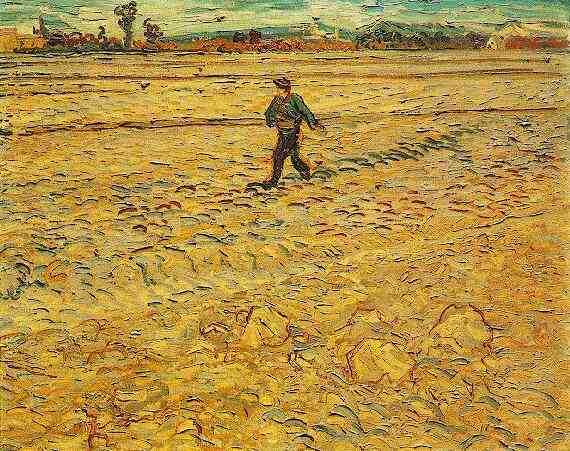
The Sower, by Vincent Van Gogh, 1881

When the Lord brought back his exiles to Jerusalem,
    it was like a dream!
We were filled with laughter,
    and we sang for joy.
And the other nations said,
    “What amazing things the Lord has done for them.”
Yes, the Lord has done amazing things for us!
    What joy!

Restore our fortunes, Lord,
    as streams renew the desert.
Those who plant in tears
    will harvest with shouts of joy.
They weep as they go to plant their seed,
    but they sing as they return with the harvest. (New Living Translation)

Many people are familiar with the phrase, “You reap what you sow.” Although the saying is typically referred to in the context of avoiding poor decisions (Galatians 6:7) the principle is woven throughout Holy Scripture in other scenarios, as well, as it is in today’s psalm.  

Sowing and reaping are, of course, agricultural terms. Farmers and gardeners tend to the soil through tilling, planting, cultivating, weeding, and eventually harvesting. The images of farming and the growth of plants serve as fitting metaphors for the spiritual life. Growth does not occur quickly. Instead, constant and vigilant attention to one’s spirit eventually brings a harvest of good works and godly attitudes. 

Jesus said, “My food is to do what the one who sent me wants me to do. My food is to finish the work that he gave me to do.” (John 4:34, ERV)

In a culture which values immediacy and having things now, the slow growth of the spiritual life can be a difficult principle to grasp. We may think that whenever we sin – with no immediate lightning to zap us – that therefore what we did must not have been so bad. 

Eventually, however, our implanted seeds will sprout and become visible to all. Conversely, we might believe whenever we dedicate ourselves to altruistic service, and then see no immediate results, that we must be doing something wrong. So, we may easily become discouraged and give up.

Sow for yourselves righteousness; reap steadfast love. Break up your fallow ground; for it is time to seek the Lord, that he may come and rain righteousness upon you. (Hosea 10:12, NRSV)

The psalmist reminds us of the need for patience. Just as it takes continual watering to reap a harvest in the field, so the Christian’s life of weeping and tears, of tilling deeply into the things of God, is the necessary work to eventually spot a sprout, see growth, and finally bear fruit. 

The tedious cultivating and weeding of our souls is the task before us. If we are patient and consistent, we will realize a harvest of righteousness. 

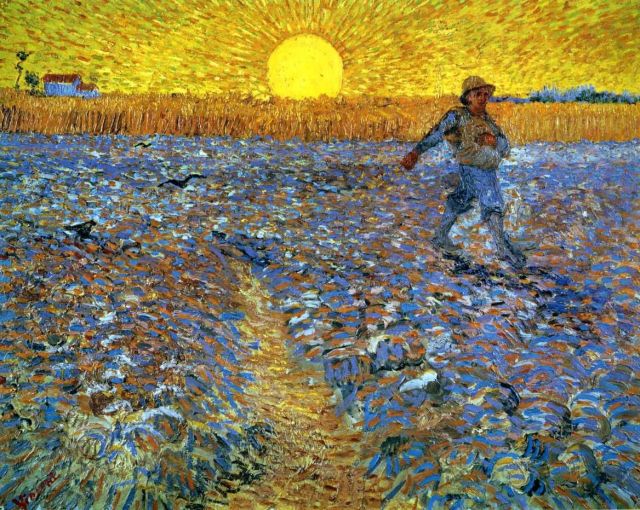
The Sower, by Vincent Van Gogh, 1888

Jesus taught his Beatitudes to help us understand that righteousness, peace, and joy come through connecting with our poverty of spirit; mourning over personal and corporate sin; embracing humility and meekness; hungering and thirsting after righteousness.

Only through the blood, sweat, and tears of spiritual agony will we come through to the deep happiness of seeing the Lord accomplish great things in our lives. In other words, joy is neither cheap nor easy. It is the fruit of many tears.

Spiritual farming involves sound practices of sowing and reaping. There is suffering before glory, tears before joy, lament before healing.

Just as a farmer cannot take short-cuts in the planting and cultivating process if he wants to have a bounteous and delicious harvest, so there is no getting around the painful work of grieving our changes and losses.

Avoiding the hard work of spiritual farming leads to a bogus harvest where we bite into a fresh ear of sweet corn only to discover a mouthful of worms.

Remember this: The person who plants a little will have a small harvest, but the person who plants a lot will have a big harvest.

2 Corinthians 9:6, NCV

The bulk of our lives are played out in the liminal space between sowing and reaping. The farmer plants and waits, attentive to the land and the weather until the time of harvest. We, too, exist in a time of patience. So, we pray, recalling past harvests and anticipate that with God’s good help, we will enjoy abundance.

This in-between time is often characterized by tears.

As she stood behind him at his feet weeping, she began to wet his feet with her tears. Then she wiped them with her hair, kissed them and poured perfume on them. (Luke 7:38, NIV)

I grew up on an Iowa farm. I only saw my father cry twice in my life. The first time, I was just a boy, two days after my eighth birthday – a devastating hailstorm destroyed the crops that had been planted just six weeks before. Despite farm equipment and technological savvy, the farmer is still at the mercy of the weather.

And we will always be at the mercy of God. Because God is good, just, and fair, the Lord does great and benevolent things. To be blessed, we need to embrace the dog days of summer in all its banality and its tears until we reach the time of reaping. There is joy, and it is coming, if we do the work of spiritual farming and wait patiently.

Likely, none of us awake in the morning, sit up on the edge of the bed, and say to ourselves, “Well, let’s see, I think I’ll cry and be sorrowful today.” We might do that with joy, but not with sadness. It can be easier to gravitate toward the fulfillment of dreams, laughter, and happiness than tears and weeping.

Yet, if we want to experience authentic joy, the path to it is through crying because it is our tears which find a better way.

“Normality is a paved road: It’s comfortable to walk, but no flowers grow on it.”

Vincent Van Gogh

Whether it comes from a certain denominational tradition, ethnic background, or family of origin dynamics, there are many Christians who love to emphasize Jesus as Victor and camp in resurrection power – while eschewing Christ as the man of sorrows, acquainted with grief and sadness.

By viewing only one dimension of Christ’s redemptive work, pastoral care often falls far short of true help. Trying to engineer cheerfulness and create solutions to a person’s genuine grief is, at best, not helpful, and at worst, damaging to their soul. It only leads to cheap inauthentic joy.

Sincerely singing spontaneous songs of joy, with a sense of abundant satisfaction, comes through suffering and sorrow. There must be a crucifixion before there is a resurrection. In the agrarian culture of ancient Israel, the metaphor of sowing a reaping connected well to the importance of planting tears and allowing them to flower later into an abundant harvest of joy.

Perhaps in contemporary American culture, a more apt metaphor would be financial investing and cashing out. The investment we put into attending to our grief with expressions of lament through tears, will eventually get a return, and we shall be able to cash out with a rich bounty of joy.

Easter is coming. Resurrection and new life will occur. The journey of Lent, with seeds repentance carefully planted, watered with tears, shall bring an abundant harvest of joy.

Gratias Deo. Thanks be to God.

Luke 19:41-44 – Theological Tears

As Jesus approached Jerusalem and saw the city, he wept over it and said, “If you, even you, had only known on this day what would bring you peace—but now it is hidden from your eyes. The days will come upon you when your enemies will build an embankment against you and encircle you and hem you in on every side. They will dash you to the ground, you and the children within your walls. They will not leave one stone on another, because you did not recognize the time of God’s coming to you.” (New International Version)

There are Christians who believe in withdrawing as much from the world as possible, this side of heaven. There are yet others who believe in accommodating to the world, its structures and society. And there are yet others who believe the world and the church are simply two distinct realms which Christians move back and forth within, like doffing one hat and donning another.

For the moment, let’s just leave all that aside. Instead, observe the pathos of Jesus. Christ came to Jerusalem, a city with deep roots in both religion and the world. He stopped and gazed affectionately at the ancient place with a heart full of longing for what she could be, as well as a heart profoundly sad for what she presently is.

And as Jesus stood and looked at the city in all of its religious piety, as well as its worldly pungencies, he wept.

This was not a quiet shedding of a tear. No, the word “wept” means that Jesus openly cried aloud over the city. This is the kind of crying which happens when a person is in the throes of grief and lament. Jesus was expressing great emotional heaves of loud weeping.

The reason Jesus was lamenting with so much feeling was that the city did not recognize they had a gracious visit from God. The Lord looked at the city and saw all the future disaster which was coming. He knew it could be different, and he was completely undone by the city’s inability to see God, right in front of their own face.

That Jesus wept over a city is more than a deep emotional response; it is also a profound theological statement of subversion against the present order of things. Tears and crying are ways of pronouncing that the status quo of human oppression and indifference is not okay – that there is an alternative path, The Way, which leads to peace and life.

Contrary to many contemporary forms of Christian spirituality, theology and tears are not antithetical nor foreign to one another. They are related, and when practiced well, they inform each other in a full-orbed Christianity that is both holistic and holy. We can no more separate the two anymore than we can divide the humanity and divinity of Christ into parts, as if Jesus were some weird schizophrenic God-Man.

A dispassionate follower of Jesus is really no follower, at all.

Now, let’s return to our view of the world and our involvement in it. Taking some cues from our Lord Jesus, the first and foremost posture we are to take toward the worldly city is not separation, accommodation, or dual citizenship – it is, rather, to weep, to grieve and lament, to sit with and feel the immense sadness of a society askew and awry of God.

The longing Jesus had in his heart was to see the city of Jerusalem annexed and incorporated into the kingdom of God. The way of peace, of shalom on this earth, is to bring all things and all the world under the benevolent reign of God. It’s as if there are Twin Cities, like Minneapolis and St. Paul, which exist side-by-side but have different municipal structures. 

The kingdom of this world and the kingdom of God exist next to each other. Jesus wanted to bring the earthly kingdom into the peaceful and gracious realm of God’s kingdom. But the people would have nothing to do with it. Both the religious establishment and the secular authorities of the city wanted their own municipal conceptions of how things should go – and they both rejected the Christ who could bring everyone true harmony.

King Jesus is our rightful benevolent ruler. Yet, there are so many who do not, or will not, acknowledge that grace and mercy is among them if they would but only look and see.

Let us lament this world, which is chocked full of both religious and secular people who do not recognize the time of God’s visitation. May we journey with Jesus and follow him in his Passion for this world and all its inhabitants. May we sit at the feet of Jesus and imbibe his deep love for all who are estranged from God.

Blessed Father, Son, and Holy Spirit, the holy Trinity whom I serve – the world and even sometimes the church is estranged from grace – they have not recognized your gracious coming and presence. I lament such a state of things, and ask you, blessed Spirit, to draw all people to the Savior, Jesus Christ, in whose name I pray.  Amen.

1 Samuel 2:1-10 – A Hope Fulfilled

Then Hannah prayed:

“My heart rejoices in the Lord!
    The Lord has made me strong.
Now I have an answer for my enemies;
    I rejoice because you rescued me.
No one is holy like the Lord!
    There is no one besides you;
    there is no Rock like our God.

“Stop acting so proud and haughty!
    Don’t speak with such arrogance!
For the Lord is a God who knows what you have done;
    he will judge your actions.
The bow of the mighty is now broken,
    and those who stumbled are now strong.
Those who were well fed are now starving,
    and those who were starving are now full.
The childless woman now has seven children,
    and the woman with many children wastes away.
The Lord gives both death and life;
    he brings some down to the grave but raises others up.
The Lord makes some poor and others rich;
    he brings some down and lifts others up.
He lifts the poor from the dust
    and the needy from the garbage dump.
He sets them among princes,
    placing them in seats of honor.
For all the earth is the Lord’s,
    and he has set the world in order.

“He will protect his faithful ones,
    but the wicked will disappear in darkness.
No one will succeed by strength alone.
    Those who fight against the Lord will be shattered.
He thunders against them from heaven;
    the Lord judges throughout the earth.
He gives power to his king;
    he increases the strength of his anointed one.” (New Living Translation)

This is the song of Hannah, a woman unable to conceive children. She offered a heartfelt petition to God for a child. Hannah’s prayer was answered. A thousand years later, Mary, the mother of Jesus, took this same song, reworked it, and personalized it, to voice and sing her own praise to God. (Luke 1:46-55)

Hannah dared to hope. It might seem from the perspective of one who has never struggled with being childless that offering a prayer for children is easy. However, when hope has been dashed and all seems impossible, putting oneself out there to ask, even to beg, is downright hard. In the fear of having what little hope remains be crushed, it is far easier to stay away from God and keep the prayers to oneself.

Hannah actively sought divine help and risked praying and emoting. The Lord heard. Hannah’s weeping turned to singing. And, like Mary’s Magnificat, Hannah quickly moved from her own experience to the experiences of people everywhere. Hannah focused on the God of the impossible and the divine accessibility which exists when we become vulnerable and put ourselves out there in risky hope.

“Hope is to our spirits what oxygen is to our lungs. Lose hope and you die. They may not bury you for awhile, but without hope you are dead inside. The only way to face the future is to fly straight into it on the wings of hope….hope is the energy of the soul. Hope is the power of tomorrow.”

Lewis Smedes (1921-2002)

The great reversal of Hannah’s condition from barren to fertile gives hope for the weak to become strong, the hungry to be filled, and the lost person to be found. In a world where God is the Sovereign, nothing needs to stay the same – nothing is carved in stone. Since no part of our existence as humans is outside the purview of God, there is always the possibility of change, of a reversal of fortunes.

The underdog has a champion with God. The misfits, the exploited, and the downtrodden – those who cannot lift themselves or pull themselves up by their bootstraps – are precisely the persons whom the Lord raises up. God’s providential care shall oversee them, and justice will be dispensed with perfect equity.

It is one thing to hope; it is another thing altogether in daring to hope against all odds and while others poo-poo your dreams. Godly hope is not wishful thinking; it is a confident expectation that God will show up and be gracious, merciful, and kind.

The place of crying and weeping is important because it is our tears which find a better way.

Anyone can offer cheap praise. Yet, the person who sits with their sadness and feels the heart-wrenching agony of a hope unfulfilled is the one who is able to give genuine praise and to sing with authenticity. Since their hope was planted and watered with tears, their joy in the harvest is abundant and plenteous.

As Christians anticipate the season of Advent, allow the daring hope of Mary and Hannah to conceive a fresh hope in your own life so that you will give birth to new life.

God of hope, in these times of change, helplessness, and uncertainty give us courage to overcome our fears, and help us to build a future in which all may prosper and share together, through Jesus Christ our Lord. Amen.