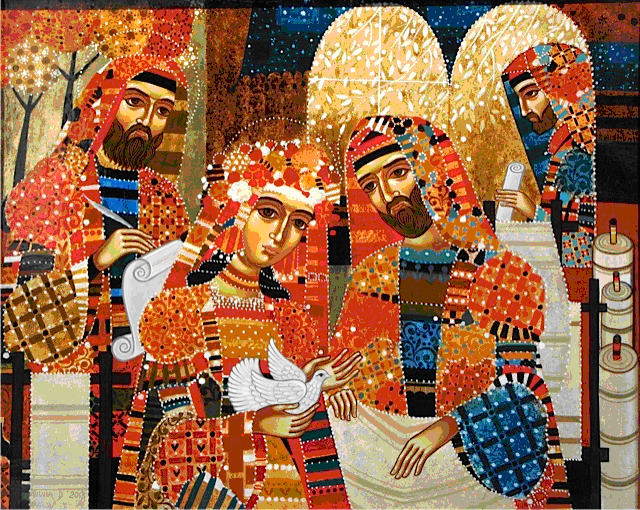
Work Together (Acts 18:24-28)

Priscila and Aquila host Paul and train Apollos, Unknown artist

Meanwhile a Jew named Apollos, a native of Alexandria, came to Ephesus. He was a learned man, with a thorough knowledge of the Scriptures. He had been instructed in the way of the Lord, and he spoke with great fervor and taught about Jesus accurately, though he knew only the baptism of John. He began to speak boldly in the synagogue. When Priscilla and Aquila heard him, they invited him to their home and explained to him the way of God more adequately.

When Apollos wanted to go to Achaia, the brothers and sisters encouraged him and wrote to the disciples there to welcome him. When he arrived, he was a great help to those who by grace had believed. For he vigorously refuted his Jewish opponents in public debate, proving from the Scriptures that Jesus was the Messiah. (New International Version)

I really like this story. I like it for two reasons:

  1. Apollos, although a very learned and gifted guy, nonetheless had the humility to listen and accept the counsel of the couple, Priscilla and Aquila. He had a teachable spirit and a submissive heart.
  2. Priscilla and Aquila, a woman and a man, wife and husband, shared equally in taking the initiative to practice hospitality and make a significant contribution to the learning of Apollos. They had teachers’ spirits and caring hearts.

An intelligent mind doesn’t do much good if it isn’t accompanied by humility – a willingness to be taught, and a heart that is open to receive.

And instructing others accomplishes nothing if it isn’t directed by an egalitarian mindset – a desire to love strangers of all backgrounds and walks of life, and give, in any sort of way that is helpful to the other.

Who was Apollos?

Apollos was an educated man from the city of Alexandria in Egypt. He was well acquainted with Old Testament Scripture and familiar with John the Baptist’s teachings. In the middle of the first century C.E. he came to the city of Ephesus in Asia Minor (present day Turkey) where he began to teach in the Jewish synagogue.

Priscilla, and her husband Aquila, were followers of Jesus in Ephesus and they heard Apollos speaking. They hospitably took him aside and told him the rest of the story. After this, Apollos went to preach in Achaia, having been highly recommended by the Ephesian Christians. His effectiveness was unprecedented.

Apollos was in Corinth (Acts 19:1) where he was useful in watering the spiritual seed which the Apostle Paul had planted (1 Corinthians 3:6). He was such a skilled teacher and so much appreciated by the believers there that, unfortunately, many of the Corinthian believers became attached to him in an unhealthy way, creating schisms within the church, much to the chagrin of Apollos (and Paul). (1 Corinthians 1:12, 16:12)

Who were Priscilla and Aquila?

Priscilla and Aquila were tentmakers native to Rome. After the persecution of the Jewish people under the Emperor Claudius, they made their way to Greece, where they encountered the Apostle Paul and tutored Apollos. Their impact on these Christian leaders – and the bravery they demonstrated within the early church—became legendary, and Priscilla and Aquila are referenced in four different New Testament books.

What’s interesting about the references to this couple in Holy Scripture is the order in which their names are mentioned. In the seven references to the married couple, the wife is mentioned before the husband five times. This is somewhat uncharacteristic of the naming conventions in the Bible and suggests that Priscilla played a leading role in their ministry work.

It was in Corinth that Priscilla and Aquila first encountered the Apostle Paul. They welcomed him into their workplace, providing him with meaningful employment that facilitated his missionary activities. When Paul determined to return to Syria, they accompanied him across the Aegean Sea to Ephesus, where their ministry continued – and it was there that Priscilla and Aquila met Apollos.

In his catalog of greetings to the Roman church, Paul sent his regards to Priscilla and Aquila, indicating that they eventually returned to Rome – which was quite a risky thing to do considering the political climate of the time. Paul notes that Priscilla and Aquila stuck out their necks for him. (Romans16:3)

What do we learn from Priscilla, Aquila, and Apollos?

The story of Priscilla and Aquila holds out a cache of important truths. For one, it demonstrates the added value of men and women partnering over the long term for the cause of Christ. It’s important to collaborate and be willing to consult each other and accept instruction and even correction.

The interaction of these early believers points to the importance of true Christian hospitality. When Paul arrived in their community, they gathered in a worn-out traveler. They provided shelter, company, and income for him, advancing his missionary ventures.

In Ephesus, they followed the same template with Apollos, perhaps sharing what they had learned from Paul to strengthen the witness of this remarkable young preacher. Their table and living room became sources of encouragement and instruction for those who would teach the church at large.

Priscilla, Aquila, and Apollos are good models for all men and women called to Christian mission and service. They longed to serve Christ and the Church in whatever ways they could. They sought to help the next generations of believers in their walk with Christ. And they displayed the sort of qualities needed for the burgeoning church to work together and reach the world with good news.

God of grace and might, who gave to your servants Apollos, Priscilla, and Aquila gifts of zeal and eloquence to make known the truth of the Gospel: Raise up, we pray, in every country, heralds and evangelists of your kingdom, so that the world may know the immeasurable riches of our Savior Jesus Christ; who lives and reigns with you and the Holy Spirit, one God, now and forever. Amen.

Be Open-Minded (Acts 17:10-15)

That same night the believers sent Paul and Silas to another city named Berea. When they arrived there, they went to the Jewish synagogue. The people in Berea were more open-minded than those in Thessalonica. They were so glad to hear the message Paul told them. They studied the Scriptures every day to make sure that what they heard was true. The result was that many of them believed, including many important Greek women and men.

But when the Jews in Thessalonica learned that Paul was telling people God’s message in Berea, they came there too. They upset the people and made trouble. So, the believers immediately sent Paul away to the coast, but Silas and Timothy stayed in Berea. Those who went with Paul took him to the city of Athens. They returned with a message for Silas and Timothy to come and join him as soon as they could. (Easy-to-Read Verson)

Sometimes it’s not you but the audience. The Apostle Paul was, at times, treated like Rodney Dangerfield (getting no respect) and, at other times, like George Carlin (causing people to think and listen without even knowing it).

Everywhere Paul went on his missionary journeys he experienced both acceptance and opposition. Determined to spread the good news of Christ’s redeeming work, Paul found a receptive audience and was able to establish churches.

Yet, Paul also upset the religious status quo wherever he went. As a result, there were times when he and his colleagues needed to steal out of town before an angry mob could get their hands on him. Sometimes, the furious cabal got ahold of Paul; and he forever carried the scars of those beatings on his body. Talk about no respect!

So, it must have been a refreshing experience for Paul to arrive in the city of Berea (located at the base of the Olympian Mountains in southwestern Macedonia) and discover a different spirit than he typically found in other places – a willingness to investigate, scrutinize, and grapple with the message presented. A receptive audience is a beautiful thing.

To spiritually thrive and flourish in this life we all must embrace the noble character of remaining open-minded with a teachable spirit. Just as the body grows, changes, and matures over time, so the human spirit does the same, and needs continual spiritual development. To become closed-minded and believe all questions are answered and settled, is to cut off oneself from truth and reality.

The Apostle Paul, I believe, is a good model of what it takes to be open-minded and a lifelong learner. The following are some ways he kept alive to spiritual truth:

Paul found his motivation. He went on missionary journeys because he wanted to make Christ known in places where he wasn’t. “It doesn’t matter if people are civilized and educated, or if they are uncivilized and uneducated. I must tell the good news to everyone. That’s why I am eager….” (Romans 1:13-14, CEB)

Paul went to new places and met new people. Getting stuck in a rut comes from never doing anything new or going to new places. We don’t have to be missionaries like Paul to do some movement and discover personally unexplored places, both literally and spiritually. Habits and routines are good. Sometimes we just need to create new ones so that we see a different perspective and have new experiences. The inability to see another’s viewpoint comes from an unwillingness to entertain any kind of change.

Paul avoided speculation. He did not superimpose his own experiences onto others. Paul was remarkably open to people everywhere he went, instead of being afraid and expecting trouble and/or abuse. The Bereans were open to Paul because Paul was open to them. Paul avoided looking at them as Thessalonians or Philippians; both were places where he got into loads of trouble just before coming to Berea. A contemporary way of stating Paul’s attitude and practice is that he was free of prejudice and discrimination.

Furthermore, notice the intellectual characteristics of the Berean people:

  • They were curious to hear what Paul thought.
  • They were able to have their ideas challenged.
  • They didn’t get angry when new ideas were presented.
  • They practiced both intellectual humility and mental empathy.
  • They believed Paul had a right to share his arguments, beliefs, and thoughts.

Today, in our intellectually and politically polarized world, far too many people are uncomfortable with uncertainty and ambiguity. So, they are unwilling to wrestle with spirituality by eliminating all mystery from their religion. When that happens, oppression is born. Those were the folks who could not tolerate Paul’s ideas and gave him such a hard time.

By rejecting alternative ideas that might challenge the status quo, people may be able to minimize uncertainty and risk – or at least their perception of risk – yet, the closing of their minds to other’s thoughts opens them to abusing the bodies of those same people.

When people are intellectually and spiritually proud, they wrongheadedly believe that they already know all there is to know, and so, they refuse to listen. At best, this limits the potential for learning; at worst, it forms a cognitive bias which blinds them to their own ignorance and blunts their ability for compassion.

It is, therefore, imperative that we be humble about our knowledge, understanding that there is always more to learn.

Almighty God, in you are hidden all the treasures of wisdom and knowledge. Open our eyes that we may see the wonders of your Word; and give us grace that we may clearly understand and freely choose the way of your wisdom. As the source of all light, enlighten our spirits. Pour out on us the spirit of understanding so that our hearts and minds may be opened. Amen.

Make Wise Choices (Proverbs 3:5-12)

Trust in the Lord with all your heart. Never rely on what you think you know. Remember the Lord in everything you do, and he will show you the right way. 

Never let yourself think that you are wiser than you are; simply obey the Lord and refuse to do wrong. If you do, it will be like good medicine, healing your wounds and easing your pains. 

Honor the Lord by making him an offering from the best of all that your land produces. If you do, your barns will be filled with grain, and you will have too much wine to store it all.

My child, when the Lord corrects you, pay close attention and take it as a warning. The Lord corrects those he loves, as parents correct a child of whom they are proud. (Good News Translation)

“The choice to make good choices is the best choice you can choose. Fail to make that choice and on most choices you will lose.”

Ryan Lilly

The biblical book of Proverbs is a collection of short pithy statements based in experiential truth. That is, they are wisdom sayings.

Wisdom is a gradual accumulation of understanding, over time, with a combination of observation and practice.

The Teacher (the Collector of the proverbs) highlights the wisdom needed to navigate life. It’s a bit like learning the basic laws of the universe, such as respecting the force of gravity by not walking off the roof of your house.

Wisdom observes and pays attention; then applies the understanding gained to reality.

Failing to cultivate a wise life (foolishness) creates all kinds of problems.

Notice the realities we need to respect in our Old Testament lesson for today: God, God’s guidance, God’s honor, God’s discipline.

And then notice the verbs which tell us how to respond wisely: trust, remember, obey, honor, pay close attention. Submitting to reality, respecting others, and accepting situations as they are, and not as we want them to be, is evidence of a sage life.

In contrast to the sage response, foolish reactions are made up of pride, avarice, and hate.

Both wisdom and foolishness are evidenced by their outcomes.

The wise person, having been taught a respect for God and the ways of grace, will most likely have the experience of receiving guidance, health, abundance, and love. Conversely, the fool who ignores divine counsel will probably experience misplaced trust, health issues, short-sighted financial decisions, and cruddy attitudes.

“You can’t choose your potential, but you can choose to fulfill it.”

Theodore Roosevelt

All things being equal, the wise person who deliberately and carefully applies knowledge and understanding to life will have an abundant spirit full of satisfaction – whereas the fool who improvises everything will struggle to live in a small world of holistic poverty and want.

The gist of today’s verses is that one cannot live as an island. We all need to practice consultation and collaboration to achieve a good life. Instruction and correction are necessary to obtain the good life. To spurn both divine and human connections in favor of radical personal independence is plain old foolish; it leads to a lousy life.

In short, the fool incessantly airs opinions with useless sophistry to an empty room; and, the sage is an observant student to universal rhythms and has learned the timing of proper words and of silence.

I am going to state this all in a different way: Relying on God and others through making and keeping promises to one another is the basis of a solid community and a gratifying personal life. Relying merely on one’s self is a one-way road to spiritual pain and emotional damage, not to mention physical illness and financial scarcity.

Fools always think they know best. Sages always know better than that.

The collection of Proverbs we have in the biblical canon is a presentation, a dialectic, a contrast and a setting forth of two ways of approaching how to live in the world:

  • foolishness or wisdom
  • independence or interdependence
  • cognitive pride or mental humility
  • negligence of evidence-based research or consultation through books, literature, and reading
  • exploitation of resources or submission to the natural laws and rhythms of the land
  • holding-on with clenched fists or generosity with open hands
  • Grinch-like attitudes or God-like dispositions
  • incessant criticism or heartfelt tribute
  • blaming or recognizing other’s contributions
  • shame or vulnerability
  • bitterness or forgiveness
  • resistance to correction or acceptance of discipline
  • hate or love
  • judgment or grace

There is always a fork in the road. And standing at those intersections of life, we must choose whether to take the difficult path of wisdom, or amble down the broad highway of foolishness.

The two paths will lead to either life or death, joy or despair, hope or disappointment, faith or fear.

How will you choose? Which way will you go?

Choose wisely, my friend.

Almighty God, the fountain of all wisdom, you know our necessities before we ask and our ignorance in asking: Have compassion on our weakness, and mercifully give us those things which for our unworthiness we dare not, and for our blindness we cannot ask; through the worthiness of your Son Jesus Christ our Lord, who lives and reigns with you and the Holy Spirit, one God, now and forever. Amen.

Nehemiah 8:1-12 – Word and Worship

Ezra Reads the Law to the People by Bernadette Lopez

All the people came together as one in the square before the Water Gate. They told Ezra the teacher of the Law to bring out the Book of the Law of Moses, which the Lord had commanded for Israel.

So, on the first day of the seventh month Ezra the priest brought the Law before the assembly, which was made up of men and women and all who were able to understand. He read it aloud from daybreak till noon as he faced the square before the Water Gate in the presence of the men, women and others who could understand. And all the people listened attentively to the Book of the Law.

Ezra the teacher of the Law stood on a high wooden platform built for the occasion. Beside him on his right stood Mattithiah, Shema, Anaiah, Uriah, Hilkiah and Maaseiah; and on his left were Pedaiah, Mishael, Malkijah, Hashum, Hashbaddanah, Zechariah and Meshullam.

Ezra opened the book. All the people could see him because he was standing above them; and as he opened it, the people all stood up. Ezra praised the Lord, the great God; and all the people lifted their hands and responded, “Amen! Amen!” Then they bowed down and worshiped the Lord with their faces to the ground.

The Levites—Jeshua, Bani, Sherebiah, Jamin, Akkub, Shabbethai, Hodiah, Maaseiah, Kelita, Azariah, Jozabad, Hanan and Pelaiah—instructed the people in the Law while the people were standing there. They read from the Book of the Law of God, making it clear and giving the meaning so that the people understood what was being read.

Then Nehemiah the governor, Ezra the priest and teacher of the Law, and the Levites who were instructing the people said to them all, “This day is holy to the Lord your God. Do not mourn or weep.” For all the people had been weeping as they listened to the words of the Law.

Nehemiah said, “Go and enjoy choice food and sweet drinks, and send some to those who have nothing prepared. This day is holy to our Lord. Do not grieve, for the joy of the Lord is your strength.”

The Levites calmed all the people, saying, “Be still, for this is a holy day. Do not grieve.”

Then all the people went away to eat and drink, to send portions of food and to celebrate with great joy, because they now understood the words that had been made known to them. (NIV)

God’s Holy Word is central to worship. Since the Bible is God’s self-revelation, it makes sense to gather in worship which is saturated with Scripture. The proclamation of God’s Word is important because it is a means of knowing God and teaches us how to live.

The ancient Israelites were taken into captivity from their home in Jerusalem to Babylon. Nehemiah became the king’s cupbearer (a servant who fills wine cups for royalty). Years later, Nehemiah heard about the condition of Jerusalem and determined to do something about it. The walls were broken down and the people were without leadership. Because of his relationship to the king and God’s sovereign working on the king’s heart, Nehemiah returned from exile in Babylon to Jerusalem to rebuild the wall. 

Ezra was a scribe (a copier of the Scriptures), a priest, and a teacher of the Law of Moses (the first five books of the Old Testament). Together, Ezra and Nehemiah were like God’s dynamic duo, renewing the worship of God. It was a time of revival, in which the Israelites found new life around God’s Word.

Renewal, revival, and reformation happen when God’s revelation is carefully and faithfully read, listened to, and acted upon. Life change occurs through Holy Scripture, as we come to understand and apply it to all our circumstances and relationships.

Ezra arrived in Jerusalem first, fourteen years before Nehemiah. At that time, morality was low, and the spiritual condition of the people was unhealthy. Yet, as Ezra prayerfully taught them God’s Word, over time they began to respond.

The rebuilding of the wall under Nehemiah’s leadership was a direct result of the spiritual foundation Ezra had built through the Word of God. After the wall was finished, it was time to hear the entire Book of the Law read aloud. 

Imagine and picture your entire community gathering early in the morning in a park or large space, staying till noon doing nothing but listening to Scripture being read, with various local pastors taking their turn reading and making the meaning clear. All the while the people are responding in worship, tears, and celebration…. If this seems far-fetched for today, it also seemed that way to most people in Nehemiah’s day.

Holy Scripture is a powerful unifying force within the life of God’s people. We may not explain every Bible verse the same way; and the riffraff might attempt to magnify differences and minimize a common confession of faith around Scripture. However, a universal desire to honor, apply, and obey God’s Word draws us closer together rather than separates us.

A first century Jewish teacher, Rabbi Akiva, once noticed a tiny stream trickling down a hillside, dripping over a ledge on its way toward the river below. Below was a massive boulder. The rock bore a deep impression. The drip, drip, drip of water over the centuries had hollowed away the stone. Rabbi Akiva commented, “If mere water can do this to hard rock, how much more can God’s Word carve a way into my heart of flesh?” He realized that if the water had flowed over the rock all at once, the rock would have been unchanged. It was the slow steady impact of each droplet, year after year, that completely reformed the stone.

We oftentimes want quick answers to our questions without taking the time to prayerfully listen and reflect on the Word of God. Yet, God tends to reveal truth over days, months, and years, as we read and discuss Scripture. Through the slow drip of study, prayer, and reflection, day after day, year after year, God shapes and spiritually forms us.

The people in today’s story were responsive, both vocally and physically. They shouted “Amen!” (literally, “yes, may it be so!”)  and raised their hands. Word and worship always go together. 

The people were submissive, bowing in worship (literally, “to prostrate oneself”). True worship listens attentively to God’s Word and surrenders to the Lord. It is an act of humility, pledging to act upon what is heard.

The people were teachable, attentively listening to the Levite priests explain Scripture. Sometimes the Bible is not apparently relevant. We need others to help us, and the patience to stick with it, even when we are not sure about what it is saying. Interpreting Scripture (hermeneutics) typically happens in community, not isolation, which is why small groups of people interacting on the Bible’s message is significant.

The people mourned and wept. Hearing the Word illumined their failures and disobedience. When we look intently into Scripture, we see divine faithfulness and human disloyalty; God’s compassion and our selfishness; the Lord’s holiness and people’s fickle nature.

Awareness of truth causes grief and distress over personal sin and the sin of the world. Yet, there is mercy and forgiveness. Grace washes away guilt and shame and brings restoration. God’s Word both slays us and gives us new life.

In ancient Israel, every Jewish boy had the first five books of the Old Testament memorized by age twelve. The goal was to have Torah internalized and known so that it influenced every situation and every relationship of their lives.

Ezra and Nehemiah were only reinstituting what their ancestors had done:

Moses said, “Gather the people together—men, women, children, and the foreigners living among you—so they can listen well, so they may learn to live in holy awe before God, your God, and diligently keep everything in this Revelation. And do this so that their children, who do not yet know all this, will also listen and learn to live in holy awe before God.” (Deuteronomy 31:12-13, MSG)

Joshua said, “Never stop reading The Book of the Law. Day and night, you must think about what it says.” (Joshua 1:8, CEV) 

David said, “I have hidden your Word in my heart, that I might not sin against you.” (Psalm 119:11, NLT)

The practice of personal and public worship through God’s Holy Word continued with the New Testament writers:

Paul said, “All Scripture is inspired by God and is useful for teaching, for reproof, for correction, and for training in righteousness so that everyone who belongs to God may be proficient, equipped for every good work.” (2 Timothy 3:16-17, NRSV)

“God means what he says. What he says goes. His powerful Word is sharp as a surgeon’s scalpel, cutting through everything, whether doubt or defense, laying us open to listen and obey. Nothing and no one are impervious to God’s Word. We can’t get away from it—no matter what.” (Hebrews 4:12-13, MSG)

Jesus, quoting the Law, said, “It is not just bread that keeps people alive. Their lives depend on what God says.” (Matthew 4:4, ERV, Deuteronomy 8:3)

We need God’s Word because we need God. It is a delight and a duty to learn the Scriptures so that we can know God and know God’s will.

God Almighty, your statutes are wonderful; therefore, I obey them. The unfolding of your words gives light; it gives understanding to the simple. I open my mouth and pant, longing for your commands. Turn to me and have mercy, as you always do to those who love your name. Direct my footsteps according to your word; let no sin rule over me. Redeem me from the oppression of men, that I may obey your precepts. Make your face shine upon your servant and teach me your decrees. Amen. (Psalm 119:129-135)