Divine Intervention (Isaiah 1:24-31)

The Siege and Destruction of Jerusalem, by David Roberts (1796-1964)

So now, listen to what the Lord Almighty, Israel’s powerful God, is saying: “I will take revenge on you, my enemies, and you will cause me no more trouble. I will take action against you. I will purify you the way metal is refined, and will remove all your impurity. I will give you rulers and advisers like those you had long ago. Then Jerusalem will be called the righteous, faithful city.”

Because the Lord is righteous, he will save Jerusalem and everyone there who repents. But he will crush everyone who sins and rebels against him; he will kill everyone who forsakes him.

You will be sorry that you ever worshiped trees and planted sacred gardens. You will wither like a dying oak, like a garden that no one waters. Just as straw is set on fire by a spark, so powerful people will be destroyed by their own evil deeds, and no one will be able to stop the destruction. (Good News Translation)

Judgment does not mean that you need to leave a part of yourself behind in order to be accepted or belong. Judgment isn’t about stuffing down emotions and denying certain thoughts about things because you were told to.

Rather, judgment – divine judgment – is for those leaders, and the persons who support such leaders, who tell people they have to live a particular way, be a certain way, and think in the same way the leaders say you have to think.

Isaiah’s prophecy is first and foremost directed toward leaders – political leaders and religious leaders. Indeed, the nation of Israel had gone down a path of worship that God never condoned nor wanted.

And the Lord put the primary blame squarely upon rulers who led their people in unacceptable ways by telling them things that God never wanted. As a result, the nation as a whole, lived unjustly and unrighteously.

God was determined to do something about the situation of bad leadership: Replace the rulers and advisers. Get rid of them, just like a metallurgist gets rid of impure and worthless dross.

A lot of things in life rise and fall because of leadership. The character and competence of a leader is of upmost importance. God raises up particular people to lead. So, leaders and rulers are expected to fulfill their mandated duty with all diligence and decorum.

The city of Jerusalem fell to the invading Babylonians in 586 B.C.E. All of the Old Testament prophetic books are related to that seminal event in one way or another.

Jerusalem’s destruction, according to the prophets, had a direct relationship to the failure of political kings and religious priests to lead the people according to God’s law. And that failure was specifically tied to the lack of religious piety and leadership performance amongst the rulers of the land.

Indeed, individuals are responsible for their own thoughts and words and actions. Yet, at the same time, the leaders of a city and a nation are also responsible for whether they are leading the people into ways of justice and equity, or injustice and prejudice.

People in responsible positions of authority are to take ownership of the sort of culture they develop. And when people, as a whole, have rude and irresponsible words and actions, such behavior isn’t only on individuals – it’s on the leaders, as well.

God will hold everyone accountable – especially leaders = for what they have done, and not done, to foster a just and right society.

In the time of the prophets, the majority of those in authority led the people into a degenerate state. It had become so bad that divine judgment would intervene in order to burn out the evil, and remove the worthless dross of incompetent and inconsiderate leadership.

Only through the wholesale replacement of rulers and advisers could restoration and regeneration ever take place.

Fortunately, the Lord is a God of justice, mercy, and grace. The Lord is a redeeming God. And the theme of redemption runs throughout the Book of Isaiah. Yet, for a nation to be redeemed, it will require an elimination of rebellious evil.

The wrath of God exists precisely because of the love of God. Since the Lord has a steadfast, committed, and covenantal love for the people, God will render judgment, purging hate and injustice from the land.

When God decrees something, no one can stop it. And when God decrees destruction upon the material things which promote illegitimate worship and public injustice, you can be absolutely sure that it’s going to happen.

No one, no city, and no nation is truly autonomous, in the sense that they can do whatever the heck they want to do, regardless of whether it is right or just, or not. There is no person and no government who is free to indulge in their own selfish agenda.

We have a purpose and a mandate as people on this earth, to care for this world – the people and the environments we inhabit.

All of the ways in which individuals, groups, and governments cheapen and degrade human dignity and environmental worth, puts everyone at risk of survival and a good life on this planet.

Unjust and dysfunctional systems and structures must be purged of their impurities. And that means, in many cases, a new order of things must occur.

If we cannot learn to play well with one another, then playtime will be over; and God will call us back into the house and make us sit in the corner for a long time – or worse.

Whenever leadership fails to be neighborliness, then we have a huge problem.

Our world suffering divine devastation of all the things we know and love may not be far behind. And, quite frankly, it will be our own damn fault – and not somebody else’s.

However, in the prophetic biblical tradition, devastation and destruction never have the last word. There is always hope – a confident expectation that good, right, and just forms of social, economic, and religious communities will function yet again.

There are good leaders waiting in the wings. It’s just that no one yet sees or knows them. But God will raise them up at the proper time, to accomplish good purposes in communities, churches, families, and governments everywhere.

A divine intervention will make the last be first, and the first be last.

May it be so, for the blessing of the world, and to the glory and praise of God. Amen.

Christ the King Sunday (John 18:33-37)

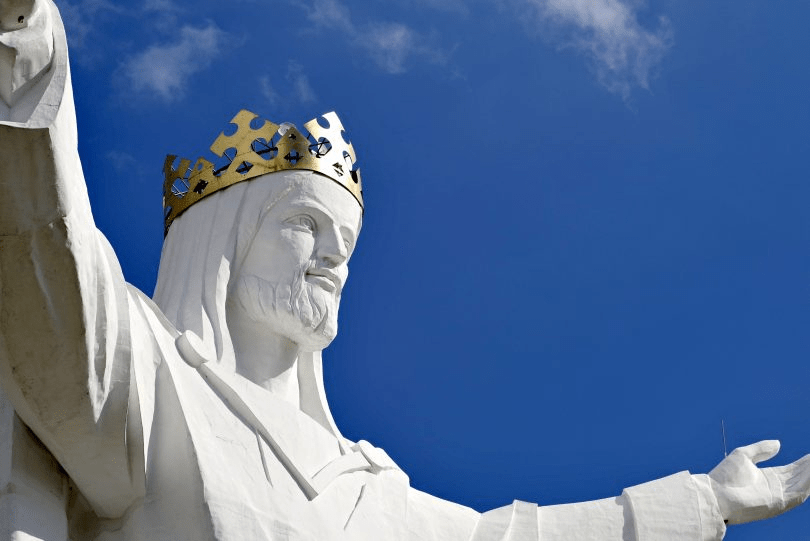
Statue of Christ the King, in Świebodzin, Poland

Then Pilate entered the headquarters again, summoned Jesus, and asked him, “Are you the King of the Jews?” 

Jesus answered, “Do you ask this on your own, or did others tell you about me?” 

Pilate replied, “I am not a Jew, am I? Your own nation and the chief priests have handed you over to me. What have you done?” 

Jesus answered, “My kingdom does not belong to this world. If my kingdom belonged to this world, my followers would be fighting to keep me from being handed over to the Jews. But as it is, my kingdom is not from here.” 

Pilate asked him, “So you are a king?”

Jesus answered, “You say that I am a king. For this I was born, and for this I came into the world, to testify to the truth. Everyone who belongs to the truth listens to my voice.” (New Revised Standard Version)

Each year in the Christian Calendar, Christ the King Sunday is observed as the final Sunday in the liturgical year. It comes at this time, just before the beginning of Advent, in order to consider an important question.

Since Jesus came to this earth in his incarnation to be a king, we must ask, “What kind of a king was Jesus?”

Christ was not, and is not, a king, a ruler (or any other sort of title one wants to use for an authoritative leader) in the same way as was the Roman Emperor, King Herod, or the regional authority of the time, Pontius Pilate.

Jesus was also not like those in authority such as the Jewish High Priest, the Jewish ruling council of the Sanhedrin, or the local synagogue ruler. And Christ is most definitely not like any sort of present day President, Prime Minister, or petty dictator in any of the world’s nations.

Jesus was a king and a ruler who used his power and authority for those on the underbelly of society, that is, people without much, if any, power or authority.

That means Christ the King is concerned to effect a very different set of values from that of any politically dominant governmental system or society that was or is on this earth.

Whether a person or group of people are seeking to win an election, initiate a coup, or effect a change in government, they want their particular system of governing to be in power. They want to call all the shots in a particular place.

That means there will be winners and losers. There will be people in power, and others without it. Some people will benefit from the system, and others will not. Looking at kingship and/or leadership from that perspective, there is a built in failure rate.

The obsession with winning, at a national level, typically involves securing a strong military. Yet, despite military might, soldiers rarely secure any sort of political solution to anything. All it really does is strongarm others into doing what the powerful want done. It does nothing to change the hearts of people.

People in power can be enamored with their authority to do things. And they don’t like it whenever they are not in control of everything. The kings, rulers, and even religious leaders in Christ’s day, were used to controlling public discourse and even the daily lives of common people.

From that sort of worldly understanding of power, Jesus had no real authority. He was this pathetic person standing before a powerful person. Most people would have been begging for their lives. But not Jesus. Christ knew who was really in charge. And it was not Pilate.

Pilate was flummoxed by the presence of Jesus. From Pilate’s perspective, Jesus was not at all acting like a king ought to. Pilate, in his authoritative role, wanted answers about what was going on. But he didn’t realize that his authority was given to him from a power outside the Roman Empire.

Christ’s kingdom is not of this world. Therefore, the power politics and authority positions of that kingdom are nothing what people like Pilate were used to. There was no way that Pilate could use the typical tactics of manipulation, lies, corruption, and leveraging power to come to a satisfactory outcome for himself.

The values of God’s kingdom are quite different from any political government in this world, either past or present.

Jesus had no need to try and be at the top of Pilate’s system, or of the Roman world. So, he wasn’t even going to try and exercise that kind of authority within it. And neither were his disciples. Clubs and swords and pitched battles would not be happening. There was absolutely no need for it whatsoever.

For us today, that means we serve the interests of humility, gentleness, respect, righteousness, mercy, purity, and peace. We are not here on this earth to engage in the routine and typical ways of earthly power politics.

For the Christian, Jesus is King. But this king isn’t riding around in a chariot or a limousine; he comes to us on a jack ass and driving a Subaru.

Jesus is the king with all the power of the universe, and yet is tortured and killed by those with the local society’s authority. That happened not because of weakness or inability, but because of a completely different set of values which have to do with love defeating hate, instead of an army winning a victory.

A God who is crucified is diametrically different than any other deity or authority which has ever existed. The power of love is the ultimate power of doing what is right, just, and good; and letting truth have its way, no matter what.

Christians everywhere must be reminded, on this Christ the King Sunday, that we serve a sovereign king whose power and authority is used to be a humble servant who meets the needs of others.

All Christians, therefore, ought to embrace and engage in becoming gentle folk who bring humble service to others wherever they go. Seeking power, position, prestige, and pedigree is in direct opposition to the values of God’s kingdom, with Christ as King.

Any sort of Christendom, which seeks to control both government and society, or a Christian Nationalism which intends to ensconce personal agendas into society, ought to be rejected.

Christian Nationalism is nothing more than Grape Nuts; just as the cereal is neither grapes nor nuts, so the political movement is neither Christian nor concerned for national interests.

This is a day for the church to reassess what is most important, to affirm its true values, and to evaluate how it really ought to operate in society.

Almighty and everlasting God, whose will it is to restore all things in your well-beloved Son, the King of kings and Lord of lords: Mercifully grant that the peoples of the earth, divided and enslaved by guilt and shame, may be freed and brought together under his most gracious rule; who lives and reigns with you and the Holy Spirit, one God, now and forever. Amen.

Victory Over the Power of Evil (Luke 4:31-37)

He went down to Capernaum, a village in Galilee. He was teaching the people on the Sabbath. They were surprised and impressed—his teaching was so forthright, so confident, so authoritative, not the quibbling and quoting they were used to.

In the meeting place that day there was a man demonically disturbed. He screamed, “Stop! What business do you have here with us, Jesus? Nazarene! I know what you’re up to. You’re the Holy One of God and you’ve come to destroy us!”

Jesus shut him up: “Quiet! Get out of him!” The demonic spirit threw the man down in front of them all and left. The demon didn’t hurt him.

That knocked the wind out of everyone and got them whispering and wondering, “What’s going on here? Someone whose words make things happen? Someone who orders demonic spirits to get out and they go?” Jesus was the talk of the town. (The Message)

During his earthly life and ministry, Jesus was a Deliverer and a Liberator; he came to save people from their guilt and shame, and to free the world from the clutches of evil.

And so, it was inevitable that Jesus would come into conflict with the forces of darkness.

In today’s story, Jesus had a confrontation with an unclean spirit, that is, a demon who is an ally of the devil. The particular demon was not only speaking for himself, but also for his fellow band of wicked spirits.

Christ’s ministry put him in direct opposition to the hosts of Satan. The nub of the issue for the demon was whether Jesus had come for their immediate destruction. Jesus, however, wasn’t in the habit of answering questions from demons.

So, Christ rebuked the demon, told him to get out of the person he was influencing. And that is exactly what happened. The writer, Luke, pointed out that this demonstrated Christ’s authority, that it even includes the power to command unclean spirits, and out they go.

And that is how the liberating and saving ministry of Jesus began.

In the Gospel of Luke, this account of Jesus being confronted by a demon happens just after Christ’s 40 days of being tempted in the desert, even by Satan himself. So, the entire demonic realm was alert to beginning ministry of Christ. They went after Jesus right away, perhaps trying to trip him up before he could get any ministerial momentum.

Jesus was teaching on the Sabbath in the town of Capernaum. We ought not to be surprised that a demonized man was among those observing the Sabbath. The wise believer will be savvy to this reality.

Furthermore, we aren’t told who the man was or of any symptoms he may have had. Apparently, he presented himself as a normal Jewish villager. So, we ought not to think that anyone being demonized will necessarily demonstrate madness or illness of some sort.

The demon was perhaps more aware of who Jesus was than anyone else there on that Sabbath Day in Capernaum. He acknowledged Christ’s power and mission. Jesus indeed came to destroy the power and influence of evil in the world.

You believe that there is one God. Good! Even the demons believe that—and shudder.

James 2:19, NIV

Since Jesus Christ is the rightful authority over all, that means Satan and his wicked spirits are not; and they must submit to that true and real power.

Truth and doctrine are not only about objective facts and right belief. Even though our thinking is important and critical, there is more to it than that: Orthodoxy (right belief) requires orthopraxy (right actions).

A right truth that is only described is not the whole truth. In reality, a false witness and a liar may state the truth, but not entirely, withholding important information; thus, impairing any sort of right action from taking place.

Gaslighting relatives, oppressive bosses, and tyrannical rulers who tell some truth, and even support some good things, are still gaslighting and oppressing others with their narcissistic brand of leadership.

Truly, believers in and followers of Jesus can sometimes be duped into supporting evil leaders who use all sorts of unjust tactics, just because that leader tells the part of truth I want upheld.

Jesus saves; he is Savior of the world – but that is only part of the truth. We must also ask: What has Christ come to save us from? Not just our mistakes, mess-ups, and sins. Christ came to deliver us from the very power of evil that supports injustice and unrighteous behavior to begin with.

If we merely view Jesus as our personal Savior from hell after we die, then we will likely focus almost exclusively on heaven. But if we see all the freedom we need from unhealthy behaviors and unjust ways, then we view Christ as so much more than a fire insurance policy.

We need a more expansive understanding of Christ’s cross. Yes, Jesus died for our sins. Yet, he also died to conquer evil; Christ made it possible for us to become liberated from the shackles of systemic sin and structural evil, as well as personal guilt. In other words, Christ came to topple all evil, and not just human foibles.

And this was why the dark powers of Satan, and his demons, were so afraid of Jesus. They knew their time was short. There is yet another power that has a hold on us today – and that is the reality that many people no longer believe in demons and devils and dark forces.

Since we are a technically advanced people with great understanding of medical science, we now know all sorts of things which cause physical and mental illness. Ancient people did not know about human hormones and chemicals, and the impact of genetic codes on our health. They had no idea about bacteria and viruses, microbes and hygiene.

Therefore, we can jettison all this mumbo-jumbo about demons, right?… Not so much.

Even with all of our modern (and postmodern) explanations for the body and brain, we are still finding ourselves having to contend with the mystery of evil, and the malevolent suffering it causes us.

We modern folk can certainly provide a lot of insight into the cause and effect of particular symptoms a person has according to their biology. And yet, that doesn’t take away the presence of malevolent forces on this earth.

Even with all of our understanding, evil still resides within organizations, institutions, and even faith communities. The meanness and malevolence, the injustice and the ingratitude, and the profound violence (both verbal and physical) which one human being can exact on another is still here – and some would argue that it’s worse than ever.

Knowing something isn’t the same as doing it. If that were true, then education ought to deliver us from evil. Even some intelligent and objective people, who are fluent in facts and figures, still use their calculations for evil.

No matter our creeds or convictions, whether we are religious or not, all of us seem to have a collective sense that this old world of ours is profoundly broken.

All the research dollars in the world has not produced a solution to fix evil. And even if we could completely understand evil, that isn’t the same as ridding ourselves of it.

What’s more, those who put all their trust in changing things through modern means (which means without God) have been some of the worst offenders of producing wars, political tyranny, and gross injustice.

To put all of this perhaps more succinctly in the form of question: We know and understand a lot in combating disease, disaster, and death; but does all of that insight do away with the evil of it? Are things less tragic now?

I argue that is has not. Evil is still evil. Chronic pain, homelessness, poverty, injustice, and health inequities are still wreaking their evil on people.

I believe that evil really does exist, even if it has different language today than it did in the ancient world.

There is real opposition, conflict, and confrontation from evil today. The victory Christ has achieved over the forces of evil has a 2,000 year track record of helping people experience renewed lives, even when their bodies are wasting away.

In the end, the victory of Jesus Christ shall become evident to all the world. Overcoming evil doesn’t come from us, but from God. We can and we must deal with evil in this world. But we are not the Savior or the Liberator.

We need faith in the Son of God who loved us and gave himself for us. Amen.

Human Plans vs. Divine Plans (Micah 2:1-13)

The Prophet Micah Preaching, by Peter Gorban, 1990

Woe to those who plan iniquity,
    to those who plot evil on their beds!
At morning’s light they carry it out
    because it is in their power to do it.
They covet fields and seize them,
    and houses, and take them.
They defraud people of their homes,
    they rob them of their inheritance.

Therefore, the Lord says:

“I am planning disaster against this people,
    from which you cannot save yourselves.
You will no longer walk proudly,
    for it will be a time of calamity.
In that day people will ridicule you;
    they will taunt you with this mournful song:
‘We are utterly ruined;
    my people’s possession is divided up.
He takes it from me!
    He assigns our fields to traitors.’”

Therefore you will have no one in the assembly of the Lord
    to divide the land by lot.

“Do not prophesy,” their prophets say.
    “Do not prophesy about these things;
    disgrace will not overtake us.”
You descendants of Jacob, should it be said,
    “Does the Lord become impatient?
    Does he do such things?”

“Do not my words do good
    to the one whose ways are upright?
Lately my people have risen up
    like an enemy.
You strip off the rich robe
    from those who pass by without a care,
    like men returning from battle.
You drive the women of my people
    from their pleasant homes.
You take away my blessing
    from their children forever.
Get up, go away!
    For this is not your resting place,
because it is defiled,
    it is ruined, beyond all remedy.
If a liar and deceiver comes and says,
    ‘I will prophesy for you plenty of wine and beer,’
    that would be just the prophet for this people!

“I will surely gather all of you, Jacob;
    I will surely bring together the remnant of Israel.
I will bring them together like sheep in a pen,
    like a flock in its pasture;
    the place will throng with people.
The One who breaks open the way will go up before them;
    they will break through the gate and go out.
Their King will pass through before them,
    the Lord at their head.” (New International Version)

One of the reasons the Daily Lectionary has been giving us a generous portion of prophetic and divine judgment, is that Advent is upon us. In other words, Jesus didn’t just show up in a vacuum. Christ came in his incarnation because the world needs him. The time was ripe for the Lord to come.

Sin is like a humungous rat’s nest that’s been intertwined with the human heart. You cannot simply destroy the nest without also destroying the heart. It takes painstaking attention and patience to undo the connection. And it requires such consummate skill that only God has the combination of motivation, endurance, and ability to do the job.

Perhaps you, like me, are weary of sin’s presence in this world – not to mention having to deal with it daily within the shadows of our own hearts. To keep going, we need God. Secularism cannot help us here, because secular answers cannot offer us good and permanent directives for life.

What’s more, even our religious institutions and faith communities have become, for many, a source of grief instead of hope. Churches can be wracked with sin as much, or more, than any secular system. Though religion ought to help connect us with our true selves, it too often causes us to stray from our authentic self.

Religious bodies too often wed themselves with secular bodies, and encourage us toward extreme independence. Thus, we forget that our real destiny is to live in community within a larger human context – to contribute to the whole of humanity, and in turn, be enriched by others.

This situation is one of the reasons God sent the prophets to warn the people and call them back to a healthy and holistic way of life, connected to the divine and to one another in vital and joyous community.

The prophet Micah, along with his fellow prophets, warned and lamented that the people are abandoning the soul of Holy Scripture – keeping up appearances of holiness, while actually planning to take advantage of others for self-centered purposes.

Religious faith in the prophet’s day, as well as our own, is continuing to wane because its biblical foundation is being undermined – not by liberal or progressive theologians, as much as conservative and fundamental adherents who lose sight of Scripture’s spirit and gospel, in favor of hardline law.

We need light – not the dark negations of those who insist on remaining religious masters of extremely small worlds. We must pay attention to, and cultivate, the vineyard of the Lord. Let the faithful concern themselves with clarifying the important elements of religion, such as the nature of prophecy, the Holy Spirit, redemption, and the sanctification of individuals and the community.

As long as we only absorb ourselves with one’s personal piety and one’s small group of cronies, and ignores the common good of all persons, and justice in the world, refusing to look beyond the end of one’s nose, then we will continue to turn away from the prophetic utterance we already have within Scripture. And we will have no ability to discern nor hear the modern day prophet when they speak.

Micah the prophet made a specific charge against his fellow citizens who were powerful businessmen. They spent their time devising schemes to get possession of land from small farmers. Much like the big corporation today, the ancient business people carried out their schemes because they had the financial backing, political influence, and judicial power to do it.

In response, God devises his own plans to thwart the evil machinations of greedy and powerful persons. Micah was supremely confident that the wrongs in this world would eventually be made right; he firmly believed that a sovereign and just God would handle it.

Also, much like today, the greedy business persons and corporations simply dismiss all this God-talk as irrelevant; calamity will not overtake them. But keeping God out of sight and out of mind doesn’t mean that God isn’t there. They will have to give an account for their unethical business practices.

It seems, as in the day of Micah, that our contemporary situation is not so different. Much of the world’s institutions, corporations, and governments are so out of touch with religion and religious ethics, that if a charismatic person comes along proclaiming a gospel of injustice, the business leaders would hire that person on the spot.

Lord, have mercy.