


When they were in Hazeroth, Miriam and Aaron criticized Moses on account of the Cushite woman whom he had married—for he had married a Cushite woman. They said, “Has the Lord spoken only through Moses? Hasn’t he also spoken through us?” The Lord heard it. Now the man Moses was humble, more so than anyone on earth.
Immediately, the Lord said to Moses, Aaron, and Miriam, “You three go out to the meeting tent.” So the three of them went out. Then the Lord descended in a column of cloud, stood at the entrance of the tent, and called to Aaron and Miriam. The two of them came forward. He said, “Listen to my words: If there is a prophet of the Lord among you, I make myself known to him in visions. I speak to him in dreams. But not with my servant Moses. He has proved to be reliable with all my household. I speak with him face-to-face, visibly, not in riddles. He sees the Lord’s form. So why aren’t you afraid to criticize my servant Moses?” The Lord’s anger blazed against them, and they went back. (Common English Bible)
I have three observations about today’s Old Testament lesson I want us to notice and lift-up, because they are crucial considerations for us in our present world.
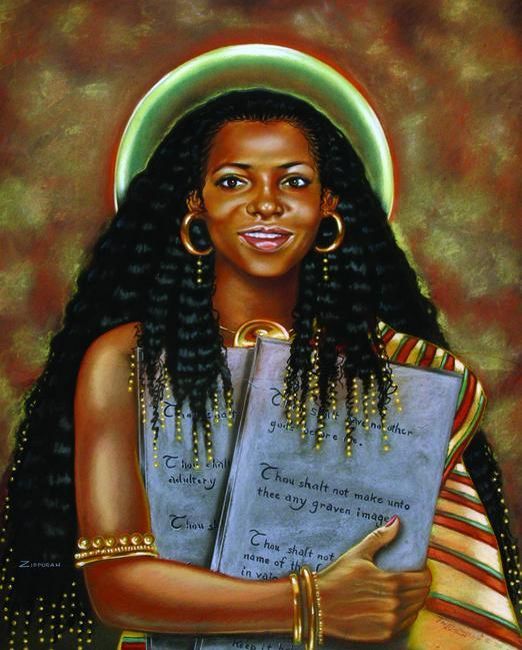
First, the older siblings of Moses – Miriam the eldest and Aaron the other brother – had a problem with their sister-in-law (whose name was Zipporah). She was a Cushite. Cush was an ancient country which encompassed present day northern Sudan and much of Ethiopia in Africa. In other words, Zipporah was black, and Miriam and Aaron were critical of their little brother for marrying her.
Second, although having a black sister-in-law was the real issue, Miriam and Aaron confronted Moses not about this, but went after him concerning his role as a prophet. In other words, the siblings engaged in the age-old practice of ostensibly presenting a concern which was not really the matter on their hearts.
Third, the omniscient God knew what was happening. God was fully cognizant of Miriam and Aaron’s cloak-and-dagger attack at Zipporah through her husband Moses. The Lord was incensed with this coup attempt because it was unjust, unfair, ungodly, and frankly, racist. And so, the text states that God, with divine anger aroused, “immediately” addressed the situation.
Racism is insidious. It tends to get expressed most often through the methods similar to those used by Miriam and Aaron by criticizing another somewhat related issue. So, I offer the following questions with as much humility from Moses I can muster:
- Are we aware of our own inheritance of centuries, and even millennia, of dominance language which keeps other human beings docile and subservient to another’s authority?
- Have we chosen to challenge points of order and procedure in the attempt to marginalize certain persons?
- Are we detached from our own needs, and so, unable to listen well?
- Is there secret fear in our hearts, believing that we must maintain our hegemony, or else there will be chaos?
- Is the goal for others to become like us, as if we were the Borg who talk about how resisting us is futile?
- Are we willing to do the hard work of pulling out our own roots of racial segregation and injustice?
- Do we want cheap diversity or true solidarity?
- Will we work toward creating a new liberated humanity, championing equity in all things for all people, instead of attempting to sanitize existing systems?
For far too long, too many individuals, institutions, and even faith communities, have relied upon individualism and anti-structuralism; and it has not served us well in addressing our contemporary problems. Individualism sees only individual racist words and actions and is blind to systemic issues. It views social problems as merely a reflection of broken relationships, and, so, again, makes it impossible to see the systemic nature of our racialized society.
Anti-structuralism (not addressing racism as an organizing structure) is the assumption that racism is only individual racial prejudice and hatred. Thus, the approach in dealing with racism is to always be on the lookout for “bad racists.” This avenue, however, diverts attention from upholding biblical justice, forming policies of liberation, and establishing equitable care and opportunity for the common good of all persons.
As a historian, I tend to view things through historical lenses. So, I resonate deeply with the late twentieth-century essayist James Baldwin when he said, “White people are still trapped in a history which they do not understand; and until they understand it, they cannot be released from it.”
I want my history to be with Moses and freedom. I want God to show up and put racism to an end. I want to be part of the solution, and not the problem. I want justice and fairness to flow like a river that never runs dry.
Lord, Jesus Christ, you reached across ethnic boundaries between Samaritans, Romans, and Jews. In your earthly ministry you offered fresh sight to the blind and freedom to captives. Gracious Savior, help us to break down walls and barriers in our community; enable us to see the reality of racism and bigotry; and free us to challenge and uproot it from ourselves, our faith communities, our society, and our world. Amen.



 Rev. Tim Ehrhardt