Morality Matters (2 Kings 9:14-26)

Then Jehu, Jehoshaphat’s son and Nimshi’s grandson, plotted against Joram. Now Joram along with all of Israel had been guarding Ramoth-Gilead against Aram’s King Hazael, but King Joram had gone back to Jezreel to recover from wounds that the Arameans had given him when he fought Hazael.

So Jehu said, “If this is the way you feel, then don’t let anyone escape from the city to talk about it in Jezreel.” Then Jehu got on a chariot and drove to Jezreel because Joram was resting there. Judah’s King Ahaziah had also come to visit Joram.

The guard standing on the tower at Jezreel saw a crowd of people coming with Jehu. He said, “I see a crowd of people.”

Joram said, “Take a chariot driver. Send him out to meet them to ask, ‘Do you come in peace?’”

So the driver went to meet him and said, “The king asks, ‘Do you come in peace?’”

Jehu replied, “What do you care about peace? Come around and follow me.”

Meanwhile, the tower guard reported, “The messenger met them, but he isn’t returning.”

The king sent a second driver. He came to them and said, “The king asks, ‘Do you come in peace?’”

Jehu said, “What do you care about peace? Come around and follow me.”

The tower guard reported, “The messenger met them, but he isn’t returning. And the style of chariot driving is like Jehu, Nimshi’s son. Jehu drives like a madman.”

Joram said, “Hitch up the chariot!” So they hitched up his chariot. Then Israel’s King Joram and Judah’s King Ahaziah—each in his own chariot—went out to meet Jehu. They happened to meet him at the plot of ground that belonged to Naboth the Jezreelite.

When Joram saw Jehu, he said, “Do you come in peace, Jehu?”

He said, “How can there be peace as long as the immoralities of your mother Jezebel and her many acts of sorcery continue?”

Then Joram turned his chariot around and fled. He shouted to Ahaziah, “It’s a trap, Ahaziah!”

Jehu took his bow and shot Joram in the back. The arrow went through his heart, and he fell down in his chariot. Jehu said to Bidkar his chariot officer, “Pick him up, and throw him on the plot of ground belonging to Naboth the Jezreelite. Remember how you and I were driving chariot teams behind his father Ahab when the Lord spoke this prophecy about him: Yesterday I saw Naboth’s blood and his sons’ blood, declares the Lord. I swear that I will pay you back on this very plot of ground, declares the Lord. Now pick him up, and throw him on that plot of ground, in agreement with the Lord’s word.” (Common English Bible)

Jehu shoots an arrow that strikes Joram in the back, by Jan Luyken, 1712

Ancient storytelling often had a moral to it. Historical writing was typically less concerned for objective details and much more interested to point out, in narrative form, how people morally lived and what happened to them. Rather than commenting on what the moral(s) are, the storyteller lets the story speak for itself.

Today’s Old Testament lesson brings several kings into the story (Jehu, Joram, Ahaziah, and Ahab). We are meant to contrast Jehu’s zeal for justice and living into God’s call with the others kings’ injustice and living for power and wealth. The final end of the kings is designed for us to see the ultimate consequence of injustice.

Elisha the prophet had given a non-descript Israelite military man, Jehu, instructions from the Lord about carrying out divine judgment against the unjust royal house of Omri – and more specifically, against King Ahab and Queen Jezebel.

After Jehu’s prophetic call and anointing, the soldiers under his command immediately acclaimed him as king. Jehu wasted no time in going after the people responsible for years of abusive power.

Rather than simply giving orders to his soldiers and remaining in back of his army, Jehu led his men into the thick of battle. We get the picture of a person with single-minded determination, aggressively going after unjust leaders; and seeking to upend a royal system of power which strayed far from their original mandate of upholding God’s system of law and covenant.

Jehu’s zeal is exemplified in his chariot driving: He was going to speedily get to where he needed to go, and do what he needed to do.

The story emphasizes the increasing drama of messengers sent to enquire of Jehu’s intentions: Are they peaceful? Clearly, no. There was betrayal afoot, as Jehu boldly drove against his own king of Israel, as well as the king of Judah.

The unjust kings had created a situation in their nations of peace for themselves, but not necessarily others. So, Jehu would take that peace from them.

The two kings of Israel and Judah personally went out to Jehu, not realizing what was about to happen. Ironically, it took place on land which Naboth had previously owned, and of which Ahab and Jezebel diabolically stole. It is a powerful depiction of what goes around comes around.

Jehu quickly got to the nub of the issue: There cannot be peace as long as Jezebel’s idolatry and witchcraft abound in the land. Her wicked ways had become thoroughly imbued throughout both Israel and Judah, and was supported by both of the kings.

From the perspective of Jehu, there was no peace that could exist between a follower of Yahweh and a practitioner of the Baal and Asherah cults. Jehu’s intent was to fulfill the prophecy that was announced by Elijah twelve years earlier. And he went about it with violent zeal.

Whenever the Lord begins to exact judgment and ensconce justice, there’s no way anyone is going to stop it. Joram went out to face an enemy that he could not stop. There was no escaping the inexorable force of God.

Divine providence brought the kings together on the very piece of land that was once Naboth’s vineyard – the place where Ahab took sinister control of it. (1 Kings 21). Murderous theft was the inevitable result of spiritual fornication; Ahab and Jezebel had prostituted themselves with the gods Baal and Asherah.

Spiritual adultery never ends well. Because God is a jealous Lover. Peace is not achieved by letting everyone do whatever they want. Instead, it is established through integrity, justice, truth, and ethical morality.

Eternal God, in whose perfect kingdom the sword of righteousness is drawn: Spread abroad your mighty Spirit, so that all peoples may be gathered under the banner of the Prince of Peace, as children of one Father; to whom be dominion and glory, now and forever. Amen.

A Calling Is a Sacred Responsibility (2 Kings 9:1-13)

King Jehu

The prophet Elisha called to a member of the group of prophets, “Get ready, take this jug of oil with you, and go to Ramoth-Gilead. When you arrive there, look for Jehu, Jehoshaphat’s son and Nimshi’s grandson. Go to him, then pull him away from his associates, taking him to a private room. Take the jug of oil and pour it on his head. Then say, ‘This is what the Lord has said: I anoint you king of Israel.’ Then open the door, and run out of there without stopping.”

So the young prophet went to Ramoth-Gilead. He came in, and the military commanders were sitting right there. He said, “Commander, I have a word for you.”

“For which one of us?” Jehu asked.

The young prophet said, “For you, Commander.”

So Jehu got up and went inside. The prophet then poured oil on his head and said to him, “This is what the Lord, Israel’s God, says: I anoint you king over the Lord’s people, over Israel. You will strike down your master Ahab’s family. In this way I will take revenge for the violence done by Jezebel to my servants the prophets and to all the Lord’s servants. Ahab’s whole family will die. I will eliminate from Ahab everyone who urinates on a wall, whether slave or free, in Israel. I will make Ahab’s dynasty like the dynasty of Jeroboam, Nebat’s son, and like the dynasty of Baasha, Ahijah’s son. And as for Jezebel: The dogs will devour her in the area of Jezreel. No one will bury her.” Then the young prophet opened the door and ran.

Jehu went out to his master’s officers. They said to him, “Is everything okay?

Why did this fanatic come to you?”

Jehu said to them, “You know the man and the nonsense he talks.”

“That’s a lie!” they said. “Come on, tell us!”

Jehu replied, “This is what he said to me: ‘This is what the Lord says: I anoint you king of Israel.’”

Then each man quickly took his cloak and put it beneath Jehu on the paved steps. They blew a trumpet and said, “Jehu has become king!” (Common English Bible)

The biblical books of 1 & 2 Kings (originally one book of Kings) tells of the kingdoms of Israel and Judah over a five-hundred year period from c.960-586 B.C.E. The dynasties of the house of Omri and the house of Jehu were the longest lasting in Israel.

The books of First and Second Kings are primarily concerned with an evaluation of the 20 kings of Judah and the 19 kings of Israel. Of greatest concern was whether the particular king was loyal to God, or not. If the king tolerated worship of other gods besides Yahweh, and established sacrifices outside of Jerusalem, then that king was evaluated as doing evil in the eyes of the Lord.

This judgment of the kings is consistent with Deuteronomic laws of sole loyalty to God, and the importance of a central location for all Jewish people to worship (in Jerusalem).

To understand why it was so important for Jehu to be anointed with a mission is to know something of the house of Omri, and in particular, the king Ahab and his queen Jezebel. They are both conveyed to us in the biblical text as a power couple who want what they want, without a lot of concern about the subjects of their kingdom.

Jezebel was a follower of Baal and Asherah, not Yahweh. She provided for hundreds of their prophets. Her husband the king was fine with this situation. Jezebel was a clear enemy of God’s prophets, and killed hundreds of them, so that there were only a few left, including Elijah and Elisha (1 Kings 18:13).

Ahab and Jezebel’s powerful misuse of authority is relayed in the story of Naboth (1 Kings 21). Ahab wanted to buy Naboth’s vineyard, which was adjacent to his own land. But Naboth refused to sell, mainly because the land was his family’s ancient generational inheritance.

Jezebel went to work and arranged false witnesses to claim that Naboth had cursed both God and King (which was the ultimate sign of treason in Israel). As a result, Naboth was wrongly stoned to death; and Ahab unjustly confiscated his property.

Elijah prophesied that Ahab’s descendants would die, his dynasty will perish, and that Jezebel would be eaten by dogs (1 Kings 21:17-24). In our story for today, this is alluded to in the reference of God eliminating all that belong to Ahab who “urinate on a wall,” that is, unjustly marking the territory of another as their own property.

Indeed, it all shook-out according to prophecy. Ahab died in battle. Then, Ahab and Jezebel’s son Ahaziah succeeded him as king. Young Ahaziah died two years into his reign, and his brother Jehoram became king. Jehoram was then killed by Jehu. After this, some of Jezebel’s own palace officials tossed her out a window to her death, and dogs descended on her carcass – all to Elijah’s earlier prophecy.

Injustice, unrighteousness, abuse of power, and selfish concerns are ugly nasty business. These sorts of attitudes and behaviors ruin people, and keep others locked into patterns of poverty and powerlessness. God is not okay with any of it.

Whenever we are in the middle of oppression and/or authoritative people abusing their power for their own benefit, its hard to maintain our sense of rightness and goodness. Yet, we must. In such times, patience and perseverance is needed without resorting to attempts of paying back evil with evil.

What’s more, we can find ways of tapping into the spiritual power of God within us, in order to resist and subvert unjust authority with righteousness. To some degree, everyone can do something by employing nonviolent resistance tactics like networking, protest, persuasion, non-cooperation, and speaking out through either speech or writing.

Only those who possess nothing can be entrusted with everything. Systemic evil isn’t changed from the top, because those at the top benefit from the system. Rather, structural evil is transformed through grass roots efforts from the bottom up. What’s more, individuals rarely change from the outside-in, but rather from the inside-out.

A ruling establishment is not always necessarily wrong. Yet, it takes a lot of willing accountability and plenty of intentional soul searching for administrations to remain on the straight and narrow.

Such realities characterized Jehu. He was a non-descript military man. There was nothing, in particular, which distinguished him as having a special calling from God.

Yet, although Jehu fulfilled his calling, he added to the call; the Lord was not pleased with Jehu’s form of violent bloodshed, and so, put an end to Jehu’s house, just as Omri’s house had been purged from Israel.

Power and authority will do that to a person – which is why leaders must be continuously vigilant to guard against developing a thick ego and following their pride.

And so do we. Anyone who receives a call from God has a sacred responsibility and trust to fulfill that calling with competence, care, and conscientiousness.

Almighty God, direct me in all my activity with Your grace, wisdom, and help, so that in all I do and say may glorify Your holy Name; through Jesus Christ our Lord, in the power of the Holy Spirit. Amen.

Deliver Us From Evil (Psalm 144:9-15)

I will sing a new song to you, God.
    I will sing praises to you on a ten-stringed harp,
        to you—the one who gives saving help to rulers,
        and who rescues his servant David from the evil sword.
Rescue me and deliver me from the power of strangers,
        whose mouths speak lies,
        and whose strong hand is a strong hand of deception,
    so that our sons can grow up fully, in their youth, like plants;
    so that our daughters can be like pillars carved to decorate a palace;
    so that our barns can be full, providing all kinds of food;
    so that our flocks can be in the thousands—
        even tens of thousands—in our fields;
    so that our cattle can be loaded with calves;
    so that there won’t be any breach in the walls,
    no exile, no outcries in our streets!

The people who have it like this are truly happy!
    The people whose God is the Lord are truly happy! (Common English Bible)

And lead us not into temptation, but deliver us from evil.”

Jesus (Matthew 6:13, KJV)

Evil lurks everywhere. It resides in the human heart, hidden in the dark shadows, coming out sideways through shameful lies and guilty actions.

The presence of evil is also found throughout the world in every institution, organization, and group, ensconced as systemic injustice – hoarding resources for the powerful at the expense of the powerless; showing prejudice and favoritism to some, while ignoring others.

Since there is wickedness found in all places and with all people, evil needs to be dealt with and expunged from both hearts as well as institutions and organizations. Part of the solution is to do away with all obstacles which stand in the way of human flourishing.

Save us from the Evil One. (Matthew 6:13, ERV)

To be sure, the heart of humanity must be dealt with and be the focus of change. Yet, if we only focus one-dimensionally on evil, it will persist, and even grow into monstrous proportions, unless we equally direct our right and just efforts on structural and systemic evil.

People and their institutions need deliverance from the power of evil in the world. And for that to happen, the hindrances and handicaps to human thriving must be eliminated.

Our entire concept of salvation needs a fuller scope. Not only do individuals need personal deliverance from sin, death, and hell, so do entire societies. Complete systemic rescue from oppressive obstacles is a must. Far too many people in this fallen world are weighed down from institutional sin.

Christ obeyed God our Father and gave himself as a sacrifice for our sins to rescue us from this evil world.

Galatians 1:4, CEV

In looking at the need for deliverance from evil in a different context, the genius of the American experiment was that the founding fathers (and mothers!) of the United States created a political and societal system which sought to eliminate class distinctions and allowed people of lower means to achieve land ownership and business acumen simply through hard work and thrift.

Unfortunately, the experiment only extended mostly to landowning white men. Native American and African American people still had huge systemic obstacles to overcome. And the new republic had different expectations for women.

It took a Civil War and decades of grueling work to address political and social change (not to mention religious). We are still today laboring to truly give liberty and justice for all, and to achieve the ideal of an egalitarian nation.

We, as both individuals and citizens, need divine intervention through deliverance. Like Gilligan and the crew of the Minnow stranded on a deserted island, we seek to be rescued – knowing we need help beyond ourselves for salvation.

Rescue us from the evil one. (Matthew 6:13, NRSV)

The psalmist looked ahead in hope, convinced that a good God will deliver and provide good people with everything they need to thrive and flourish in this life, and in the life to come.

If God doesn’t fight our overwhelming battles for us, we are lost. This present darkness, this both ancient and contemporary evil, is an extremely powerful foe. However, the Lord is greater and will have the last word.

Christianity asserts that Jesus is the pioneer of our salvation, and the once for all answer to the problem of evil, for both the world and the human heart. Christ, in other words, is the fulfillment of the psalmist’s prayers for deliverance, health, and hope.

Protect us from evil. (Matthew 6:13, CEV)

In his earthly ministry, Jesus did not give explanations for our pain and sorrow. Instead, Jesus comes where our pain is most acute, and takes it upon himself – bringing healing and hope.

The Lord tackles evil, not by having a Zoom conference on the subject of wickedness, but by allowing evil to do its worst to him. Christ exhausts evil by draining it of its power, emerging resurrected with new life for all.

The good news: Jesus is Lord and has defeated the powers of evil.

Now, renewal and reform can occur. Hearts can change. Systems can be revamped. God’s new world has begun.

God rescued us from the control of darkness and transferred us into the kingdom of the Son he loves. He set us free through the Son and forgave our sins. (Colossians 1:13-14, CEB)

I, personally, am a Christian because I believe God is the one who satisfies the passion for justice, the longing for spirituality, the hunger for relationship, and the yearning for beauty. I see God in Jesus of Nazareth, the world’s true Lord.

Hope, like the psalmist expressed, is what you get when you realize a different worldview is possible. Hope springs to life when those who feel the brunt of evil in the world become acutely aware that the rich, the powerful, and the unscrupulous are not the ones really in charge.

“Our task as image-bearing, God-loving, Christ-shaped, Spirit-filled Christians, following Christ and shaping our world, is to announce redemption to a world that has discovered its fallenness, to announce healing to a world that has discovered its brokenness, to proclaim love and trust to a world that knows only exploitation, fear and suspicion…” N.T. Wright

May you be delivered from evil, and saved from the Evil One. May you know the Savior, and take solace in his peace. And may you be buoyant in faith, confident in hope, and overflowing with love. Amen.

Labor and Building the Temple (1 Kings 5:13-18)

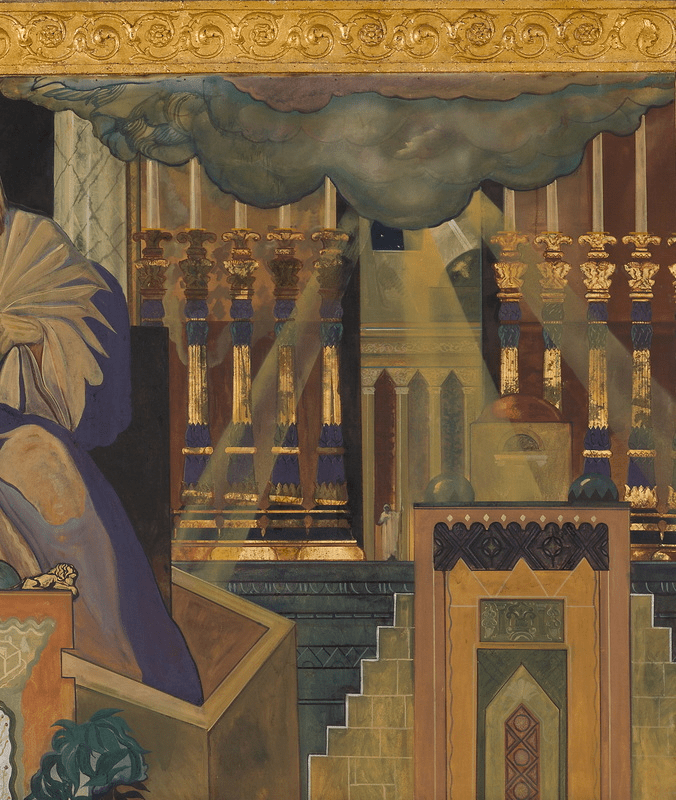
Mural of King Solomon and building the Temple, Wilshire Boulevard Temple, Los Angeles

Solomon ordered 30,000 people from all over Israel to cut logs for the temple, and he put Adoniram in charge of these workers. Solomon divided them into three groups of 10,000. Each group worked one month in Lebanon and had two months off at home.

He also had 80,000 workers to cut stone in the hill country of Israel, 70,000 workers to carry the stones, and over 3,000 assistants to keep track of the work and to supervise the workers. He ordered the workers to cut and shape large blocks of good stone for the foundation of the temple.

Solomon’s and Hiram’s men worked with men from the city of Gebal, and together they got the stones and logs ready for the temple. (Contemporary English Version)

A lot of labor went into construction of the temple in Jerusalem. King Solomon raised a massive workforce, and placed them under the command of Adoniram. The work was not voluntary, but compulsory; no tribe or citizen in Israel or Judah had a choice of whether to labor in the forest and the quarry, or not.

This treatment of the Israelite people, in being required to work in Lebanon one month out of every three months, became a significant reason for the kingdom’s split after Solomon’s death. (1 Kings 11:26-28; 12:1-16)

There was an even larger group of workers to quarry and dress the stones in the hill country. The workforce was likely made up of both Jewish and non-Jewish persons, because of the needed manpower.

King Solomon was a master administrator. All of the planning, and movement of supplies and people, was a major endeavor to pull off. And this gets to the nub of working relations, both then and now.

Cedars of Lebanon, in “The Land of the Book,” by W.M. Thomson, 1894

Oftentimes, what looks good on paper, and makes sense to those in charge, is short-sighted. The actual people who will do the work are rarely consulted. This is especially strange and unacceptable in this day and age.

If companies can put a lot of time, energy, and expenditures into marketing focus groups to determine things like what color to use on packaging in order to sell more, then it is curious that no time and energy is placed into communication and interaction with workers.

It is sad and tragic that the corporation with high levels of effective engagement between management and employees is so very rare.

At the core of it all, I believe, is our anthropological view. Show me a workplace with sour relations and strained negotiations, and I will show you a management and executive team who use workers as replaceable parts in a machine.

But show me a company that discerns people as inherently worthy of respect and kindness, and I will show you a place where effective communication flows freely, and worker satisfaction is high.

Furthermore, our anthropology determines how we treat safety on the job. Rather than putting some safe policies in place because of government oversight and pressure, a view of people as important above all else will ensure that both the physical and psychological environment are secure – and they will take a zero tolerance approach to any and all unsafe practices, in order to preserve human dignity and life.

Therefore, why we do what we do is just as important as what we do.

And the only effective way to answer the why is through a broad and involved connection with a diversity of people within an organization. There is absolutely no substitute for this. Taking shortcuts only leads to ineffectiveness, and more importantly, to human duress and harm.

In order to achieve such an ambitious goal of constructing a temple – along with a palace and administrative buildings – a large corporate government was required to make it all happen.

Essentially, King Solomon enacted a massive administration akin to ancient Egypt and their construction of pyramids. With such a government came classes and ranks and opportunities. Frankly, it was a lot like a totalitarian regime, in which the major function was to bless what was happening.

This resulted in a humungous structure and system that became intolerant of any alternative thinking. Thus, the kingdom (the government) was prepared to crush anything or anyone that threatened the established status quo of how to operate. This is why the Old Testament prophets were not viewed well by the state, and many of them were killed.

So, if you have been following me through these reflections on King Solomon over the past several days, you may wonder if I like him, or loathe him. The fact of the matter is that Solomon, like us, is a complicated person. He tends to get hailed as the wisest person who ever lived, to the neglect of some of his unwise choices. For many, Solomon too easily gets off the hook.

Along with all of Solomon’s grandeur and sagacity, he also had a slave labor force that toiled in quarries, forests, and mines. He was given to excess in most things, and didn’t seem to have a stop button. And, later in life, he honored forbidden gods with sinister sacrifices at shrines on the outskirts of Jerusalem.

The truly wise person in the room will view Solomon in his totality; will have a broader and more contextual view of work and labor; and will discern people as majestic creatures in God’s image, who also have a tragically twisted heart which can easily be prone to foolishness and harming others.

So, as we remember the temple Solomon built, we can keep in mind its beauty and architectural wonder, and the skill needed to make it happen, as well as the thousands of people who endured harsh and sometimes inhumane treatment.

Looking at history from only one angle is really not seeing history at all. We need a full-orbed understanding of people, their situations, the context of events, and the challenges they faced. Otherwise, we’ll get a sanitized version which only ends up demeaning everyone.

Lord God Almighty, who has made all the peoples of the earth for your glory, to serve you in freedom and in peace: Give to the people of this world a zeal for justice and the strength of forbearance, so that we may use our liberty in accordance with your gracious will; through Jesus Christ our Lord, who lives and reigns with you and the Holy Spirit, one God, now and forever. Amen.