

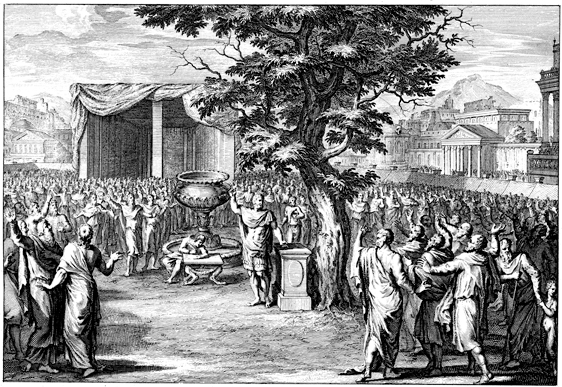
On that day Joshua made a covenant for the people, and there at Shechem he reaffirmed for them decrees and laws. And Joshua recorded these things in the Book of the Law of God. Then he took a large stone and set it up there under the oak near the holy place of the Lord.
“See!” he said to all the people. “This stone will be a witness against us. It has heard all the words the Lord has said to us. It will be a witness against you if you are untrue to your God.”
Then Joshua dismissed the people, each to their own inheritance.
After these things, Joshua son of Nun, the servant of the Lord, died at the age of a hundred and ten. And they buried him in the land of his inheritance, at Timnath Serah in the hill country of Ephraim, north of Mount Gaash.
Israel served the Lord throughout the lifetime of Joshua and of the elders who outlived him and who had experienced everything the Lord had done for Israel.
And Joseph’s bones, which the Israelites had brought up from Egypt, were buried at Shechem in the tract of land that Jacob bought for a hundred pieces of silver from the sons of Hamor, the father of Shechem. This became the inheritance of Joseph’s descendants.
And Eleazar son of Aaron died and was buried at Gibeah, which had been allotted to his son Phinehas in the hill country of Ephraim. (New International Version)
All things, if they exist for any length of time, require renewal. This is especially true of relationships, and in particular, our relationship with God.
The book of Joshua is closely connected to the book of Exodus. God’s special relationship with Israel was confirmed with a covenant. God’s gave the Law to Moses as the leader of the people. And God brought a mighty deliverance to the Israelites from Egyptian bondage. These are all themes that linger with importance into the leadership and life of Joshua and the Israelites as they entered and inhabited the Promised Land.
Joshua was a faithful attendant to Moses, a model soldier, and an effective spy. After the death of Moses, Joshua was the appointed successor to bring Israel into Canaan and capture it. He was just as faithful to God and the people as Moses had been. In taking the land, Joshua made sure to do the following with the people:
- Reminded all the Israelite tribes of their covenantal relationship and obligations to God
- Allocated the land to each of the tribes, as specified by God’s command
- Circumcised all the males that had been born during the forty years in the desert
- Established cities of refuge, and cities for the Levites (because they had no land inheritance)
- Admonished the people to be steadfast in observing the laws given to Moses by God
- Made it clear what the consequences are for any break or breach in the covenant agreement
Joshua did all of this by facilitating a covenant renewal ceremony. There were still some Canaanites in the land, and so, the Israelites were at risk of worshipping foreign deities and engaging in intermarriage. The people needed to have a collective memory of God’s deliverance, covenant, and law.
The covenant renewal emphasized obedience to the law and fealty to God because the Israelites are a holy nation, set apart for the Lord’s purposes. They were to serve the Lord with faithfulness and sincerity. There were to be no foreign gods whatsoever. Obedience would bring blessings, whereas disobedience would lead to the land being cursed.
As the mediator between God and Israel, Joshua commanded Israel to make a firm choice about what they were going to do. He was holding them accountable and ensuring they actively participate in the covenantal agreement.
The people declared that they would not forsake the Lord to serve other gods. And Joshua pledged to hold them accountable to their words and commitments.
Just as Israel was to be renewed in loyalty to their God, so we, too, in each generation of believers, must experience a renewal of our relationship to the Lord. We do so through reaffirmation, recording our response, and setting up a remembrance of the renewal.
Reaffirm
To reaffirm is to make a renewed commitment to something, usually verbally. In affirming God as the Lord, we are saying, “I believe!” So reaffirming repeats the belief, and makes it clear that you still feel that way. We make promises and make plans to keep them. We vow to be faithful and restate our love for God and God’s Word.
Joshua repeated, restated, and reaffirmed God’s Law for the people, so that they would know exactly what their responsibilities are, and pledge to keep them always.
Record
To record something is to establish a written record of what was said. Joshua made sure that everything was written down so that nobody in the future could say something contrary, or forget what was said.
One of the most powerful ways we can engage in personal renewal is by actually recording our promises and commitments to the Lord in a journal. The act of writing, in-and-of itself, is a transforming practice. And when we couple the practice with important and impactful words of intention and desire, then we are doubling our chances of actually following through and doing what we say we will do.
Remember
Memory is more than the mind. Remembering is activated with tangible things that we can see, touch, or smell. With the Israelites, Joshua set up a huge stone as a remembrance of what was said and promised. And he engaged the imagination by stating that the stone heard it all – and would hold them all accountable.
Physical objects, such as the cup and the bread in Christian communion, press the remembrance much better and deeper into both our minds and our hearts. Anything in life that is vital to remember ought to have a tangible item which symbolizes the importance of the memory.
Experiencing renewal in life doesn’t simply happen, but is an intentional process of reaffirming, recording, and remembering. Concerning God’s Word, Holy Scripture is something worth putting the effort into in order to realize new life and a renewed relationship with the Lord.
O God, King eternal, your light divides the day from the night and turns the shadow of death into the morning: Drive from us all wrong desires; incline our hearts to keep your law; and guide our feet into the way of peace; so that, having done your will with cheerfulness during the day, we may, when night comes, rejoice to give you thanks, through Jesus Christ our Lord. Amen.


 Rev. Tim Ehrhardt