The Need for Sacrifice

Man of Suffering by Georges Rouault, 1942
Ecce Homo by French artist Georges Rouault, 1942

Christ’s Church is not so much made up of saints or sinners as it is made up of saintly sinners and sinning saints.  The Church is at the same time both beautiful and ugly, holy, and wicked, full of faith and full of fear.  The Body of Christ is the place of spiritual sensitivity as well as a den of depravity.  So, anyone searching for a squeaky-clean church on a nice upward path of success with everything done to perfection and where no one ever gets hurt or unhappy… it does not exist; and, it never did.

Jesus stands alongside his imperfect people, despite their faults and egotism.  Jesus intimately knows our damaged emotions and our open putrid spiritual abscesses.  Yet, he treats us with mercy because he never tires of rehabilitating and reforming his Church.

Christ’s disciple, Peter, is the poster child for all the mixed motives and imperfect following of God we experience. For example, Peter stepped out of the boat in great faith and walked on the water, only to begin sinking because of his great fear. It was Peter who made a bold and right confession of faith, and then turned around here in our story for today and bought into Satan’s agenda. And Jesus was right there next to Peter all the way. Christ both rebukes and loves, all the while never abandoning us, but always working in and through us to accomplish his kingdom purposes.

Here is what we need to know or be reminded of today: Following Jesus involves pain and sacrifice because we live in a broken mixed-up world, and, on top of it, Christ’s Church is still imperfect and in the process of becoming holy.  If we will admit it, we are all like Peter – a little devil who needs to get in line behind Jesus. (Matthew 16:21-28)

Peter Admonishes Jesus
Peter Admonishes Jesus by Unknown artist

We all, at times, get frustrated and/or disgusted with the whole church thing.  We can whine and complain and even avoid it.  Or, we can commit to taking up our cross, and give our lives for Jesus Christ.  We can choose to put love into the church where love is not, even when we do not feel loved. Priest and professor, Ron Rollheiser, once gave the following analogy about staying together around Jesus:

Imagine that the family is home for Christmas, but your spouse is sulking, you are fighting being tired and angry, your seventeen year old son is restless and doesn’t want to be there, your aging mother isn’t well and you are anxious about her, your uncle Charlie is batty as an owl… and everyone is too lazy or selfish to help you prepare the dinner.  You are ready to celebrate but your family is anything but a Hallmark card.  All their hurts and hang-ups are not far from the surface, but you are celebrating Christmas and, underneath it all, there is joy present.  A human version of the messianic banquet is taking place and a human family is meeting around Christ’s birth….

In the same way, here we are, the community of the redeemed. We gather in our imperfect way, a crazy mix of sinner and saint.  But we gather in and around Jesus – and that makes all the difference.  There is a reason we are here on this earth, a reason much bigger than all our dysfunctional ways and dyspeptic attitudes. Jesus Christ is building-up the people of God and he will keep doing it until the end of the age. In other words, Jesus is not quite finished with us yet; we still have some things to learn about the need for sacrifice.

The need for sacrifice by Jesus. (Matthew 16:21-23)

Jesus stated openly and in detail what must happen.  It was necessary for Christ to suffer deeply and die a cruel death; it was God’s will and plan. Yet, good ol’ Peter was not down for this plan, at all.  He took Jesus aside and rebuked him, believing him to be off his rocker for even suggesting such a terrible scenario.  Jesus, however, turned the tables on Peter and rebuked him right back.  Essentially, what Jesus said is that being Christ-centered without being cross-centered is satanic.

The error of Peter was that he presumed to know what was best for Jesus. He believed the suffering of the cross would “never” happen. Peter’s perceptions were dim and limited; he did not clearly see how broken the world really is and how much it would take to heal it. Jesus needed to offer himself as a sacrifice for the sins of the entire planet.

Crucifixion of Christ by Georges Rouault, 1936

Sometimes, like Peter, we might think that the way I see and the way I perceive is the way things really are, or, at least, how they should be. Peter had been walking with Jesus for a few years, watching and enjoying his ministry of teaching, healing, and extending compassion.  It was all good for Peter, and, therefore in his mind, it should not change. Peter wanted to hold this moment forever. After all, why try and fix something that is not broken? Oh, but broken the world is – so much so that it required the ultimate sacrifice.

Just because it was good for Peter did not mean it was good for everybody or should always be this way.  If Peter were to have his way, we would all be in hell right now; it would not have been good for us.  We, like Peter, are finite humans with limited understanding and perceptions.  We can easily slip into a satanic mode of believing that because something is going fine for me that everyone else is doing okay, too.  I like it, I want it, so what is the problem?

The problem is that we too easily look at life through narrowly selfish lenses, and then cannot see other people’s needs; cannot perceive the lost world around us with any sense of reality; cannot see that Jesus has an agenda very different from our own.  Our limited perceptions come out in saying things like, “Oh, she is just depressed because she is avoiding responsibility.”  “People on government welfare are lazy.”  “He’s addicted because he doesn’t want to help himself.”  “They’re demonstrating on the streets because they are a bunch of malcontents.” These, and a legion of statements like it, betray a satanic worldview devoid of grace and a compulsive need to find blame, believing that if there is personal suffering there must be personal sin.

In truth, we are all part of one human family, and we are all in this together; one person’s joys are our joys; one person’s struggles are our struggles. We really are our brother’s keeper. The detachment we can have toward other human beings is completely foreign to the words of Jesus.  The Christian life involves suffering, and Jesus invites us to follow him in his way of sacrifice.

The need for sacrifice by the followers of Jesus. (Matthew 16:24-28)

There is a way to reverse demonic thinking.  Jesus issues an invitation to practice self-denial, to fall in line behind him, and walk with him in his suffering.  Self-denial is not so much doing something like giving up sweets for Lent as it is giving up on ourselves as our own masters.  It is the decision to make the words and ways of Jesus the guiding direction for our lives.  It is the choice to quit holding onto the way I think things ought to be, and to take the time to listen to Jesus.

The logic of Jesus is relentless.  Life comes through death, so, we must give up our lives to find them.  It does us no good to adulterate our lives by serving the gods of success and perfectionism.  Jesus invites us to quit our moonlighting job with the world and go all in with him.  Only in this way will we truly find life.

Jesus was saying more than just submitting to suffering – we are to embrace it. In doing so, we will find reward and joy.  For those familiar with this path, they can tell you that suffering is a blessing because they have found the true purpose and meaning of life.

Crucifixion with Lamp by Colin McCahon 1947
Crucifixion with Lamp by New Zealand artist Colin McCahon, 1947

Few people have suffered as much as the nineteenth-century missionary medical doctor to Africa, David Livingstone.  He was a pioneer explorer who opened the interior of Africa to the outside world.  He had two reasons for doing so: To be able to take the good news of Christ’s suffering to the African people; and, to open Africa to legitimate trade so that the illicit slave trade would end.

Dr. Livingstone’s hand was once bitten and maimed by a lion; his wife died while on the mission field; he was most often alone on his travels; the one house he built was destroyed in a fire; he was typically wracked with dysentery and fever, or some other illness in the jungle.  Someone once commented to him that he had sacrificed a lot for going in the way of Jesus. Livingstone’s response was, “Sacrifice? The only sacrifice is to live outside the will of God.”  When asked what helped him get through so much hardship, he said that the words of Jesus to take up his cross were always ringing in his ears.

We may believe we must watch out for ourselves; that we need to push for our personal preferences; that if I accept this invitation to follow Jesus in the way of self-denial I will be miserable and people will walk all over me. Such thoughts are demonic whispers in our ears.

There are two ways of thinking and approaching the Christian life: There is the way which believes success, perfection, and a pain-free life is the evidence of God’s working; while the other way believes that suffering is right and necessary to connect with God and to be in solidarity with those who suffer.

Suffering, rejection, and execution did not fit into Peter’s church growth plan or factor into his view of Messiah. So, I will say it plainly: We do not exist only for ourselves. We do not exist to be a spiritual country club.  We do exist to follow Jesus in his path of sacrifice and suffering for a world of people who desperately need to know the grace of forgiveness and the mercy of Christ. Jesus died.  We are to die to ourselves. Christ lives; so, we are to live a new life.  In God’s upside-down kingdom, joy comes through suffering. We are to follow Jesus as the mix of sinners and saints that we are.

Peter eventually learned his lesson from Jesus. After Christ’s resurrection and ascension, Peter caught fire with courage and boldness – which landed him in hot water with the Jewish ruling council. As a result, he was severely whipped and flogged and told to keep in line. Peter’s response demonstrates how far he had come. He left the experience rejoicing that he had been counted worthy of suffering disgrace for the Name of Jesus Christ. (Acts 5:41)

May dear old Peter’s spiritual tribe increase.

Exodus 3:16-25 – A Great Reversal

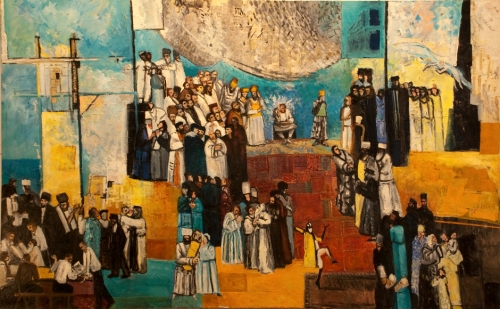
Moses and the Children of Israel by Richard McBee
“Moses and the Children of Israel” by Richard McBee

“Go, assemble the elders of Israel and say to them, ‘The Lord, the God of your fathers—the God of Abraham, Isaac and Jacob—appeared to me and said: I have watched over you and have seen what has been done to you in Egypt. And I have promised to bring you up out of your misery in Egypt into the land of the Canaanites, Hittites, Amorites, Perizzites, Hivites and Jebusites—a land flowing with milk and honey.’ 

“The elders of Israel will listen to you. Then you and the elders are to go to the king of Egypt and say to him, ‘The Lord, the God of the Hebrews, has met with us. Let us take a three-day journey into the wilderness to offer sacrifices to the Lord our God.’ But I know that the king of Egypt will not let you go unless a mighty hand compels him. So, I will stretch out my hand and strike the Egyptians with all the wonders that I will perform among them. After that, he will let you go. 

“And I will make the Egyptians favorably disposed toward this people, so that when you leave you will not go empty-handed. Every woman is to ask her neighbor and any woman living in her house for articles of silver and gold and for clothing, which you will put on your sons and daughters. And so, you will plunder the Egyptians.” (NIV) 

Moses spent forty years in the back side of the desert tending sheep. The first forty years were lived in the most powerful place on earth at the time, Egypt. Although Moses had a privileged position, he forsook his place to be in solidarity with the enslaved Israelites. With a skewed sense of timing and method, he slew a cruel Egyptian, and was forced to flee into the desert. 

The time eventually became ripe, and God was on the move. At eighty years old, God called Moses out of the desert and back to Egypt. The deliverance was going to be accomplished according to God’s designs and purposes, and not from the impetuous actions of a younger Moses. God knew exactly what he was doing and put Moses on a course which would strike at the heart of imperial Egypt and bring freedom to millions of slaves. 

Today’s story is laced thick with divine promises. After all, it is the promises of God which give people hope and a future. Referring to himself as the God of Abraham, Isaac, and Jacob, the Lord connects the generations-long covenant promise to the Israelites and reminded them they are not forgotten. God’s covenant has neither disappeared nor changed; it still exists. While the Jews were languishing in slavery, God was not aloof but watching – carefully inspecting, caring, and paying close attention. 

The inheritance of the Promised Land was coming, and it would be realized. God affirmed the covenant, knowing the plans he has for them – plans to give them abundance and joy. And God knew full well that dislodging the Israelites from Egypt would take some work, since Pharaoh relied so heavily on slave labor to support his massive imperial state. 

You, like me, have likely noticed that God tends to move rather slow by our standards. We might question and wonder about so much injustice going unabated for so long. Yet, that is our perspective of things, not God’s. Whereas we often have our own self-interest at mind, the Lord has the concern of an entire world. God is patient and long-suffering, providing full opportunity for both individual and national repentance. The Lord is on the lookout for people to amend their errant ways and return to their true purpose for living. He only judges at the proper time. 

And when that time comes, look out! Nothing can stand in the way of God’s good plans for the earth. The ancient Egyptians had built an empire on the backs of slavery, and everything went into supporting the power and wealth of the state. God was not okay with this situation. As he had done many times before, the Lord would thoroughly dismantle and destroy the powerful system of oppression. God is the expert at flip-flopping the status of people – the slaves become free, and the free are bound; the hated become favored, and those who enjoyed all the perks of power and privilege become the despised. 

Embracing God’s upside-down kingdom means advocating for justice, righteousness, and holiness for all people, not just a select few whom I like. Jesus, over 1,500 years after Moses and the exodus from Egypt, had this to say: 

“Those who are last now will someday be first, and those who are first now will someday be last.” (Matthew 20:16, NCV) 

“Blessed are you who are poor, 
    for yours is the kingdom of God. 
“Blessed are you who are hungry now, 
    for you will be filled. 
“Blessed are you who weep now, 
    for you will laugh. 

“Blessed are you when people hate you, and when they exclude you, revile you, and defame you on account of the Son of Man. Rejoice in that day and leap for joy, for surely your reward is great in heaven; for that is what their ancestors did to the prophets. 

“But woe to you who are rich, 
    for you have received your consolation. 
“Woe to you who are full now, 
    for you will be hungry. 
“Woe to you who are laughing now, 
    for you will mourn and weep. 

“Woe to you when all speak well of you, for that is what their ancestors did to the false prophets. (Luke 6:20-26, NRSV) 

And the Apostle Paul said to the Church: 

“For our present troubles are small and won’t last very long. Yet they produce for us a glory that vastly outweighs them and will last forever!” (2 Corinthians 4:17, NLT) 

The New Testament references are not meant to sanitize or put a positive spin on the very real suffering that so many people have endured both past and present. It is, however, meant to lift-up the reality that we have a sure and certain hope. Our trust in the promises and presence of God will eventually be realized and gives shape to how we live today in persistent prayers with patience and perseverance. 

So, may the Lord of all creation bless and protect you. May the Lord show you mercy and kindness in your affliction. And, may the Lord be good to you and give you peace. Amen. 

Exodus 2:11-15 – Time Out

A Time for Everything

In the course of time Moses grew up. Then he went to see his own people and watched them suffering under forced labor. He saw a Hebrew, one of his own people, being beaten by an Egyptian. He looked all around, and when he didn’t see anyone, he beat the Egyptian to death and hid the body in the sand.

When Moses went there the next day, he saw two Hebrew men fighting. He asked the one who started the fight, “Why are you beating another Hebrew?”

The man asked, “Who made you our ruler and judge? Are you going to kill me as you killed the Egyptian?” Then Moses was afraid and thought that everyone knew what he had done.

When Pharaoh heard what Moses had done, he tried to have him killed. But Moses fled from Pharaoh and settled in the land of Midian. (GW)

Faith is not a static phenomenon that one possesses, or not. Rather, faith is a dynamic movement which is continually either being strengthened or weakened through our life choices.  Moses needed to learn how to make healthy decisions of faith, just as much or more than the rest of us.  The fact that he was eighty years old before he became the human agent of God’s deliverance of the Israelites from the Egyptians, after a forty year stint in the backside of the desert, tells us that it took him awhile to mature.  Even though Moses may have had a sense that the Israelites needed freedom from slavery and acted on that sense by killing a ruthless Egyptian, his method and sense of timing were off.

There is a time for everything, said the writer of Ecclesiastes.  Wisdom, which is the ability to apply faith to concrete situations with appropriate forms, is often in the timing of things.  To know when to speak and when to listen, when to act and when to wait, is an important facet of faith.  The ancient Israelites were slaves in Egypt for a long time.  Moses knew they were suffering, and he acted in “good faith.” Yet, it was not yet time and it was a rash movement.  Eventually, the Jewish cry of suffering arose to God, and God heard them, remembering his covenant with them.  Why God did not act sooner, or use Moses earlier, is information that is only privy within God himself.

If we are to develop a strong and wise faith with an opportune sense of timing, we will need to rely on God.  Trusting in ourselves, our own efforts, and our own gauge of how things ought to proceed will usually not end well.  We may, like Moses, find ourselves taking a “time out” from God in obscurity until we learn to wait on him.

In the fullness of time, Paul said to the Galatians, Jesus came, born of a woman, born under law, to redeem those under the law (Galatians 4:4-5).  God knows what he is doing, even though it might seem like he is sometimes slow to act.  God sees.  God delivers.  And he does it in his timing – not ours.

Redeeming God, you control all things, including the clock.  Give me wisdom so that my sense of timing might reflect your will and your way, through Jesus Christ, your Son, who with you and the Holy Spirit reign supremely as one God, now and forever.  Amen.

Acts 14:19-28 – Strength through Suffering

William Ellery Channing quote

Then some Jews came from Antioch and Iconium and persuaded the people to turn against Paul. So, they threw stones at him and dragged him out of the town. They thought they had killed him. But when the followers of Jesus gathered around him, he got up and went back into the town. The next day he and Barnabas left and went to the city of Derbe.

They also told the Good News in the city of Derbe, and many people became followers of Jesus. Then Paul and Barnabas returned to the cities of Lystra, Iconium, and Antioch. In those cities they helped the followers grow stronger in their faith and encouraged them to continue trusting God. They told them, “We must suffer many things on our way into God’s kingdom.” They also chose elders for each church and stopped eating for a period of time to pray for them. These elders were men who had put their trust in the Lord Jesus, so Paul and Barnabas put them in his care.

Paul and Barnabas went through the country of Pisidia. Then they came to the country of Pamphylia. They told people the message of God in the city of Perga, and then they went down to the city of Attalia. And from there they sailed away to Antioch in Syria. This is the city where the believers had put them into God’s care and sent them to do this work. Now they had finished it.

When Paul and Barnabas arrived, they gathered the church together. They told them everything God had used them to do. They said, “God opened a door for the non-Jewish people to believe!” And they stayed there a long time with the Lord’s followers. (ERV)

The Apostle Paul and his traveling companions went on three missionary journeys in the New Testament book of Acts. “Mission” is more than an activity the church does; it is an expression of the church’s identity. To be the community of the redeemed is to embrace and embody the grace and love of Jesus in proclaiming in both word and deed the good news of restoration to God in Christ.

What is good news for many is bad news for others, that is, those for whom are ensconced in power and take advantage of their position to maintain the status quo. Paul was much too radical for them, as he persistently spoke truth to power when needed – not to mention that his effectiveness as a missionary caused a religious, social, and economic impact wherever he went.

It only takes a few rabble-rousers to gin up an angry mob, and Paul saw his share of them. He sometimes escaped unscathed. Yet, in other situations, Paul was beaten or stoned, sometimes being left for dead. So, how does that square with a God who sees all and is able to protect all, especially his own devoted followers?

Paul and his missionary coterie were forthcoming about the nature of following Jesus. Here are a few various translations of their words to new believers (Acts 14:22):

Through many tribulations we must enter into the kingdom of God. (ASV)

If we are to enter God’s kingdom, we must pass through many troubles. (CEB)

We have to suffer a lot before we can get into God’s kingdom. (CEV)

We must go through many hardships to enter the kingdom of God. (NIV)

It is through many persecutions that we must enter the kingdom of God. (NRSV)

Through many afflictions we must enter into God’s Kingdom. (WEB)

The various English words used to translate the original Greek word accurately depict what Paul was talking about. My own translation of the verse is:

It is through a lot of varied stressful adversity that we must enter the rule and reign of God.

Paul was doing so much more than explaining his own suffering. He saw his experience as paradigmatic for all who would follow Jesus. For it was Christ himself who exhorted people to count the cost of discipleship:

“Whoever does not carry their cross and follow me cannot be my disciple…. Those of you who do not give up everything you have cannot be my disciples.” (Luke 14:27, 33, NIV)

In doing the very thing which Jesus asks, the Christian life becomes pressurized from those who do not wish to see us:

Proclaim good news to the poor, freedom for the prisoners and recovery of sight for the blind, to set the oppressed free, to proclaim the year of the Lord’s favor. (Luke 4:18, NIV)

Yet, we also have words from the Lord Jesus about how it all shakes-out for us when we deliberately and unflaggingly follow him with steadfast commitment:

“Blessed are you when people hate you, avoid you, insult you, and slander you because you are committed to the Son of Man. Rejoice then, and be very happy! You have a great reward in heaven. That’s the way their ancestors treated the prophets.” (Luke 6:22-23, GW)

Adversity quote

Late in Paul’s life as he reflected on his missionary journey experiences, he said to his young protégé Timothy:

You know about my persecutions and my sufferings. You know all the things that happened to me in Antioch, Iconium, and Lystra—the persecution I suffered in those places. But the Lord saved me from all of it. Everyone who wants to show true devotion to God in Christ Jesus will be persecuted. (2 Timothy 3:11-12, ERV)

Christian faith is strengthened through the stress, pressure, and adversity of facing hardship through utilizing the words and ways of Jesus. So, receive these blessings from the Apostle Paul today:

And God’s peace, which is so great we cannot understand it, will keep your hearts and minds in Christ Jesus. (Philippians 4:7, NCV)

And now may God, who gives us his peace, be with you all. Amen. (Romans 15:33, NLT)

May the grace of our Lord Jesus Christ be with your spirit, brothers and sisters. Amen. (Galatians 6:18, NRSV)