Psalm 36:5-10 – Steadfast Love

Your steadfast love, O Lord, extends to the heavens,
    your faithfulness to the clouds.
Your righteousness is like the mighty mountains,
    your judgments are like the great deep;
    you save humans and animals alike, O Lord.

How precious is your steadfast love, O God!
    All people may take refuge in the shadow of your wings.
They feast on the abundance of your house,
    and you give them drink from the river of your delights.
For with you is the fountain of life;
    in your light we see light.

O continue your steadfast love to those who know you,
    and your salvation to the upright of heart! (New Revised Standard Version)

Love suffers. Every parent knows this. Because of a parent’s committed and faithful love toward a child, they feel not only the joys but also the sorrows and pain of their children. I can say that this feeling does not go away, even with adult children. And it is compounded with grandchildren. Just as our love is big enough to hold multiple children and grandchildren, so our capacity for experiencing deep emotion for their welfare is equally large.

True love is sacrificial. It is willing to suffer anything on behalf of the beloved. God’s steadfast love is immensely large, holding both the joy of witnessing our lives as well as the pain of watching us make unhealthy decisions which damage us and each other.

God’s people, walking in the way of love, quickly discover that it is simultaneously walking in the way of suffering. From Old Testament times through the New Testament and into the present day, the faithful have always experienced suffering as a central part of their piety and devotion in showing steadfast love. 

The medieval mystics of the Church understood well the connection between suffering and love. They could not imagine a Christian life without hardship, difficulty, and persecution. Thomas à Kempis, a sort of pastor to pastors, wrote in the fifteenth century these words:

“Sometimes it is to our advantage to endure misfortunes and adversities, for they make us enter into our inner selves and acknowledge that we are in a place of exile and that we ought not to rely on anything in this world.  And sometimes it is good for us to suffer contradictions and know that there are those who think ill and badly of us, even though we do our best and act with every good intention….  When men ridicule and belittle us, we should turn to God, who sees our innermost thoughts, and seek His judgment….  It is when a man of good will is distressed, or tempted, or afflicted with evil that he best understands the overwhelming need he has for God, without whom he can do nothing….  It is in such times of trial that he realizes that perfect security and full peace are not to be found in this world.”

Thomas à Kempis, The Imitation of Christ

And yet, it is because of love that suffering is transformed and endured as something wholly other than sheer pain or hurt. Thomas à Kempis went on to say:

“Love is a mighty power, a great and complete good; Love alone lightens every burden and makes the rough places smooth. It bears every hardship as though it were nothing and renders all bitterness sweet and acceptable. The love of Jesus is noble and inspires us to great deeds; it moves us always to desire perfection. Love aspires to high things and is held back by nothing base. Love longs to be free, a stranger to every worldly desire, lest its inner vision become dimmed, and lest worldly self-interest hinder it, or ill-fortune cast it down…. Love knows no limits, but ardently transcends all bounds. Love feels no burden, takes no account of toil, attempts things beyond its strength; love sees nothing as impossible, for it feels able to achieve all things. Love therefore does great things; it is strange and effective; while he who lacks love faints and fails.”

Thomas à Kempis, The Imitation of Christ

In this season of Epiphany, we remember that Jesus is the light of the world. God became flesh and blood to experience the full range of the human condition – both joys and sorrows in a love so committed to us that it led to a cruel cross of suffering.

Salvation has come to all peoples because of God’s steadfast love – a love that never lets go no matter the circumstances.

Almighty God, whose Son our Savior Jesus Christ is the light of the world: Grant that your people, illumined by your Word and Sacrament, may shine with the radiance of Christ’s glory, that he may be known, worshiped, and obeyed to the ends of the earth; through Jesus Christ our Lord, who with you and the Holy Spirit lives and reigns, one God, now and forever. Amen.

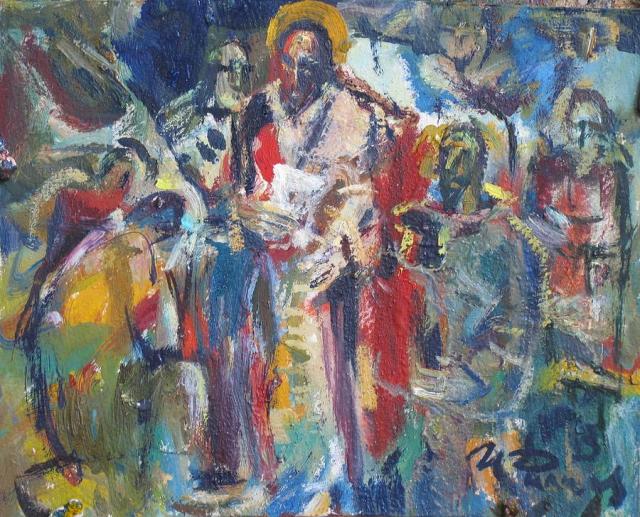
Acts 28:23-31 – Focused on Mission

Apostle Paul by Ivan Filichev

They arranged to meet Paul on a certain day and came in even larger numbers to the place where he was staying. He witnessed to them from morning till evening, explaining about the kingdom of God, and from the Law of Moses and from the Prophets he tried to persuade them about Jesus. Some were convinced by what he said, but others would not believe. They disagreed among themselves and began to leave after Paul had made this final statement: “The Holy Spirit spoke the truth to your ancestors when he said through Isaiah the prophet:

“‘Go to this people and say,
“You will be ever hearing but never understanding;
    you will be ever seeing but never perceiving.”
For this people’s heart has become calloused;
    they hardly hear with their ears,
    and they have closed their eyes.
Otherwise they might see with their eyes,
    hear with their ears,
    understand with their hearts
and turn, and I would heal them.’

“Therefore, I want you to know that God’s salvation has been sent to the Gentiles, and they will listen!”

For two whole years Paul stayed there in his own rented house and welcomed all who came to see him. He proclaimed the kingdom of God and taught about the Lord Jesus Christ—with all boldness and without hindrance! (New International Version)

The Apostle Paul took quite a licking throughout his Christian life. Incredibly, Paul not only physically survived whippings, beatings, stoning, arrests, shipwreck, and imprisonment – he also came through it all with a robust spirit and a dogged determination to live his life with purpose and mission.

Acts 28 is the final chapter in the book. Paul is in Rome under house arrest. Even in this situation, he kept finding ways to engage others. Since he couldn’t go to them, he had others come to him – lots of them.

Paul described to the visitors his own experience of encountering the risen Christ. He reasoned with his fellow Jews and vigorously debated with them from the Scriptures. It was always the deep desire and hope of Paul that his own people come to faith in Christ, just as he had. Although some did, most didn’t.

Many decades ago, my grandfather was approached by one of his friends about investing in a new insurance company startup. For a lot of reasons, grandpa ended up not participating in his friend’s venture. So, the friend asked others. Eventually, the startup happened and steadily grew. Today, Nationwide Insurance has over 250 billion dollars of assets. Good old gramps just didn’t know what he was rejecting.

The good news of Jesus Christ, I believe, is worth infinitely more than an insurance company. Christian mission, I believe, is worth investing my life into. I’m glad the gospel was proclaimed to Gentiles because I am a recipient of such grace. And I’m grateful that Paul tenaciously kept interacting with people for the last two years of his life under arrest.

Despite, and even because of, Paul’s sufferings and his house arrest, the message of faith and forgiveness in Christ was confidently and consistently presented to a steady flow of people, including the highest heads of state. Difficulties are no problem for God. The Lord bends all circumstances to divine and good purposes, creating new avenues of faith, hope, and love that wouldn’t be possible under “normal” times.

“He is no fool who gives what he cannot keep to gain that which he cannot lose.”

Jim Eliot

In fact, Paul endured five years of imprisonment: two in a Caesarea jail; two under house arrest in Rome; and nearly a year in transport between the two cities. For a personality like Paul, we might imagine this would drive him nuts. Yet, several letters to the churches, now contained in the New Testament, were written during that time.

Whether we like it, or not, nothing proves, affirms, and grows our faith quite like our willingness to endure suffering for the gospel. Witness, suffering, and martyrdom are inextricably bundled together in God’s economy. When suffering is viewed as a necessary means to an altruistic and noble end, then, although the pain is no less real, there is the opportunity for both willing endurance and genuine joy.

Paul was willing to labor on behalf of people who were very different from himself. His concern was for all people everywhere – both his own people, the Jews, as well as Gentiles. Paul never gave in and never gave up. He had a magnanimous spirit and even greater spiritual gifts. He willingly and gladly used that spirit and gifts for the benefit of humanity.

In 64 C.E. Paul was condemned and executed. Before his death, he wrote that he had fought the good fight, finished the race, and kept the faith. Now, the next generations of new believers must follow in his footsteps and continue the work

This is precisely why the book of Acts ends so abruptly, with no resolution, no tidy conclusion – because the work is still being done and will carry on until Christ returns.

Gracious and loving God, you work everywhere reconciling, loving, and healing your people and your creation. In your Son Jesus, and through the power of your Holy Spirit, you invite each of us to join you in your work. We ask you to form us more and more in your image and likeness, through our prayer and worship of you and through the study of Holy Scripture so that our eyes will be fully opened to your mission in the world. Then, God, into our communities, our nation, and the world, send us to serve with Christ, taking risks to give life and hope to all people and all of your creation, through Jesus Christ our Lord.. Amen.

The Suffering of Christmas

Christmas:  a time for joy and a time for cheer…  But, unfortunately, it is also a time of profound loneliness and a yearning of days gone by for many people.  A few years back, I received a call on Christmas Day.  One of my parishioners was stretching out to put the angel on top of the family Christmas tree, and fell over dead from a heart attack.  The family’s Christmas will never be the same again, a weird mix, a strange amalgam of both happiness and heartache.  Tragedy that occurs around the holidays makes all future holidays awkward and different.

I also know folks who were expecting a juicy Christmas bonus, instead finding a pink slip and a surprise lay-off from their job.  Children of divorce probably know the strangeness of the holiday the most, being shuttled here and there obtaining more gifts than they need but more bitterness than they want.  For every one of us who look forward to Christmas Day, there is another who dreads facing another season with unpleasant memories of what happened and what could have been….

Whether Christmas is chiefly joyous for one or sorrowful for another, the bald fact of the matter is that we all suffer in some way.  Let me offer a definition/description of suffering for you to ponder: 

Suffering occurs when someone or some circumstance acts against your will and damages either your body, mind, soul, spirit, or all/part of them, creating the great need for healing.

Suffering creates a portal, an opening to either love or hate.  It brings us to the point of decision:  We did not choose suffering; it chose us.  But the choice for healing is very much in our control.  Suffering is an event, maybe even extended over time, which will make us either bitter, or better – it’s your choice.

There are numerous people who will offer you a cup of bitterness, the sour wine vinegar which will dull the pain.  Jesus had such an offer while he hung on the cross, and he refused it.  Nothing was going to stand in the way of his full faculties experiencing the vicarious suffering for our sins.  Dulling the pain doesn’t bring healing; it only makes us forget for a time and just prolongs the actual healing.

Instead, the wise choice is to take charge of your life and choose the hard path of healing.  There is a world of difference between the pain that is forced upon us, and the pain which we choose so that we become better and healthy.  The pain of violation must be followed with the pain of healing. 

“It takes courage to love, but pain through love is the purifying fire which those who love generously know. We all know people who are so much afraid of pain that they shut themselves up like clams in a shell and, giving out nothing, receive nothing and therefore shrink until life is a mere living death.”

Eleanor Roosevelt

A major way you know your choice of healing is happening is when your heart and life open-up to love, when the shape of grace begins to mold your soul and brings a reception to people who benevolently wait to help with kind words and ways.  Your sight becomes different.  The world becomes brighter.  Decisions are motivated more by love than by protection.  There is the willingness to persevere and patiently complete the process of healing and see it through to a new maturity.  You cease trying to manipulate others and focus more on your own responses to people and situations.  Every day becomes a fresh opportunity to love God by serving others.

Because God is love, and we are created in the image of God, this means we were designed to receive and to give love.  We are love, as well.  To not love is to buck our inherent design from the beginning of time.  We are not just to grit our teeth and force loving words and actions; we are to tap into the originality of our souls and be love.  The great task of the Christian life is to awaken to who we really are, to become a whole person, complete and mature.  The means for this to happen is through the person and work of Jesus Christ.  Jesus, our great professor in the faith, knows that suffering is a teacher.

Far too many persons are perplexed as to why they still struggle and hurt.  They have prayed.  They have read the Bible.  They have tried, time and time again.  Hurt and pain might and is very personal; but healing is communal – it demands more than our own efforts.  Unless we open ourselves to the love of others, and risk putting our souls on the line, we will not realize the peace we long for and the mending of our spirits. 

The first step is speaking to someone who is safe, someone for whom you trust, and telling them where you are in your soul – not making yourself look better than you are, and providing a real picture of the state of your life – and, not diminishing the very real abuse which occurred against you by saying others have it harder than you.  In other words, be real.  Humility and honesty will always serve you well.

Yes, it’s Christmas.  How will you choose to deal with it?

Hebrews 5:1-10 – Our Great High Priest

Mosaic of Jesus Christ in the Hagia Sophia, Istanbul, Turkey

Every high priest is selected from among the people and is appointed to represent the people in matters related to God, to offer gifts and sacrifices for sins. He is able to deal gently with those who are ignorant and are going astray, since he himself is subject to weakness. This is why he has to offer sacrifices for his own sins, as well as for the sins of the people. And no one takes this honor on himself, but he receives it when called by God, just as Aaron was.

In the same way, Christ did not take on himself the glory of becoming a high priest. But God said to him,

“You are my Son;
    today I have become your Father.”

And he says in another place,

“You are a priest forever,
    in the order of Melchizedek.”

During the days of Jesus’ life on earth, he offered up prayers and petitions with fervent cries and tears to the one who could save him from death, and he was heard because of his reverent submission. Son though he was, he learned obedience from what he suffered and once made perfect, he became the source of eternal salvation for all who obey him and was designated by God to be high priest in the order of Melchizedek. (New International Version)

The New Testament letter of Hebrews is perhaps the most Christ-centered book in all the Bible. If you like Jesus, or are at all intrigued by him, this is the best place to go, outside the four Gospels.

Hebrews deliberately points out and exalts the supremacy of Jesus Christ over the Old Testament prophets, the angelic realm, and even Moses and the Law. And, as today’s New Testament lesson insists, Jesus is superior to the old Levitical priesthood because Christ is our salvation. His priesthood is from a different and better order.

With all this talk in Hebrews about Christ’s superiority over everything, some might expect a focus on his deity. Yet, it is the humanity of Jesus which gets the most attention. The actual lived experience of Jesus on this earth is the highest qualification there is to intercede between God and us.

Jesus, as a true bona fide human person, had to learn obedience just like the rest of us. He went through all the hardships and sufferings of life, too. Jesus was dependent on prayer, just as we are. And he was heard by God the Father because of his reverent submission.

One of the great deceptions which can befall Christians is that Christianity is all about strength, victory, and glory. That, however, is only part of the story. If Jesus needed to learn and grow by means of suffering, then how much more do we need to be spiritually formed through the adversities, challenges, and heartaches of life?

Jesus Christ proved himself through his obedience to God. Even though he himself was God, he submitted himself to being human with all of it’s limitations, weaknesses, and pains. Through it all, Christ maintained perfect submission and obedience to the will of God.

All of this means that Jesus, the pioneer and perfecter of our faith, is eminently qualified to be our great high priest. Jesus can relate to us. Jesus knows us. Jesus understands what it’s like for us. And Jesus has dealt with the endemic issue of guilt and shame once for all through the cross.

So, what does this mean for you and me? Without a realization of who Jesus is, what he did for us, and continues to do for us, we easily take Christ for granted and slip into spiritual lethargy – and perhaps even spiritual self-loathing – and needlessly suffer in loneliness and despair.

The truth is: Jesus Christ loves us. He has become our high priest, the one who is able to intercede for us – constantly taking our prayers and advocating for us to God the Father.

Let Christians everywhere be reminded that we serve a Trinitarian God – Father, Son, and Spirit – who conspires to do what is best for us, at all times. There is a divine community of three persons, the Holy Trinity, who work seamlessly and with perfect unity to provide deliverance from sin, death, and hell. The God whom we serve is both willing and capable to meet our most pressing needs.

Here are 17 ways we can live into being mature Christian believers who are spiritually growing in the grace of God:

  1. Realize God has called you to be holy and righteous and has given you everything you need to do so. (2 Peter 1:3-4)
  2. Be an integral part of a Christian faith community so that you can be encouraged and encourage others. (Hebrews 10:24-25)
  3. Listen to the counsel of others and discern what is good and what is not. (Philippians 1:9-11)
  4. Stick to a consistent regimen of Bible reading and Scripture study. (Hebrews 4:12-13)
  5. Find good books to read and go through them carefully. (2 Timothy 2:15)
  6. Seek to obey Holy Scripture with all your heart. (Psalm 119:89-96)
  7. Persevere and keep growing spiritually. (Hebrews 10:35-36)
  8. Pray continually, realizing your utter dependence on Christ. (1 Thessalonians 5:16-18)
  9. Always look for ways to praise God and serve Christ. (2 Corinthians 1:1-7)
  10. Consider the consequences of your words and actions before you say and do them. (Galatians 6:7-10)
  11. Enjoy God and God’s people. (Philippians 4:4-9)
  12. Understand that the Christian life is not always easy. (Philippians 1:27-30)
  13. Be patient: Spiritual growth and maturity take time. (Hebrews 6:1-3)
  14. Use the spiritual gifts given to you for the benefit of others. (Romans 12:3-8)
  15. Make plans with other like-minded persons to become spiritually self-disciplined. (Proverbs 27:17)
  16. Pursue genuine and intimate spiritual friendships. (2 Corinthians 7:1-4)
  17. Engage in spiritual conversation and prayer around the Bible’s contents and message. (Colossians 4:2-6)

Gracious Father, we pray for Christ’s Church. Fill it with all truth and peace. Where it is corrupt, purify it; where it is in error, direct it; where in anything it is amiss, reform it. Where it is right, strengthen it; where it is in want, provide for it; where it is divided, reunite it; for the sake of Jesus Christ, your Son, our Savior. Amen.