Isaiah 52:13-53:12 – Good Friday

This stained-glass window was donated to the Sixteenth Street Baptist Church of Birmingham, Alabama by the people of Wales after the church was bombed in 1963.

The Lord says,

“My servant will succeed in his task;
    he will be highly honored.
Many people were shocked when they saw him;
    he was so disfigured that he hardly looked human.
But now many nations will marvel at him,
    and kings will be speechless with amazement.
They will see and understand
    something they had never known.”

The people reply,

“Who would have believed what we now report?
    Who could have seen the Lord’s hand in this?
It was the will of the Lord that his servant
    grow like a plant taking root in dry ground.
He had no dignity or beauty
    to make us take notice of him.
There was nothing attractive about him,
    nothing that would draw us to him.
We despised him and rejected him;
    he endured suffering and pain.
No one would even look at him—
    we ignored him as if he were nothing.

“But he endured the suffering that should have been ours,
    the pain that we should have borne.
All the while we thought that his suffering
    was punishment sent by God.
But because of our sins he was wounded,
    beaten because of the evil we did.
We are healed by the punishment he suffered,
    made whole by the blows he received.
All of us were like sheep that were lost,
    each of us going his own way.
But the Lord made the punishment fall on him,
    the punishment all of us deserved.

“He was treated harshly, but endured it humbly;
    he never said a word.
Like a lamb about to be slaughtered,
like a sheep about to be sheared,
    he never said a word.
He was arrested and sentenced and led off to die,
    and no one cared about his fate.
He was put to death for the sins of our people.
He was placed in a grave with those who are evil,
    he was buried with the rich,
even though he had never committed a crime
    or ever told a lie.”

The Lord says,

“It was my will that he should suffer;
    his death was a sacrifice to bring forgiveness.
And so he will see his descendants;
    he will live a long life,
    and through him my purpose will succeed.
After a life of suffering, he will again have joy;
    he will know that he did not suffer in vain.
My devoted servant, with whom I am pleased,
    will bear the punishment of many
    and for his sake I will forgive them.
And so I will give him a place of honor,
    a place among the great and powerful.
He willingly gave his life
    and shared the fate of evil men.
He took the place of many sinners
    and prayed that they might be forgiven.” (Good News Translation)

We all suffer. 

Whether a chronic physical condition, emotional or moral distress, mental illness, or spiritual oppression, everyone falls prey to this world’s pain and heartache. 

The refugee, the poor, the oppressed, the lonely, the forgotten, the disadvantaged, the diseased, the distressed, and the displaced are just a few of the persons experiencing their own private pain, public humiliation, and an awful suffering.

Suffering that defies reason, the kind of pain which seems senseless, the type of hurt where nothing good appears to be going on at all, is all horribly troubling to the soul.

Perhaps it seems ironic, maybe even cruel, that Christians observe a day called “Good” Friday. Considering the adverse circumstances of so many people, to call today “good” appears awkward, as if Christ’s followers have their collective heads in the sand. 

Even for Christians, “Good Friday” may seem a bit oxymoronic for a day observing the torture and death of an innocent man. Some argue that Christ is no longer on the cross, and so, we need to give all our focus on the resurrected Jesus and the victory he achieved. No need for all this suffering stuff. 

Yet, the Resurrection only has meaning because of this very day, Good Friday. Without the Suffering Servant of Isaiah, there is no King Jesus. 

Holy Hill Stations of the Cross, Hubertus, Wisconsin

For Christians everywhere, this day is very good in the sense that the crucifixion of Jesus Christ means the redemption of the world. On this day we remember and commemorate the events that led up to the cross; unpack those events and interpret them with profound meaning and significance; and worship Jesus with heartfelt gratitude because of his redeeming work of the cross.

The bulk of the New Testament Gospels of Matthew, Mark, Luke, and John are given to the final week of Christ’s life, especially leading to the cross. Good Friday observances often take a somber form due to the brevity of Christ’s experience on the cross. 

Christians remember the last words of Christ and recognize the significant impact his death had on the immediate persons around him. Believers also contemplate the lasting results of that singular death as an atoning sacrifice; perfect love; reconciliation between God and humanity; victory over evil; and redeeming all creation.

Sadness, then, is far from the only emotion on this day. It is appropriate to feel wonder, gratitude, and deep satisfaction for deliverance from the power of sin. There is the recognition that something profound and meaningful has truly happened in the egregious suffering of Jesus. 

Thus, we not only remember the anguish of Christ, but what that horrible torment accomplished. In fact, the cross of Jesus is so significant that an eternity of considering its import and impact could never plumb the depths of its far-reaching effects.

With all that has been said, one would think that Good Friday is a hugely observed day on the Christian Calendar. Yet, for a chunk of churches and Christians, it’s not. The bottom line is that the cross is not popular.  Maybe it’s because neither Christian nor non-Christian wants to ponder something so incredibly violent, hateful, and bloody.

Episcopal priest Fleming Rutledge has adroitly put her finger on the issue:

“Religious people want visionary experiences and spiritual uplift; secular people want proofs, arguments, demonstrations, philosophy, and science.  The striking fact is that neither one of these groups wants to hear about the cross.” 

Fleming Rutledge

Indeed, as the Apostle Paul has said, the cross of Christ is “a stumbling block to Jews and folly to Gentiles” (1 Corinthians 1:23).

A personalized religion which leaves the cross out of the picture (too much blood and violence) might seem appealing. Yet it will only leave us bereft of the communion of saints both past and present. Consider the ancient witness of the Church:

“I believe in Jesus Christ, his only Son, our Lord… he suffered under Pontius Pilate, was crucified, died, and was buried; he descended to hell.”

Apostles’ Creed

“For our sake he [Christ] was crucified under Pontius Pilate; he suffered death and was buried.” –Nicene Creed

Christ suffered “in both body and soul – in such a way that when he sensed the horrible punishment required by our sins ‘his sweat became like great drops of blood falling down on the ground.’ He cried, ‘My God, my God, why have you forsaken me?’ And he endured all this for the forgiveness of our sins. 

Therefore, we rightly say with the Apostle Paul that we know nothing ‘except Jesus Christ, and him crucified;’ we ‘regard everything as loss because of the surpassing value of knowing Christ Jesus our Lord.’ We find all comforts in his wounds and have no need to seek or invent any other means than this one and only sacrifice, once made, which renders believers perfect forever.” –Belgic Confession, Article 21

And let us consider further the New Testament witness:

“Jesus suffered outside the gate in order to sanctify the people through his own blood.  Therefore, let us go forth to him outside the camp, and bear the abuse he endured.” (Hebrews 13:12-13, NIV)

“May I never boast of anything except the cross of our Lord Jesus Christ, by whichthe world has been crucified to me, and I to the world.” (Galatians 6:14, NRSV)

The extent of Good Friday goes far beyond just a day on the calendar; it is the fulcrum upon which all of Christianity hinges. 

Because Christ suffered, our suffering has meaning.

Each situation of trauma; every case of disease; adversity and wholesale hard circumstances, all make sense, in the Christian tradition, when they are viewed in solidarity with Jesus Christ crucified.

So, today, let Christians everywhere contemplate the cross, observe the salvation accomplished through Christ’s death, and offer prayers and petitions for those who need deliverance from the power of evil. In short, let us worship God in Jesus Christ because of the suffering on the cross.

Along with all believers everywhere we pray:

Jesus, Lamb of God, have mercy on us.

Jesus, Bearer of our sins, have mercy on us.

Jesus, Redeemer of the world, grant us your peace. Amen.

Hebrews 12:1-3 – Wednesday of Holy Week

As for us, we have this large crowd of witnesses around us. So then, let us rid ourselves of everything that gets in the way, and of the sin which holds on to us so tightly, and let us run with determination the race that lies before us. Let us keep our eyes fixed on Jesus, on whom our faith depends, from beginning to end. He did not give up because of the cross! On the contrary, because of the joy that was waiting for him, he thought nothing of the disgrace of dying on the cross, and he is now seated at the right side of God’s throne.

Think of what he went through; how he put up with so much hatred from sinners! So do not let yourselves become discouraged and give up. (Good News Translation)

“If there is a meaning in life at all, then there must be a meaning in suffering. Suffering is an ineradicable part of life, even as fate and death. Without suffering and death, human life cannot be complete.”

Viktor E. Frankl

We are moving, step by step, inexorably to the cross of Christ. Along the way we will face opposition, ridicule, misunderstanding, and betrayal. We will be befuddled and feel confused. The path of discipleship is not easy.

And yet, on this Holy Wednesday, today’s New Testament lesson informs us that all the suffering of Christ was motivated and animated because of joy. 

The road to the cross, along with the cross itself, is painful, in every sense of the word. None of this tortuous suffering seems joyful, at all! There’s no definition, in any dictionary, of joy including severe spiritual anguish, bodily harm, and emotional shame. Joy isn’t remotely mentioned when talking about betrayal from someone close to you.

Jesus did not relish the pain. He was no masochist. Pain with no purpose is nothing but tragic despair. Rather, Jesus clearly understood what the end of his suffering would accomplish: the saving of many lives.

It is most necessary that we do not try to sanitize Christ’s death.

Although many beautiful crosses can be found in stores, the cross of Jesus was anything but lovely to look at. It was bloody. The cross was a harsh implement of torture and execution, meant to expose the condemned to public shame.

Trying to make sense of this great sacrifice on our behalf can be difficult. No earthly illustration or word-picture can begin to adequately capture the idea of vicarious suffering. Perhaps, then, we may understand the necessity of discipline, effort, endurance, and yes, pain, in order to accomplish a goal. We know from agonizing experience that the realization of our most important goals requires a great deal of blood, sweat, and tears. 

In a former life I was a cross country runner (back far enough for Sherman to set the way-back machine). Whenever I was running on a road or a golf course, I would sometimes get that very nasty and sharp pain in my side while running. It is called a side cramp, or side stitch. 

If you have never experienced such a cramp, the pain feels like an intense stabbing, as if someone were taking a knife and twisting it inside you. Runners know there’s only one thing to do when this occurs: Keep running through the pain, and then it will subside in a few minutes. To stop running only exacerbates and prolongs getting over the hurt, not to mention losing a race.

Jesus endured the cross knowing he was going to experience terrible excruciating pain. He also knew that avoiding the shame and agony would only make things worse; it wouldn’t take care of the problem of sin. 

Jesus persevered through the foulness and degradation of the cross for you and me. All of the wretched pain was worth it to him. Christ did not circumvent the cross; he embraced it so that the result would be people’s deliverance from guilt and shame, death and hell. 

The end game of Christ’s redemptive work on the cross was joy over deposing the ruler of this dark world and obliterating the obstacles to people’s faith.

Suffering often does not fit into our equation of the Christian life. However, it needs to. No suffering, no salvation. Since Jesus bled and died for us, it is our privilege to follow him and walk with him along the Via Dolorosa, the way of suffering. 

Holy Week is a time to reflect and remember on such a great sacrifice, and to consider our Christian lives in the face of such great love. On this Wednesday, allow yourself to feel the bittersweet experience of simultaneous pain and joy – the very real bitterness of seeing the Lord crucified, along with the exultation of joy over being washed clean by the blood of the Lamb.

Gracious Lord Jesus, I give you eternal thanks for your mercy toward me through the cross. It is a small thing for me to follow you even it means great suffering on my part. My life is yours. Use it as you will, through the power of the Holy Spirit. Amen.

John 12:20-36 – Tuesday of Holy Week

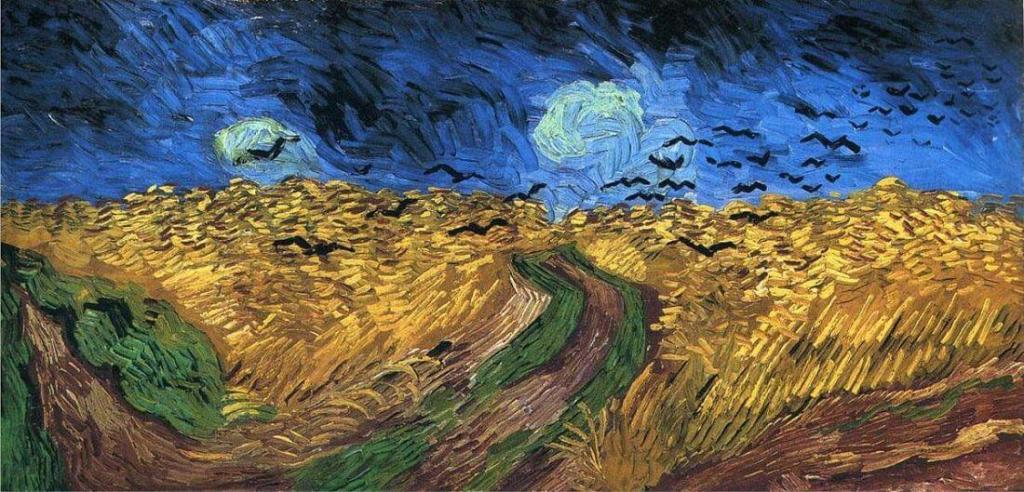
Wheatfield with Crows by Vincent Van Gogh, 1890

Some Greeks were among those who had gone to Jerusalem to worship during the festival. They went to Philip (he was from Bethsaida in Galilee) and said, “Sir, we want to see Jesus.”

Philip went and told Andrew, and the two of them went and told Jesus. Jesus answered them, “The hour has now come for the Son of Man to receive great glory. I am telling you the truth: a grain of wheat remains no more than a single grain unless it is dropped into the ground and dies. If it does die, then it produces many grains. Those who love their own life will lose it; those who hate their own life in this world will keep it for life eternal. Whoever wants to serve me must follow me, so that my servant will be with me where I am. And my Father will honor anyone who serves me.

“Now my heart is troubled—and what shall I say? Shall I say, ‘Father, do not let this hour come upon me’? But that is why I came—so that I might go through this hour of suffering. Father, bring glory to your name!”

Then a voice spoke from heaven, “I have brought glory to it, and I will do so again.”

The crowd standing there heard the voice, and some of them said it was thunder, while others said, “An angel spoke to him!”

But Jesus said to them, “It was not for my sake that this voice spoke, but for yours. Now is the time for this world to be judged; now the ruler of this world will be overthrown. When I am lifted up from the earth, I will draw everyone to me.” (In saying this he indicated the kind of death he was going to suffer.)

The crowd answered, “Our Law tells us that the Messiah will live forever. How, then, can you say that the Son of Man must be lifted up? Who is this Son of Man?”

Jesus answered, “The light will be among you a little longer. Continue on your way while you have the light, so that the darkness will not come upon you; for the one who walks in the dark does not know where he is going. Believe in the light, then, while you have it, so that you will be the people of the light.”

After Jesus said this, he went off and hid himself from them. (Good News Translation)

Today is another step in our journey together with Jesus. The path we are on together leads to a cruel cross. For the past six weeks the Christian has been on a Lenten walk. To keep the long sojourn going, believers focus on spiritual discipline, prayer, and repentance. 

Shadow

Along the way we come face-to-face with the shadow parts of ourselves. We discover that within us there is the pull to hold-on to unhealthy rhythms and habits of life. There is an inner push to arrange our lives with the fragmentation of disordered love.

Our reflexive response to things we do not like about ourselves might be to either use sheer willpower to change, or to try and manage our brokenness – as if we could boss our spiritual selves out of the darkness. However, the problem and the solution are much more radical than we often would like to admit.

While on this journey, Jesus invites us to die to ourselves. The pull and push of sin cannot be managed or willed away – it must be eradicated and completely cut out, like the cancer it is. Transformation and new life can only occur through death. 

A tiny little seed can grow, break the ground, and develop into something which provides sustenance for others.  It does no good to remain a seed in the ground. The little kernel must change beyond it’s current recognition if it is to reach for the sky and become food for the world.

Suffering

Christ is the ultimate example of the one who died to himself and for us. Only through suffering and death did he secure deliverance and freedom from sin, death, and hell. By his wounds we are healed. Through his tortuous death, new life became possible – because there must be a death if there is to be a resurrection; there must be suffering before there is glory.

Through dying to self and following Jesus, a transformative experience happens. As we change, mature, and produce a crop, we bring the kind of spiritual sustenance the world so desperately needs. Following Jesus, leaving all to walk with him, is true repentance and authentic discipleship.

Perhaps you protest, thinking I’m being too forceful or insistent about this Jesus stuff. Yes, you have perceived rightly. Within some corners of Christianity, a wrongheaded notion has developed that believes suffering is not God’s will.

Jesus, however, is insistent that dying to self is necessary. And it hurts like hell. It’s a hard teaching to absorb when you so desperately want things to be rainbows and unicorns. Suffering, whether we like it, or not, is the way of Jesus:

“In the days of his flesh, Jesus offered up prayers and supplications, with loud cries and tears, to the one who was able to save him from death, and he was heard because of his reverent submission.  Although he was a Son, he learned obedience through what he suffered; and having been made perfect, he became the source of eternal salvation for all who obey him.” (Hebrews 5:7-9, NRSV)

We are not above our Master. Christ’s life on this earth, before his crucifixion and death, was marked with suffering. Jesus learned obedience through struggle and adversity. The Lord himself did what he is now asking us to do.

Christ gave himself up to do the Father’s will. Jesus offered loud cries and tears and submitted to what the Father wanted. We must do no less. We don’t get to choose which parts of Christ’s life and teaching we will observe and which ones we won’t, as if Jesus were some spiritual buffet line. 

All who live for Jesus will follow him into the path of suffering, of death to self, and of new life through the power of his resurrection. In Christ’s own words: “Those who love their life will lose it, and those who hate their life in this world will keep it for eternal life.”  We must…

Surrender

We have hundreds, maybe thousands of small decisions every day with the use of our time, our money, our energy, and our relationships. If we have tried to fix what is broken inside of us, we will likely just try to hastily fix the problems and the people in our lives, then move on with getting things done on our to-do list. 

Instead, we have the invitation to surrender. We have the opportunity to create sacred space for solitude and silence, prayer and repentance. Take the time to (in person or virtually) sit with a person in pain and listen.  Reflect on how to use your money for kingdom values. See your life as a holy rhythm of hearing God and responding appropriately.

Sacrifice

Holding-on to our stuff and time is the opposite of sacrifice – it’s avarice. I understand that you and I are not Jesus – our sacrifice and suffering are not efficacious, that is, it doesn’t deliver other people from sin. Only Christ’s death does that. Yet, we are still called to sacrifice:

“I am now rejoicing in my sufferings for your sake, and in my flesh, I am completing what is lacking in Christ’s afflictions for the sake of his body, that is, the church.” (Colossians 1:24, NRSV)

Pleasure is not the summum bonum of life. Our lives are not meant to be lived solely for minimizing pain and maximizing comfort. Jesus has extended the call to view our workplaces, communities, neighborhoods, and families as our mission field of grace to a world in need of basic human kindness and attention – which takes sacrificial love on our part.

Christianity isn’t a religion that’s for people who have neatly packaged theological answers and certainties to all of life’s questions. Rather, Christianity is a dynamic religion of learning to follow Jesus, discovering how to die to self, and struggling to put Christ’s teaching and example into practice. 

The way of Christ is often characterized by a three-steps-forward, two-steps-backward sort of reality. The road is zig-zags with plenty of potholes. Those who don’t struggle are in big trouble. However, those who go through the pain of dying to self for the sake of their Lord, find that the harvest they produce leads to eternal life.

May you struggle well, my friend.

Almighty God, your dear Son did not ascend to joy until he first suffered pain; he did not enter glory before he was crucified. Mercifully grant that we, walking in the way of the cross, may find it as the true way of life and peace, through Jesus Christ, your Son, our Lord. Amen.

Psalm 31:9-16 – Lord, Have Mercy

Christ in Gethsemane by Michael O’Brien

Have mercy on me, Lord, for I am in distress.
    Tears blur my eyes.
    My body and soul are withering away.
I am dying from grief;
    my years are shortened by sadness.
Sin has drained my strength;
    I am wasting away from within.
I am scorned by all my enemies
    and despised by my neighbors—
    even my friends are afraid to come near me.
When they see me on the street,
    they run the other way.
I am ignored as if I were dead,
    as if I were a broken pot.
I have heard the many rumors about me,
    and I am surrounded by terror.
My enemies conspire against me,
    plotting to take my life.

But I am trusting you, O Lord,
    saying, “You are my God!”
My future is in your hands.
    Rescue me from those who hunt me down relentlessly.
Let your favor shine on your servant.
    In your unfailing love, rescue me. (New Living Translation)

One of my parishioners from years ago had seen hard combat in Italy during World War II. He saw his best friend killed, right next to him. I still remember his story and what he said in conclusion to it, in his own sage way: “In my experience, war is a very poor way of dealing with problems.”

And yet, we sometimes find ourselves embedded in circumstances we neither wanted nor asked for. Just ask the Ukrainians. No one puts their name on a sign-up sheet for suffering. Yet not a one of us can avoid it. 

Pain comes in all kinds of forms. Maybe the worst kind of suffering is the wound inflicted from others looking down at you when you’re already experiencing trouble and damaged emotions. 

Whether it is an ethnic or racial group of people facing ridicule, anger, and even beatings or death; or whether it is refugees trying to survive the ravages of war, the physical effects of pain can oftentimes be secondary to the primary hurt experienced within the spirit. 

“Suffering is part of the human condition, and it comes to us all. The key is how we react to it, either turning away from God in anger and bitterness or growing closer to Him in trust and confidence.”

Billy Graham

The Old Testament character, David, knew first-hand about suffering through hard circumstances. There were times when he felt completely overwhelmed by the evil machinations of people trying to take his life. If we could put ourselves in David’s sandals, we can understand why he was worn-out to the point of not sleeping, not eating well, even with a hint of paranoia. 

David responded to his seemingly impossible situation by entrusting himself to God. He truly believed he was in the Lord’s hands – and that fact was David’s go-to truth. 

Crossing over into the New Testament Gospels, Jesus uttered his last words on the cruel cross from this today’s psalm: “Father, into your hands I commit my spirit” (Luke 23:46). 

The cross was an obvious place of extreme bodily pain. That wretched pain, however, was dwarfed by the great spiritual pain of holding the entire world’s hurts and their curse of separation. The stress of both body and soul must have been crushing for Jesus. 

Yet, there was a strength of assurance, for Jesus, in the eye of that pain – the confidence of knowing he was in good hands, just like David’s confidence a millennium before.

There are times in life when we all struggle with why particular afflictions happen to us, in whatever form they might take in us. 

It is in the situation of being forgotten by others that we are most remembered by God.

It is within the crucible of trouble that God is the expert in deliverance.

It is when others revile us, say terrible things about us, and talk behind our backs that God comes alongside and whispers words of grace and steadfast love to us. 

It is whenever life is downright hard that we see a soft-hearted God standing to help us and hold us. 

While we are feeling our awful suffering, God is carefully crafting within us resilience through the rejection, empathy in our loneliness, purpose because of the trauma, forgiveness out of the shame, courage from having been failed, and self-awareness in the wake of emotional devastation. 

The biblical psalms are the consummate place to go when we are most in need. They provide the means to lift heartfelt prayers whenever our own words fail us. 

The psalms give us structure and meaning when the world around us makes no sense. 

The psalms do not always give us answers to our most vexing questions; they do, however, point us to the God who is attentive to the least, the lost, and the lonely.

Together, as people sharing the human condition of suffering, we cry out, “Lord, have mercy. Christ, have mercy. Lord, have mercy on us and grant us your peace. Amen.”