
Get Up and Pray! (Luke 22:39-46)

The Garden of Gethsemane by He Qi

Jesus went out as usual to the Mount of Olives, and his disciples followed him. On reaching the place, he said to them, “Pray that you will not fall into temptation.” He withdrew about a stone’s throw beyond them, knelt down and prayed, “Father, if you are willing, take this cup from me; yet not my will, but yours be done.” An angel from heaven appeared to him and strengthened him. And being in anguish, he prayed more earnestly, and his sweat was like drops of blood falling to the ground.

When he rose from prayer and went back to the disciples, he found them asleep, exhausted from sorrow. “Why are you sleeping?” he asked them. “Get up and pray so that you will not fall into temptation.” (New International Version)

The prayer of Jesus and the sleeping of his disciples presents a contrast of approach when severe stress is upon us.

The Prayer of Jesus

Christ’s prayer expresses the tension all devout persons face: expressing our own wishes while seeking to submit to the Father’s wishes.

However, what is not the same, between our own prayers and the prayers of Jesus, is that we too often believe that if we are intense, wordy, and insistent enough with God, that our prayers will be answered.

While only feigning a few words about God’s will, we put our real efforts into lawyer-like presentations of why the Lord should answer our prayers in the way we want them answered.

Thus, prayer can too easily become a willful imperative that God grant our demands based in a very limited understanding of the big picture.

There is a big difference between willfulness and willingness. We must embrace the latter and eschew the former.

Jesus clearly stated exactly what he wanted: to have this terrible suffering, especially the pain about to be experienced, taken from him. Yet, he asks this with a willingness to accept the Father’s will for his life. Although an angel comes to bring comfort and strength, Christ’s request was denied. And Jesus was good with that.

We can, following the example of Jesus, unashamedly express our anguish, while at the same time, accepting God’s will for us, no matter what it may be.

Christ in Gethsemane by Michael O’Brien

It was God’s will for Jesus to suffer. And Christ not only suffered in the Garden of Gethsemane and on the cross; Jesus experienced the full range of human suffering throughout his life. He knew what it felt like to face continual adversity and hardship. 

The suffering of Christ helps us make sense of our own suffering. We can only truly be free from our stubborn expectations by embracing that which makes us suffer. 

Some suffer through the death of a loved one; some through cancer or a serious health issue; other believers right now throughout the world are suffering due to grinding poverty and la ack of food and clean water; many others suffer through violence done to them or their families.

Because of this reality, some of us may not even express our anguish to God in prayer. After all, what is a harshly worded e-mail, or trying to lose a few extra pounds, or an unexpected car repair, compared to starving children in the world? 

It’s good to keep our life situations in proper perspective, but it is also not good to tell God what he should and shouldn’t care about in this world. 

If the only things that matter and qualify as hardship and difficulty is human trafficking or the terrors of war, then you will soon find yourself plastering a smile on your face and nodding over-enthusiastically whenever someone asks you how you are doing…. Good grief…. I find chronically happy Christians to be insufferable (pun intended).

The sufferings of Christ qualified him to be a compassionate high priest, able to help us (Hebrews 2:5-18). A priest is one who stands in between the person and God, making things right with God. Christians possess a union with Jesus Christ because of his suffering, death, and resurrection. He is our champion. He stands with us in our suffering and temptations.    

The Sleep of the Disciples
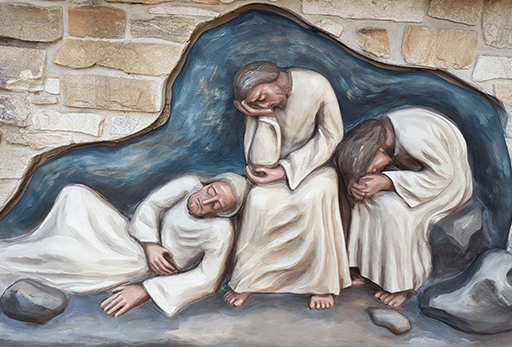
Even though their Lord told them to pray, the disciples nod-off in a stress-induced sleep. Jesus wanted them to remain awake, and he was talking of more than just physical alertness. The disciples needed to keep watch so that they didn’t fall into temptation.

Throughout his earthly ministry, Jesus had been warning them that his cross will lead to their own cross to bear. They, too, will have times of trial, so intense that it will be emotionally and spiritually overwhelming. Christ desired the disciples to follow his own example of offering anguished prayer which is thoroughly submissive to God.

So, our great task is to get up and pray!

Get up and pray so that no temptation can overtake you! (1 Corinthians 10:13)

Get up and pray so that you can endure hardship! (Hebrews 12:7)

Get up and pray for the enemies who persecute you so that you may be children of your Father in heaven! (Matthew 5:44-45)

Get up and pray so that you can encourage others and build them up in the faith! (1 Thessalonians 5:10-11)

Get up and pray so that you can be joyful in hope and patient in affliction! (Romans 12:12)

Get up and pray so that you may have peace in this world of trouble! (John 16:33)

Get up and pray so that you can submit to God and resist the devil! (James 4:7)

Get up and pray so that you will not be overcome by evil but overcome evil with good! (Romans 12:11)

Get up and pray so that you can submit to one another out of reverence for Christ! (Ephesians 5:21)

Get up and pray so that you can be the salt of the earth and the light of the world! (Matthew 5:13-16)

Get up and pray so that you can proclaim that the kingdom of God is near! (Matthew 10:7)

Get up and pray so that you can preach the Word with great patience and careful instruction! (2 Timothy 4:1-2)

Get up and pray so that you can have confidence in your leaders and submit to their authority, because they keep watch over you as those who must give an account. (Hebrews 13:17)

Get up and pray!…

Persevere Through Adversity (Psalm 129)

Painting of Jerusalem by Alex Levin

From my earliest youth my enemies have persecuted me.
    Let all Israel repeat this:
From my earliest youth my enemies have persecuted me,
    but they have never defeated me.
My back is covered with cuts,
    as if a farmer had plowed long furrows.
But the Lord is good;
    he has cut me free from the ropes of the ungodly.

May all who hate Jerusalem
    be turned back in shameful defeat.
May they be as useless as grass on a rooftop,
    turning yellow when only half grown,
ignored by the harvester,
    despised by the binder.
And may those who pass by
    refuse to give them this blessing:
“The Lord bless you;
    we bless you in the Lord’s name.” (New Living Translation)

The Jewish people know a thing or two about perseverance through suffering; they’ve been enduring it for millennia. If we let them, they can show us a better way of facing adversity.

It seems to me that we modern Gentiles could learn from our Jewish brothers and sisters. We Westerners tend toward burying the past, putting things behind us, and forgetting all the bad things which occurred back there. But the Psalms, a wonderful depository of Jewish thought and practice, will have none of that approach.

Today’s Psalm comes from a group known as the “Psalms of Ascent.” (Psalms 120-134) These were sung by ancient Jewish worshipers as they made the journey up to Jerusalem for the Feast of Tabernacles.

As the pilgrims walked together on their ascent to the great city, the experience of collectively singing and worshiping made the people feel united in joy, purpose, and sorrow. Remembering was central to that sense of solidarity.

The Jewish people have been attacked by countless enemies, not only throughout the Old Testament, but also throughout their long history. Empires tend to not like Jews because Jews hold to their own set of laws and worship practices – which seem to always come into conflict with what some Emperor, Dictator, or Tyrant wants. So, they try to be rid of Jews, like plowing a field to break up the stubborn hard ground of Yahweh worship. The Jewish people end up being treated, literally, like dirt.

“The attempt to eliminate the people of God was an attempt to eradicate the presence of God from the human situation. The fact that after Auschwitz the Jewish people still lives and can still affirm its faith is the most powerful testimony that God still lives.”

Rabbi Jonathan Sacks, Crisis and Covenant

God will deliver… eventually. Whether Jew or Christian, there will always be enemies to the faith. And sadly, the history of Christianity includes their own brand of persecuting Jews. *Sigh*

Haters, the Psalm hopes, will be like grass in shallow soil: They may sprout quickly, but will also wither quickly and blow away to be gone forever.

The evil of this fallen world is terrible and ugly; but it isn’t permanent. Therefore, we need patience and perseverance through the suffering and adversity to realize the deliverance.

And as much as aggressive bullies try to wipe out those not conforming to their ways, the Lord simply brings in a harvest of righteousness, despite it all.

Even though the Psalms of Ascent were written long ago by people living in a time and place very different from ours, yet they express the emotions we all feel, which makes them helpful for our journey through life, as well.

Although none of us delights in persecution, pain, and struggle, we can take the stance of embracing our hard circumstances because suffering produces perseverance; perseverance, character; and character, hope. And hope does not put us to shame, since love is the force that binds the world together. (Romans 5:3-8)

“When two friends climb a hill, the hill seems less steep than if they climbed it alone.”

Sherri Mandell

Oftentimes, it is inside the pain that we begin to become one with our own vulnerable humanity. And that humble humanity is where great courage, great creativity, and great work germinates within our spirits and cultivates the ground of this world, growing to produce faith, hope, and love.

Everyone facing adversity knows how hard it is to keep going without seeing the goal. Like the farmer, we must expectantly wait till the harvest. There is nothing we can do to speed up the process and go straight from planting to harvest. It takes time and plenty of patience. Grumbling and complaining about how long it is taking will not make it go any faster.

Perseverance in the face of hardship is a major pathway to realizing a holy life. Consider the ancient prophets:

  • Jeremiah was faithful to proclaim God’s message yet was thrown into a cistern and left for dead. Yet, he was delivered from it. (Jeremiah 38:1-28)
  • Micaiah was faithful to declare truth to King Zedekiah, who then promptly imprisoned him, even though the king asked for God’s message. (1 Kings 22:24-27)
  • Daniel was faithful to pray consistently to the one true God and was thrown into the lion’s den to be killed. But the Lord saved him. (Daniel 6:1-28)

The prophets all suffered for doing the right thing and did not waver in their commitment to the Lord. Through their troubles they learned to trust God and draw near to the Lord. The adversity strengthened, not weakened, their faith.

What’s more, consider the Old Testament character of Job, who is Exhibit A of perseverance through grinding hardship. Job had it all; and he lost it all… except his faith. Job tenaciously held onto righteousness, despite his awful physical, mental, emotional, and spiritual pain. And he eventually came through it, restored and whole.

We are to keep going in our faith and not give up – and the Psalms of Ascent can help us in our endurance.

The soul would have no rainbow if the eyes had no tears. We live in a time when we will either sink or swim – there is no in-between. God’s celestial shore is within sight; don’t miss it by getting discouraged by all the fog. 

Hang in there, my friend. There is good reason to do so.

Heartfelt Prayer (Lamentations 5:1-22)

Orthodox icon of Jeremiah praying

O Lord, reflect on what has happened to us;
consider and look at our disgrace.

Our inheritance is turned over to strangers;
foreigners now occupy our homes.

We have become fatherless orphans;
our mothers have become widows.

We must pay money for our own water;
we must buy our own wood at a steep price.

We are pursued—they are breathing down our necks;
we are weary and have no rest.

We have submitted to Egypt and Assyria
in order to buy food to eat.

Our forefathers sinned and are dead,
but we suffer their punishment.

Slaves rule over us;
there is no one to rescue us from their power.

At the risk of our lives, we get our food
because robbers lurk in the wilderness.

Our skin is as hot as an oven
due to a fever from hunger.

They raped women in Zion,
virgins in the towns of Judah.

Princes were hung by their hands;
elders were mistreated.

The young men perform menial labor;
boys stagger from their labor.

The elders are gone from the city gate;
the young men have stopped playing their music.

Our hearts no longer have any joy;
our dancing is turned to mourning.

The crown has fallen from our head;
woe to us, for we have sinned!

Because of this, our hearts are sick;
because of these things, we can hardly see through our tears.

For wild animals are prowling over Mount Zion,
which lies desolate.

But you, O Lord, reign forever;
your throne endures from generation to generation.

Why do you keep on forgetting us?
Why do you forsake us so long?

Bring us back to yourself, O Lord, so that we may return to you;
renew our life as in days before,
unless you have utterly rejected us
and are angry with us beyond measure. (New English Translation)

“’Knock and it shall be opened.’ But does knocking mean hammering and kicking the door like a maniac?”

C.S. Lewis, A Grief Observed

Prayer is not about getting the right words strung together in a correct formula in a perfect disposition of the heart. Rather, prayer is conversation and a dialogue with God. 

Sometimes prayer looks a lot more like a triage unit in a hospital than it does a steeple on a church. Prayer often looks like desperation more than it does praise. 

God is a Being that we can tell the truth about what is really going on in our lives. Prayer isn’t prayer when we just tell God what we think God wants to hear.

“Prayer is not asking. It is a longing of the soul. It is daily admission of one’s weakness. It is better in prayer to have a heart without words than words without a heart.”

Mahatma Gandhi

The biblical book of Lamentations is the prophet Jeremiah’s extended prayer of grief, lament, complaint, and raw feeling. His hometown of Jerusalem was decimated by the invading Babylonian army. Thousands of people were taken out of the city and into exile. The ones left, including Jeremiah, were beside themselves with anger, grief, sadness, and fear.

We hear his cry to God, not worrying about whether it is appropriate language or not. Jeremiah’s words and phrases to God were heartfelt and real:

“We’re worn out and without any rest.”

“All the joy is gone from our hearts.” 

“We are heartsick.”

“We can hardly see through our tears.”

“Why do you keep forgetting us, God?”
“Lord, why dump us and leave us like this?

“Give us a fresh start, for God’s sake!”

Jeremiah was not concerned about how he looked or sounded, and not afraid to express his real thoughts and feelings.

Every thought and feeling is a valid entry into prayer. It is of utmost importance that we pray what is actually inside of us and not what we believe God would like to hear from us. 

The Lord doesn’t like pretense and posturing; God wants the real us. 

Plastic words and phony speeches are an affront to God. We must pray precisely what is on our minds and in our hearts – unfiltered, if need be. No matter the headache or the heartache, we only need to pray, without any concern for doing it perfectly.

“Suffering forces us to change.
We don’t like change and most of the time we fear it and fight it.
We like to remain in emotionally familiar places
even through sometimes those places are not healthy for us.
On occasion, the suffering is so great that we have to give up.
We surrender the old and begin anew.
Often it is the pain we experience that leads us, not only to a different life,
but a richer and more rewarding one.” Dennis Wholey

Gracious God, sometimes I feel like I have to have it all together to even speak to you. Yet you already know my heart better than I know it myself. Forgive my constant hiding from you and accept my heartfelt prayer to you for grace and help, through Jesus Christ my Savior and Lord. Amen.

How to Cope with Trials of Faith (James 1:2-11)

Consider it pure joy, my brothers and sisters, whenever you face trials of many kinds, because you know that the testing of your faith produces perseverance. Let perseverance finish its work so that you may be mature and complete, not lacking anything. If any of you lacks wisdom, you should ask God, who gives generously to all without finding fault, and it will be given to you. 

But when you ask, you must believe and not doubt, because the one who doubts is like a wave of the sea, blown and tossed by the wind. That person should not expect to receive anything from the Lord. Such a person is double-minded and unstable in all they do.

Believers in humble circumstances ought to take pride in their high position. But the rich should take pride in their humiliation—since they will pass away like a wild flower. For the sun rises with scorching heat and withers the plant; its blossom falls, and its beauty is destroyed. In the same way, the rich will fade away even while they go about their business. (New International Version)

Where do you turn when unwanted circumstances leave you wondering how to cope?

The Apostle James, no stranger to adversity and stressful situations, likened our position in hard situations as faith being on the witness stand, put to the test. Faith is being examined and cross-examined. And it must stand the test. 

Our attitude toward such trials, in all their varied forms, determines whether we will become upset, hard-hearted, and calloused, or, come through having our faith confirmed with newfound peace and joy.

Christians are to view their adverse situations as an opportunity for their faith in Christ to develop and grow.

Rejoice in the midst of trials

Telling someone to consider their tough situation as pure joy is a really hard pill to swallow. 

James, however, was looking to fortify the believers’ faith. Whenever we get a cut or a laceration, the first thing needed is to apply peroxide to the wound so there will be no infection from the injury. It might seem insensitive because peroxide applied to an open wound, frankly, hurts like hell. Yet it must happen. It’s a necessary part of healing. 

The Apostle cared enough about the people to tell them what they needed to hear, up front. Without a positive, godly, and wise perspective on their difficulties, their faith would fail. Infection would set in and destroy the fledgling church.

Suffering is a significant part of the Christian life. God never promised that life would be or should be all cupcakes and unicorns. 

In fact, Christ promised just the opposite – that everyone who wants to live for Jesus in this present broken world will have a hard time of it. It’s not a matter if you will face the testing of your faith, but of whenever you face trials.

The good news is that adversity can become our teacher. We can learn patient endurance, which is necessary to the development of our faith. Spiritual growth only matures through the testing of faith through adversity.

These troubles come to prove that your faith is pure. This purity of faith is worth more than gold, which can be proved to be pure by fire but will ruin. But the purity of your faith will bring you praise and glory and honor when Jesus Christ is shown to you.

1 Peter 1:7, NCV

Faith is not a neutral or static thing. Faith is active and dynamic. It’s always either developing or degenerating.  Without spiritual peroxide, faith degenerates and becomes rancid. Eventually, gangrene sets in, and an amputation will happen. To avoid this, we need to learn how to experience joy in the middle of hard things.

Faith is challenging, and often hard. Yet, even within the pain, faith is incredibly invigorating and joyful.

Do not avoid trials

We need perseverance. Only through endurance is spiritual maturity realized. Let your hard situation do its necessary work. Immature people avoid hard things and instead put their energy into keeping up appearances.

Conversely, the mature person perseveres through the test and trial of faith. They understand that there must be pressure for spiritual maturity to occur.

God is looking to do something beautiful in our lives. So, if we constantly run away and do not deal with our hard situations, there will never be a pearl. It takes about ten years for a pearl to form in an oyster in the ocean.  Observing an oyster every day, you never notice any movement is happening. But it’s there.

In the Christian life, the consistent daily choices over a long period of time (perseverance) form the eventual beauty.

Pray for wisdom in the trials

Ask God for wisdom to see the adverse circumstance from a different angle – of its positive good, and for what God is accomplishing in and through it. The truth is, God is developing within people a strong vibrant faith, if we allow it.

Within a hardship, it does little good to ask, “Why is this happening to me?” It is much better to ask, “Why is this trial here for me? What can I learn from it?”

With no meaningful prayers, there is no meaningful wisdom for our circumstances.

Believe God is good no matter the trial

God is not mean, but generous. The Lord gives with no questions asked, and without giving us a hard time about our situation. Yet, there is a condition….

We must believe – that God is good, answers prayer, and gives wisdom. We may doubt a lot of things. Yet we are always to be secure in the knowledge that God has our best interests at heart. This is why there can be joy and perseverance, even when everything around us is going to hell.

Christians in humble circumstances actually have a high position because their poverty enables them to be open to God; and the pressures of poverty lead them to rely on God’s enablement and provision.

Whenever you find yourself with few material possessions; work hard but struggle to keep food on the table; and find it difficult to pay the bills – then, you are stripped of the illusion of independence and are left vulnerable before God. Trust isn’t optional, but absolutely necessary for survival.

Will we pour our lives into things, or into people?

Will we look for ingenuity and technical solutions in order to make our budgets budge, or will we come to God?

Will we define success as worldly wealth, or will we define success as acting justly, loving mercy, and walking humbly with our God?

Do not trust in wealth during a trial

In the midst of hard times, those who love the Lord Jesus are realize their true position and draw strength from it. Yet, for those who do not trust God alone but trust in their wealth and resources, things will not end well.

“Watch out! Guard yourself against all kinds of greed. After all, one’s life isn’t determined by one’s possessions, even when someone is very wealthy.” Then he told them a parable: “A certain rich man’s land produced a bountiful crop. He said to himself, What will I do? I have no place to store my harvest! Then he thought, Here’s what I’ll do. I’ll tear down my barns and build bigger ones. That’s where I’ll store all my grain and goods. I’ll say to myself, You have stored up plenty of goods, enough for several years. Take it easy! Eat, drink, and enjoy yourself. But God said to him, ‘Fool, tonight you will die. Now who will get the things you have prepared for yourself?’ This is the way it will be for those who hoard things for themselves and aren’t rich toward God.” (Luke 12:15-21, CEB)          

Such persons fade away even while they go about their business. Those who trust in things are the real underprivileged people. They may grow up and look beautiful. And yet, the next day, they’re gone – annihilated by a hot wind. 

Like a cornfield in a massive hailstorm, or a flower in a severely hot sirocco wind, the rich cannot stand in the judgment, that is, if they are trusting in their wealth to provide power, control, attention, and status.

The upwardly mobile path of worldly success and financial security, never stopping to lay up treasure in heaven, will have a rude awakening with a major career change in hell.

Conclusion

Where are you on the spectrum of faith? 

Do you need to turn from trust in stuff, and trust in Christ? 

Confess to God a love of things over love of Christ.

Declare to God that you want to change.

Believe in forgiveness through the cross of Christ.

Tell a trusted person about your decision.

Grant, O God, that we may never lose our way through stubborn self-will, and never abandon the struggle but endure to the end. Help us never to choose the cheap way of avoiding or circumventing our trials but embrace the Via Dolorosa. May we never forget that sweat is the price of all things, and that without the cross, there cannot be the crown. Amen.