Handling Opposition (John 8:48-59)

Christ and Pharisee, by Russian artist Ivan Filichev, 1993

The Jews answered him, “Aren’t we right in saying that you are a Samaritan and demon-possessed?”

“I am not possessed by a demon,” said Jesus, “but I honor my Father and you dishonor me. I am not seeking glory for myself; but there is one who seeks it, and he is the judge. Very truly I tell you, whoever obeys my word will never see death.”

At this they exclaimed, “Now we know that you are demon-possessed! Abraham died and so did the prophets, yet you say that whoever obeys your word will never taste death. Are you greater than our father Abraham? He died, and so did the prophets. Who do you think you are?”

Jesus replied, “If I glorify myself, my glory means nothing. My Father, whom you claim as your God, is the one who glorifies me. Though you do not know him, I know him. If I said I did not, I would be a liar like you, but I do know him and obey his word. Your father Abraham rejoiced at the thought of seeing my day; he saw it and was glad.”

“You are not yet fifty years old,” they said to him, “and you have seen Abraham!”

“Very truly I tell you,” Jesus answered, “before Abraham was born, I am!” At this, they picked up stones to stone him, but Jesus hid himself, slipping away from the temple grounds. (New International Version)

I am a recovering perfectionist. There was a time in my life when I believed that I could attain perfection in all things. And, what’s more, I thought that if I could be perfect in everything I said and did, I would never face any opposition.

It took me awhile to realize that Jesus, the perfect Son of God, handled life on this earth as well as anybody ever did or could, and yet he still faced continual opposition. Then, at the end of his life, Jesus was ridiculed, tortured, and killed by people who should have known better.

The religious leaders, at the time of Christ, leveled on Jesus their worst accusations by calling him a Samaritan and demon possessed. But Jesus handled it. He wasn’t surprised by it. Nothing they said threw him off.
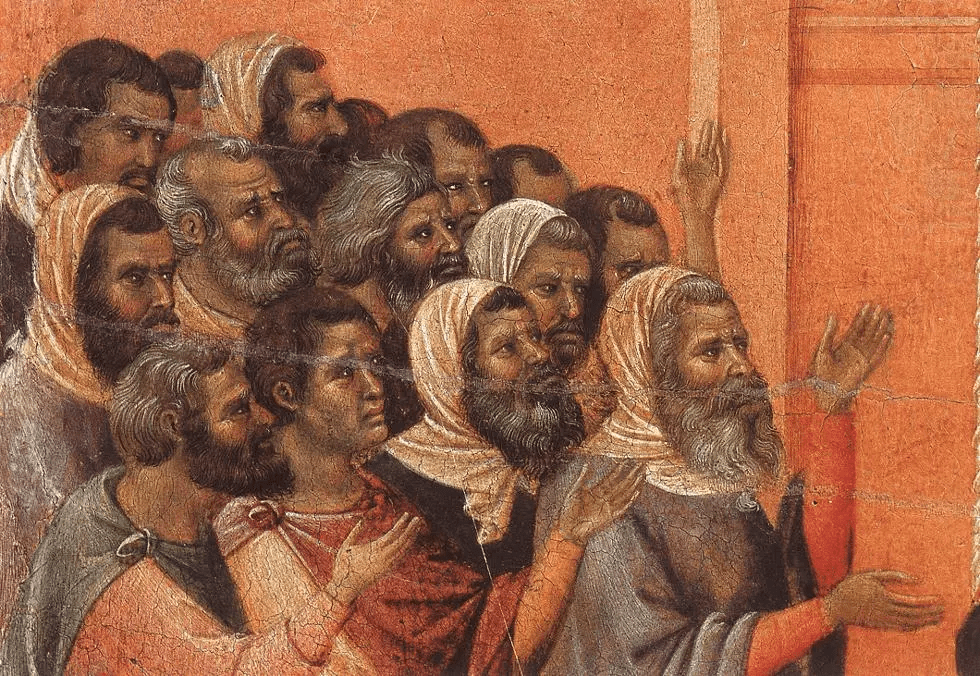
Christ Accused by the Pharisees, by Duccio di Buoninsegna, 1308

There is a way to deal with opposition. There’s a path to dealing effectively with the meanness of others. And there’s a way to face the trouble, as well as your Anfechtung (spiritual oppression and depression) about what’s happening.

The road ahead, however, may be counter-intuitive to how you think. And the way forward might be so far off your radar that you may dismiss what I’m about to say to you. Maybe you’ll even call me a Samaritan.

But before I get to that, I’ll say this: Opposition, even oppression, is endemic to the human condition. Everyone, at times, suffers this way; none of us are immune to affliction, nor can we insulate ourselves from pain. If you are not currently suffering in some way, it means you are either coming off a time of hardship, or are about to enter a new period of distress.

Holiness and godliness don’t keep suffering at bay. Just ask Jesus. In fact, the Lord Jesus himself promised that following him involves a sort of oppression that those who are not Christians will never face. (John 16:33) 

Christ’s disciple, Peter, came to understand the reality that since Jesus experienced opposition, so will his followers. (1 Peter 4:12).

The Lord’s brother, James, understood that everyone faces difficulty; and he wisely discerned that opposition is a teacher, from which we learn maturity, perseverance, and patience. (James 1:2). 

Jesus’ greatest follower, Paul, continually dealt with opposition from others, more than any follower of Jesus in history. And he insisted that anyone who belongs to Christ will have trouble;  and that suffering enables us to persevere and be in solidarity with Jesus. (2 Timothy 3:12; Romans 5:3-5; Philippians 1:29)

Yes, in this world you will have trouble. But take heart. Jesus has overcome the world. (John 16:33)

Now, back to the topic of handling opposition from others. Here’s the truth:

Dealing with opposition, oppression, and suffering comes through Christ, and not from us. And the practice of overcoming trouble doesn’t come from fighting against it, but by sitting with it and learning from it.

Stated differently: Jesus has overcome the world through his death, resurrection, and ascension. On the cross, he absorbed all the sin and suffering of everyone. This means that your suffering, no matter it’s source, will be subdued whenever you invite it to take a seat with you and have a conversation with it.

Said yet another way: Quit fighting against your suffering. Stop kicking and screaming long enough to look your feelings square in the face and learn from them.

The opposition is trying to tell us something. But if we keep taking the stance of a pugilist, trying to punch it away, it will just keep moving forward and never topple. 

Oppression isn’t something you beat; it’s something you learn from. Jesus already did the beating and the winning.

And we’ll only learn from suffering and overcome it when we embrace it. Therefore, the counter-intuitive, counter-cultural practice is: Submit to suffering. When we do that, like Jesus, we simply slip away from the oppressors. They no longer have any power over us.

Don’t hear what I’m not saying. I’m not an advocate for sanitizing your troubles or trauma with a positive spin. Evil is evil, bad is bad, and no amount of saying otherwise will change the leopard’s spots. 

And yet, only through submitting to the process of what opposition teaches us, can we hope to break its power over us.

Let’s liken our opposition to encountering a bear in the wilderness. The National Park Service gives us this advice if facing a bear while out hiking: “Once a bear has noticed you and is paying attention to you, these strategies can help prevent the situation from escalating:”

  • Identify yourself by talking calmly so the bear knows you are a human and not a prey animal. Remain still; stand your ground but slowly wave your arms. Help the bear recognize you as a human. It may come closer or stand on its hind legs to get a better look or smell. A standing bear is usually curious, not threatening.
  • Stay calm and remember that most bears do not want to attack you; they usually just want to be left alone. Bears may bluff their way out of an encounter by charging and then turning away at the last second. Bears may also react defensively by woofing, yawning, salivating, growling, snapping their jaws, and laying their ears back. Continue to talk to the bear in low tones; this will help you stay calmer, and it won’t be threatening to the bear. A scream or sudden movement may trigger an attack. Never imitate bear sounds or make a high-pitched squeal.
  • Hike and travel in groups. Groups of people are usually noisier and smellier than a single person. Therefore, bears often become aware of groups of people at greater distances, and because of their cumulative size, groups are also intimidating to bears.
  • If the bear is stationary, move away slowly and sideways; this allows you to keep an eye on the bear and avoid tripping. Moving sideways is also non-threatening to bears. Do not run, but if the bear follows, stop and hold your ground. Bears can run as fast as a racehorse both uphill and down. Like dogs, they will chase fleeing animals. Do not climb a tree. Both grizzlies and black bears can climb trees.

Fighting against someone’s oppression is about as useful as taking on a bear. Both bears and oppressors can be dangerous. We don’t blame bears if they act like bears. Likewise, let’s not be surprised when opposition arises.

I suggest we treat opposition as if we are facing a bear in the wilderness of trouble:

  • Calmly identify yourself. Doing the big freak-out is only going to encourage suffering to do damage. Oppression will pass, but you must be patient and calm. 
  • Talk in low tones to the opposition.
  • Remember who you are; you belong to God. 
  • Handle oppression as if it is curious about you. 
  • Walk with others. You’re not John Wayne. Community is necessary, not optional.
  • Keep your eye on opposition. Don’t ignore it, or pretend it isn’t there. Don’t run. Face it and keep it in front of you.

Jesus was calm, honest, and forthright. He was, therefore, able to speak and handle himself with wisdom in the face of opposition and trouble. Christ knew who he was, who the opposition was, and what his purpose was; and we can know those same things, as well.

Grant us patience, O Lord, to follow the road you have taken. Let our confidence not rest in our own understanding but in your guiding hand; let our desires not be for our own comfort, but for the joy of your kingdom; for your cross is our hope and our joy now and unto the day of eternity. Amen.

Trust In God’s Timing (Exodus 2:15-25)

Moses fled from Pharaoh and went to live in Midian, where he sat down by a well. Now a priest of Midian had seven daughters, and they came to draw water and fill the troughs to water their father’s flock. Some shepherds came along and drove them away, but Moses got up and came to their rescue and watered their flock.

When the girls returned to Reuel their father, he asked them, “Why have you returned so early today?”

They answered, “An Egyptian rescued us from the shepherds. He even drew water for us and watered the flock.”

“And where is he?” Reuel asked his daughters. “Why did you leave him? Invite him to have something to eat.”

Moses agreed to stay with the man, who gave his daughter Zipporah to Moses in marriage. Zipporah gave birth to a son, and Moses named him Gershom, saying, “I have become a foreigner in a foreign land.”

During that long period, the king of Egypt died. The Israelites groaned in their slavery and cried out, and their cry for help because of their slavery went up to God. God heard their groaning and he remembered his covenant with Abraham, with Isaac and with Jacob. So God looked on the Israelites and was concerned about them. (New International Version)

Faith is active, not static; it’s a dynamic experience of growth, not a possession that sits on your desk to admire. The experience of faith is much like a muscle that needs exercise and growth in order to be strengthened. 

Moses needed to learn and grow in faith, just as much or more than the rest of us. He didn’t always get it right. Wanting to show solidarity with his own people, and to help them by doing what he could, Moses killed an Egyptian overseer who was abusing a Hebrew slave.

Even though Moses tried to hide what he did, the word got out. And having grown up in the royal court of Pharaoh, he knew it was only a matter of time before he was found out. So, he left, at forty years old, knowing nobody outside of Egypt that he might connect with.

For the next forty years, Moses was in Midian, having received the hospitality he needed to survive. He married, settled down, and lived a very different life than the one he once had in Egypt. I doubt he forgot about his people in slavery. But I am pretty sure Moses doubted himself and saw no connection between himself and being able to do anything about his people’s awful situation.

Little did he know what was coming in his future.

“God is too good to be unkind. Too wise to be mistaken; and when you cannot trace his hand you can trust his heart.”

Charles Haddon Spurgeon

The fact that Moses was eighty years old before he became the human agent of God’s deliverance, after a forty year stint in the backside of the desert as a shepherd, tells us that it took him awhile to mature. Even though Moses may have had a sense that the Israelites needed freedom from slavery, and acted on that sense by killing a ruthless Egyptian, his sense of timing was not good.

There is a time for everything, said the writer of Ecclesiastes. Wisdom, the ability to apply faith in concrete situations, is often in the timing of things. To know when to speak and when to listen, when to act and when to wait, is an important facet of faith. 

The ancient Israelites were slaves in Egypt for centuries. Moses knew they were suffering, and he acted impetuously. But it was not yet time. The groans of the people, however, did not go unnoticed. Eventually, the Jewish cry came up to God, and God heard them. The Lord remembered his covenant with them. 

But why did God not act sooner, or use Moses earlier? Why did the Hebrew people have to suffer for so long? That, my friend, is information that is only privy within the mind of God. The Lord has the big picture of what is happening in the universe; and I don’t.

The perspective of time surely looks much different when you can stand above it and see the past, present, and future all in one look.

For us, if we are to develop in faith and gain a wise sense of timing, we will need to rely on God. Trusting in ourselves, our own efforts, and our own perceived timing of how things ought to proceed will usually not end well. 

We may, much like Moses, find ourselves taking a “time out” from God in obscurity, until we learn to wait on the Lord’s deliverance.

Moving into the New Testament, in the fullness of time, Paul said to the Galatians, Jesus came, born of a woman, born under law, to redeem those under the law. (Galatians 4:4-5)

Faith is trusting in what God is doing, even though it might seem like the Lord is painfully slow in acting when circumstances are difficult. Yet, God sees; and God delivers. 

The Lord accomplishes deliverance according to divine timing – not ours. So, don’t be impetuous and cockeye about what needs to be accomplished, and when it needs to be done. Instead, do your best to keep up your spiritual growth, develop a good sense of timing, and rely upon the wisdom gained while you’re living in the backside of the desert.

Redeeming God, you control all things, including the clock. Give me wisdom so that my sense of timing might reflect your will and your way. Help me to persevere through suffering, and to trust in your goodness and grace, through Jesus Christ my Lord, in the strength of the Holy Spirit. Amen.

Have Spiritual Eyes to See (1 Peter 1:8-12)

You love him, although you have not seen him, and you believe in him, although you do not now see him. So you rejoice with a great and glorious joy which words cannot express, because you are receiving the salvation of your souls, which is the purpose of your faith in him.

It was concerning this salvation that the prophets made careful search and investigation, and they prophesied about this gift which God would give you. They tried to find out when the time would be and how it would come. This was the time to which Christ’s Spirit in them was pointing, in predicting the sufferings that Christ would have to endure and the glory that would follow. 

God revealed to these prophets that their work was not for their own benefit, but for yours, as they spoke about those things which you have now heard from the messengers who announced the Good News by the power of the Holy Spirit sent from heaven. These are things which even the angels would like to understand. (Good News Translation)

No less real than our actual physical eyes are our spiritual eyes – which enable us to see things invisible to our physical eyesight. Faith is the glasses that bring those things into focus.

To have faith is to be sure of the things we hope for, to be certain of the things we cannot see. (Hebrews 11:1, GNT)

Our life is a matter of faith, not of sight.

(2 Corinthians 5:7, GNT)

Faith creates the conditions for love. Cold dispassionate ideas and thoughts are just that; but faith gives us sight to see the true nature and meaning of love. Faith enables us to see Jesus Christ, who is Love incarnate.

This spiritual sight, made possible by faith, and bringing Christ into focus, is the basis for joy and the foundation of hope. It is more than joy; it’s joy unspeakable, beyond words, greater than the vocal chords can produce. It’s the sort of joy that takes your breath away.

Joy elevates us and brings us face to face with the glory of heaven. And once we have experienced this, our contentment is solely in Christ, and we have no need for anything the world offers. This is what it means to be saved.

Salvation always involves two equal and important facets: deliverance from something, so that we may attach to something else.

For the believer, with spiritual eyes to see in faith, we are saved from all the snake oil promises and allurements of the world; we are delivered from the weight of guilt and shame we carry; and we are snatched from the flames of hell and the machinations of the devil to ensnare us in evil.

The deliverance comes so that we can then connect with goodness, truth, justice, integrity, wholeness – with the love of God in Jesus Christ. Experiencing this wondrous spiritual fruit leads to a pure confession of faith:

But all those things that I might count as profit I now reckon as loss for Christ’s sake. Not only those things; I reckon everything as complete loss for the sake of what is so much more valuable, the knowledge of Christ Jesus my Lord. For his sake I have thrown everything away; I consider it all as mere garbage, so that I may gain Christ and be completely united with him. (Philippians 3:7-9, GNT)

I am neither a Christian because I was raised in cultural Christianity, nor because it was all I knew at the time. Rather, I am a Christian – a follower of Jesus Christ – because I was given a great gift of faith and saw divine love given for me, even though I deserved none of it.

So, my heart fully and forever belongs to Christ. It is a life worth living, a life of faith, hope, and love. No matter the hardship, adversity, or crud which happens to me on this earth, I am thoroughly surrounded by God’s grace, peace, and love.

And if I have to explain it to you, you probably don’t have it. That’s because it takes a different sort of eyesight, a countercultural set of ears, and a new meaning of touch, smell, and taste.

This sort of deliverance from sin, death, and hell, and into a great inheritance of faith, is so incredible that the ancient prophets, and the even older angels, longed to know what this salvation truly is.

And what they foretold, and believers now know, is that the cross is the way to victory; death is the passage to life; suffering is the road to glory.

Therefore, our present afflictions need not discourage nor debilitate us, as though we were miserable without any hope. Even more, it is through these very troubles that we are blessed.

No matter the evil thrown our way, there is always glory attached to it. If we must suffer, let us do so in the same spirit as Christ suffered:

My dear friends, do not be surprised at the painful test you are suffering, as though something unusual were happening to you. Rather be glad that you are sharing Christ’s sufferings, so that you may be full of joy when his glory is revealed. 

Happy are you if you are insulted because you are Christ’s followers; this means that the glorious Spirit, the Spirit of God, is resting on you. If you suffer, it must not be because you are a murderer or a thief or a criminal or a meddler in other people’s affairs. However, if you suffer because you are a Christian, don’t be ashamed of it, but thank God that you bear Christ’s name. (1 Peter 4:12-16, GNT)

Allow your spiritual eyes to confirm the truth, and to behold the living Christ.

“Why are you alarmed? Why are these doubts coming up in your minds? Look at my hands and my feet, and see that it is I myself.” Jesus (Luke 24:38-39, GNT)

May you know Christ, and him crucified, risen, and coming again. And may you know the hope of glory, indescribable joy, and everlasting love. May you know salvation.

Good Friday (Psalm 22)

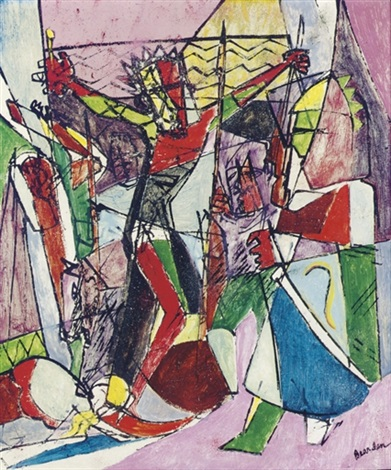
Golgotha – Crucifixion, by Romare Bearden, 1945

My God, my God, why have you forsaken me?
    Why are you so far from helping me, from the words of my groaning?
O my God, I cry by day, but you do not answer;
    and by night but find no rest.

Yet you are holy,
    enthroned on the praises of Israel.
In you our ancestors trusted;
    they trusted, and you delivered them.
To you they cried and were saved;
    in you they trusted and were not put to shame.

But I am a worm and not human,
    scorned by others and despised by the people.
All who see me mock me;
    they sneer at me; they shake their heads;
“Commit your cause to the Lord; let him deliver—
    let him rescue the one in whom he delights!”

Yet it was you who took me from the womb;
    you kept me safe on my mother’s breast.
On you I was cast from my birth,
    and since my mother bore me you have been my God.
Do not be far from me,
    for trouble is near,
    and there is no one to help.

Many bulls encircle me;
    strong bulls of Bashan surround me;
they open wide their mouths at me,
    like a ravening and roaring lion.

I am poured out like water,
    and all my bones are out of joint;
my heart is like wax;
    it is melted within my breast;
my mouth is dried up like a potsherd,
    and my tongue sticks to my jaws;
    you lay me in the dust of death.

For dogs are all around me;
    a company of evildoers encircles me;
they bound my hands and feet.
I can count all my bones.
They stare and gloat over me;
they divide my clothes among themselves,
    and for my clothing they cast lots.

But you, O Lord, do not be far away!
    O my help, come quickly to my aid!
Deliver my soul from the sword,
    my life from the power of the dog!
    Save me from the mouth of the lion!

From the horns of the wild oxen you have rescued me.
I will tell of your name to my brothers and sisters;
    in the midst of the congregation I will praise you:
You who fear the Lord, praise him!
    All you offspring of Jacob, glorify him;
    stand in awe of him, all you offspring of Israel!
For he did not despise or abhor
    the affliction of the afflicted;
he did not hide his face from me
    but heard when I cried to him.

From you comes my praise in the great congregation;
    my vows I will pay before those who fear him.
The poor shall eat and be satisfied;
    those who seek him shall praise the Lord.
    May your hearts live forever!

All the ends of the earth shall remember
    and turn to the Lord,
and all the families of the nations
    shall worship before him.
For dominion belongs to the Lord,
    and he rules over the nations.

To him, indeed, shall all who sleep in the earth bow down;
    before him shall bow all who go down to the dust,
    and I shall live for him.
Posterity will serve him;
    future generations will be told about the Lord
and proclaim his deliverance to a people yet unborn,
    saying that he has done it. (New Revised Standard Version)

Crucifixion, by Romare Bearden, 1947

It’s one thing to be alone because of other’s mocking, yelling, spitting at you, even physically beating you; that, in and of itself, is terribly traumatic. Yet, it’s quite another thing altogether to feel forsaken by one’s God, to experience a deafening divine silence amidst all the human commotion.

There are levels of suffering – and physical suffering is the least of our agony; the experiences of mental, emotional – and I insist, spiritual suffering – is worse than a hundred kidney stones.

“Suffering” is a word many would like to avoid. Simply seeing or hearing the word might make us cringe. Suffering? No thanks. I’ll pass. Yet, something inside us instinctively knows we cannot get around it. Everyone suffers in some way; it’s endemic to the human condition. 

Sometimes, maybe even most times, we are not immediately relieved of suffering because it is meant to have a redemptive purpose to it – that somehow, some way, the awful affliction shall result in eventual blessing to either oneself, another, or perhaps to many.

Miracles are miracles not because they fall from heaven with no connection to what’s happening on this earth. No, miracles occur because of suffering, because something gut-wrenching is happening, because someone or many people are tragically hurt.

Jesus intimately knows suffering, first hand. And he knows what suffering can produce: the deliverance of many.

For Christians everywhere, today is “Good” not because of the pain experienced but because the crucifixion of Jesus Christ means the redemption of the world.

On this Good Friday, followers of Jesus remember and commemorate the events that led up to the cross; unpack those events and interpret them with profound meaning and significance; and worship Jesus with heartfelt gratitude because of the redeeming work of the cross.

It is today that Christians remember the last words of Christ, and recognize the significant impact his death had on the immediate persons around him. Believers also contemplate the lasting results of that singular death as an atoning sacrifice; perfect love; reconciliation between God and humanity; victory over evil; and the redemption of all creation.

For believers, there’s the recognition that something deeply impactful is happening in the egregious suffering of Jesus. Therefore, we acknowledge and remember the anguish of Christ; and also what that horrible torment accomplished.

With such profound meaning, one would think that Good Friday is a hugely observed day for all Christians in every tradition. Yet, for a chunk of churches and Christians, it is not. The cross is not a popular subject. It could be because neither Christian nor non-Christian wants to ponder something so tragically bloody and sad.

“Religious people want visionary experiences and spiritual uplift; secular people want proofs, arguments, demonstrations, philosophy, and science. The striking fact is that neither one of these groups wants to hear about the cross.” 

Fleming Rutledge, The Crucifixion: Understanding the Death of Christ

Indeed, as the Apostle Paul has said, the cross of Christ is “a stumbling block to Jews and folly to Gentiles.” (1 Corinthians 1:23)

A personalized religion which leaves the cross out of the picture (too much violence and sacrifice) might seem appealing, yet will only leave us bereft of the communion of the saints both past and present. Consider the confessional witness of the Church:

Christ suffered “in both body and soul – in such a way that when he sensed the horrible punishment required by our sins ‘his sweat became like great drops of blood falling down on the ground.’ He cried, ‘My God, my God, why have you forsaken me?’ And he endured all this for the forgiveness of our sins. Therefore, we rightly say with the Apostle Paul that we know nothing ‘except Jesus Christ, and him crucified;’ we ‘regard everything as loss because of the surpassing value of knowing Christ Jesus our Lord.’ We find all comforts in his wounds and have no need to seek or invent any other means than this one and only sacrifice, once made, which renders believers perfect forever.”

Belgic Confession, Article 21

And let us consider further the New Testament witness:

“Jesus suffered outside the gate in order to sanctify the people through his own blood. Therefore, let us go forth to him outside the camp, and bear the abuse he endured.” (Hebrews 13:12-13, NIV)

“May I never boast of anything except the cross of our Lord Jesus Christ, by which the world has been crucified to me, and I to the world.” (Galatians 6:14, NRSV)

The extent of Good Friday goes far beyond a day on the calendar; it is the fulcrum upon which all of Christianity hinges.

Because Christ suffered, our suffering has meaning. Each situation of trauma; every case of disease; all suffering, abuse, and hardship makes sense, in the Christian tradition, when they are viewed in solidarity with the cross of Jesus Christ.

So, today, let Christians everywhere contemplate the cross, observe the salvation accomplished through Christ’s death, and offer prayers and petitions for those who need deliverance from the power of evil.