Final Exhortations on the Christian Life (Hebrews 13:1-16)

Forever Hebrews, by Anthony Falbo

Keep on loving one another as brothers and sisters. Do not forget to show hospitality to strangers, for by so doing some people have shown hospitality to angels without knowing it. Continue to remember those in prison as if you were together with them in prison, and those who are mistreated as if you yourselves were suffering.

Marriage should be honored by all, and the marriage bed kept pure, for God will judge the adulterer and all the sexually immoral. Keep your lives free from the love of money and be content with what you have, because God has said,

“Never will I leave you;
    never will I forsake you.”

So we say with confidence,

“The Lord is my helper; I will not be afraid.
    What can mere mortals do to me?”

Remember your leaders, who spoke the word of God to you. Consider the outcome of their way of life and imitate their faith. Jesus Christ is the same yesterday and today and forever.

Do not be carried away by all kinds of strange teachings. It is good for our hearts to be strengthened by grace, not by eating ceremonial foods, which is of no benefit to those who do so. We have an altar from which those who minister at the tabernacle have no right to eat.

The high priest carries the blood of animals into the Most Holy Place as a sin offering, but the bodies are burned outside the camp. And so Jesus also suffered outside the city gate to make the people holy through his own blood. Let us, then, go to him outside the camp, bearing the disgrace he bore. For here we do not have an enduring city, but we are looking for the city that is to come.

Through Jesus, therefore, let us continually offer to God a sacrifice of praise—the fruit of lips that openly profess his name. And do not forget to do good and to share with others, for with such sacrifices God is pleased. (New International Version)

Whenever I read this final chapter in the New Testament book of Hebrews, it gives me the feel of a parent blurting out a bunch of loving exhortations before the kids leave.

Throughout this incredible letter to a group of struggling Jewish Christians, the author of Hebrews offered a mix of pastoral encouragement along with pointed spiritual warnings. Now, after doing his best to demonstrate that Jesus is worth holding on to, the author exhorts the people with several practical instructions to help focus them for a life of guidance and direction in the ways of Christianity.

Keep on Loving Each Other

Love is the distinguishing characteristic of a Christian. A group of people can only persevere if they encourage one another daily with a combination of cheerleading and rebuke. The big idea is that everyone must hold each other accountable for living the Christian life.

Show Hospitality to Strangers

The word for hospitality literally means “love of stranger.” It’s the opposite of xenophobia (fear of the other). Hospitality is an expression of love for Christ in meeting the needs of people we don’t even know. Why do it? One good reason is that they just might be angels.

Remember Prisoners and Mistreated Persons

In the ancient world, there was no state-supported prison system. Incarcerated persons were completely dependent upon the mercy of their family and friends for food and relational connection. In the case of those who were truly alone, the church extended needed benevolence to them. Otherwise, prisoners would languish and eventually die.

Furthermore, we are to be observant of those who endure suffering from mistreatment. Why? Because the believers were in that position, too. Instead of “looking out for number one,” the church was to engage the community and not be isolated from its needs.

Honor the Institution of Marriage

God cares about how we honor our commitments. Ideally, couples are to keep their relationship pure without adulterating themselves with others. They submit to one another out of reverence for Christ. And they keep their promises to each other, no matter what circumstances they find themselves in.

In God’s economy, there’s no such thing as “free love” in the sense that we can have multiple partners without any sort of consequence or fallout. Friends with benefits is a misnomer. Random sex is oxymoronic. And casual lovers are in huge denial. There is a high cost to it all.

Don’t Love Money

This, of course, is a tricky one. We need money. Everyone must use money. But the love of money sets us on a dark path from which few are able to return. The best way (and really the only way) of avoiding the money pit is to be content with what you have.

Gratitude and thanksgiving has the power to grant us a happy life, even though it may be a very simple one. The only permanent things in the universe are relationships – everything else will burn.

Remember Your Leaders

Recall those persons who were good examples in both their speech and action. And imitate their faith. I wonder how many of us could say that to another person – to mimic our own life. If you’re like me, one of the things which stick out to you about respected leaders in your life, is their passion and desire in living for Christ. And, like Jesus, they were never fickle, but were always consistent and unwavering in their commitments.

Don’t Be Carried Away by Different Teachings

The basic message of the gospel has not changed: There is still good news of great joy for all who believe, because Jesus has taken care of the sin issue once for all through his singular sacrifice. And Jesus will sustain us by means of the Holy Spirit graciously given us. There’s no need to look elsewhere for our needs to be met.

Bear Christ’s Disgrace

Go to Jesus outside the camp – or in other words – live a holy life. Live into the words and ways of Christ. In doing so, we will actually end up being ridiculed, even abused. In concluding the Beatitudes in the Sermon on the Mount, Jesus promised that living a holy life of humility, righteousness, mercy, purity and peacemaking will result in persecution. (Matthew 5:10-12)

So, why live this way? Because it is the path to our eternal inheritance. The broad road leads to destruction, but the narrow way of holiness brings us to eternal life.

Continually Offer to God a Sacrifice of Praise

Praise comes from a heart full of gratitude for deliverance from sin, death, and hell – for salvation from all the guilt and shame of things done and things left undone. Praise is our sacrifice, not animals. In a world where many people want followers of Jesus to keep their mouths shut, those devoted to Christ find themselves incessantly chattering about Jesus because of their union with him.

Be Benevolent

Part of offering a sacrifice of praise is using our time and resources for the benefit of blessing the church and the world. We aren’t simply consumers who receive salvation and blessing from God; we are also producers who thoughtfully and compassionately give of our gifts, talents, time, and money for those in need of grace and love.

Conclusion

Why are we to obey these various exhortations from the author of Hebrews? Because we were purchased at a price – the precious blood of Jesus Christ. And as a result of receiving such a grace from God, the believer willingly gives themselves to becoming holy, serving faithfully, and offering compassionate spiritual care in the name of Christ.

For love is always the true litmus test of every genuine follower of Jesus, and the thing which gives motivation and shape to each exhortation.

Amen. May it be so, to the glory of God.

Do You Really Know? Probably Not (Job 38:22-38)

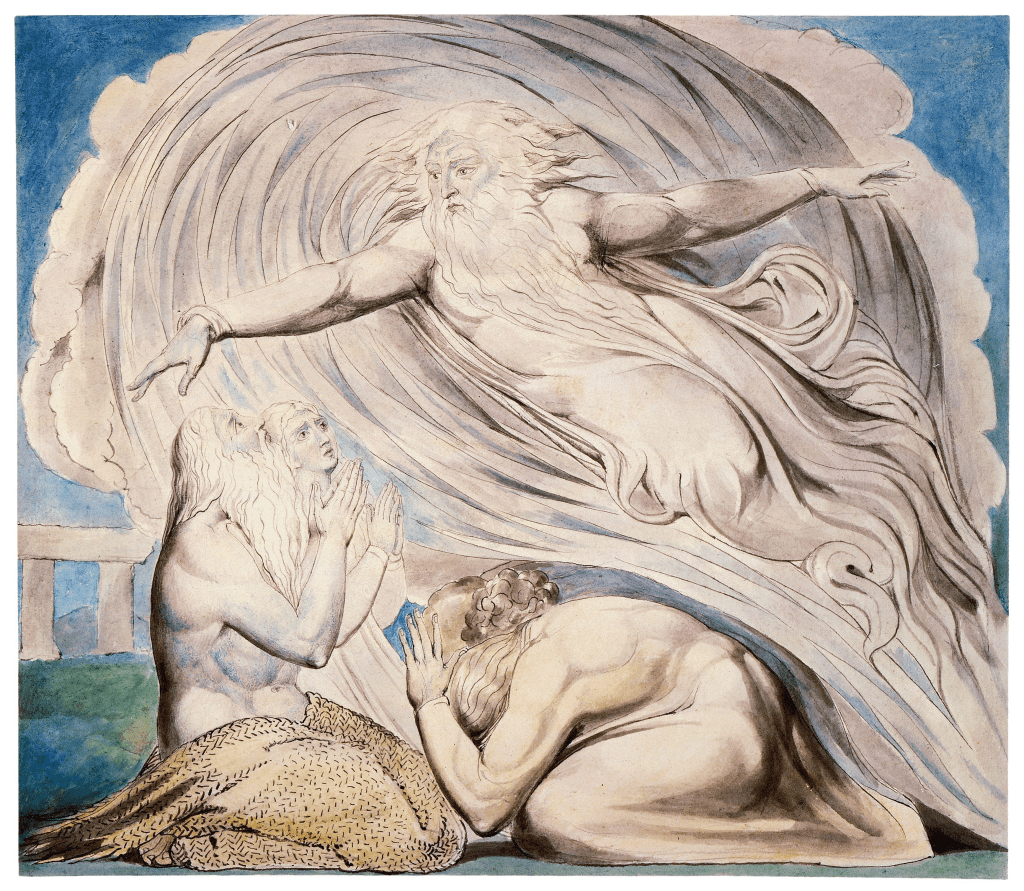
God Answers Job Out of the Whirlwind, by William Blake, 1826

“Have you entered the storehouses of the snow
    or seen the storehouses of the hail,
which I reserve for times of trouble,
    for days of war and battle?
What is the way to the place where the lightning is dispersed,
    or the place where the east winds are scattered over the earth?
Who cuts a channel for the torrents of rain,
    and a path for the thunderstorm,
to water a land where no one lives,
    an uninhabited desert,
to satisfy a desolate wasteland
    and make it sprout with grass?
Does the rain have a father?
    Who fathers the drops of dew?
From whose womb comes the ice?
    Who gives birth to the frost from the heavens
when the waters become hard as stone,
    when the surface of the deep is frozen?

“Can you bind the chains of the Pleiades?
    Can you loosen Orion’s belt?
Can you bring forth the constellations in their seasons
    or lead out the Bear with its cubs?
Do you know the laws of the heavens?
    Can you set up God’s dominion over the earth?

“Can you raise your voice to the clouds
    and cover yourself with a flood of water?
Do you send the lightning bolts on their way?
    Do they report to you, ‘Here we are’?
Who gives the ibis wisdom
    or gives the rooster understanding?
Who has the wisdom to count the clouds?
    Who can tip over the water jars of the heavens
when the dust becomes hard
    and the clods of earth stick together? (New International Version)

The older I get, and the more understanding I gain, the more I realize how little knowledge I truly possess.

When I was eighteen years old, I thought I had the world pretty much figured out. Since then, it’s all been downhill. With each passing year, my ignorance seems to grow. I suppose this all really makes some sense when talking about God’s upside-down kingdom.

There’s so much of life that is a mystery; and as we accumulate our life experiences, it seems all, not just some, of life is a mystical encounter. In other words, the more discernment I gain, I discover I know a lot less than I thought I did.

God Answers Job from the Whirlwind, by William Blake, c.1804

It seems as if the biblical character of Job found this out the hard way. If there is any person in Holy Scripture that would be wise and understanding, its him. God speaks highly of Job in the Bible.

Regarding the upcoming destruction of Jerusalem, God said, “even if these three men—Noah, Daniel and Job—were in it, they could save only themselves by their righteousness, declares the Sovereign Lord.” (Ezekiel 14:14)

Job is held up as the model of patience under suffering: “As you know, we count as blessed those who have persevered. You have heard of Job’s perseverance and have seen what the Lord finally brought about. The Lord is full of compassion and mercy.” (James 5:11)

Yet, with all of Job’s integrity, patience, and righteousness, his understanding barely moves the Richter Scale of God’s expansive knowledge.

We might be somewhat familiar with the story of Job. Being a conscientious follower of God, Job is careful to live uprightly. He acknowledges God in all things and worships him alone. Yet, suffering befell him – for no other reason than that God allowed it. Job knew fully well that there was no personal sin behind his awful ordeal of grief and grinding pain.

So, Job contended with God. For an agonizing thirty-five chapters (Job 3:1-37:24) Job questions God and respectfully takes him to task – as Job’s supposed friends questioned him and assume his guilt. Through it all God is there… silent… saying nothing.

The Desperation of Job, by William Blake, 1821

Then, just when we think God is paying no attention whatsoever, the Lord suddenly speaks.

And what is so remarkable about God’s speech is that for four chapters (Job 38:1-41:34) the Lord gives no answers. It’s all rhetorical questions. God said, “Brace yourself like a man; I will question you and you shall answer me.” (Job 38:3)

It becomes abundantly clear after just a few questions that it would be impossible for any human being to even come close to having the understanding God has. And that was the whole point.

God is God, and we are not. Our questions, however legitimate, real, and raw they are, come from a very puny perspective. Turns out, we just don’t know as much as we think we do.

To Job’s credit, he keeps his mouth shut and listens. At the end of the questioning, Job responds in the only wise way one could, after such an encounter: “Surely I spoke of things I did not understand, things too wonderful for me to know.” (Job 42:3)

None of this means that, for us, we need to face our hardships and our sufferings with a stoic keep-a-stiff-upper-lip approach. Trapped grief will inevitably come out sideways and only cause more hurt. I believe God allowed Job to express his terrible physical, emotional, and spiritual pain for chapter after chapter because he needed to.

Only when God sensed it was the proper timing did he jump in and bring the perspective Job then needed. And even after being challenged by God about his vantage point, Job still did not receive answers as to why he had to endure the awfulness of loss beyond what most of us could comprehend.

Maybe we lack being able to understand, even if God directly answered all our questions. Most likely, God protects us from knowing things that might bring irreparable damage to our human psyches. Again, this is all pure conjecture. Which leaves us with perhaps one of our greatest challenges as human beings:

We must eventually come to the place of being comfortable with mystery – and even embracing it. We simply will not have all things revealed to us that we want to know. And that’s okay.

There is yet one more comment to observe about God’s questioning of Job: God is sarcastic. Sarcasm often gets a bad rap, much like anger does, because it is so often associated with unacknowledged emotions and/or expressing our feelings in an unhelpful way.

Yet, there the sarcasm is, with the God of the universe. I take some odd comfort in knowing that God can be snarky at times – in a good way.

Anytime we try to pin God down to some tidy understandable categories, the Lord typically colors outside our human contrived lines and demonstrates to us that the divine cannot be contained in our ramshackle box.

I like it that God is playful, wild, and free to be God – even if there are times it may bug me.

God is unbound by any human knowledge, understanding, ideas, or plans. God will do what God will do. God will be who God will be. “I AM who I AM.” Now that’s a God I can put my trust in.

O Lamb of God that takes away the sins of the world, have mercy upon me.

O Lamb of God that takes away the sins of the world, have mercy upon me.

O Lamb of God that takes away the sins of the world, grant me your peace. Amen.

In the Place of Life (1 Peter 4:1-6)

Therefore, since Christ suffered in his body, arm yourselves also with the same attitude, because whoever suffers in the body is done with sin. As a result, they do not live the rest of their earthly lives for evil human desires, but rather for the will of God. For you have spent enough time in the past doing what pagans choose to do—living in debauchery, lust, drunkenness, orgies, carousing and detestable idolatry. They are surprised that you do not join them in their reckless, wild living, and they heap abuse on you. But they will have to give account to him who is ready to judge the living and the dead. For this is the reason the gospel was preached even to those who are now dead, so that they might be judged according to human standards in regard to the body, but live according to God in regard to the spirit. (New International Version)

I haven’t been a confessing Christian my entire life. And so, I can relate to Peter’s exhortation. I still remember what it feels like to live my life without any thought to God or spiritual matters. I also have many memories of giving my life to Christ and, for years, having people puzzled as to why I didn’t want to join them in activities which would clearly diminish my spirit and suck the soul out of me.

The thing about partying and immorality is that it’s a life filled with constant movement. Slowing down only makes one come face-to-face with what is truly inside the soul. And if someone has an empty vacuous soul, or a damaged spirit, or a broken heart, then attempting to drink or work away the inner pain makes sense when there’s no regard for God. 

The last thing I ever wanted to do was suffer, yet before my own spiritual awakening, it seemed I could never outrun the hurt no matter how hard I tried, even with all the constant locomotion.

But I found in a committed Christianity the slow and quiet place I so desperately needed. I discovered in ancient Christian practices of solitude, silence, and stillness the opportunity of finding my true self.

There are times in our lives when we need to explore the place between our hurting hearts and the hunting for joy. It’s actually a quiet place sandwiched between the ignominy of the cross and the celebration of resurrection. 

Within the geography of the soul, this is something of a lost country for many folks. Some people have never had the thought that such a place even exists. Yet, this is the very place which gives meaning and focus to a disjointed and frenetic lifestyle.

To be even more specific and focused, there cannot be a better life, a new life without a death to the old life and dying to self. There must be suffering before there can be glory.

I’m a heady sort of guy. Most things, for me, have to go through my brain. Although I have come to appreciate and value my heart and my gut, I still find myself sometimes gravitating toward my intellect as the answer for my stress. Yet, there are many times (maybe even most times) when I really need to get out of my head, connect to my gut, and wrap my heart around whatever problem or challenge is before me. 

I have been a devoted follower of Jesus for many decades now. Yet, I still encounter a sizable chunk of Christians who devalue the place between the real suffering on Good Friday, along with the very real death of Holy Saturday. In the tomb, there is no movement. All is silent and still. 

Jesus was in the solitude of a dark tomb. So, there’s no getting around it. If we want a Resurrection Day with all its celebration and glory, then we cannot circumvent the place of darkness and stillness.

To be a Christian means a readiness to follow Jesus and suffer as he did. It involves a willingness to stop our striving, manifested through constant movement, and embrace the disciplines of solitude, silence, and stillness with its contemplation and radical acceptance of what is – and not just what we want something to be. 

This requires the sense enough to pray and please a higher power than fair weather friends. It demands a Christian counter-cultural shift to face the ridicule of friends so that we might take some much-needed time to be with Jesus in his life, ministry, suffering, death, resurrection, and ascension.

Put plainly and bluntly: If you and I want to live with Jesus, we must die with Jesus.

I could give you ten steps to having a better life, but this would ultimately mean nothing apart from the willingness to spend some time and sit in the place of suffering and death.

And, ironically, in doing so, we find the life that is truly life, and discover a way of existence which is far greater and better than we could have ever dreamed.

Merciful and almighty God and Father of our Lord Jesus Christ, we submit ourselves to you, knowing that our lives are in the hands of a gracious and sovereign Being who cares deeply for all creation and every creature. May our longings for transcendence result in the deep and good desires of our hearts to be met fully in Christ, who with you and the Holy Spirit are one God, now and forever. Amen.

A (Needed) Perspective on the Christian Life (Acts 27:39-44)

Paul’s Shipwreck, by Ludolf Backhuysen (1630–1708)

When daylight came, they did not recognize the land, but they saw a bay with a sandy beach, where they decided to run the ship aground if they could. Cutting loose the anchors, they left them in the sea and at the same time untied the ropes that held the rudders. Then they hoisted the foresail to the wind and made for the beach. But the ship struck a sandbar and ran aground. The bow stuck fast and would not move, and the stern was broken to pieces by the pounding of the surf.

The soldiers planned to kill the prisoners to prevent any of them from swimming away and escaping. But the centurion wanted to spare Paul’s life and kept them from carrying out their plan. He ordered those who could swim to jump overboard first and get to land. The rest were to get there on planks or on other pieces of the ship. In this way everyone reached land safely. (New International Version)

Saul was an up and rising star among the Jewish Pharisees. He was committed to his religion to the point of approving the death of the first Christian martyr, Stephen. Saul saw followers of Jesus as an aberration to Judaism, and did whatever he could to stamp out the sect.

During one of his travels to do just that, he was confronted by a vision of Christ himself, who said to Saul, “Why do you persecute me?” (Acts 9:4-5) For days Saul was blind, mimicking his spiritual blindness. Both his physical and spiritual eyesight were restored when he came to faith in Christ and began following the words and ways of Jesus. His name changed from Saul to Paul the Apostle.

Paul’s conversion was a complete transformation of life. Yet, this in no way meant that the rest of his life was all rainbows and butterflies. Just the opposite. Saul the Persecutor ended up becoming Paul the Persecuted One.

With the same drive and desire that he once had to do away with Christians altogether, so now the Apostle Paul put all that energy into proclaiming the good news of grace and forgiveness in Jesus Christ his Savior and Lord. And, as one might expect, this put Paul in the crosshairs of his former partners, the Jewish Pharisaical leadership. They now despised Paul.

The Jewish religious authorities hated Paul so much that they made sure to stir up trouble for him everywhere he went, even when it was way out in the Gentile sticks of Galatia and the Gentile strongholds of Greece. And that is essentially why Paul landed in prison. He was portrayed as a rebel and a troublemaker, an enemy of the social order (even though Paul himself was actually a citizen of Rome).

As a Roman citizen, Paul invoked his right to appeal to Caesar. And so, he was put on a Roman prison ship, bound from Palestine to Italy. And that is where we pick up today’s New Testament lesson.

Paul had been through an awful lot of adversity, hardship, and persecution. His faith had become so robust that a terrible storm and a shipwreck could not at all wreck his commitment to Christ. In fact, it only strengthened it.

It’s not always easy to see, but Paul’s words to the Roman Christians are true, even for us today:

And we know that God causes everything to work together for the good of those who love God and are called according to his purpose for them.

The Apostle Paul (Romans 8:28, NLT)

This is an understanding of God, a deep theological perspective, which is informed by years of walking with Jesus in the crucible of suffering and difficulty. It discerns the Lord as caring and loving, even when it appears on the surface that God is mean and capricious.

Many Christians today tend to believe that the redemption which Christ secured is a mere life insurance policy for heaven. And, if it has anything to do with the here-and-now, it means we ought to have all our desires met for earthly peace and abundance. If that were true, both Jesus and Paul were miserable failures as godly people.

God, however, cares about our salvation, our wholeness and integrity as people on this earth. Yes, we have eternal life, yet that life has already begun, and we are to live into it now.

Christianity is a paradoxical faith. The way to gain your life is to lose it. The path to glory is through suffering.

This, my friends, means that we do not gain a good and blessed life by attempting to make everything in life go our way, without any difficulty. Instead, the good life comes by acknowledging the grit and grist of life. It is in the full acceptance of suffering, persecution, illness, death, and our own psychological infirmities that leads us into becoming who God wants us to be – and thus more open to what joy really is.

On the practical level, this means that our failures, our missed expectations, and our dashed hopes are very important pieces to our faith and it’s development. All of this is what awakens us to compassion – both for others and ourselves.

So then, Paul’s perspective on all the difficulties in his life is that they are significant spiritual incubators of faith for him. Paul accepted his sufferings and hardships – and more than that – he valued them for the ways they developed his faith in God and ability to minister to others.

As one old Rabbi once put it:

“There are many rooms in God’s castle. There is, however, one key that opens every room, and that key is a broken heart.”

Ba’al Shem Tov (1698-1760)

Sovereign God, let our love be genuine; help us to hate what is evil, and to hold on to what is good; and empower us to love one another with mutual affection. Strengthen our spirits so that we might serve our Lord Jesus. With you as our faith, we choose to rejoice in hope; be patient in affliction; and persevere in prayer, by means of your blessed Holy Spirit. Amen.