Monday of Holy Week (Psalm 36:5-11)

The Via Dolorosa (Latin: the way of sorrows) is a narrow path through the streets of the Old Jerusalem, the final route traveled by Jesus of Nazareth on the way to his crucifixion.

Your steadfast love, O Lord, extends to the heavens,
    your faithfulness to the clouds.
Your righteousness is like the mighty mountains;
    your judgments are like the great deep;
    you save humans and animals alike, O Lord.

How precious is your steadfast love, O God!
    All people may take refuge in the shadow of your wings.
They feast on the abundance of your house,
    and you give them drink from the river of your delights.
For with you is the fountain of life;
    in your light we see light.

O continue your steadfast love to those who know you
    and your salvation to the upright of heart!
Do not let the foot of the arrogant tread on me
    or the hand of the wicked drive me away. (New Revised Standard Version)

The desert journey is almost over. The sojourn with Jesus in his life and ministry will soon culminate in the ultimate experience of sorrow and joy. The Christian season of Lent is nearly at the end. We are in it’s final days, known as Holy Week.

We have a Holy Week because of love. There is yet another journey we must take, along the Via Dolorosa to the hill of Golgotha, because of God’s steadfast love.

Love suffers. Every parent knows this. Because of a parent’s committed and faithful love toward a child, they feel not only the joys but also the sorrows and pain of their children. I can say that this feeling does not go away, even with adult children. And it’s compounded with grandchildren. Just as our love is big enough to hold multiple children and grandchildren, so our capacity for experiencing deep emotion for their welfare is equally large.

Holy Week reminds us that God’s committed parental love suffers. It is because of God’s immense and steadfast love that there is a road to the cross and a tortured death for Jesus. The cost of our salvation involves a very bloody affair. Deliverance comes at the price of horrible violence. Jesus Christ lived and died for us, because of love.

He suffered much because he loved much.

God’s people, walking in the way of love, quickly discover that it is simultaneously walking in the way of suffering. From Old Testament times through the New Testament era and into the present day, the faithful have always experienced suffering as a central part of their piety and devotion in showing steadfast love. 

The medieval mystics of the Church understood quite well the connection between suffering and love. They could not imagine a Christian life without hardship, difficulty, and persecution. Thomas à Kempis, a sort of pastor to pastors, wrote in the fifteenth century:

“Sometimes it is to our advantage to endure misfortunes and adversities, for they make us enter into our inner selves and acknowledge that we are in a place of exile and that we ought not to rely on anything in this world.  And sometimes it is good for us to suffer contradictions and know that there are those who think ill and badly of us, even though we do our best and act with every good intention….  When men ridicule and belittle us, we should turn to God, who sees our innermost thoughts, and seek His judgment….  It is when a man of good will is distressed, or tempted, or afflicted with evil that he best understands the overwhelming need he has for God, without whom he can do nothing….  It is in such times of trial that he realizes that perfect security and full peace are not to be found in this world.”

Thomas à Kempis, The Imitation of Christ

And yet, it is because of love that suffering is transformed and endured as something wholly other than sheer pain or hurt. Thomas à Kempis went on to say:

“Love is a mighty power, a great and complete good; Love alone lightens every burden and makes the rough places smooth. It bears every hardship as though it were nothing and renders all bitterness sweet and acceptable. The love of Jesus is noble and inspires us to great deeds; it moves us always to desire perfection. Love aspires to high things and is held back by nothing base. Love longs to be free, a stranger to every worldly desire, lest its inner vision become dimmed, and lest worldly self-interest hinder it, or ill-fortune cast it down…. Love knows no limits, but ardently transcends all bounds. Love feels no burden, takes no account of toil, attempts things beyond its strength; love sees nothing as impossible, for it feels able to achieve all things. Love therefore does great things; it is strange and effective; while he who lacks love faints and fails.”

Thomas à Kempis, The Imitation of Christ

Holy Week’s message is certainly one of suffering love. Jesus went to the greatest lengths possible to give Divine steadfast love to humanity. So, let us not shy away from the cross, but journey with Jesus to Golgotha, embracing the love of God for us. In so doing, we will find the inner resources needed to love the world, even in all its unloveliness.

Grant, we pray, almighty God, that, though in our weakness we fail, we may be revived through the Passion of your Only Begotten Son. Who lives and reigns with you in the unity of the Holy Spirit, God, for ever and ever. Amen.

Isaiah 52:13-53:12 – Good Friday

CrossChrist
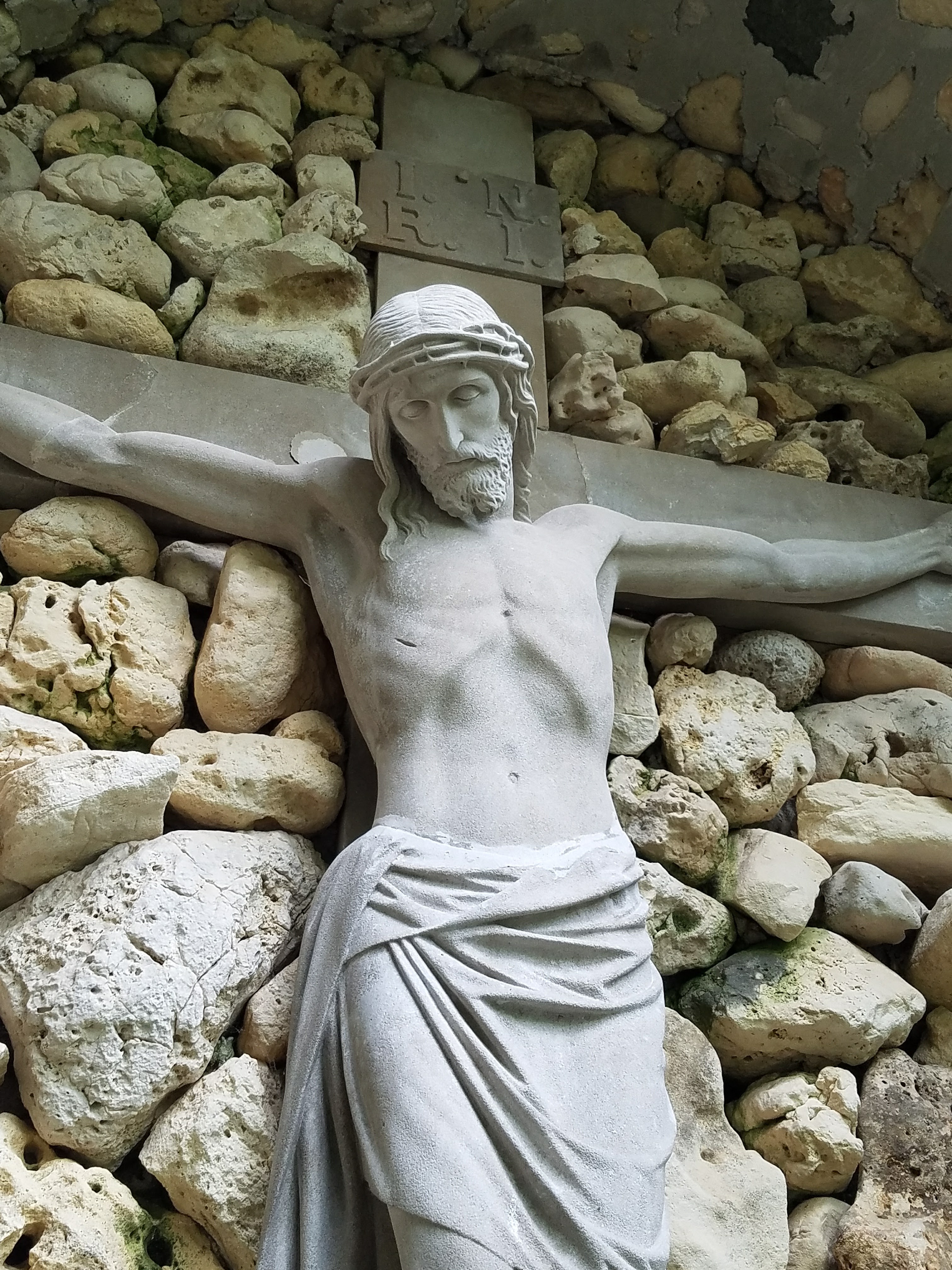
Depiction of Christ on the Cross at Holy Hill in Hubertus, Wisconsin

The Lord says, “See, my servant will act wisely.
People will greatly honor and respect him.
Many people were shocked when they saw him.
His appearance was so damaged he did not look like a man;
his form was so changed they could barely tell he was human.
But now he will surprise many nations.
Kings will be amazed and shut their mouths.
They will see things they had not been told about him,
and they will understand things they had not heard.”

Who would have believed what we heard?
Who saw the Lord’s power in this?
He grew up like a small plant before the Lord,
like a root growing in a dry land.
He had no special beauty or form to make us notice him;
there was nothing in his appearance to make us desire him.
He was hated and rejected by people.
He had much pain and suffering.
People would not even look at him.
He was hated, and we didn’t even notice him.

But he took our suffering on him
and felt our pain for us.
We saw his suffering
and thought God was punishing him.
But he was wounded for the wrong we did;
he was crushed for the evil we did.
The punishment, which made us well, was given to him,
and we are healed because of his wounds.
We all have wandered away like sheep;
each of us has gone his own way.
But the Lord has put on him the punishment
for all the evil we have done.

He was beaten down and punished,
but he didn’t say a word.
He was like a lamb being led to be killed.
He was quiet, as a sheep is quiet while its wool is being cut;
he never opened his mouth.
Men took him away roughly and unfairly.
He died without children to continue his family.
He was put to death;
he was punished for the sins of my people.
He was buried with wicked men,
and he died with the rich.
He had done nothing wrong,
and he had never lied.

But it was the Lord who decided
to crush him and make him suffer.
The Lord made his life a penalty offering,
but he will still see his descendants and live a long life.
He will complete the things the Lord wants him to do.
“After his soul suffers many things,
he will see life and be satisfied.
My good servant will make many people right with God;
he will carry away their sins.
For this reason I will make him a great man among people,
and he will share in all things with those who are strong.
He willingly gave his life
and was treated like a criminal.
But he carried away the sins of many people
and asked forgiveness for those who sinned.” (NCV)

We all suffer.  In some way, whether a chronic physical condition, emotional or moral distress, mental illness, or spiritual oppression, everyone faces living in a fallen world with its pain and heartache.  Presently, the entire world is suffering the scourge of the COVID-19 virus.  Every person in my neighborhood, city, state, and nation is impacted and affected.  Not only do many suffer because of disease and death itself, all are enduring either lost wages, limitations, loneliness or more.  Suffering that seems to have no reason, the senseless kind, the type where nothing good appears to be going on at all can be very troubling to our souls.

Perhaps it seems ironic, maybe even cruel, that Christians would observe a day called “Good” Friday.  Considering the hard circumstances of so many people, to call today “good” appears awkward, as if Christ’s followers have their heads in the sand.  Even for Christians, at first glance, “Good Friday” might seem a oxymoronic for a day observing the torture and death of an innocent man.  Some would argue that Christ is no longer on the cross and we need to give all our focus on the resurrected Jesus and the victory he achieved.  No need for all this suffering stuff.  Yet, the Resurrection only has meaning because of this very day, Good Friday.  Without the Suffering Servant of Isaiah, there is no King Jesus.  For Christians everywhere, this day is very good in the sense that the crucifixion of Jesus Christ means the redemption of the world.  On this day we remember and commemorate the events that led up to the cross; unpack those events and interpret them with profound meaning and significance; and, worship Jesus with heartfelt gratitude because of his redeeming work of the cross.

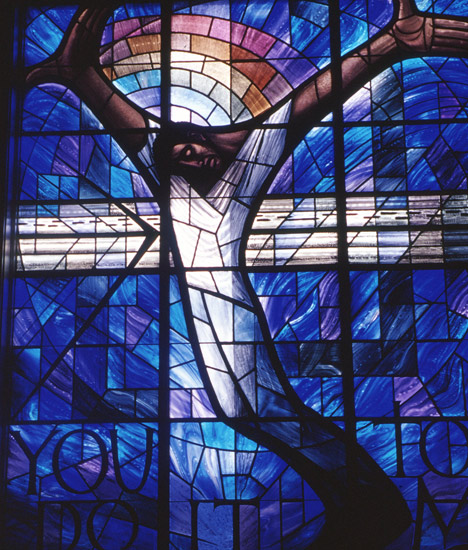
16th St Baptist Church Crucifixion Stained Glass Window
This stained-glass window was donated to the Sixteenth Street Baptist Church of Birmingham, Alabama by the people of Wales after the church was bombed in 1963.

The bulk of the New Testament Gospels of Matthew, Mark, Luke, and John are given over to the final week of Christ’s life, especially leading to the cross.  Good Friday observances often take a somber form due to the brevity of Christ’s experience on the cross.  Christians remember the last words of Christ, and recognize the significant impact his death had on the immediate persons around him.  Believers also contemplate the lasting results of that singular death as an atoning sacrifice; perfect love; reconciliation between God and humanity; victory over evil; and, redeeming all creation.

Sadness, then, is far from the only emotive expression on this day.  It is appropriate to feel wonder, gratitude, and deep satisfaction for the accomplishment of deliverance from the power of sin.  There is the recognition that something profound and meaningful has truly happened in the egregious suffering of Jesus.  Thus, we not only remember the anguish of Christ, but what that horrible torment accomplished.  In fact, the cross of Jesus is so significant that an eternity of considering its import and impact could never plumb the depths of its far-reaching effects.

With all that has been said, one would think that Good Friday is a hugely observed day on the Christian Calendar.  Yet, for a chunk of churches and Christians, it’s not.  The bottom line is that the cross is not popular.  Maybe it’s because neither Christian nor non-Christian wants to ponder something that appears so icky and bloody.

Episcopal priest Fleming Rutledge has adroitly put her finger on the issue: “Religious people want visionary experiences and spiritual uplift; secular people want proofs, arguments, demonstrations, philosophy, and science.  The striking fact is that neither one of these groups wants to hear about the cross.”  Indeed, as the Apostle Paul has said, the cross of Christ is “a stumbling block to Jews and folly to Gentiles” (1 Corinthians 1:23).

A personalized religion which leaves the cross out of the picture (too much blood and violence) might seem appealing yet will only leave us bereft of the communion of the saints both past and present.  Consider the ancient witness of the Church:

“I believe in Jesus Christ, his only Son, our Lord… he suffered under Pontius Pilate, was crucified, died, and was buried; he descended to hell.” –Apostles’ Creed

“For our sake he [Christ] was crucified under Pontius Pilate; he suffered death and was buried.” –Nicene Creed

Christ suffered “in both body and soul – in such a way that when he sensed the horrible punishment required by our sins ‘his sweat became like great drops of blood falling down on the ground.’  He cried, ‘My God, my God, why have you forsaken me?’  And he endured all this for the forgiveness of our sins.  Therefore, we rightly say with the Apostle Paul that we know nothing ‘except Jesus Christ, and him crucified;’ we ‘regard everything as loss because of the surpassing value of knowing Christ Jesus our Lord.’ We find all comforts in his wounds and have no need to seek or invent any other means than this one and only sacrifice, once made, which renders believers perfect forever.” –Belgic Confession, Article 21

And let us consider further the New Testament witness:

“Jesus suffered outside the gate in order to sanctify the people through his own blood.  Therefore, let us go forth to him outside the camp, and bear the abuse he endured.” (Hebrews 13:12-13, NIV)

“May I never boast of anything except the cross of our Lord Jesus Christ, by which the world has been crucified to me, and I to the world.” (Galatians 6:14, NRSV)

6a7f0-thecross

The extent of Good Friday goes far beyond just a day on the calendar; it is the fulcrum upon which all of Christianity hinges.  Because Christ suffered, our suffering has meaning.  Each situation of trauma; every case of disease; all adversity and wholesale hard circumstances make sense, in the Christian tradition, when they are viewed in solidarity with Jesus Christ crucified. So, today, let Christians everywhere contemplate the cross, observe the salvation accomplished through Christ’s death, and offer prayers and petitions for those who need deliverance from the power of evil.  In short, let us worship God in Jesus Christ because of the suffering on the cross.

Along with all believers everywhere we pray:

Jesus, Lamb of God, have mercy on us.

Jesus, Bearer of our sins, have mercy on us.

Jesus, Redeemer of the world, grant us your peace.  Amen.

Click Were You There performed by The Vigil Project as we station ourselves near the cross.