Be Patient – Third Sunday of Advent (James 5:7-10)

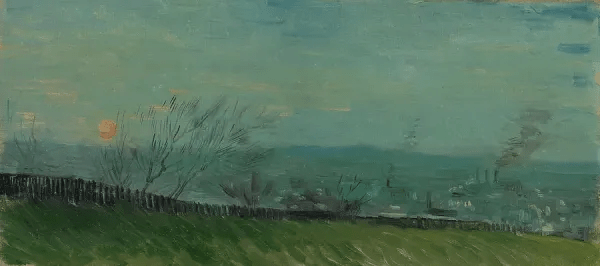
Sunset in Montmartre, by Vincent Van Gogh, 1887

Be patient, therefore, brothers and sisters, until the coming of the Lord.

The farmer waits for the precious crop from the earth, being patient with it until it receives the early and the late rains. You also must be patient.

Strengthen your hearts, for the coming of the Lord is near.

Brothers and sisters, do not grumble against one another, so that you may not be judged. See, the Judge is standing at the doors! 

As an example of suffering and patience, brothers and sisters, take the prophets who spoke in the name of the Lord. (New Revised Standard Version)

Patience is a wonderful virtue… unless you’re smack in the middle of circumstances you neither want nor asked for. Then, patience feels a whole lot more like a vice.

It’s easy to be impatient; it takes little to no effort at all. And praying for patience doesn’t help, because you’re prayer actually gets answered; God puts you in one of those unwanted situations.

The Jewish Christians for whom the Epistle of James was addressed were in that weird life-place of enduring hard circumstances. They were struggling with impatience, so much that the believers began cozying up to the rich and powerful to meet their ever-increasing needs. In their misery, they were looking to the very people who were using them and withholding wages from them. (James 2:1-7; 5:1-6)

It seemed as if God was shuffling his divine feet and not getting around to helping the Christians in their difficulty. They gave everything to Jesus and following him, to the point of being willing to suffer for the Name.

Their suffering led to outright persecution. The believers had to flee Judea for Gentile lands to the West (Acts 8:1-3). In their new homes they got double-trouble. Because they were Jews, they were looked at with suspicion. And because they were Christians, the Jewish community didn’t accept them. The believers were truly alone. All they had was Jesus.

It was enough, at least for a while. But it’s one thing to face difficulty, and quite another thing for the trouble to bleed into next week, next month, next year… When is this ever going to end?

Impatience doesn’t help. In fact, it only exacerbates an already agonizing situation. Grumbling and arguing and verbal fights begin to occur. The community starts to fracture. Blaming and shaming slowly replace the love and encouragement they once had together.

Every good thing in life takes time – lots of time! And the best things in life require a lifetime of endurance, perseverance, and patience. In order to keep going and hold onto our spiritual commitment, we need solid examples of patience, and reasonable ways to think about our situations.

I admit that it has been hard for me to be patient, as of late. I’m weary of American politics and the current administration. I’m tired of seeing my family members struggle with health issues day after day – many of them having to endure debilitating and heart-wrenching trials.

And there are some days when I’ve just had it with my own limitations. I can’t do many of the things I used to do, and it’s frustrating to tears to try and do some things that others do effortlessly.

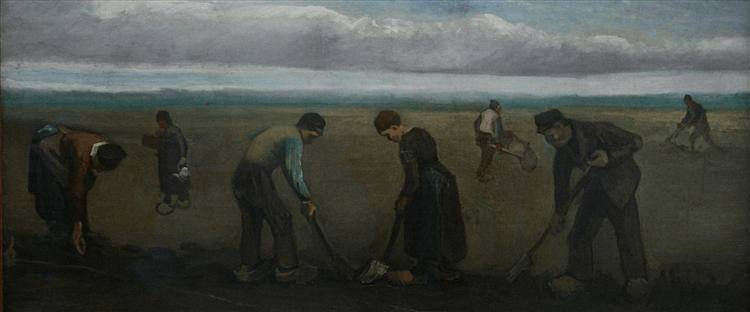
Yet the Scripture reminds me of my days growing up on the farm. Planting and harvesting never happened in a week; it takes months to realize a return on all the hard work done through the Spring and Summer to get to Fall’s mature crop.

Peasants Planting Potatoes, by Vincent Van Gogh, 1884

I’m also reminded of the biblical prophets who suffered much for their message to the people. Lately, I’ve been reading the prophecy of Ezekiel in the Old Testament. If you have never read Ezekiel, or only read bits of it, you may not realize how incredibly difficult Ezekiel’s life was in serving Yahweh.

The prophet kept up a steady stream of very challenging situations to illustrate the message of judgment he was continually giving. Needless to say, Ezekiel was not always a popular guy. Proclaiming gloom, doom, and death all day every day tends to do that. In one encounter, for month after month, the prophet laid on his side and had to use excrement to light a fire and cook his food every day. God told him to, so that the people would see what was about to happen to them. (Ezekiel 4:1-17)

We have no record of Ezekiel grumbling or talking back to God. He faithfully did all that the Lord commanded him to say and do. He endured all the grumblers around him, and all the grieving people who had been displaced from their homes in Jerusalem.

In every generation, there are people in this world that undergo difficulties and troubles which others could never even imagine. And it’s been going on for millennia. Furthermore, terrible adversity will keep happening… until Christ returns.

Yes, there will be an end to all the suffering. But we may have to persevere to the end of our lives, remaining faithful to our spiritual commitment, and keeping up our love for one another. It won’t be easy to do.

I would be nothing but a hack preacher if I told you that everything will be bunnies and butterflies if you only look to Jesus and have faith. Although there can be joy, even in our mourning, there will always be the need for an agonizing form of patience that continually watches for help, healing, and hope in the return of Christ.

This is why it is so important not to let your own family, church, and faith community break down into fissures of impatience and grumbling.

We must keep our hearts strong. Ironically and paradoxically, that happens through our weakness.

In some ways, I’m weaker than I’ve ever been in my life. Yet, in other ways, I’ve never been stronger. The Trump administration can break me down and mess with my healthcare and my finances… my illness can keep me from ministry that I long to do… and the daily crud of life may redirect me in ways I don’t like… but I can truly say that God is good; God is the strength of my life.

I know that Christmas is coming. I’m looking for the birth of the Savior. I expect to see the angels rejoicing in the sky. I fully look forward to stepping in a few cow pies and horse apples in order to get a glimpse at the baby who changes the world.

Every good thing in life comes with a bit of manure on the shoes. And the best things in life are worth all the hardship one goes through in order to see the glory and majesty of the Divine.

I may not know you, my friend, but please know that I am praying for you. No matter what happens, I can always pray, always watch, always hope, always believe, and always love my neighbor, despite all the hate in this old fallen world.

Be safe. Be strong. Be spiritual. We are all in this life together.

God of joy and exultation, you strengthen what is weak; you enrich the poor and give hope to those who live in fear. Look upon our needs this day. Make us grateful for the good news of salvation and keep us faithful in your service until the coming of our Lord Jesus Christ, who lives forever and ever. Amen.

The Suffering of Job (Job 6:14-30)

The Sufferings of Job, by Silvestro Chiesa (1623-1657)

“Those who withhold kindness from a friend
    forsake the fear of the Almighty.
My companions are treacherous like a torrent bed,
    like swollen streams that pass away,
that run dark with ice,
    turbid with melting snow.
In time of heat they disappear;
    when it is hot, they vanish from their place.
The caravans turn aside from their course;
    they go up into the waste and perish.
The caravans of Tema look;
    the travelers of Sheba hope.
They are disappointed because they were confident;
    they come there and are confounded.
Such you have now become to me;
    you see my calamity and are afraid.
Have I said, ‘Make me a gift’?
    Or, ‘From your wealth offer a bribe for me’?
Or, ‘Save me from an opponent’s hand’?
    Or, ‘Ransom me from the hand of oppressors’?

“Teach me, and I will be silent;
    make me understand how I have gone wrong.
How forceful are honest words!
    But your reproof, what does it reprove?
Do you think that you can reprove words,
    as if the speech of the desperate were wind?
You would even cast lots over the orphan
    and bargain over your friend.

“But now, be pleased to look at me,
    for I will not lie to your face.
Turn, I pray; let no wrong be done.
    Turn now; my vindication is at stake.
Is there any wrong on my tongue?
    Cannot my taste discern calamity? (New Revised Standard Version)

There was a time when faith, hope, and love meant something; a time in which neighbor cared for neighbor, basic human kindness was extended to the stranger, and one’s word was more of a bond than a legal document. At least, that’s what the ancient character of Job felt like. And to be honest, I feel like that, too.

Wherever there is suffering, death, and accusations, there you will find behind it all the character we know as Satan. Evil is very much real. And it exists as much today as it did all those millennia ago when Job experienced Satan’s sinister touch of horrible suffering.

Today, we too often interact with each other much like Job’s supposed friends talked to him in a strictly legalistic way. They believed the world operated in a way where the sign of being under God’s blessing was to be wealthy and healthy. And those who were cursed could expect poverty and sickness.

But the world we live in is not so simplistic as that. Good and godly people suffer; whereas the bad use their riches and power to gain more riches and power for themselves. Satan is alive and well. He lives just down the street, even next door.

Until we can get a hold of that reality, we will be continually flummoxed about the real nature of the Book of Job in the Bible’s Old Testament. And we will fail to discern that not only was Job a profoundly righteous person, but that in all righteousness he contended with God. What’s more, he was eventually vindicated by God.

Some of the greatest suffering a human can endure is not what can be done to the body, but what affects the soul. To experience the silence of God, and the ignorant chattering of friends, is perhaps the hardest of all sufferings to daily contend with.

Job’s companions were more than unhelpful – they were just as harmful as the physical machinations of Satan. And if you can accept it, the companions themselves were mere tools of the evil one. It’s a scary thought, but one we must face.

Although Job was cursed with terrible pain of both body and soul, he never gave a curse back to his companions; and he never chose to curse God and die. You see, Job understood, more than most of us today, that it is diabolical and demonic to return curse for curse.

Nowhere in Holy Scripture will you find that God desires someone who has been struck on the cheek to strike the other back with so much force that they won’t ever do it again. Payback and retaliation may be the way of the world, but it is not the way of God’s everlasting kingdom. And Job knew it.

Job’s friends did not see the reality about his calamity. That’s probably because they just couldn’t admit the truth of it. Their self and spiritual awareness was so small that they stubbornly held to false notions of God, God’s world, and God’s people.

The thing any of us needs from friends and neighbors in a time of crisis is some commitment to helping, not harming. Unfortunately, Job’s friends were of the fair weather type; when the weather’s good, they’re all in; but when the weather’s bad, they emotionally and spiritually distance themselves as far from their friend as they can get.

As a person of integrity, Job never asked his companions to rescue him. He only expected them to stand by him, and not haggle over his worth as a friend. They proved to be false friends who were more harm than help.

The suffering person is in a time of profound disorientation. It’s difficult for them to know which way is up. They don’t need a friend who has all the answers; in fact, someone with all the answers is only annoying. Instead, they need a friend who will come alongside and never forsake them.

In the end, God’s anger didn’t extend to Job but to his so-called friends. Their pride and ignorance was their undoing. What’s more, Job continued to show his integrity by praying for his friends, despite all their emotional harm to him.

You would never find Satan responding in the way of Job.

O God, help me to keep my heart clean and to live so honestly and fearlessly that no outward failure can dishearten me or take away the joy of conscious integrity. Open wide the eyes of my soul that I may see good in all things. Grant me this day some new vision of divine truth; and inspire me with the spirit of joy and gladness. Make me the cup of strength to suffering souls; in the name of the strong Deliverer, our only Lord and Savior, Jesus Christ. Amen.

An Advent Message of Suffering and Deliverance (Micah 4:8-13)

The Prophet Micah Exhorts the Israelites, by Gustave Doré, 1866

As for you, Jerusalem,
    the citadel of God’s people,
your royal might and power
    will come back to you again.
The kingship will be restored
    to my precious Jerusalem.

But why are you now screaming in terror?
    Have you no king to lead you?
Have your wise people all died?
    Pain has gripped you like a woman in childbirth.
Writhe and groan like a woman in labor,
    you people of Jerusalem,
for now you must leave this city
    to live in the open country.
You will soon be sent in exile
    to distant Babylon.
But the Lord will rescue you there;
    he will redeem you from the grip of your enemies.

Now many nations have gathered against you.
    “Let her be desecrated,” they say.
    “Let us see the destruction of Jerusalem.”
But they do not know the Lord’s thoughts
    or understand his plan.
These nations don’t know
    that he is gathering them together
to be beaten and trampled
    like sheaves of grain on a threshing floor.
“Rise up and crush the nations, O Jerusalem!”
    says the Lord.
“For I will give you iron horns and bronze hooves,
    so you can trample many nations to pieces.
You will present their stolen riches to the Lord,
    their wealth to the Lord of all the earth.” (New Living Translation)

A lot of people don’t understand much about the Bible, especially many parts of what some call the Old or First Testament of it. It seems to them like it’s all either nonsense or gobbledygook.

I am not exaggerating when I say that I have read the entire Bible not once, but hundreds of times. And there are still many places within Holy Scripture which are an enigma to me.

Part of the reason the Bible can seem so difficult is that, at times, the perspective being written about is so expansive, so large, and so wide that it nearly defies human comprehension.

None of this talk on my part is meant to discourage anyone from reading scripture. Rather, it’s meant to encourage you to keep on reading it, listening to it, talking about it, and exploring its contents.

Instead of a being an impossible puzzle we cannot put together, the Bible is, instead, a deep treasure trove of knowledge, wisdom, and insight into the human condition and the human purpose for being on this earth.

The reason the biblical prophets came along – and included into the canon of Holy Scripture – is that they called people back to their original purpose for being here in the first place.

In every prophetic book, the culture, the society, the religion, and the politics of a people had strayed so far from their reason for existing, that it took what seems to us as extreme language in order to get them back on track.

There were some cases so bad that the prophet’s message to people was inevitable doom. And yet, even then, there was a nugget of grace, showing us that no matter how terrible things may get, the arm of God is not too short to pull the faithful from the brink of annihilation.

Examining the Book of Micah, there is nothing easy about it. The prophet wrote at a time when Assyrian power was dominate, and about to swallow up the northern kingdom of Israel. Yet, he spoke directly to Jerusalem in the southern kingdom of Judah.

Much like a woman in labor and about to give birth, Jerusalem’s cry of suffering will be transformed into a cry of deliverance and freedom.

But we aren’t talking about something that will happen in a few days or even a few years; the prophet was giving the people a panoramic sweep of centuries.

Eventually, the Babylonians come, take the people out of the city into exile to Babylon. It is a cry of pain. Micah was speaking about events which would not occur for another two hundred years.

Yet, at the same time, Micah was talking about his own present generation of people in Israel and Judah. What the people were doing, at that time, was leading to a future of great pain. And there would be a great crying out for salvation from it.

Injustice always creates a state of distress for some, while the ones perpetrating the unjust ways become wealthy on the backs of others who are miserable.

Babylon represented both the place of punishment and of liberation. Out of the exilic darkness, a new age bursts into the light.

Born into a time where many people were longing for God’s deliverance, centuries after the destruction of Jerusalem, after the exile and return to Judea, and after the days of the Maccabees, Jesus subversively entered human history.

Despite all of the human sin, the degradation and oppression of others, the injustice and abuse extant in the world, grace comes in the shape of a baby; mercy enters the world in the form of a child.

The God whom all things depend upon, became dependent, needing a mother to clean him up after a filled first-century diaper. Few people knew at the time that this little baby would be the one to clean up a massive spiritual and metaphorical diaper, full of the world’s nasty stinky injustice.

Presently, it is clear that the nations do not know they will be beaten and trampled – that all who are now in power will be answering to that subversive child born two millennia ago.

How you live makes a difference. How you are, matters.

God of both judgment and grace, we pray for all nations, that they may live in unity, peace, and concord; and that all people may know justice, and enjoy perfect freedom. Embrace the most vulnerable members of our society; end the growing disparity between the rich and poor; and grant us courage to strive for economic justice, so that all might know your mercy, and not your wrath. Amen.

I Want To Know Christ (Philippians 3:7-11)

Jesus Christ and the Apostles, by Nikolas Martínez Ortiz de Zarate (1907-1990)

But whatever were gains to me I now consider loss for the sake of Christ. What is more, I consider everything a loss because of the surpassing worth of knowing Christ Jesus my Lord, for whose sake I have lost all things. I consider them garbage, that I may gain Christ and be found in him, not having a righteousness of my own that comes from the law, but that which is through faith in Christ—the righteousness that comes from God on the basis of faith. 

I want to know Christ—yes, to know the power of his resurrection and participation in his sufferings, becoming like him in his death, and so, somehow, attaining to the resurrection from the dead. (New International Version)

Whenever someone asks me what my favorite portion of Holy Scripture is, I reflexively turn to these verses in our New Testament lesson for today.

I resonate with these words from the Apostle Paul to the Church at Philippi, because they match what I truly believe, and how I really feel about Jesus.

We go through a lot of loss in this earthly life. We experience hardship and adversity. We grieve and lament.

Some of the losses in this life, we are okay with, or at least, we come around to being okay with them after a bit of time. Yet, there are other losses that are heartrending.

On the flipside, there are many gains we experience in this life. Some of them we worked very hard for, and others came to us as gifts.

Oftentimes, our gains and our losses are inextricably bound with each other. Something we consider precious is lost. We may even choose to set aside or give up something we have – we allow it become lost – so that we can gain something even better.

At other times, the process of gaining, losing, then gaining something good was not purposed by us, but by God.

And, to me, that’s probably the best sort of good there is.

Another way of putting the matter is: We must let go and accept how something or someone is, before we can experience what a truly good life really is.

Jesus, by Ghanshyam Gupta

Allow me, or please indulge me, as I frame the Apostle’s words in my own sort of language:

Anything in this life that I have achieved; anything I have come to possess; any sort of position or title I hold or have held; any kind of identification I have, or prestige  I have gained, is of no value. In reality, it’s all rather worthless.

If you will let me take it even further, compared to having an authentic, real, and experiential relationship with Jesus as my Savior, my Lord, and my Friend, everything else is like a bunch of garbage. That’s how much I value Jesus. There’s no other thing, no other relationship, that comes remotely close to knowing Christ.

It isn’t so much that I found Jesus, but that he found me. So, I have a faith that’s got nothing to do with keeping up appearances or rule-keeping, or keeping ahold of anything. I have the life that is truly life.

But, oh my, there is so much more to experience and to know with Jesus! I want to experientially know the power of Christ’s mighty resurrection. I  want to be like him, and participate with him, as if Jesus were living his life through me.

And, I must tell you, I know that this sort of life means suffering. But I also know that this suffering puts me in solidarity with my Lord – which is exactly where I want to be.

I only want to live up to who I’m supposed to be in Christ, to be my true self, and not some faux Christian living according to mere rules and regulations. The only thing that counts to me is faith expressing itself through love.

I understand that I took a lot of liberties with the text, and elaborated on it in order to make it my own. But, truth be told, we all need to find ways to make scripture as our own.

We all must let go of some old ways and unlearn a lot of things, in order to discover new life and be united with Christ. Everyone needs to learn from the past, so that we can live a new life here in the present.

If you don’t like my words, that’s fine. You aren’t under any obligation to read them. Yet, I do believe we have an obligation to Holy Scripture, and specifically, to ingest it as if it were the best meal you’ve ever eaten.

Indeed, we end up experiencing a lot of losses in this life. Yet, with Jesus, we will never lose him, because he will never forsake us. Christ is our eternal gain. He’s alive, always living, so that we need never be concerned about him not existing anymore.

That’s my faith. That’s what I trust in, or rather whom I put my faith in, and my trust upon. It’s all about Jesus. Anything less will not stand the test of time, nor of satisfaction in life.

What will you do with Jesus?

Christ isn’t going to strongarm you into the kingdom of God. But he will doggedly go after you, and be a pester pup in your ears and an ever-present sense in your heart.

You might as well go ahead and consider him, or perhaps reconsider him, like you’ve never done before.

After all, you’ve really got nothing to lose.

We believe in one Lord, Jesus Christ,

the only Son of God,
eternally begotten of the Father,
God from God, Light from Light,
true God from true God,
begotten, not made,
of one being with the Father;
through him all things were made.
For us and for our salvation
he came down from heaven:
was incarnate of the Holy Spirit and the Virgin Mary,
and became truly human.
For our sake he was crucified under Pontius Pilate;
he suffered death and was buried.
On the third day he rose again
in accordance with the Scriptures;
he ascended into heaven
and is seated at the right hand of the Father.
He will come again in glory to judge the living and the dead,
and his kingdom will have no end. – The Nicene Creed, on Jesus Christ