How Much Is Too Much? (1 Kings 4:20-28)

King Solomon’s court, by Claude Vignon (1593-1670)

The people of Judah and Israel were as numerous as the sand on the seashore; they ate, they drank and they were happy. And Solomon ruled over all the kingdoms from the Euphrates River to the land of the Philistines, as far as the border of Egypt. These countries brought tribute and were Solomon’s subjects all his life.

Solomon’s daily provisions were thirty cors of the finest flour and sixty cors of meal, ten head of stall-fed cattle, twenty of pasture-fed cattle and a hundred sheep and goats, as well as deer, gazelles, roebucks and choice fowl. For he ruled over all the kingdoms west of the Euphrates River, from Tiphsah to Gaza, and had peace on all sides. During Solomon’s lifetime Judah and Israel, from Dan to Beersheba, lived in safety, everyone under their own vine and under their own fig tree.

Solomon had four thousand stalls for chariot horses, and twelve thousand horses.

The district governors, each in his month, supplied provisions for King Solomon and all who came to the king’s table. They saw to it that nothing was lacking. They also brought to the proper place their quotas of barley and straw for the chariot horses and the other horses. (New International Version)

Wealth, in and of itself, is neither good nor bad – it just is. The real issue is why any particular person wants to be wealthy, how we view wealth, and what we do with it when we have it.

In ancient Israel, under King Solomon, the Israelites enjoyed a time of prosperity, safety, and abundance. To flourish and thrive in life is good. The ability to meet basic needs, and to enjoy life is good.

King Solomon on his throne, by Frans Francken the Younger (1581-1642)

But what about beyond that? Is there such a thing as too much? And what about others who may not be able to make ends meet?

Solomon certainly had a lot. Yet, we do have warnings in Holy Scripture about exorbitant wealth. Here is what the Deuteronomic law says concerning any future king:

The king, moreover, must not acquire great numbers of horses for himself or make the people return to Egypt to get more of them, for the Lord has told you, “You are not to go back that way again.” He must not take many wives, or his heart will be led astray. He must not accumulate large amounts of silver and gold. (Deuteronomy 17:16-17, NIV)

Whatever standard one may use, I would say 12,000 horses falls into the great-numbers-of-horses category. And likewise, having 1,000 wives is most likely 999 too many for just about every man on the planet.

Indeed, Solomon’s heart was eventually led astray. It’s quite sad. Even the wisest and wealthiest person who ever lived was not able to sustain complete faithfulness to God. The remainder of Deuteronomy’s instruction about a future king is this:

When he takes the throne of his kingdom, he is to write for himself on a scroll a copy of this law, taken from that of the Levitical priests. It is to be with him, and he is to read it all the days of his life so that he may learn to revere the Lord his God and follow carefully all the words of this law and these decrees and not consider himself better than his fellow Israelites and turn from the law to the right or to the left. Then he and his descendants will reign a long time over his kingdom in Israel. (Deuteronomy 17:18-20, NIV)

In all fairness, King Solomon started out paying attention to God’s law. In his wisdom, he sought to learn and obey – but it ended up being only a partial obedience.

A dimension of any rule or government is to realize that – with any sort of success, security, and wealth – there is always a dark underbelly to it. That is, there are people within that government who are not enjoying its largess and wealth.

Under the new expanded governmental system, Solomon had his kingdom, and its subject peoples, divided into districts in order to give provisions, as well as laborers for his ambitious building projects. Not everyone was enjoying leisure time under a fig tree.

King Solomon set up an economic system that transferred wealth from nations subservient to Israel, and from subsistence farmers within Israel, to support the massive needs of Jerusalem.

The city, under Solomon, was living off the surplus grain to feed all of the horses, as well as the tribute exacted from surrounding nations. In other words, the wealth was being centralized by Solomon for his many projects and interests.

All of the opulence was meant to impress people with wealth, exhibiting Israel’s and Solomon’s great power and wisdom. Yet, if we are to follow the old adage, “follow the money,” we would discover a governmental system that extracted money from others; and produces a lot of oppression, grievances, and exploitation – hence, the dark underbelly of it all.

This sort of situation is precisely why we have prophetic literature in the Old Testament. The prophets are especially attuned to the cries of injustice amongst the people. Every society needs such persons who are within the system, yet are able to be a voice for those who are voiceless.

Had King Solomon moved beyond his partial obedience to complete and total obedience, I surmise that he likely would have considered the needs of everyone within his empire, before establishing a system of government that depended upon economic exploitation.

Specifically, perhaps Solomon ought to have engaged more vigorously and robustly with the covenant code between God and Israel that he was supposed to know so well.

And perhaps, Christianity and the Church have been too lax on the subject of handling Holy Scripture. Because, for all of our talk of being faithful to scripture, that talk has not translated into a solid social and economic understanding of human need and justice.

It simply will not do to label anything we don’t like as communist or socialist. And it will not do to say King Solomon was wealthy and successful, as if that, in and of itself, is the evidence of God’s favor. In reality, it means little, apart from a complete fidelity to God’s law.

In my judgment, Jesus did better than all of this. He pointed us to an alternative system which considers the common good of all persons, and not just some people. The ethics and morality of his Sermon on the Mount lays out the foundational means upon which any sort of governmental system ought to build upon. (Matthew 5-7)

But seek first his kingdom and his righteousness, and all these things will be given to you as well.

Jesus (Matthew 6:33, NIV)

If we are looking for the same sort of wealth and success as Solomon, that means we’ll need to ignore Jesus. Yet, if faithfulness, obedience, humility, righteousness, mercy, purity, and peacemaking matter more than our economic bottom line, then I believe we will discover that the pursuit of these virtues leads to having all of our needs met, as well.

Lord of our lives, teach us how to use our money and our possessions. Deliver us from stinginess and wasteful extravagance; inspire our giving with the spirit of true generosity. Help us always to remember your generous love for us, that we may be wise and faithful stewards of the good gifts you have given us. Amen.

Divine Sovereignty and Human Responsibility (2 Samuel 8:1-18)

In the course of time, David defeated the Philistines and subdued them, and he took Metheg Ammah from the control of the Philistines.

David also defeated the Moabites. He made them lie down on the ground and measured them off with a length of cord. Every two lengths of them were put to death, and the third length was allowed to live. So the Moabites became subject to David and brought him tribute.

Moreover, David defeated Hadadezer son of Rehob, king of Zobah, when he went to restore his monument at the Euphrates River. David captured a thousand of his chariots, seven thousand charioteers and twenty thousand foot soldiers. He hamstrung all but a hundred of the chariot horses.

When the Arameans of Damascus came to help Hadadezer king of Zobah, David struck down twenty-two thousand of them. He put garrisons in the Aramean kingdom of Damascus, and the Arameans became subject to him and brought tribute. The Lord gave David victory wherever he went.

David took the gold shields that belonged to the officers of Hadadezer and brought them to Jerusalem. From Tebah and Berothai, towns that belonged to Hadadezer, King David took a great quantity of bronze.

When Tou king of Hamath heard that David had defeated the entire army of Hadadezer, he sent his son Joram to King David to greet him and congratulate him on his victory in battle over Hadadezer, who had been at war with Tou. Joram brought with him articles of silver, of gold and of bronze.

King David dedicated these articles to the Lord, as he had done with the silver and gold from all the nations he had subdued:Edom and Moab, the Ammonites and the Philistines, and Amalek. He also dedicated the plunder taken from Hadadezer son of Rehob, king of Zobah.

And David became famous after he returned from striking down eighteen thousand Edomites in the Valley of Salt.

He put garrisons throughout Edom, and all the Edomites became subject to David. The Lord gave David victory wherever he went.

David reigned over all Israel, doing what was just and right for all his people. Joab son of Zeruiah was over the army; Jehoshaphat son of Ahilud was recorder; Zadok son of Ahitub and Ahimelek son of Abiathar were priests; Seraiah was secretary; Benaiah son of Jehoiada was over the Kerethites and Pelethites; and David’s sons were priests.(New International Version)

“God’s sovereignty does not negate our responsibility; it empowers us to live out God’s purposes.”

D. A. Carson

In every biblical story, the real hero is God. That’s because, in each scriptural narrative, God’s sovereignty, power, and authority works on behalf of the people. The secondary characters – if they are good people – take up their mantle of responsibility by working for the people in fulfillment of God’s good promises to them.

Divine sovereignty and human responsibility work together. When that happens, it doesn’t matter what the odds of a situation are, because God’s people will emerge as recipients of God’s gracious promises.

It’s good to always keep in mind that God is working – albeit, mostly behind the scenes where we never see it – and that therefore we must remember to be ourselves continually responsible for acting consistent with God’s revealed will to us.

Up to this point in today’s story, the Ark of the Covenant has been brought to the new national capitol of Jerusalem. The Ark signifies the presence of God, and it’s central placement in the life of the Jewish nation, signifies King David’s desire to be responsible in working on God’s behalf.

So, this is why we have a litany of David’s successes, in order to show us the connection between God’s presence and the national advancement of Israel’s people in the region. King David was able to defeat Jewish enemies in all the geographic places around Israel and Judah.

King David’s Jerusalem, by Julia Goddard

All of the areas mentioned in today’s text fit the boundary promises given to the original Jewish ancestor Abraham, centuries earlier. (Genesis 15:18-21)

David defeated Judah’s main enemy in the West, the Philistines, by capturing their main city, and thus, controlling their entire territory. Philistia had been the major thorn in Judah’s side for a very long time. After David’s victory over them, the Philistines never regained their power again.

David defeated Israel and Judah’s enemies in the East. The Moabites were ancient foes, having tried to put a curse on Israel so that they could enter the Promised Land (Numbers 24:17). But the curse backfired. King David was perhaps merciful to them by not wiping out Moab altogether, but only humbling them with limited violence.

David defeated Israel’s enemies in the North by achieving an overwhelming decisive victory against the Arameans and the city of Damascus, despite insurmountable odds. Yahweh, Israel’s God, clearly outdid Aram’s storm god Hadad – proving to the people once and for all that the Lord is not limited to the geography of Israel.

David defeated Judah’s enemies in the South. The Edomites were always looking to take advantage of their brother Jews, constantly playing out the ancient rivalry between Esau and Jacob. Overcoming the nation of Edom, along with the other surrounding nations, allowed David’s kingdom to more than double in size.

The hallmark description of any good and godly leader is that they do what is right and just for all the people – which is precisely what King David sought to do, and did. And he didn’t do it alone, but had a solid group of good and godly people helping him in his royal administration.

King David acted according to his understanding of God’s will for the Jewish nation, which meant decisively handling the ancient enemies which previous leaders either could not or would not take on. David moved with confidence, believing that God was with him in all his endeavors, based upon divine promises from God’s covenant with Israel.

The God of David is still watching over the nations, and still yet remains sovereign. People are still responsible to act according to their understanding of God’s will – not confusing that responsibility with Israel’s, but knowing what their place is in the kingdom of God with King Jesus as the ultimate Sovereign.

Today, I believe that two significant problems plague us: 1) A lack of knowing God and God’s will for us; and 2) An unwillingness to act confidently in faith and take a risk based on a solid understanding of God. The result of these two problems is pervasive spiritual immaturity and mediocrity.

We have a lot of work to do. And it’s high time we roll up our sleeves and deal with the primary problems in front of us – not with military weapons and shedding blood – but by the means of knowledgeable prayer and loving actions.

May it be so, to the glory of God and for the blessing of the nations. Amen.

Walk on Water? Why? (Matthew 14:22-33)

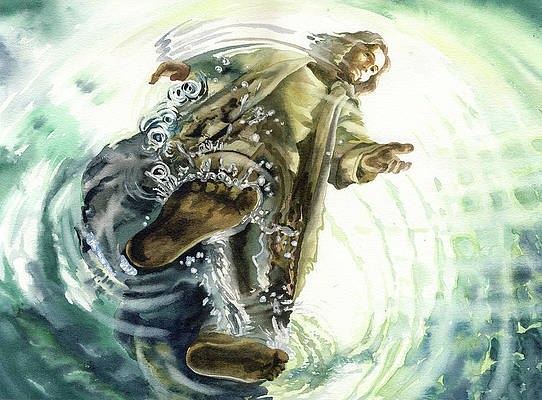
Jesus Walks on Water, by Konstantin Alexejewitsch Korowin, 1890 

Immediately Jesus made the disciples get into the boat and go on ahead of him to the other side, while he dismissed the crowd. After he had dismissed them, he went up on a mountainside by himself to pray. Later that night, he was there alone,and the boat was already a considerable distance from land, buffeted by the waves because the wind was against it.

Shortly before dawn Jesus went out to them, walking on the lake. When the disciples saw him walking on the lake, they were terrified. “It’s a ghost,” they said, and cried out in fear.

But Jesus immediately said to them: “Take courage! It is I. Don’t be afraid.”

“Lord, if it’s you,” Peter replied, “tell me to come to you on the water.”

“Come,” he said.

Then Peter got down out of the boat, walked on the water and came toward Jesus. But when he saw the wind, he was afraid and, beginning to sink, cried out, “Lord, save me!”

Immediately Jesus reached out his hand and caught him. “You of little faith,” he said, “why did you doubt?”

And when they climbed into the boat, the wind died down. Then those who were in the boat worshiped him, saying, “Truly you are the Son of God.” (New International Version)

In the New Testament Gospels, we see Jesus for who he is – Son of God and true Sovereign of the universe – seeking to reconcile people to God through his life, miracles, and teaching. In the Gospels we also see Christ’s disciples for who they are – a rag-tag bunch who express both belief and doubt, and experience both faith and failure.

The reality of the Christian life is that it is a sort of three-steps-forward and two-steps-backward kind of experience. The expectation that we will “succeed” and have everything go hunky-dory each time we step out in faith, is far from how things actually work in both the world and in God’s kingdom. Doubt and failure are important experiences for the believer in Jesus.

Without failure, there is no Christian life. Why? Because it means we are still in the boat.

It’s evidence that we never left the safety of established routines and responded to God’s command to step out of our comfort zone, and boldly go where we’ve never gone before.

Our failures may, like Peter, be colossal bellyflops. Yet, Jesus is there – extending grace to Peter and helping him, even in his failure of faith. Failure does not define us; it isn’t our identity. Jesus is Lord over everything, including storms, hardship, and trouble. 

Yes, there are a lot of scary things in life. Learning to ride a bike was scary. Driving for the first time on an icy road was scary. Getting married and having kids was scary. Admitting a fault, mistake, or weakness is scary. Being vulnerable with another person is scary.

It can even be scary to be at church. Why? Because we might fail, and it may crush us.

The fear of failure, however, need not control our lives. Why? Because grace overcomes everything.

We all find ourselves, at times, caught midway between faith and doubt. But to know this situation is to experience grace. If the worst scenario you worry about in your head would actually come to pass, it will still never change the reality that God loves you! And it will not stop Jesus from extending his hand to you in a life-saving grip of grace. 

Fear melts away when we keep our eyes on Jesus. So, we must focus on Christ, instead of fixating on the waves around us. The truth sets us free. Therefore, let’s notice five truths about Jesus that help us overcome the fear of failure and embrace a life of faith.

1. Jesus is a person of prayer

Jesus was deeply dependent on his heavenly Father. His life exhibited the necessities of simple prayer and obedience. If Jesus found the need for solitude and prayer for his life and ministry, how much more to we need it!? 

The Lord had his disciples get into the boat and go out on the lake. Jesus knew they were about to face a storm. The boat ended up getting thrown around by the waves. Even though the disciples were doing God’s will by going out on the lake, they were not spared from adversity.  

Jesus wanted his disciples to experience the storm. Why? Because it is through the storm that we learn faith.  

Faith is developed through experience and adversity. Faith that never endures distress, never grows and matures. Faith must be exercised – and if it isn’t, it atrophies and becomes useless. 

Show me a person with great faith, and I’ll show you a person that has gone through a boatload of adversity and hurt, having allowed Jesus to grace them with healing.

2. Jesus is present with us, and this presence brings an end to fear

Being in the middle of a lake during a storm did not prevent Jesus from being present with the disciples – he just walked on the water to be with them. Even though the disciples had just participated in the miracle of Jesus feeding the five thousand, another miracle was not on their radar – which is why they did not recognize Jesus and were afraid when they saw him.

While afraid, we don’t see Jesus, even when he’s right in front of our faces. Why? Because we don’t expect him to be there and mistake him for a ghost.  

When the disciples cried out in fear, Jesus responded. I used to have a factory job, training workers. When the training was completed, I had the trainees evaluate our time together. The top response I received is that my presence helped them to learn their job – the freedom to fail time and time again without judgment. Having me there to rescue them, when things got too much, built confidence that they could do it on their own.

3. Jesus desires those who follow him to imitate him

Jesus walked on water. Jesus invited Peter to walk on water. Peter was not chided by Jesus for getting out of the boat, but for doubting that he could continue in the miracle that was happening. 

Jesus isn’t merely interested in disciples being able to regurgitate his teaching. Why? Because he wants us to exercise our learning through actual deeds of faith.  

Once the command of Jesus was given to Peter, “Come”, then walking on water became only a matter of trust.

“Christianity has not been tried and found wanting. It has been found difficult and left untried.”

G.K. Chesterton

We understandably get nervous when a crazy Jesus and an unpredictable Holy Spirit call us to change by getting out of the friendly confines of the boat. Why? After all, we might fail. 

However, it is at those times that we bank on God’s Word and promises. The Apostle James said that if we find ourselves lacking wisdom to deal with the unpredictable and unknowable, we are to ask God who gives generously to all without finding fault and will be given to us. (James 1:5)

Christ Walking on the Sea, by Natali Fedorova

Peter responded to his predicament by crying out to Jesus, “Lord, save me!” Jesus immediately reached out and saved Peter from his own doubt and lack of faith. Jesus called Peter a “little-faith.”

Many people have lived too long with the notion that God is some stern angry deity who is constantly displeased with sinful people, and that only through perfection will God ever be happy with us. The truth is that Jesus wants us to imitate him; and, when we fail, he is there to pick us up. 

4. Jesus has the authority to settle the storm when he is ready to do it

Jesus is King. Christ is Sovereign of the world. He will bring the crisis to an end according to his own good pleasure and good timing. Rather than spending all our emotional capital by worrying or conniving to get out of a situation, we can trust God and keep our eyes on Jesus.  Our job is to believe; God’s job is everything else.

5. Jesus’ power led the disciples to acknowledge who he is

Worship happens when we see Jesus as he really is, the Son of God. Flat, dull, boring worship comes from flat, dull, boring Christians who are unable to see the power of Jesus in their lives. We discover the power of God when we are in a situation which requires God’s strength to deliver us. Grasping Jesus as the Son of God is more than a verbal confession of faith; it is being able to trust him, like getting out of a boat in the middle of a lake.

We are to live by faith in the Son of God who loved us and gave himself for us (Galatians 2:20). It doesn’t require much faith to pray that Aunt Mable’s bunions will feel better. It only requires a little faith to give a dollar when you have ten dollars. It takes no faith to discuss the weather and steer clear of hard conversations.

But it does require faith:

  • to pray for a miraculous healing every day without giving up for a little boy who is racked by epilepsy, and trust God to spare his life
  • to write a check for $100 to someone in need when you have exactly $100 in your checking account, and trust God to provide for you own necessities. 
  • to go off the grid of the routine schedule to have a difficult discussion about social justice, and trust God to act on Christ’s teachings. 
  • to live as though the mission of God in this world is the most important thing we could ever do, and trust God to step out and do it.

It would be great if we could pray and act without ever doubting or failing, yet the only way to do that is to never step out of the boat. Instead, live life. Trust God. And see what happens.

Holy God, help us, your people, to embrace the life that is truly life by stepping out of the boat.  May Jesus define our lives instead of letting failure define us. May we accept the grace that is ours in Jesus Christ our Lord, in whose name we are bold to pray. Amen.

Be Courageous (Joshua 1:1-9)

After the death of Moses the servant of the Lord, the Lord spoke to Joshua son of Nun, Moses’s assistant, saying: 

“My servant Moses is dead. Now proceed to cross the Jordan, you and all this people, into the land that I am giving to them, to the Israelites. Every place that the sole of your foot will tread upon I have given to you, as I promised to Moses. From the wilderness and the Lebanon as far as the great river, the River Euphrates, all the land of the Hittites, to the Great Sea in the west shall be your territory. 

No one shall be able to stand against you all the days of your life. As I was with Moses, so I will be with you; I will not fail you or forsake you. 

Be strong and courageous, for you shall lead this people to possess the land that I swore to their ancestors to give them. Only be strong and very courageous, being careful to act in accordance with all the law that my servant Moses commanded you; do not turn from it to the right hand or to the left, so that you may be successful wherever you go. 

This book of the law shall not depart out of your mouth; you shall meditate on it day and night, so that you may be careful to act in accordance with all that is written in it. For then you shall make your way prosperous, and then you shall be successful. I hereby command you: Be strong and courageous; do not be frightened or dismayed, for the Lord your God is with you wherever you go.” (New Revised Standard Version)

Freedom came to the ancient Israelites; they were delivered from their cruel Egyptian bondage. Then, they wandered through the desert for forty years; and, after the death of their leader Moses, were poised to enter the Promised Land. 

However, it was going to be no cakewalk. There were pagan peoples entrenched in the land. It would be a huge feat to conquer their territory. Joshua, the young aide-de-camp of Moses, now leader of the people, would be the one to go before them in battle. Understandably, Joshua was likely nervous, maybe even downright scared. 

So, the Lord came to Joshua. God told him to be strong and courageous, to not be afraid to claim the divine promise of the land. 

The path to success for Joshua – as well as all God’s people – is not by the physical sword but by the sword of the Lord, the Word of God. 

The Lord was plainspoken about the need to intimately know the Law given to the people and to continually meditate upon it. Being careful to do everything written within it, Joshua would find both the courage and the wisdom to lead the people to victory.

It still remains true for all God’s people that faithful knowledge, sage wisdom, and careful adherence to Holy Scripture comes through meditation upon its contents. 

There is a great need amongst believers to continually ruminate on God’s Word. We live on a broken planet, filled with all sorts of adversity, hardship, difficulty, and challenge to living a committed spiritual life. And so,

we may sometimes wonder how to address and deal with it all; our problems might seem as large as taking the Promised Land. 

The place to begin is by going to the Word of God – not so much in an anxious, hasty, or impatient question-and-answer sort of way which looks for a quick response; but instead, in a slow, deliberate, contemplative way. 

Lasting and genuine spirituality, as well as a sense of settled success, comes not only through acknowledging the importance and integrity of Scripture; one must know it’s contents, and allow it’s wisdom to saturate the soul through consistent and continual meditation.

Scripture memorization is a discipline worth pursuing. Having large chunks of the Holy Bible in our minds and hearts helps us in the crucible of challenging situations and adverse circumstances. 

What’s more, when doing the everyday pedantic and tedious work, we can engage our minds in the practice of contemplation on those verses we have committed to memory. Meditation on God’s Word is a necessary practice if we want to have success in living a genuinely well-rounded life.

Courage and meditation are a package deal. Bravery and contemplation are meant to be wed together. One rarely comes without the other – which means the realization of our good dreams, for both us and the world, needs the practice of Scripture meditation.

God Almighty, my delight is in your law, and on it I meditate day and night. (Psalm 1:2)

O how I love your law! It is my meditation, my food and drink, all day, every day. (Psalm 119:97)

I will meditate on your precepts and honor your ways in all I do and say. (Psalm 119:15)

I am determined to lift my hands to your commandments, which I love; and I will meditate on your statutes. (Psalm 119:48)

I look forward to the wee hours of the night because it provides me the space and the quiet to meditate on your word. (Psalm 119:148)

In fact, I meditate on all your doings through both day and night; I ponder and consider the works of your hands. (Psalm 143:5)

Amen.