
Why? (Job 18:1-21)

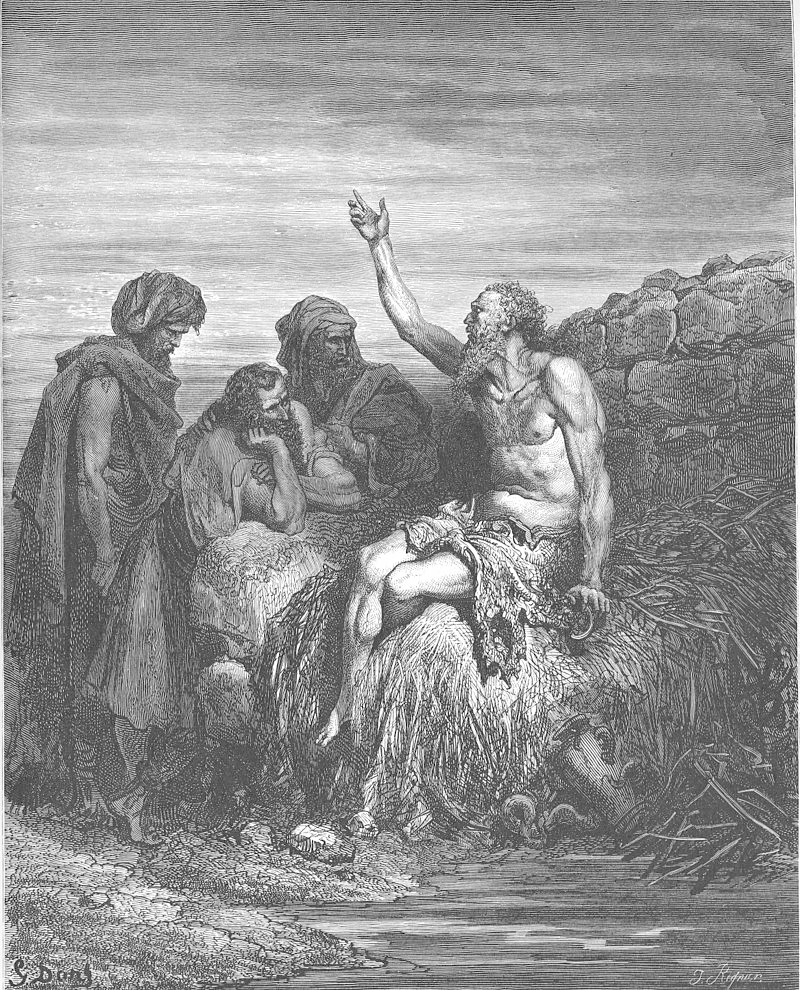
Job speaks with his friends, by Gustave Doré, 1866

Then Bildad the Shuhite replied:

“When will you end these speeches?
    Be sensible, and then we can talk.
Why are we regarded as cattle
    and considered stupid in your sight?
You who tear yourself to pieces in your anger,
    is the earth to be abandoned for your sake?
    Or must the rocks be moved from their place?

“The lamp of a wicked man is snuffed out;
    the flame of his fire stops burning.
The light in his tent becomes dark;
    the lamp beside him goes out.
The vigor of his step is weakened;
    his own schemes throw him down.
His feet thrust him into a net;
    he wanders into its mesh.
A trap seizes him by the heel;
    a snare holds him fast.
A noose is hidden for him on the ground;
    a trap lies in his path.
Terrors startle him on every side
    and dog his every step.
Calamity is hungry for him;
    disaster is ready for him when he falls.
It eats away parts of his skin;
    death’s firstborn devours his limbs.
He is torn from the security of his tent
    and marched off to the king of terrors.
Fire resides in his tent;
    burning sulfur is scattered over his dwelling.
His roots dry up below
    and his branches wither above.
The memory of him perishes from the earth;
    he has no name in the land.
He is driven from light into the realm of darkness
    and is banished from the world.
He has no offspring or descendants among his people,
    no survivor where once he lived.
People of the west are appalled at his fate;
    those of the east are seized with horror.
Surely such is the dwelling of an evil man;
    such is the place of one who does not know God.” (New International Version)

It only makes sense that Bildad was expecting a sensible discussion with Job.

But it was not going to happen.

Why?

Because grief doesn’t make sense; it’s nonsensical, whimsical, and fractal.

If you’ve ever been in a discussion with someone in which the person speaks illogically, it’s likely that you tried to talk sensibly and logically, pointing out the thought process.

And if you have ever done that, it’s also likely that the person did not change one iota of what they said.

Why?

Because people are not primarily thinking creatures who happen to have emotions. Instead, people are emotional creatures who happen to think.

Why do people ask, “Why?”

Because they’re angry. It’s not a cerebral question; it’s an emotional question.

Bildad, a “friend” of Job, was exasperated with his carrying on about being innocent, contending with God, and expressing anger – which is rather funny, because Bildad himself was angry.

Why?

Because supposedly logical and controlled people have illogical and emotional issues, too.

Welcome to the human race, all of you who pride yourselves on your flawless logic and neatly formed theology.

There is a chunk of people in this world who think that everything either works, or ought to work, according to Cartesian coordinates.
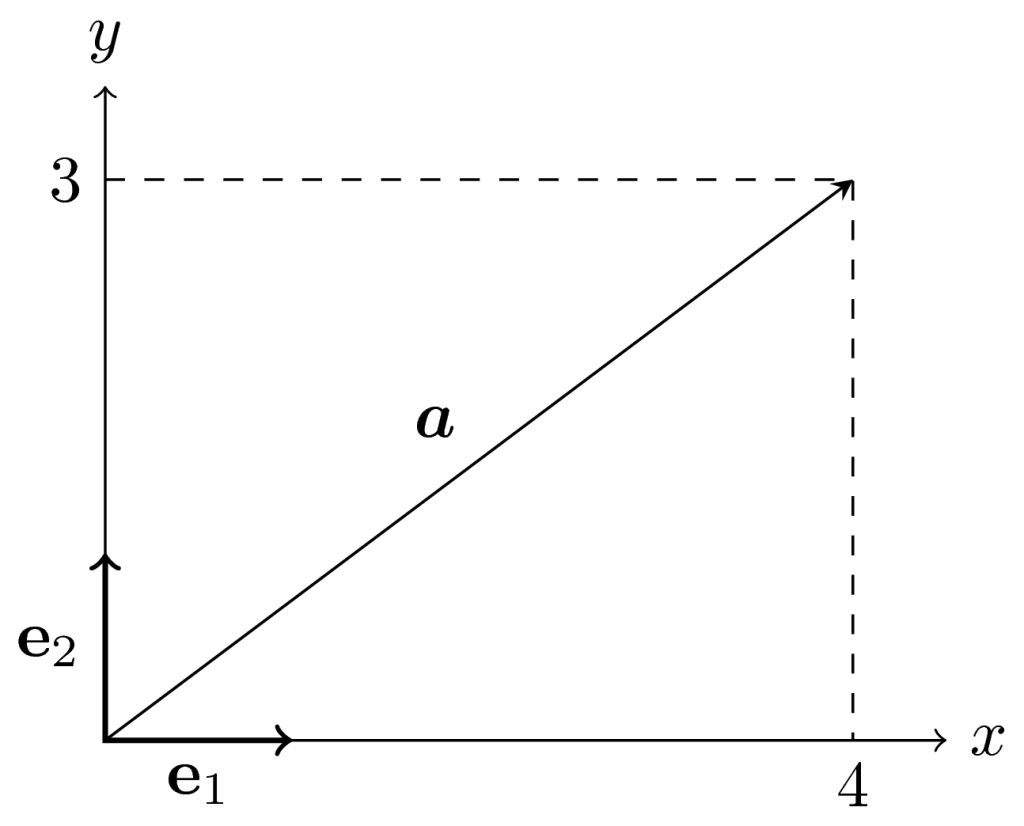
A Cartesian coordinate system describes the position of points in space using perpendicular axis lines that meet at a point called the origin. Any given point’s position can be described based on its distance from the origin along each axis. In other words, Cartesian coordinates allow one to specify the location of a point.

So, why am I talking about Cartesian coordinates?

Because that is what Bildad the Shuhite was trying to do with Job, to fix him on a plane that he could understand.

Because in Bildad’s theological world, the wicked are punished by God with bad circumstances and suffering. In the Cartesian world, as the wickedness increases, so does the pain and suffering.

Hence, one is being punished by God… But does the world really operate according to Bildad’s conception of it?

Hell no! (apparently wicked people say that sort of thing when not in the Cartesian world; they should probably get right with God; and, by the way, sarcastic people are wicked, too)

Bildad went so far as to suggest that perhaps Job doesn’t know God at all.

After all, that’s where one goes in a conversation with someone who doesn’t conform to clear and tidy Cartesian-style theology.

They can preach hellfire and damnation to others, yet when another even uses the word “hell” in a phrase, that is where they’re going to go.

It seems that Bildad isn’t really making sense.

Why?

Because he’s stuck. He cannot imagine life outside of his theological bubble.

The difference between Bildad and Job is that Job will admit that he is stuck, confused, messed-up, angry, and has no decent answer to what is going on in his life.

Whereas Bildad would never admit such a thing, even though he is so far stuck in the mud that it would take a divine miracle to get him out.

In fact, it appears we all need a divine miracle.

But God is silent.

Why?

I don’t know. But I do know that it won’t be for long.

Everyone might want to brace themselves for what’s coming.

Why?

Because we will receive precisely what we’re looking for: A word from God. But it’s probably not going to be what we expect.

After all, we aren’t living in a world of Cartesian coordinates.

O Lord God almighty, Creator of heaven and earth: I admit that these people you created drive me nuts! And I’m one of them! I can barely live with myself, let alone others.

In my wondering and confusion and pain, it’s hard to focus on anything. I don’t know why everything is upside-down and topsy-turvy. Yet, somehow I know, and am convinced, that you are present with me, and that you love me.

How in the world could I accept good from you, and not bad? If you love me, and are present with me, then I believe that whatever happens from this point forward, I shall not be forsaken by you.

Contend with those who contend against me. Help me with today, for tomorrow has enough worries of its own. Amen.

Preparing the Way (John 1:19-28)

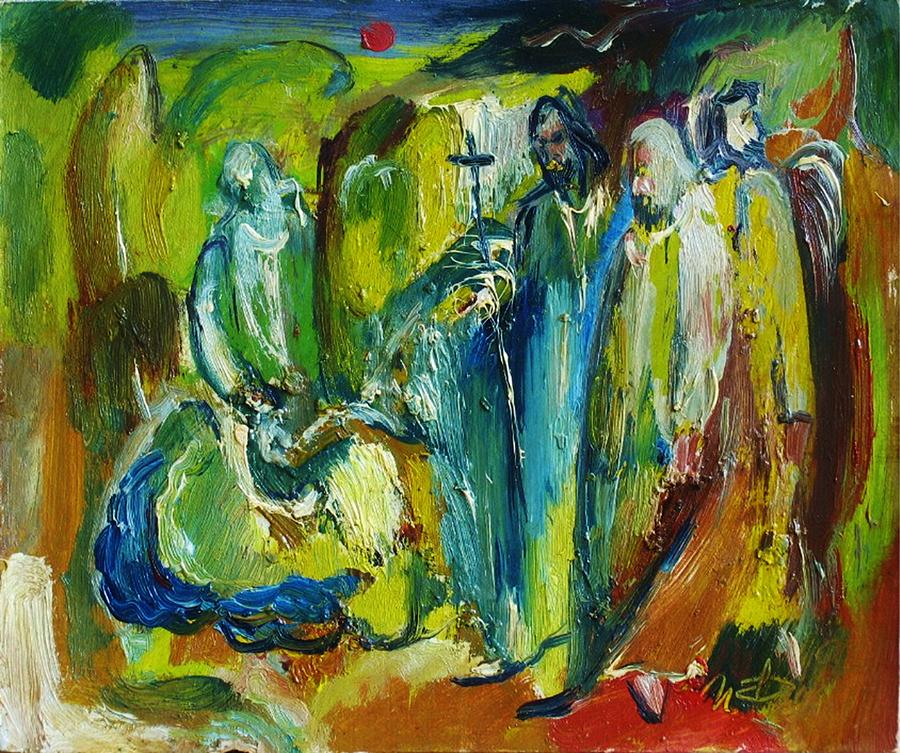
John the Baptist by Ivan Filichev, 1992

Now this was John’s testimony when the Jewish leaders in Jerusalem sent priests and Levites to ask him who he was. He did not fail to confess, but confessed freely, “I am not the Messiah.”

They asked him, “Then who are you? Are you Elijah?”

He said, “I am not.”

“Are you the Prophet?”

He answered, “No.”

Finally they said, “Who are you? Give us an answer to take back to those who sent us. What do you say about yourself?”

John replied in the words of Isaiah the prophet, “I am the voice of one calling in the wilderness, ‘Make straight the way for the Lord.’”

Now the Pharisees who had been sent questioned him, “Why then do you baptize if you are not the Messiah, nor Elijah, nor the Prophet?”

“I baptize with water,” John replied, “but among you stands one you do not know. He is the one who comes after me, the straps of whose sandals I am not worthy to untie.”

This all happened at Bethany on the other side of the Jordan, where John was baptizing. (New International Version)

John was not the Messiah. Jesus is the Messiah. John’s life was devoted to preparing people and pointing them to Jesus. You and I are not the Messiah; Jesus is. You and I are to devote are lives to preparing people and pointing them to Jesus.

John the Baptist had a way of communicating that didn’t exactly win friends; but he sure influenced a lot of people. (Matthew 3:1-12) 

Considering that John lived in seclusion, dressed weird, and ate different food, it’s not a stretch to see how people might dismiss him as a kook and move on. Yet, there’s no evidence that people viewed John that way. 

Instead, John the Baptist had an effective ministry. I suggest that’s because John didn’t seek his own gain, wasn’t trying to build a big following, but understood that he was to point to the coming Christ. 

John believed judgment was imminent, so he put all his efforts into getting people to realize the wrath of God was real and coming soon.

The kingdom of God cannot be entered by forcefully pushing the door in; we enter God’s kingdom through the humility of confession and repentance. The way to the Nativity goes through John the Baptist and his message of “Repent, for the kingdom of God is near.” (Matthew 3:2; Mark 1:4; Luke 3:3)

We are, like John, to make a straight and level way for folks to come to Jesus. That’s going to require some change on our part. But if we’re stuck in our ways, that makes it really hard to make a level path to Jesus.

There’s all sorts of ways we get stuck. We might be mired in a destructive habit because we think we need it to keep going; we may get cemented into rehearsing all the past dumb decisions we made, and so, cannot move forward; or we might become fastened in an unhealthy relationship and see no way to move. 

If we are stuck long enough, we blandly accept this as a new normal, then go about our daily lives with a “meh” kind of attitude; not too low, not too high, but just “meh.”

All this sticky stuff – the patterns, behaviors, activities and habits which trap us – keep us in an immovable bondage. And we might become so used to “meh” that we are cut off from the source that would get us un-stuck.

The reason people didn’t dismiss John as some creepy clown is that he offered them something better than their sticky situations. 

Awareness of our real selves and our true condition brings hope – because God will not leave us stuck. The Lord will turn us into free people, delivered from the stickiness, to live fully for the coming King. God doesn’t give up on us, so we do not need to settle for a “meh” existence.

It can be scary, looking squarely at our sins, habits, memories, and emotions because they might keep us on the flypaper of death. We may feel overwhelmed and think there is hope for other people, but not me. Or, conversely, we might think that everyone else has a problem except me. 

Jesus will baptize with the Holy Spirit and with fire. Christ will shake things up. He’ll unstick people and free them from narrow thinking and a lack of self-awareness.

The season of Advent means that the time of the Lord’s coming is near. Therefore, preparation for the Nativity of the Lord, Christmas, is of primary importance. And the best way of preparing for Christmas Day is to repent and believe that the kingdom of God is near (as opposed to far away). 

God has come near to us in the person of Jesus; and that makes all the difference. 

It’s hard to admit we’re stuck. Yet, if many are honest, their relationship with God and/or the Church is nothing more than a shoulder shrugging “meh.”

There are two ways to deal with being stuck in guilt and shame: either justify it or confess it. 

Denying, minimizing, or excusing sin leads to separation from God – whereas confession leads to connecting with God. 

John the Baptist’s message is this: Get ready because Jesus is coming! Through the grace of repentance and faith there is hope – the hope of stopping all the petty games we play to hide our sin and hide the fact we are really super-glued to our idols. Our hope is in being cleansed from our impurities and ready for God to be with us in the person of Jesus.

God unsticks us so we can bear good fruit that is in keeping with repentance. Our lives need to be congruent between what we profess and how we live. Outward religious observance, although important, is not the way into the kingdom. And confession without genuine change is not repentance – it’s just confession. 

The God who came to his people in Jesus will one day unveil his kingdom in all its glory. We need to get ready for that day. There are roads that need straightening; fires that need to be lit in order to burn away the rubbish and brush in the path; dead trees that need to be cut down; there are people who need to repent because the kingdom of God is near.

We must clear the road so that Jesus has a way into our hearts. 

Just as law enforcement and the secret service are serious about making presidential motorcades free of obstacles and having a clear road to the destination, so we need to ensure that we are doing all we can to pave the way for Christ’s coming. 

This is no time for a spiritually milquetoast deadpan “meh” kind of life; this is the day to clear the way for Jesus. Now is the time to prepare for Christ’s coming. 

And the proper preparation for the Lord’s return is with admitting our stickiness and asking God to unstick us from the sin that so easily entraps us on the devil’s flypaper. 

The kingdom of God belongs to those who prepare the way and produce good fruit in keeping with repentance. 

Maranatha. Even so, come, Lord Jesus.