Faith, Hope, and Love (Acts 27:13-38)

When a gentle south wind began to blow, they saw their opportunity; so they weighed anchor and sailed along the shore of Crete. Before very long, a wind of hurricane force, called the Northeaster, swept down from the island. The ship was caught by the storm and could not head into the wind; so we gave way to it and were driven along. 

As we passed to the lee of a small island called Cauda, we were hardly able to make the lifeboat secure, so the men hoisted it aboard. Then they passed ropes under the ship itself to hold it together. Because they were afraid they would run aground on the sandbars of Syrtis, they lowered the sea anchor and let the ship be driven along. 

We took such a violent battering from the storm that the next day they began to throw the cargo overboard. On the third day, they threw the ship’s tackle overboard with their own hands. When neither sun nor stars appeared for many days and the storm continued raging, we finally gave up all hope of being saved.

After they had gone a long time without food, Paul stood up before them and said: “Men, you should have taken my advice not to sail from Crete; then you would have spared yourselves this damage and loss. But now I urge you to keep up your courage, because not one of you will be lost; only the ship will be destroyed. Last night an angel of the God to whom I belong and whom I serve stood beside me and said, ‘Do not be afraid, Paul. You must stand trial before Caesar; and God has graciously given you the lives of all who sail with you.’ So keep up your courage, men, for I have faith in God that it will happen just as he told me. Nevertheless, we must run aground on some island.”

On the fourteenth night we were still being driven across the Adriatic Sea, when about midnight the sailors sensed they were approaching land. They took soundings and found that the water was a hundred and twenty feet deep. A short time later they took soundings again and found it was ninety feet deep. 

Fearing that we would be dashed against the rocks, they dropped four anchors from the stern and prayed for daylight. In an attempt to escape from the ship, the sailors let the lifeboat down into the sea, pretending they were going to lower some anchors from the bow. Then Paul said to the centurion and the soldiers, “Unless these men stay with the ship, you cannot be saved.” So the soldiers cut the ropes that held the lifeboat and let it drift away.

Just before dawn Paul urged them all to eat. “For the last fourteen days,” he said, “you have been in constant suspense and have gone without food—you haven’t eaten anything. Now I urge you to take some food. You need it to survive. Not one of you will lose a single hair from his head.” After he said this, he took some bread and gave thanks to God in front of them all. Then he broke it and began to eat. They were all encouraged and ate some food themselves. Altogether there were 276 of us on board. When they had eaten as much as they wanted, they lightened the ship by throwing the grain into the sea. (New International Version)

An engraving of the Roman prison ship, by Henry Adlard (1799-1893)

Keeping your courage in the face of an intense stressor is more than challenging. Yet, the Apostle Paul did it. Not only that, but he also had the wherewithal to help keep up the spirits of the people around him – even though he was on a prison ship in the middle of storm.

How did Paul do it? How did he remain encouraged himself, while also encouraging others? What’s the answer? Three words which are essential to the Christian life: faith, hope, and love.

Every believer knows from experience how difficult it is to practice these in daily life, especially the crucible of multiple stressors. One reason it’s so doggone hard, even when we want to please the Lord, is due to the confusion between our inner feelings and our outer actions. Yet once we understand the incongruence, and how to evaluate our inner experience, then it’s a whole lot easier to make daily decisions of faith, hope, and love.

In the beginning God created humans in the divine image. Humanity’s relationship to God was central to daily life (Genesis 1:26; 2:16-25). And God created people with the capacity to interact with the divine through our ability to think and reason. (Ephesians 4:24; Colossians 3:10)

Before there were broken relationships between Creator and creature, our original ancestors had complete self-control, along with unity and harmony between one another and God. (Genesis 1:31; 2:7, 16-25). 

It’s vital for us to recognize the distinction between human being and human doing; there’s a difference in who we are and what we do. (Romans 1:21-32; 6:16-22; 1 Corinthians 9:27; Ephesians 4:21-32)

And if we fail to grasp this distinction, we’re going to have some big stress in living as Christians.

In Adam and Eve’s disobedience toward God, humanity took on its own authority, and started making decisions independent of God. In other words, the source of authority switched, and we began relying upon ourselves.

The problem with this is that our brokenness has left us in disparate parts, badly in need of integration. The fall of humanity compromised our integrity, and so, we have a messed up sense of what to do, how to feel, and how and what to think.

This is why rational people do irrational things, and why fear, stress, and anxiety rule so much of our lives. Many a church pastor, not understanding this dynamic, is forever frustrated and flabbergasted that parishioners do not simply take what has been taught them, and go do it. (If it were that simple there would be no place for the Holy Spirit!)

There’s more. In our fallen state, we lost control of our capacity to function well – and are now vulnerable to manipulation from others, and from Satan. (Ephesians 2:2-3; Galatians 5:16-21)

As a result, our inner conscience has become confused. We are not always certain of right and wrong, or what needs to happen whenever we’re distressed. We end up misunderstanding what life is really supposed to be about. We’re disconnected from our original source of faith, hope, and love.

However, the good news of Christianity is that through the redeeming work of Jesus, and a new birth, the bondage of shame and disconnection is reinstated. God once again becomes central to daily life. The Lord’s gracious authority is restored.

In this renewed relationship, we can again receive truth through the Holy Spirit and the Holy Scriptures. Our daily practical experience of this relationship brings freedom, joy, assurance, peace, and self-control. Yet, even though one is redeemed by Jesus Christ and believes in him, it is still possible to regress into conflict, doubt, fear, anxiety, frustration, disappointment, and confusion. (Romans 7:14-25; 1 Corinthians 3:1-4)

We must, therefore, make daily decisions of faith, hope, and love based in our identity as God’s image-bearers:

  • Recognize you have the ability to function in faith, hope, and love as God’s beloved child.(2 Corinthians 7:1; Romans 8:14-17)
  • Understand the difference between your being and doing. Evil thoughts and emotions do not make you evil. What you do with your feelings and thoughts is what’s vital. (See how Jesus handled this in Matthew 4:1-11).
  • Know that you can take charge of your thoughts, feelings, and actions. (Galatians 5:22-23)
  • Know also that you can reject whatever is harmful and out of sync with your basic identity. (Ephesians 4:22; Colossians 3:5-9; Titus 2:11-12)
  • Respond to God and God’s Word by daily obedience. Learn to think and act on the basis of truth. (Acts 27:25)
  • Discern that practicing the truth will result in freedom, and a re-patterning of thinking and functioning. (John 8:32; Titus 2:11-14; Philippians 2:12-16)

Supportive communities help one another live into shared values and commitments. Faith, hope, and love exists and grows in the context of community.

Paul had faith by believing what he heard; hope by looking ahead to the end of God’s promise; and love by reaching out to his fellow prisoners and the ship’s crew. Whereas stress moved to distress for most on the ship, Paul found strength, within that same stress, by practicing faith, hope, and love.

Almighty God, give us true faith, and make that faith grow in us day by day. Also give us hope and love, so that we may serve our neighbors according to your will; through your Son, Jesus Christ our Lord, who lives and reigns with you and the Holy Spirit, one God, now and forever. Amen.

Change and Stress (Acts 27:1-12)

When it was decided that we would sail for Italy, Paul and some other prisoners were handed over to a centurion named Julius, who belonged to the Imperial Regiment. We boarded a ship from Adramyttium about to sail for ports along the coast of the province of Asia, and we put out to sea. Aristarchus, a Macedonian from Thessalonica, was with us.

The next day we landed at Sidon; and Julius, in kindness to Paul, allowed him to go to his friends so they might provide for his needs. From there we put out to sea again and passed to the lee of Cyprus because the winds were against us. When we had sailed across the open sea off the coast of Cilicia and Pamphylia, we landed at Myra in Lycia. There the centurion found an Alexandrian ship sailing for Italy and put us on board. We made slow headway for many days and had difficulty arriving off Cnidus. When the wind did not allow us to hold our course, we sailed to the lee of Crete, opposite Salmone. We moved along the coast with difficulty and came to a place called Fair Havens, near the town of Lasea.

Much time had been lost, and sailing had already become dangerous because by now it was after the Day of Atonement. So Paul warned them, “Men, I can see that our voyage is going to be disastrous and bring great loss to ship and cargo, and to our own lives also.” But the centurion, instead of listening to what Paul said, followed the advice of the pilot and of the owner of the ship. Since the harbor was unsuitable to winter in, the majority decided that we should sail on, hoping to reach Phoenix and winter there. This was a harbor in Crete, facing both southwest and northwest. (New International Version)

Change is an emotionally charged word. For some, change is longed for. Those with adverse circumstances and difficult situations may look for change, and even for a miracle to turn their life around. Others want nothing to do with change; they’ve had a bad experience with it. Their fortunes were good, until something changed. And now they’re stressed out.

The majority of us have some sort of love/hate relationship with change – which is why there are people who look askance on Christianity and raise their eyebrow in skepticism toward Christians or religious folk in general. At the heart of Christianity is change, and change can be quite threatening toward a lot of people.

The Apostle Paul perhaps knew about change better than any Christian in history. He went from resisting change with violence, to embracing change so wholeheartedly that he became a victim of other’s violence. We meet him in today’s New Testament lesson as a prisoner being shipped from Palestine to Rome.

Paul’s message, at its core, is the good news of transformation because of Christ’ crucifixion and resurrection. It’s a message of radical and joyous change, of new life. And it’s also a scandalous message which impacts the surrounding culture.

Wherever the gospel of Jesus Christ went, people responded, and it influenced society to a significant degree. Throughout the Acts of the Apostles, political authorities, religious leaders, and cultural elites felt powerful shifts in their societies. Yes, a few became Christians themselves, but most resisted the change, and in some cases, in their irritated stress response, retaliated against believers.

The message of Christianity doesn’t yield to political forces that attempt to domesticate God; and that reality put many believers in the crosshairs of those forces.

Paul’s ability to keep up his witness to Christ, even while held prisoner under powerful Roman authority, comes from a theology that God is above all earthly rule and can make a way where there seems to be no way. In other words, no matter whether human institutions, empires, and structures either acquiesce or oppose the gospel makes no difference; God is able to bend any system and authority for divine purposes.

And this is precisely why the Apostle Paul appears calm, non-anxious, and able to encourage others in the center of a storm in which everyone might lose their lives. Put simply: Paul trusted God.

Yes, we have unwanted circumstances. Yet, if we are able to entrust ourselves to a good God (which may sound trite and easy, yet is anything but that) then we find that we’re also able to have a radical acceptance of the situation we’re presently in.

Faith and trust help us to accept difficult changes and respond to stress with resilience because faith is attentive to the following:

  • Knowing change is coming. Throughout the New Testament we are told that adversity and suffering are an integral part of the Christian life. Paul wasn’t caught by surprise with a storm. In his life, he expected the difficulties to come.

You have seen me experience physical abuse and ordeals in places such as Antioch, Iconium, and Lystra. I put up with all sorts of abuse, and the Lord rescued me from it all! In fact, anyone who wants to live a holy life in Christ Jesus will be harassed. (2 Timothy 3:11-12, CEB)

  • Paying attention to the feelings of self and others. Emotions are not a necessary evil. They play a very important role in helping us come to grips with what’s happening. Paul acknowledged the emotions of everyone on the ship, as well as his own. And this became the pathway to both acceptance and encouragement.

There’s a season for everything
    and a time for every matter under the heavens

a time for crying and a time for laughing,
    a time for mourning and a time for dancing. (Ecclesiastes 3:1, 4, CEB)

  • Becoming resilient. The ability to adapt, to find ways of surviving and thriving, is buoyed by a robust faith which can see with spiritual eyes and make decisions of faith, hope, and love.

“When I was born into this world,
    I was naked and had nothing.
When I die and leave this world,
    I will be naked and have nothing.
The Lord gives,
    and the Lord takes away.
Praise the name of the Lord!” (Job 1:21, ERV)

Stress and change can be hard and overwhelming. Yet, at the same time, it can be an opportunity to put faith into practice and be a blessing to the world.

Assist us, Lord, in living hopefully into the future. In the face of change, help us to set unnecessary fears aside and to recognize our potential for creative response. Help us to develop a reasonable optimism and to guard against our own defensiveness. Be with us as we remember and celebrate former times, and keep us from unreasonable yearning for them, which takes us from the work you have set before us in our time. All this we ask in the name of your Son, our Savior, Jesus Christ. Amen.

Assurance for the Next Step in Life (Judges 6:36-40)

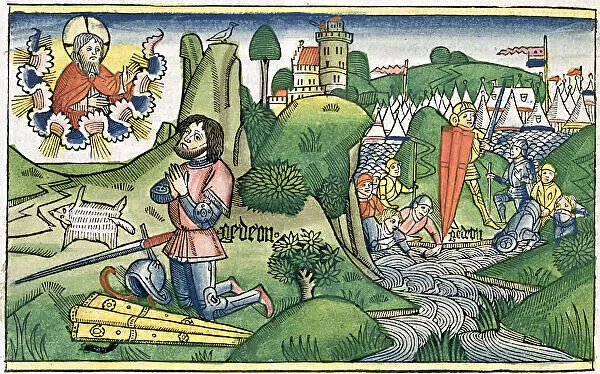
15th century German artist depiction of Gideon putting out the fleece

Gideon prayed to God, “I know that you promised to help me rescue Israel, but I need proof. Tonight I’ll spread a sheep skin on the stone floor of that threshing place over there. If you really will help me rescue Israel, then tomorrow morning let there be dew on the skin, but let the stone floor be dry.”

And that’s just what happened. Early the next morning, Gideon got up and checked the sheep skin. He squeezed out enough water to fill a bowl. But Gideon prayed to God again. “Don’t be angry with me,” Gideon said. “Let me try this just one more time, so I’ll really be sure you’ll help me. Only this time, let the skin be dry and the stone floor be wet.”

That night, God made the stone floor wet with dew, but he kept the sheep skin dry. (Contemporary English Version)

It’s only human to want assurances. And since humanity requires some sort of affirmation that they’re hearing things right, or are on the right track, God graciously accommodates to our need. Much like the disciple of Jesus, Thomas, who desired an assurance that Christ is alive and was victorious over the grave, so Gideon needed clarification that victory was truly at hand.

In both cases of doubting Thomas and anxious Gideon, the Lord does not chide them for needing such assurances. Rather, God immediately responds to their requests. You and I might feel ourselves weak or confused in needing such support, yet God doesn’t feel this way about us.

Sometimes, in our disorientation and our dismay, we try and put feelings aside and stoically attempt to do whatever must be done with complete dispassion and lack of emotion. But that’s to try and be somebody we are not; humans simply aren’t wired that way. There’s no need to try and stir up the courage and confidence on our own.

To navigate this life with any success, we’ll need to pay attention to the inner person, to what’s going on inside us, whenever we are in stressful or confusing times. Then we can connect with the God who mercifully awaits hearing our request. It’s good to be equipped and ready for what’s ahead by having a few convictions….

It’s not the destination that’s important; it’s the journey

Gideon needed to come around to seeing that getting from Point A to Point B as quickly and as efficiently as possible was not the goal. The process of getting from one place to another is the very opportunity needed to connect with the Lord and with others around us. God’s instructions may seem, at times, nonsensical – which is why we often look for assurances that we’ve heard them correctly!

Gideon and the fleece, in the Frauenkirche, Esslingen, Germany

For us modern folk, the Lord doesn’t want us getting lost in the race to become ever more streamlined and productive, only looking at the end goal. If relationships, human connection, justice, love and respect of others is our highest value, then we really need to pay a lot more attention to the process of what we’re doing, and not just the product and outcomes.

Focusing solely on a final outcome turns factory workers into extensions of the machines they are using to churn out a quality product; it turns families at church into giving units with potential to support all the programs and ministries; it turns adversity into an unwanted obstacle to achieving victory; and turns needy people into problems we can fix.

Life is a pilgrimage to walk; it’s not a race to run

At the end of life, folks don’t reminisce about how much they produced, how many places they’ve been, or how much money they made. Instead, they talk about people, both the relationships that were rich and full, as well as the broken or lapsed relationships which cause them regret.

This is why, daily, I purpose to saunter, walk slowly, and observe the people and places around me. This practice allows me to take the time to greet others, connect with some, and even have a sit down conversation with another person – all on the way to doing something else.

Frankly, from a goal-oriented perspective of achievement and accomplishment, this practice does nothing to help whittle down my massive checklist for the day. But I do it, anyway, because human connection our real purpose in life.

Humanity is our business

It doesn’t matter what we do for a living, or where we live. Relationships are the only reality we take with us in the end – both with God and other people.

Dead with ball and chain, the ghost of Jacob Marley responded to Ebenezer Scrooge’s accolade that he was such a good man of business:

“Mankind was my business. The common welfare was my business; charity, mercy, forbearance, benevolence, were all my business. The dealings of my trade were but a drop of water in the comprehensive ocean of my business!” 

Jacob Marley, in Charles Dickens, A Christmas Carol

Marley had discovered this insight too late. 

All of life is a gift given by God, meant for us to be stewards toward the benefit and welfare of humanity. All our abilities, skills, intellectual acumen, possessions, and even the lack thereof – literally everything – is meant to be used in the betterment of our fellow human beings.

We all share the common human condition of needing our stories told and heard by one another, so that we can have some assurance and comfort through what we’re facing.

Will I be there to hear another? Will another be there to hear me? Will I listen to God? Will God listen to me?

Be fully present to others; avoid thinking about the past or focusing on the future

If you think about it, Jesus was perhaps the most productive person to ever walk this earth. In just three short years his ministry completely changed the world and continues to do so. Perhaps our Lord’s “secret” was no secret at all. 

Christ was fully present to the Father, and to the people right in front of him. He was never hurried, and didn’t capitulate to the anxiety of others who wanted him to pick up the pace of being a kickass Messiah.

So, my friends, may you slow down enough to observe, see, hear, smell, and witness the incredible and deep humanity that is present next door to you, down the hall from you, and sitting across the table with you. 

May you experience the wide mercy of God and graciously extend the same love to others. 

May you embrace the process of whatever you are doing to include the space of others and their unique humanity.

For this is how we gain our assurance that God is with us and that we are on the right track for that next step in life.

Pain, Stress, and Chickens (Psalm 32)

A modern mosaic of a mother hen protecting her chicks—on the altar of Dominus Flevit Church on the Mount of Olives, Jerusalem

Oh, what joy for those
    whose disobedience is forgiven,
    whose sin is put out of sight!
Yes, what joy for those
    whose record the Lord has cleared of guilt,
    whose lives are lived in complete honesty!
When I refused to confess my sin,
    my body wasted away,
    and I groaned all day long.
Day and night your hand of discipline was heavy on me.
    My strength evaporated like water in the summer heat.

Finally, I confessed all my sins to you
    and stopped trying to hide my guilt.
I said to myself, “I will confess my rebellion to the Lord.”
    And you forgave me! All my guilt is gone.

Therefore, let all the godly pray to you while there is still time,
    that they may not drown in the floodwaters of judgment.
For you are my hiding place;
    you protect me from trouble.
    You surround me with songs of victory.

The Lord says, “I will guide you along the best pathway for your life.
    I will advise you and watch over you.
Do not be like a senseless horse or mule
    that needs a bit and bridle to keep it under control.”

Many sorrows come to the wicked,
    but unfailing love surrounds those who trust the Lord.
So rejoice in the Lord and be glad, all you who obey him!
    Shout for joy, all you whose hearts are pure! (New Living Translation)

The body knows the truth of what is happening in the spirit. Our physical selves carry the weight of our mental thoughts and emotional feelings.

Our bodies have their way of making sounds of protest and pain if our spirits are silent. For example, physical weariness and tiredness can be a lighthouse, alerting us to pay attention to our inner suffering.

In other words, stated positively, pain and stress are a gift.

“I imagine one of the reasons people cling to their hates so stubbornly is because they sense, once hate is gone, they will be forced to deal with pain.”

James Baldwin

What is stress?

Stress is any type of change that causes physical, emotional, mental, or spiritual strain. Stress is a normal reaction to everyday pressures. However, stress can become unhealthy when it upsets our daily functioning and ability to live well. Stress itself is neither good nor bad. The issue is the appropriate amount of tension we need to live a healthy life.

Where do you typically carry stress in your body?

Whenever we are under a great deal of stress – and are having difficulty either recognizing it or managing it – the body gives us clues about how to pay attention to that stress. Our mental, emotional, relational, and spiritual issues usually show up in the body as physical problems.

Why do individuals handle stress differently?

The combination of past trauma, abuse, and neglect within families and communities is unique to the individual – as well as variations in personality traits and inherited genetics.  In other words, how we deal with stress is a result of both nature and nurture.

What are some common connections between stress and the body?

  • Shoulders: Feeling overwhelmed through carrying the weight of the world’s problems.
  • Gut (stomach and intestines): Feeling anxious for not letting go of a problem.
  • Vomiting or diarrhea: Feeling emotionally sick about a situation and wanting to be rid of it once and for all.
  • Hemorrhoids or constipation: Straining or working very hard to make something happen in your life and it doesn’t come to pass.
  • Headache: Feeling afraid through overthinking that something bad will happen.
  • Chest/heart: Feeling angry or sad through either trauma or secondary trauma.
  • Lungs: Feeling suffocated, like you cannot breathe, because of difficult circumstances, e.g. asthma
  • Spine/knees/hips: Feeling discouraged and wanting to give up because you cannot take one more step.
  •  

How can I deal with my stress in a healthy way?

  1. Let go. Ask for help. Talk to God, as well as a friend, faith leader, or other about why you are stressed.
  2. Reach out. Connect with family members. Get involved in a faith community. Volunteer in an organization you care about.
  3. Eat well. Make healthy choices about food. Find someone or a group of people who share your nutrition goals.
  4. Meditate. Focus on the present moment because there is only now. Read Scripture. Pray.
  5. Walk. Take daily strolls through nature. Walk the dog. Walk with a friend. Walk with the Lord.
  6. Read. Read or listen to a good book. Do it with a cup of coffee or tea.

“The truth is that stress doesn’t come from your boss, your kids, your spouse, traffic jams, health challenges, or other circumstances. It comes from your thoughts about your circumstances.”

Andrew Bernstein

The psalmist went on to release his silence and give voice to his spiritual stress and emotional pain, thus finding relief.

Who is the stress reliever?

God. The Lord is akin to a mother hen who protects her chicks.

My youngest daughter once had a pet chicken named “Gina” (I have no idea why she named the chicken this). Gina would lay an egg or two and keep them warm and nestled underneath herself. Indeed, the eggs were in a special hiding place, protected from outside forces.

My daughter also sang to Gina (which helped her to lay more eggs) and made sure she had plenty of space to find grubs, worms, shrews, and other delectables from the ground. Gina wasn’t the only pet chicken; there were others, too. Chickens are very social and require other chickens to be happy; a solitary hen is likely to not lay any eggs, at all.

Whenever we are “chicken” and run about with anxiety and fear, God gathers us together with other believers, protects us from trouble, surrounds us with songs of deliverance, and makes sure we have everything we need for life and godliness in this present age.

The Lord will take care of us – no matter the situation, the stress, or the pain it produces.

Blessed heavenly Father and Mother Hen, your Divine presence, power, provision, and protection gives us grace and truth. May this season of Lent – a time of repentance and faith – bring us the blessing of your forgiveness and the joy of salvation, through Jesus Christ our Lord. Amen.