Psalm 89:1-4, 19-26 – Being Confident

Our Lord, I will sing
    of your love forever.
Everyone yet to be born
    will hear me praise
    your faithfulness.
I will tell them,
“God’s love
    can always be trusted,
    and his faithfulness lasts
    as long as the heavens.”

You said, “David, my servant,
    is my chosen one,
    and this is the agreement
    I made with him:
David, one of your descendants
    will always be king….”

In a vision, you once said
    to your faithful followers:
“I have helped a mighty hero.
    I chose him from my people
    and made him famous.
David, my servant, is the one
    I chose to be king,
    and I will always be there
    to help and strengthen him.

No enemy will outsmart David,
    and he won’t be defeated
    by any hateful people.
I will strike down and crush
    his troublesome enemies.
He will always be able
    to depend on my love,
    and I will make him strong
    with my own power.
I will let him rule the lands
    across the rivers and seas.
He will say to me,
‘You are my Father
    and my God,
    as well as the mighty rock
    where I am safe.’” (CEV)

I wonder where the world places its confidence. I also sometimes wonder where the church places her confidence. Poverty, injustice, starvation, human rights violations, and war have existed throughout time. We all recognize these and the awful problems they are for so many people. It is, however, quite another thing when it comes to our confidence in addressing them and how they will ever be eradicated.

If we view these great humanitarian issues as a matter of ignorance, we will pursue education as the means of tackling them. If we discern them as political issues, we will seek to elect officials who will take them on, and we will lobby to make things different. If we understand them as moral issues, we will agitate for change and speak prophetically into what we believe to be the sources of the problems. In truth, each of these approaches have merit and are necessary components to a full orbed attention of their multifaceted and complicated nature.

For the pious and devout, the ultimate confidence comes in basic faith and trust of the Divine. God’s faithfulness and steadfast love are the solid foundation from which the believer constructs her hope and confidence.

The psalmist is not one bit bashful in reminding God of divine promises. God swore to King David that his descendants would rule forever. At the time the psalmist crafted these words, it was not looking much like those promises were having any attention from the Lord.

The David spoken of in the psalm is interpreted in the Christian tradition as Jesus. King David of old was certainly no perfect man, and the psalmist presents an idealized version, looking ahead to messianic qualities of a coming Ruler. Those qualities include a concern for the common good of all persons without striving for personal power or being aloof; and an ability to be victorious over foes.

Advent, much like today’s Psalm, calls on people to rely upon and have confidence in divine promises – even when those promises seem far from being realized. It is the trust and hope of the faithful which perseveres in prayer for a coming redemption and a day when wars shall cease, the rights of people are thoroughly met, starvation eradicated, injustice turned to justice, and poverty done away with once for all. In other words, a sinless world free from the machinations of evil.

It is no small thing holding on to our confidence as believers when circumstances all around us are askew and askance. The author of the New Testament book of Hebrews had this to say to a struggling church who had a hard time seeing future promises fulfilled:

Remember those earlier days after you had received the light, when you endured in a great conflict full of suffering. Sometimes you were publicly exposed to insult and persecution; at other times you stood side by side with those who were so treated. You suffered along with those in prison and joyfully accepted the confiscation of your property, because you knew that you yourselves had better and lasting possessions. So do not throw away your confidence; it will be richly rewarded.

You need to persevere so that when you have done the will of God, you will receive what he has promised. For,

“In just a little while,
    he who is coming will come
    and will not delay.”

And,

“But my righteous one will live by faith.
    And I take no pleasure
    in the one who shrinks back.”

But we do not belong to those who shrink back and are destroyed, but to those who have faith and are saved. (Hebrews 10:32-39, NIV)

We keep going by remembering God’s faithfulness and steadfast love, and our past joy of committed faith. Then, like psalmist, we allow a song to bubble up and be sung about divine goodness. Never underestimate the power of memory and music to keep us on track toward living each day in faith and confidence.

May you be able to sing of God’s love forever.

May you give voice to God’s faithfulness.

May you express daily affirmations of faith in God.

May you bank on the promises of God.

May your faith be strengthened for the rigors of this life.

May your hope overflow.

May the love of God work in and through you to the glory of Jesus Christ. Amen.

I Could Sing of Your Love Forever by Encounter Worship Band.

Psalm 85:1-2, 8-13 – Giving the Good

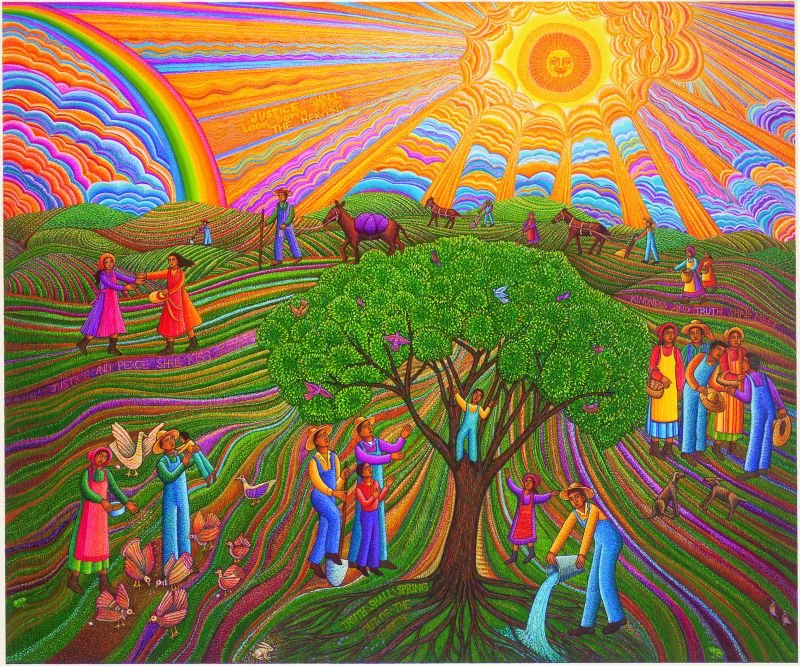
Psalm 85 by American artist John August Swanson

Lord, you were favorable to your land;
    you restored the fortunes of Jacob.
You forgave the iniquity of your people;
    you pardoned all their sin….

Let me hear what God the Lord will speak,
    for he will speak peace to his people,
    to his faithful, to those who turn to him in their hearts.
Surely his salvation is at hand for those who fear him,
    that his glory may dwell in our land.

Steadfast love and faithfulness will meet;
    righteousness and peace will kiss each other.
Faithfulness will spring up from the ground,
    and righteousness will look down from the sky.
The Lord will give what is good,
    and our land will yield its increase.
Righteousness will go before him,
    and will make a path for his steps. (NRSV)

Steadfast love, faithfulness, righteousness, and peace are terms which all spiritual folks need to be familiar with as well as experience. Steadfast love and faithfulness have its ground in God’s chesed, the divine covenant loyalty and kindness which always holds on, even despite people’s fickle commitment. Righteousness and peace are primarily relational terms which communicate a harmonious way of being with others and all creation.

This psalm says God will give exactly what the people have prayed for. It is a blessing given by the Lord to those who long for wholeness, integrity, and unhindered connection with God and God’s creation. And it is in the metaphors surrounding the words which give us such a beautiful picture of the blessing realized.

This is neither a general nor generic blessing from God Almighty. It is personal. In the grand immensity of the universe, the Creator God bends and condescends not only to all humanity but also to the individual. God’s steadfast love and faithfulness will meet to bless you and me. The Lord will come alongside and conform a divine blessing to our life. God’s grace will stick to us like glue in the form of right relationships and unity.

All of God’s attributes and character shall work in a seamless whole to bring divine acceptance and assistance to our lives. The good news here is that our struggles to be right and live right amidst terrible conditions of pandemics and people’s petulance have a vindication of divine sanction and enablement.

So, take a big breath and exhale, allowing the worries and anxieties of adverse situations to be expelled from our weary spirits. The Lord will give what is good. Today’s psalm is a wonderful reminder that salvation is not limited to a coming life; it is also deliverance in this present world we inhabit, basking in the Lord’s love and shalom and enjoying the good gifts God wants to give us right now.

Gracious God speak peace to your people. Through your Son, the Lord Jesus, we turn to you in our hearts, knowing your steadfast love and faithfulness, your righteousness and peace goes before us, with us, and behind us. In Christ, our salvation is at hand. May we reflect your goodness, as we respond to you with heart, soul, mind, and strength. This we pray in the name of the One who is your peace, your salvation—Jesus Christ. Amen.

Hosea 6:1-6 – “I Desire Mercy!”

By Brazilian street artist Edward Kobra, building in New York City, 2018

Come, let us return to the Lord.
He has torn us to pieces
    but he will heal us;
he has injured us
    but he will bind up our wounds.
After two days he will revive us;
    on the third day he will restore us,
    that we may live in his presence.
Let us acknowledge the Lord;
    let us press on to acknowledge him.
As surely as the sun rises,
    he will appear;
he will come to us like the winter rains,
    like the spring rains that water the earth.

“What can I do with you, Ephraim?
    What can I do with you, Judah?
Your love is like the morning mist,
    like the early dew that disappears.
Therefore I cut you in pieces with my prophets,
    I killed you with the words of my mouth—
    then my judgments go forth like the sun.
For I desire mercy, not sacrifice,
    and acknowledgment of God rather than burnt offerings.” (NIV)

My favorite word in all Holy Scripture is the Hebrew word chesed.  It is such a rich word that no one English word can capture its depth.  So, chesed is translated in various ways across English translations of the Bible as mercy, grace, steadfast love, covenant loyalty, kindness, compassion and more. It is no wonder, then, that since chesed marks the character and activity of God, the Lord very much desires people to reflect this same stance toward others. 

In today’s Old Testament lesson, God was calling and wooing wayward people to return to a divine life of closeness with the Lord. God demonstrated chesed by not putting the people away, like a spouse outright divorcing an unfaithful partner, but committed to loving the Israelites even when they were unlovely.

At all times, the response God wants is not simply going through the motions of outward worship. Ritual practices mean little if there is no heart behind them. The Lord longs for people to demonstrate both fidelity and fealty through mercy and a steadfast love to God and neighbor. Both our work and our worship are to be infused with divine mercy. 

Chesed by Havi Mandell

God deeply desires a close relationship with humanity and is profoundly pained when people whore after other gods to meet their needs and love them. Hosea’s prophecy is an impassioned plea for all persons to find their true fulfillment and enjoyment in a committed loving divine/human union, like a marriage.

In Christian readings of Hosea’s prophecy, repentance means accepting God’s chesed through Jesus Christ. The believer is to allow the character of God to rule and reign in their heart so that love and commitment come flowing out in words, actions, thoughts, and dispositions. Mercy finds its highest expression in the person and work of Jesus. Thus, Advent is a season of anticipating the great love and mercy of God through the incarnation of Christ.

It is no wonder, then, that Jesus lifted Hosea’s prophecy as a treasured principle of operation when asked why he deliberately made connections with “questionable” people:

While Jesus was having dinner at Matthew’s house, many tax collectors and sinners came and ate with him and his disciples. When the Pharisees saw this, they asked his disciples, “Why does your teacher eat with tax collectors and sinners?” On hearing this, Jesus said, “It is not the healthy who need a doctor, but the sick. But go and learn what this means: ‘I desire mercy, not sacrifice.’ For I have not come to call the righteous, but sinners.” (Matthew 9:10-12, NIV)

And when confronted about “questionable” activities Jesus appealed to the same source of Hosea’s prophecy:

“Look! Your disciples are doing what is unlawful on the Sabbath.” Jesus answered, “Haven’t you read what David did when he and his companions were hungry? He entered the house of God, and he and his companions ate the consecrated bread—which was not lawful for them to do, but only for the priests. Or haven’t you read in the Law that the priests on Sabbath duty in the temple desecrate the Sabbath and yet are innocent? I tell you that something greater than the temple is here. If you had known what these words mean, ‘I desire mercy, not sacrifice,’ you would not have condemned the innocent.” (Matthew 12:2-7, NIV)

One can never go wrong with mercy and grace. If in doubt between whether to judge another or show mercy, the Christian’s choice is clear. Grace and love create connections – reconnecting the disconnected. The heart of true Christian spirituality is a deep kinship with the divine. Whenever that relation is broken or severed, it is vital to restore it. The means of doing so is not judgment but mercy.

Chesed is more than a word; it is a way of life. God wants mercy. Grace is the Lord’s divine will. So, let us today receive the forgiveness of Jesus and devote ourselves to prayer and works of love which come from a heart profoundly touched by grace.  May the result be healing of that which has been broken, and reconciled relationships with others.

Merciful and loving God, the One who shows amazing grace, forgive us for our wanderings away from the divine life. Return us, again, to the grace of Jesus Christ our Savior so that our hearts will be renewed and aflame with love for others.  In the Name of the Father, Son, and Spirit, the Great Three in One.  Amen.