Epiphany of the Lord (Matthew 2:1-12)

After Jesus was born in Bethlehem in Judea, during the time of King Herod, Magi from the east came to Jerusalem and asked, “Where is the one who has been born king of the Jews? We saw his star when it rose and have come to worship him.”

When King Herod heard this he was disturbed, and all Jerusalem with him. When he had called together all the people’s chief priests and teachers of the law, he asked them where the Messiah was to be born. “In Bethlehem in Judea,” they replied, “for this is what the prophet has written:

“‘But you, Bethlehem, in the land of Judah,
    are by no means least among the rulers of Judah;
for out of you will come a ruler
    who will shepherd my people Israel.’”

Then Herod called the Magi secretly and found out from them the exact time the star had appeared. He sent them to Bethlehem and said, “Go and search carefully for the child. As soon as you find him, report to me, so that I too may go and worship him.”

After they had heard the king, they went on their way, and the star they had seen when it rose went ahead of them until it stopped over the place where the child was. When they saw the star, they were overjoyed. On coming to the house, they saw the child with his mother Mary, and they bowed down and worshiped him. Then they opened their treasures and presented him with gifts of gold, frankincense and myrrh. And having been warned in a dream not to go back to Herod, they returned to their country by another route. (New International Version)

The light exists; it’s there. But not everyone likes it.

While many celebrate the light, such as Christians on the day of Epiphany, others wrap themselves in the cloak of darkness. There are various responses to Jesus as the Light of the World; not all of them are the same.

King Herod responds with anger

Herod was distressed with the news of a potential King of the Jews being born; he saw this as a threat to his rule. Herod, ever the narcissistic person who always sought to wipe out any threat to his throne, went over the top in seeking destroy Jesus. 

At the time of Christ’s birth, Herod had been the reigning king for about 30 years. During that time, his paranoia about losing power led him to kill his wife and three of his own sons because he saw them as threats to his authority. Herod feigned a desire to worship Christ, but this was really a sinister façade in order to get rid of Jesus by any means possible.

Jerusalem responds with anxiety

The people of Jerusalem felt that Jesus was going to upset the status quo. He was, for them, a threat to their security; any change within the system might cause Herod to take it out on them (which he had done before). 

Although the people were looking for a deliverer, they did not want things to shake up too much and arouse the Romans to abuse them.

Whenever we get caught up in maintaining the status quo, out of fear, then we have no room in the inn for Mary and Joseph. 

Always trying to keep people happy and not upset them is a tenuous way to live. Such an agenda will typically result in missing Jesus when he shows up. That’s because we’re not really looking for him to start with. 

For example, if our task as parents is to just keep our kids out of trouble, they’re going to miss Jesus; and if they find him, it will be in spite of us and not because of us. Yet, if our truest desire for them is to know Christ, then our prayers, our words, and our actions will reflect the ethics of God’s kingdom.

Religious leaders respond with apathy

The chief priests and teachers of the law had all the right answers; and responded to Herod’s questions with the correct information.

The sad part is that the guys who knew the most about Scripture, who actually had a handle on God’s law, were simply satisfied with that knowledge and nothing more. They seemed  unconcerned with getting off their butts and getting on their knees to worship the Son of God.

If we know the truth, we must act on it. Jesus wants people to worship in spirit and in truth. He wants more than a mere recognition; Jesus desires us.

The Magi respond with adoration

The Three Wise Men by He Qi

The Wise men, or Magi, were Gentiles and pagan astrologers (not kings). They devoted themselves to studying the stars and discerning what was happening. Because of this, they were often advisors and counselors to kings.

Some may find it scandalous that God used such persons, but that’s okay. The Lord typically uses the folks we believe are (or should be) unusable. Turns out it is the people such as the Magi that demonstrate their devotion and adoration through actual worship and giving of costly gifts.

Epiphany

Each year on January 6 in the Church Calendar, after the twelve days of Christmas, is the celebration of Epiphany. Christ’s coming to this earth as a child and becoming like us is much more than a baby in a manger.  Epiphany of the Lord helps to bring a vision and understanding of God’s glory to all kinds of people of the world.

The word “epiphany” means “manifestation” or “appearance” – which is exactly what happened with the Magi in visiting Jesus. The season of Epiphany has a special emphasis on the teaching and healing ministry of Jesus. The focus of these weeks is that salvation is not limited to Israel but extends to the Gentiles, as well.

With Epiphany’s light, we see that one of the most scandalous truths of Christianity is that God graces common ordinary people, who seem far from God, with the gift of Jesus. 

God grants life for all kinds of people – no matter their race, ethnicity, gender, class, or background. It’s a wondrous and astounding spiritual truth that God’s gracious concern is not limited to a certain type of person or a particular group of people.

Grace

Grace is and ought to be the guiding factor in how we interact with people. 

Losing sight of grace leads to being critical and defensive. Like King Herod of old, a graceless person becomes enamored with earthly power and control. But embracing grace leads to the humility of seeing the image of God in people quite different from us. 

Like the Apostle Peter, who learned in a vision to bring the gospel to non-Jews, old legalisms begin to wear away so that people from all walks of life can have access to Jesus and his gracious saving and healing ministry. (Acts 10-11:18)

Grace topples barriers and clears away unnecessary distinctions between others. Our appropriate response to such a grace is to glorify God for this marvelous and amazing work.

Light

A light was provided to lead the Magi to Jesus. Apart from God’s gracious intervention, they would have remained in darkness. 

This old broken world is enveloped in spiritual darkness. All kinds of people have no light at the end of the tunnel of their lives for hope and new life. Christ brings that light to those unable to see. And Jesus, in his teaching ministry, exhorted his followers not to hide their light but to let it shine for all to see. (Matthew 5:14-16)

Sometimes, maybe oftentimes, the best way to bring resolution to our own troubles and problems is through helping others make sense of their lives through the gracious light of Christ. Then, they can see an appearance, an epiphany, of what their lives could be in the gracious and benevolent rule and reign of God. 

In this season of Epiphany, let us journey with Jesus through his earthly upbringing, walk with him in his gracious ministry to people; and keep watch with him so that our own light does not grow dim.

Merciful God of life and light, you have gifted the Church through the goodness of your grace to be your hands; to do your work; to be your voice; to share your words; and to bring healing for broken lives. You have graciously gifted your people with the blessings of your Spirit, the power to transform lives and make all things new.

Now may our hearts receive, our mouths proclaim, our hands prepare for compassionate service so that the love we have will overflow into the hearts of others. May they receive your grace, your renewing Spirit, and your love, through Jesus Christ our Savior. Amen.


Acts 4:1-4 – The Message of Resurrection

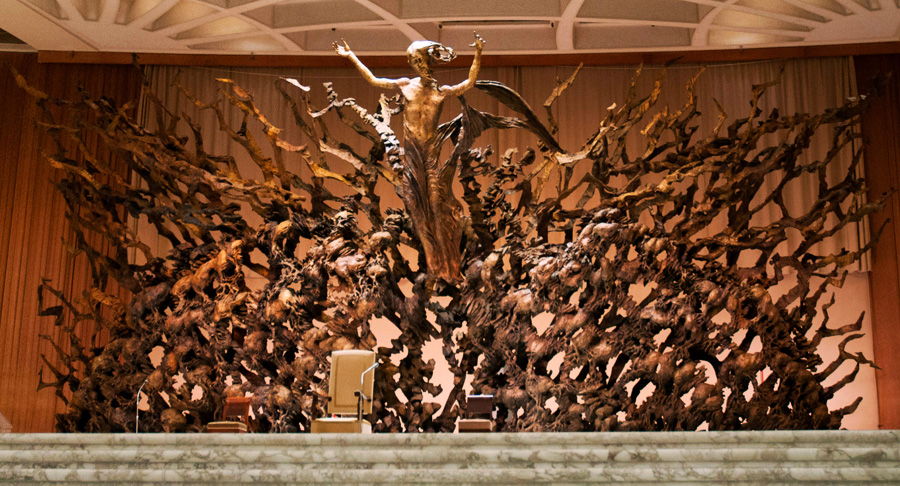
La Resurrezione by Italian sculptor Pericle Fazzini (1913-1987)

The priests and the captain of the temple guard and the Sadducees came up to Peter and John while they were speaking to the people.They were greatly disturbed because the apostles were teaching the people, proclaiming in Jesus the resurrection of the dead. They seized Peter and John and, because it was evening, they put them in jail until the next day. But many who heard the message believed; so, the number of men who believed grew to about five thousand. (NIV)

There’s nothing quite like upsetting the status quo. And that’s exactly what the apostles Peter and John were doing. Creating trouble, causing a stink, disturbing the peace, and making waves. At least, that’s how the ruling authorities saw the upstart Christians’ activity.

At the heart of the disturbance was the authorities’ deep concern of potential social disorder. After all, the Roman Empire with all its great strength was firmly ensconced in Judea. It was already hard enough trying to maintain Jewish customs and religious practices. Now, these rabblerousers come along with their unorthodox teaching and threaten the very social fabric of Jewish life. No! Get them out of here!

So, off to jail Peter and John went. That’s how the politics of fear typically works. Being afraid of change leads to removing the object of fear. Stuff the apostles in the gulag. Shut and lock the door. Maybe if they are out of sight they will be out of mind to the people.

The rulers were too late. So many people heard the message of Christ’s resurrection that the number of believers in Jesus swelled into the thousands. Well, now, everyone’s really in a pickle! Except the church. Each time the Christians get squelched and silenced, more of them show up. Oh, my, goodness. They’re multiplying like roaches!

It doesn’t help the ruling authorities that these religious bugs continue to interpret their own whippings and jailtime as a positive thing – enjoying the solidarity of suffering with their Lord. Ugh. What’s a decent Sadducee to do?

Turns out nothing can stop resurrection. It cannot be chained, bound, or imprisoned. Once life gets into the hearts of people, there’s no getting it out. The message just takes over and consumes the whole person. Then it spreads to another, like some infectious disease.

Before you know it, the entire social order is off kilter. What a bunch of weirdos. Following a dead guy who they say isn’t dead. Walked right out of the grave, they say. Sheesh. Pull yourselves together. So many unhinged delusional people believing in resurrection!

“Here’s to the crazy ones. The misfits. The rebels. The troublemakers. The round pegs in the square holes. The ones who see things differently. They’re not fond of rules. And they have no respect for the status quo. You can quote them, disagree with them, glorify or vilify them. About the only thing you can’t do is ignore them. Because they change things. They push the human race forward. And while some may see them as the crazy ones, we see genius. Because the people who are crazy enough to think they can change the world, are the ones who do.”

Rob Siltanen

It’s easy for some Christians to be hard on non-Christians, just as it was easy for the ancient Jewish rulers to be hard on others leaving their fold. Sometimes we followers of Jesus forget whence we have come. We can get so upset and worked up in fear. Could be our underwear is too tight. More likely, we take the prideful stance of believing our status quo is best for everyone. So, there’s no listening, paying attention, or teachable spirits.

Peter, John, and the other apostles just went about proclaiming good news with joy. And the gospel spread. Jesus became known first to thousands, then tens of thousands, hundreds of thousands, and millions. Today, according to the Pew Research Center, there are 2.5 billion Christians in the world. That’s a lot of people. Christianity has had two thousand years to create their own status quo, some of it good, some of it not so much.

Yet, at the heart of it all, is the resurrection of Jesus Christ from death. It’s a message that still speaks to billions. And it’s a message Christians need to come back to whenever they are fearful of others challenging their hegemony.

All the hopes and expectations of Christians everywhere are realized not in maintaining some Constantinian sort of Christendom but in the resurrection of Jesus Christ the dead. The former does a lot of handwringing over social and cultural issues. The latter has a lot of joy, celebration, and renewal which works itself out in both personal and systemic redemption.

Because the good news of Easter can hardly be contained in a single day’s celebration, it’s message of new life in Christ is like a bright sun of inexhaustible grace to people everywhere – still warming the earth all these centuries later.

The Apostle Peter went on to pen a letter to struggling Christians facing hard circumstances in a world not yet dominated by Christianity, reminding them of the heart of Christian faith:

Praise be to the God and Father of our Lord Jesus Christ! In his great mercy he has given us new birth into a living hope through the resurrection of Jesus Christ from the dead, and into an inheritance that can never perish, spoil or fade. This inheritance is kept in heaven for you, who through faith are shielded by God’s power until the coming of the salvation that is ready to be revealed in the last time. In all this you greatly rejoice, though now for a little while you may have had to suffer grief in all kinds of trials. These have come so that the proven genuineness of your faith—of greater worth than gold, which perishes even though refined by fire—may result in praise, glory and honor when Jesus Christ is revealed. Though you have not seen him, you love him; and even though you do not see him now, you believe in him and are filled with an inexpressible and glorious joy, for you are receiving the result of your faith, the salvation of your souls.

1 Peter 1:3-9, NIV

May we come back repeatedly to Christianity’s message so that our faith is strengthened, the church is edified, and the world is blessed. Amen.

Mark 2:18-22 – Structuring for Mission

Now John’s disciples and the Pharisees were fasting. Some people came and asked Jesus, “How is it that John’s disciples and the disciples of the Pharisees are fasting, but yours are not?”

Jesus answered, “How can the guests of the bridegroom fast while he is with them? They cannot, so long as they have him with them. But the time will come when the bridegroom will be taken from them, and on that day they will fast.

“No one sews a patch of unshrunk cloth on an old garment. Otherwise, the new piece will pull away from the old, making the tear worse. And no one pours new wine into old wineskins. Otherwise, the wine will burst the skins, and both the wine and the wineskins will be ruined. No, they pour new wine into new wineskins.” (NIV)

The late newspaper columnist, Abigail Van Buren, better known as “Dear Abby,” made famous the phrase, “The church is a hospital for sinners, not a museum of saints.” We occasionally need words like Dear Abby’s to remind, reorient, and reframe our call in this world and our charge for the church. Christ’s Church does not exist on this earth primarily for the healthy Christian’s benefit, any more than a hospital exists for the welfare of doctors or insurance companies.

The Church exists to extend the mission of Jesus through proclamation of the good news of God’s kingdom in both word and deed. Jesus came to restore lost sinners, redeem wayward sons and daughters, renew bodies and souls, and reform calcified religion with grace and truth.

Physical, spiritual, and emotional sickness is ubiquitous throughout the world and even the church. Many people are just not healthy. Some are sick because of destructive coping strategies; some are brokenhearted and dispirited; others are plain sick and tired of being sick and tired. Jesus is the source of healing and change and he invites us to admit our needs and come to him. Conversely, others are healthy, spiritually alive, and well. For those folks, now is the time to roll up our sleeves and participate fully in the mission of Jesus for the church and the world.

Jesus came to this earth to set up a new structure that could embrace his mission. Christ used the occasion of John the Baptist’s disciples asking him about fasting to communicate that his mission of reaching people through mercy and forgiveness will need a significant structural change. 

Jesus was letting his followers know that after he leaves this earth, things will need to change for the mission to continue. For example, when my wife and I raised our girls, our family dynamic was a certain way because we had them in the house. But when the empty nest phase of our lives finally came, I can tell you there was plenty of fasting that went on in our home. We live differently now, just the two of us. Our daily life structures have changed significantly.

The two illustrations Jesus used, of cloth and of wineskins, emphasize that old and new wineskins are incompatible – old and new pieces of cloth do not go together. I frame it this way with my own metaphor: You don’t put a new collar on a dead dog.

The incarnation of Christ was neither about perpetuating the status quo, nor to make a few cosmetic changes and minor adjustments to what was already going on. Instead, Christ came to fulfill the old and do something new so that it could accommodate his mission on this earth.

The perspective from the New Testament book of Hebrews is that the entire sacrificial system and ritual laws of the Old Testament were:

“…superficial regulations that are only about food, drink, and various ritual ways to wash with water. They are regulations that have been imposed until the time of the new order.” (Hebrews 9:10, CEB)

“Because Christ offered himself to God, he is able to bring a new promise from God. Through his death he paid the price to set people free from the sins they committed under the first promise. He did this so that those who are called can be guaranteed an inheritance that will last forever.” (Hebrews 9:15, GW)

First, Christ said, “You did not want animal sacrifices or sin offerings or burnt offerings or other offerings for sin, nor were you pleased with them” (though they are required by the law of Moses). Then he said, “Look, I have come to do your will.” He cancels the first covenant in order to put the second into effect. (Hebrews 10:8-9, NLT)

“When it says new, it makes the first obsolete. And if something is old and outdated, it’s close to disappearing.” (Hebrews 8:13, CEB)

The following three activities are necessary for Christians if the mission of Jesus is to occur:

  1. Develop intimacy with Jesus. Engaging in the spiritual disciplines of prayer, giving, fasting, reading, and meditating on Holy Scripture puts us in a position to know Christ better and affords the ability to know and respond to what is important to Jesus.
  2. Establish relationships with one another. That is, relations which avoid shallow interactions and instead help each other to spiritually grow, thrive, and flourish by holding one another accountable for the mission of Jesus.
  3. Build new relationships with those on the rim of society. People on the outside of power structures and lacking any leverage toward advancing their own needs could use some connections. Our world and our communities are filled with sick, underprivileged, hurting, lonely, oppressed, forgotten, and unhealthy persons. They don’t need slight alterations to their lives but the kind of radical change that comes from the strong meat-and-potatoes of God’s gospel of grace working through a wild bunch of sold-out-to-Jesus Christians. 

Are there any structural things we need to let go so that mission and care can happen in this world? How might the structure of our prayers change if we were to focus on what is important to Christ’s mission? In what ways will we work toward a structurally just and right society which champions the common good of all persons?

Gracious God of all creation, create generations of people transformed into wholehearted lovers of God, encountered by the living Christ, and empowered by the Holy Spirit. Contend with those who oppress others and multiply the good and the beautiful in us all. Bring the fullness of your benevolent rule and reign to this world. May we exist for the purpose of enjoying God, loving others, and joining Jesus in the restoration of all things. Amen.