


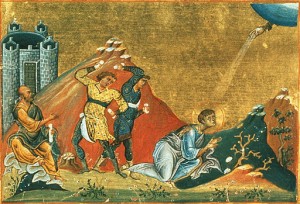
Now Stephen, a man full of God’s grace and power, performed great wonders and signs among the people. Opposition arose, however, from members of the Synagogue of the Freedmen (as it was called)—Jews of Cyrene and Alexandria as well as the provinces of Cilicia and Asia—who began to argue with Stephen. But they could not stand up against the wisdom the Spirit gave him as he spoke.
Then they secretly persuaded some men to say, “We have heard Stephen speak blasphemous words against Moses and against God.”
So they stirred up the people and the elders and the teachers of the law. They seized Stephen and brought him before the Sanhedrin. They produced false witnesses, who testified, “This fellow never stops speaking against this holy place and against the law. For we have heard him say that this Jesus of Nazareth will destroy this place and change the customs Moses handed down to us.”
All who were sitting in the Sanhedrin looked intently at Stephen, and they saw that his face was like the face of an angel. (New International Version)
Stephen was a squeaky clean guy – ethical, upright, above board, honest, spiritual – and a profoundly wise and devoted follower of Jesus. Because of his integrity, Stephen was acutely attuned to systemic evil in all its insidious institutional forms; alert and wise to the sinful nature of humanity; and aware of the devil’s evil intentions and machinations in the world.
And because Stephen had a well-developed Christian spirituality, it put him on the radar of the world, the flesh, and the devil – and ended up getting him killed as the first Christian martyr.
The big three enemies of every Christian are:
- a sinful world system (1 John 2:15-16)
- the inherent sinful nature (Ephesians 4:22)
- the devil, who seeks to exploit the world and the sinful nature to tempt and move us into rebellion against God (1 Peter 5:8-9)
However, the good news of Christianity is that Jesus Christ has obtained deliverance and freedom for people from each of those enemies. For this deliverance and freedom to be a practical reality in daily experience, each believer in Jesus must know and practice the truth.
In the original Fall of humanity, there was a passive response to the temptation of the serpent, along with an acceptance of doubt concerning God’s Word. There was also an acceptance of insinuations concerning God’s goodness and wisdom, and a deliberate choice to follow the suggestions of Satan and disobey God.
The seriousness of that Fall into disobedience cannot be overemphasized. The Fall introduced the dimensions of sin, lust, depravity, slavery, ignorance, death and every form of evil into the human race. People became alienated from God and enslaved to the devil.
The final effects of this sinful bondage will not be completely severed until the final judgment. The hold of the devil is so profound that it took the death and resurrection of Jesus Christ to break that hold and make it possible for humanity to be redeemed.
The descriptive titles given to Satan indicate his activity and what he is up to:
- Tempter (Matthew 4:3)
- Deceiver (Revelation 12:9)
- Accuser (Revelation 12:10)
- Adversary (1 Peter 5:8)
- Murderer and Liar (John 8:44)
- The god of this world (Ephesians 2:2)
Holy Scripture indicates that people can be significantly influenced – both personally and corporately – by Satan through:
- giving the devil a foothold (Ephesians 4:27)
- lying (Acts 5:3)
- physical and spiritual attacks (Job 1-2; 2 Corinthians 12:7)
- deception (Revelation 12:9-10; 2 Corinthians 11:3)
- temptation (1 Corinthians 7:5; 1 Thessalonians 3:5)
- pride (1 Timothy 3:6)
- corruption (2 Corinthians 11:3)
- accusations (Revelation 12:10)
- hypocrisy (Acts 5:1-11)
People ignore the activity of Satan at their peril.
Just like the religious leaders trying to keep Stephen’s mouth shut, Satan’s purpose and aim is to keep each and every person from spiritual progress and maturity, and from the daily experience of living in faith, hope, and love.
Unfortunately, the evidence of Satan’s success is all around us, even in the church. Whenever well-meaning Christians experience difficulty in prayer, in reading Scripture, in living for Christ, in overcoming sins, and in maintaining right fellowship with other believers, then this is a reminder of the subtle and powerful effect evil has upon us.
It is imperative that we know and understand the provision we possess in overcoming the evil one.
Basic knowledge for combating the devil is this:
- The crucifixion and resurrection the Lord Jesus Christ defeated Satan (Colossians 2:15)
- Jesus has destroyed the power of death and delivered those held in bondage (Hebrews 2:14-15)
- Christ came to this earth so that he might destroy the works of the devil (1 John 3:8)
- Through Christ’s ascension, Jesus is now seated in triumph over Satan (Ephesians 1:19-21; 2:5-6)
In order for this incredible access to become reality, there must be a complete and honest confession which repents and renounces past and present sins.
If we confess our sins, he is faithful and just and will forgive us our sins and purify us from all unrighteousness.
1 John 1:9, NIV
There must be a complete and honest obedience to God in faith, hope, and love by standing with the truth (Ephesians 6:10-18); and there also needs to be an aggressive resistance of the work of Satan through constant vigilance by being rooted and established in truth. (1 Peter 5:8-9)
If you feel guilty, but don’t know what you’ve done or why you feel this way, then be aggressive about rejecting it.
If you accuse yourself (“If you were really a Christian you would not be thinking a thought like that…”) then be pugnacious about refusing it.
If your thoughts, emotions, and desires threaten to get out of hand – then take charge of them and bring them into subjection to Jesus – because you have the authority of Christ’s death, resurrection, and ascension behind you to reject and refuse all error and every satanic whisper.
Know the enemy’s lies and deceptions. Be hawkish about dealing with false guilt and unwarranted shame according to the truth of the gospel.
Do not attempt to always do this alone; you are not an army of one. Seek the help and assistance of others who will, along with you, pray and practice the truth.
This is the sort of wisdom Stephen teaches us. So, let us learn from him and submit ourselves to the truth we know.
Almighty God, in you are hidden all the treasures of wisdom and knowledge. Open our eyes that we may see the wonders of your Word; and give us grace that we may clearly understand and freely choose the way of your wisdom; through Christ our Lord. Amen.


 Rev. Tim Ehrhardt