Psalm 126 – Planting in Tears and Harvesting with Joy

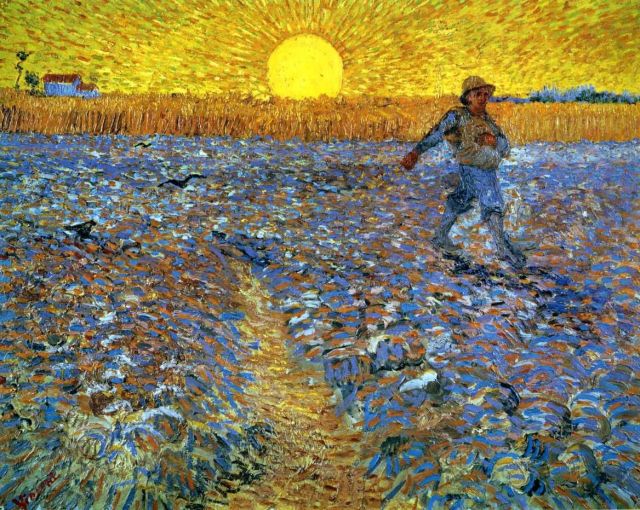
The Sower, by Vincent Van Gogh, 1881

When the Lord brought back his exiles to Jerusalem,
    it was like a dream!
We were filled with laughter,
    and we sang for joy.
And the other nations said,
    “What amazing things the Lord has done for them.”
Yes, the Lord has done amazing things for us!
    What joy!

Restore our fortunes, Lord,
    as streams renew the desert.
Those who plant in tears
    will harvest with shouts of joy.
They weep as they go to plant their seed,
    but they sing as they return with the harvest. (New Living Translation)

Many people are familiar with the phrase, “You reap what you sow.” Although the saying is typically referred to in the context of avoiding poor decisions (Galatians 6:7) the principle is woven throughout Holy Scripture in other scenarios, as well, as it is in today’s psalm.  

Sowing and reaping are, of course, agricultural terms. Farmers and gardeners tend to the soil through tilling, planting, cultivating, weeding, and eventually harvesting. The images of farming and the growth of plants serve as fitting metaphors for the spiritual life. Growth does not occur quickly. Instead, constant and vigilant attention to one’s spirit eventually brings a harvest of good works and godly attitudes. 

Jesus said, “My food is to do what the one who sent me wants me to do. My food is to finish the work that he gave me to do.” (John 4:34, ERV)

In a culture which values immediacy and having things now, the slow growth of the spiritual life can be a difficult principle to grasp. We may think that whenever we sin – with no immediate lightning to zap us – that therefore what we did must not have been so bad. 

Eventually, however, our implanted seeds will sprout and become visible to all. Conversely, we might believe whenever we dedicate ourselves to altruistic service, and then see no immediate results, that we must be doing something wrong. So, we may easily become discouraged and give up.

Sow for yourselves righteousness; reap steadfast love. Break up your fallow ground; for it is time to seek the Lord, that he may come and rain righteousness upon you. (Hosea 10:12, NRSV)

The psalmist reminds us of the need for patience. Just as it takes continual watering to reap a harvest in the field, so the Christian’s life of weeping and tears, of tilling deeply into the things of God, is the necessary work to eventually spot a sprout, see growth, and finally bear fruit. 

The tedious cultivating and weeding of our souls is the task before us. If we are patient and consistent, we will realize a harvest of righteousness. 
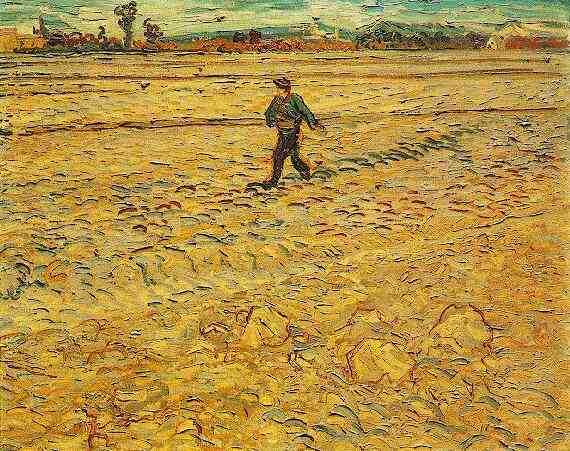
The Sower, by Vincent Van Gogh, 1888

Jesus taught his Beatitudes to help us understand that righteousness, peace, and joy come through connecting with our poverty of spirit; mourning over personal and corporate sin; embracing humility and meekness; hungering and thirsting after righteousness.

Only through the blood, sweat, and tears of spiritual agony will we come through to the deep happiness of seeing the Lord accomplish great things in our lives. In other words, joy is neither cheap nor easy. It is the fruit of many tears.

Spiritual farming involves sound practices of sowing and reaping. There is suffering before glory, tears before joy, lament before healing.

Just as a farmer cannot take short-cuts in the planting and cultivating process if he wants to have a bounteous and delicious harvest, so there is no getting around the painful work of grieving our changes and losses.

Avoiding the hard work of spiritual farming leads to a bogus harvest where we bite into a fresh ear of sweet corn only to discover a mouthful of worms.

Remember this: The person who plants a little will have a small harvest, but the person who plants a lot will have a big harvest.

2 Corinthians 9:6, NCV

The bulk of our lives are played out in the liminal space between sowing and reaping. The farmer plants and waits, attentive to the land and the weather until the time of harvest. We, too, exist in a time of patience. So, we pray, recalling past harvests and anticipate that with God’s good help, we will enjoy abundance.

This in-between time is often characterized by tears.

As she stood behind him at his feet weeping, she began to wet his feet with her tears. Then she wiped them with her hair, kissed them and poured perfume on them. (Luke 7:38, NIV)

I grew up on an Iowa farm. I only saw my father cry twice in my life. The first time, I was just a boy, two days after my eighth birthday – a devastating hailstorm destroyed the crops that had been planted just six weeks before. Despite farm equipment and technological savvy, the farmer is still at the mercy of the weather.

And we will always be at the mercy of God. Because God is good, just, and fair, the Lord does great and benevolent things. To be blessed, we need to embrace the dog days of summer in all its banality and its tears until we reach the time of reaping. There is joy, and it is coming, if we do the work of spiritual farming and wait patiently.

Likely, none of us awake in the morning, sit up on the edge of the bed, and say to ourselves, “Well, let’s see, I think I’ll cry and be sorrowful today.” We might do that with joy, but not with sadness. It can be easier to gravitate toward the fulfillment of dreams, laughter, and happiness than tears and weeping.

Yet, if we want to experience authentic joy, the path to it is through crying because it is our tears which find a better way.

“Normality is a paved road: It’s comfortable to walk, but no flowers grow on it.”

Vincent Van Gogh

Whether it comes from a certain denominational tradition, ethnic background, or family of origin dynamics, there are many Christians who love to emphasize Jesus as Victor and camp in resurrection power – while eschewing Christ as the man of sorrows, acquainted with grief and sadness.

By viewing only one dimension of Christ’s redemptive work, pastoral care often falls far short of true help. Trying to engineer cheerfulness and create solutions to a person’s genuine grief is, at best, not helpful, and at worst, damaging to their soul. It only leads to cheap inauthentic joy.

Sincerely singing spontaneous songs of joy, with a sense of abundant satisfaction, comes through suffering and sorrow. There must be a crucifixion before there is a resurrection. In the agrarian culture of ancient Israel, the metaphor of sowing a reaping connected well to the importance of planting tears and allowing them to flower later into an abundant harvest of joy.

Perhaps in contemporary American culture, a more apt metaphor would be financial investing and cashing out. The investment we put into attending to our grief with expressions of lament through tears, will eventually get a return, and we shall be able to cash out with a rich bounty of joy.

Easter is coming. Resurrection and new life will occur. The journey of Lent, with seeds repentance carefully planted, watered with tears, shall bring an abundant harvest of joy.

Gratias Deo. Thanks be to God.

Psalm 118:26-29 – A Guided Meditation into Gratitude

Blessed is the one who comes in the name of the Lord.
    We bless you from the house of the Lord.
The Lord is God,
    and he has given us light.
Bind the festal procession with branches,
    up to the horns of the altar.

You are my God, and I will give thanks to you;
    you are my God, I will extol you.

O give thanks to the Lord, for he is good,
    for his steadfast love endures forever
. (New Revised Standard Version)

Today, take some meditative time to connect with the Lord. Allow yourself some space and grace to meaningfully get in touch with God and your own deep spirituality.

Make yourself comfortable… either sit down, stand outdoors, or recline in your favorite easy chair…. whatever posture helps you relax and relate to God.

Take several deep breaths in and out…

Give yourself permission right now to focus on your relationship with the Lord…

Make God and you a priority…

There is nowhere else you need to be…

You are deserving of this time…

If you get distracted by a thought or sound, simply acknowledge that it occurred and release it. Do not allow it to take you away from this time. For the next several minutes, focus on you and your God….

Imagine you are a kernel of corn, snuggled in the ground…

Although you are small, the Lord has given you everything you need within yourself to become a tall stalk with many ears of corn…

Breathe in, feeling your lungs expand as you inhale… and as you breathe out and exhale, stretch your arms slowly over your head, as if you are breaking the ground…

Slowly bring your arms down…

Lift your face toward heaven…

Imagine feeling the warmth of the sun and the light of God upon you… basking in the Lord’s grace for you…

Feel the refreshment of a gentle rain from heaven falling on you… giving you God’s steadfast love…

Sense your created self and all the potential within coming out… growing… lifting toward the immense sky of the Lord’s favor…

See yourself standing as a nine-foot tall stalk with multiple ears of corn…

Bask in the reality that you are a gift to a hungry world… that you are blessed to be on this earth, and to be a blessing to many… know that you are enough and express your gratitude to God using the following practice:

Look around you. Identify and name:

5 things you see…

4 things you feel…

3 things you hear…

2 things you smell…

1 thing you taste…

Express your thanks to the Lord for each of those things you identified.

End your time by slowly saying out loud with flavor:

You are my God, and I will give thanks to you;
    you are my God, I will extol you.

O give thanks to the Lord, for he is good,
    for his steadfast love endures forever.

Psalm 84 – Sacred Space

How lovely is your dwelling place,
    Lord of heavenly forces!
My very being longs, even yearns,
    for the Lord’s courtyards.
My heart and my body
    will rejoice out loud to the living God!

Yes, the sparrow too has found a home there;
    the swallow has found herself a nest
    where she can lay her young beside your altars,
    Lord of heavenly forces, my king, my God!
Those who live in your house are happy;
    they praise you constantly.

Those who put their strength in you are genuinely happy;
    pilgrimage is in their hearts.
As they pass through the Baca Valley,
    they make it a spring of water.
    Yes, the early rain covers it with blessings.
They go from strength to strength,
    until they see the supreme God in Zion.
Lord God of heavenly forces,
    hear my prayer;
    listen closely, Jacob’s God! Look at our shield, God;
    pay close attention to the face of your anointed one!

Better is a single day in your courtyards
    than a thousand days anywhere else!
I would prefer to stand outside the entrance of my God’s house
    than live comfortably in the tents of the wicked!
The Lord is a sun and shield;
    God is favor and glory.
The Lord gives—doesn’t withhold! —good things
    to those who walk with integrity.
Lord of heavenly forces,
    those who trust in you are genuinely happy! (Common English Bible)

I want to be where God is.

That works out quite well, since I believe God is everywhere, anyway.

Yet, there are those special sacred spaces for us, and holy places where we especially sense and perceive a connection with the divine.

That’s why the psalmist’s heart was set on the pilgrim’s way. He was longing for the chance to go to that sacred place of basking in spiritual grace.

I know the feeling. There are times when I begin itching to go to a particular place, a hermitage, which I try to get away to, at least once a year. In 2020, with the coronavirus raging, that didn’t happen. And now, this year, with so many current responsibilities, I’m not sure when it’s going to happen. Yet, happen it must.

Even though we don’t always have the opportunity in traveling to a sacred site, having small spaces set aside just for divine connection can make a real difference. After all, we don’t need to walk a thousand miles to a grand cathedral in order to meet that deep spiritual need. It could be as simple as walking a few steps to a special chair, perhaps with small rituals of lighting a candle or incense, playing contemplative music, and/or having objects, such as a cross, which enables us to enter that connection with God.

“Your sacred space is where you can find yourself again and again.”

Joseph Campbell

Unhappiness can settle in rather quickly when we go for long stretches without a break, not properly attending to our spirit in special ways. Loneliness, and feeling as if no one understands, are normal responses when there is disconnection.

Unfortunately, we aren’t always aware of what’s happening within us. Then, all of a sudden, we wake up – as if having been in the lower deck of a boat – and discover we are in the middle of the sea, unable to see the land. The disconnection becomes palpable.

I strongly urge walking. It has more than physical benefits. The spirit also needs some movement to remain healthy and happy. Do a pilgrimage around your neighborhood of prayer walking, or purposely trying to notice things you’ve never seen before. If limited, do what you can. Even a stroll around the living room can have a therapeutic effect.

The point is to have a sense of God’s presence. For the psalmist, it was taking the journey to Jerusalem, ascending the temple mount, along with other worshipers, praying and singing along the way. It was about enjoying the process of getting to the temple, reveling in the experience of being in the temple, and descending the mount with a heartful of peaceful satisfaction – knowing that, deep down, everything is going to be okay because God is with me.

Just a single day in the sacred space is better than a thousand days elsewhere. I picture it something like enjoying those rare days when our girls and their families, with grandkids and dogs in tow, are with my wife and I for a meal. It doesn’t happen often. Yet, when it does, all the loud hubbub becomes sacred time. I take off my shoes because I realize I’m on holy ground.

Indeed, all of life is sacred and holy. And yet, those special times and places help us remember how sacred and holy life really is.

Just as good nutrition, hygiene, diet, and exercise are part of the continuum of care for the body, a personal sacred space for prayer, meditation and spiritual thought is part of the spiritual self-care that can enrich and support our practices of regular worship within a community of faith, as well as service to the world.

And we must never lose sight that the most sacred space we each have to maintain is our own heart, where the light and life of Christ resides. The fruit of the Spirit come from a humble life surrendered to God’s guidance and healing. That can happen as we visit sacred places and create sacred spaces in our lives.

Lord, let me dwell for a moment on your life-giving presence. I open my heart to you. I can tell you everything that troubles me. I know you care about all the concerns in my life. Teach me to live in the knowledge that you care for me today, will care for me tomorrow, and all the days of my life. Amen.

Genesis 1:1-19 – It Is So, and It is Good

Day When God Created the Flowers by Unknown artist

In the beginning when God created the heavens and the earth, the earth was a formless void and darkness covered the face of the deep, while a wind from God swept over the face of the waters. Then God said, “Let there be light”; and there was light. And God saw that the light was good; and God separated the light from the darkness. God called the light Day, and the darkness he called Night. And there was evening and there was morning, the first day.

And God said, “Let there be a dome in the midst of the waters, and let it separate the waters from the waters.” So, God made the dome and separated the waters that were under the dome from the waters that were above the dome. And it was so. God called the dome Sky. And there was evening and there was morning, the second day.

And God said, “Let the waters under the sky be gathered together into one place, and let the dry land appear.” And it was so.God called the dry land Earth, and the waters that were gathered he called Seas. And God saw that it was good. Then God said, “Let the earth put forth vegetation: plants yielding seed, and fruit trees of every kind on earth that bear fruit with the seed in it.” And it was so. The earth brought forth vegetation: plants yielding seed of every kind, and trees of every kind bearing fruit with the seed in it. And God saw that it was good. And there was evening and there was morning, the third day.

And God said, “Let there be lights in the dome of the sky to separate the day from the night; and let them be for signs and for seasons and for days and years and let them be lights in the dome of the sky to give light upon the earth.” And it was so. God made the two great lights—the greater light to rule the day and the lesser light to rule the night—and the stars. God set them in the dome of the sky to give light upon the earth, to rule over the day and over the night, and to separate the light from the darkness. And God saw that it was good. And there was evening and there was morning, the fourth day. (NRSV)

There is so much which could be said about the opening of Holy Scripture, the first verses of the Old Testament book of Genesis. And much already has been said. I merely want to make one observation of the text and discuss its significant import for us….

God already had within himself everything needed to create.

“Duh,” you might say, “It’s God.” Yes, and we need to unpack what that means. I will phrase it a different way….

God called forth that which is already there.

The opening statement of Genesis is there to communicate a wonderful reality – that the Lord brought order from chaos. God took what was potential and actualized it. And the Lord gave us understanding through creation to discern what is happening….

Seeds are amazing. They have the potential to totally transform from tiny objects to large plants. Perhaps we take seeds for granted because we see the evidence of them everywhere. Yet, like God at creation, a seed already has within itself everything it needs to germinate, take root, break the ground, grow, and produce fruit. The end process of the seed’s maturation looks nothing like when it started as a tiny little kernel.

The seed simply needs to be called forth with the conditions of good soil and proper amounts of sunshine and water. The seed lacks nothing inherent to its very being. It already has everything it needs within itself.

We are creatures, called forth from the earth by God. Each one of us, no matter who we are, where we have come from, whether male or female, rich or poor, black or white, introvert or extrovert, happy or depressed, privileged or underprivileged, already have everything we need within ourselves to grow, thrive, mature, and flourish in this world. In other words, we lack nothing. We are not flawed. We are enough.

We are already spiritual. Our spirituality is as much a part of our DNA as our biological self. We just need the proper conditions to grow.

Sometimes when I meet a person for the first time and it is discovered I’m a pastor and a chaplain, they immediately believe that what I do is put religion into folks – as if people lack something that I must give them.

However, just the opposite is true of what I really do. I simply call forth the spiritual nature which is already present in a person. Many individuals are not aware of who they are, unaware of the magnanimous spirit which resides within them, a resilient and loving spirit which is there to support them just as much as their literal physical spine.

“If you treat people as they appear to be, you make them worse than they are. But if you treat another as if he already were what he potentially could be, you make him what he should be.”

Johann Wolfgang von Goethe

Let there be people who see beyond the five senses and embrace the sixth sense of knowing the inherent worth and majesty of humanity.

Let there be those who discern the potential of chaotic minds and hearts to become calm and rightly ordered around the love of God.

Let there be believers who embody light in all their relational dealings and are unafraid to face the darkness within.

Let there be compassionate ones who awash others with living water.

Let there be leaders who patiently and tediously tend to the garden of people’s souls, providing the proper conditions for spiritual growth and maturation.

Let us all call forth the good in one another, for God created and called us, “good.”

And that is our name: “Good.”