

Overwhelmed with Grief (Jeremiah 20:14-18)

Cursed be the day
    on which I was born!
The day when my mother bore me,
    let it not be blessed!
Cursed be the man
    who brought the news to my father, saying,
“A child is born to you, a son,”
    making him very glad.
Let that man be like the cities
    that the Lord overthrew without pity;
let him hear a cry in the morning
    and an alarm at noon,
because he did not kill me in the womb;
    so my mother would have been my grave
    and her womb forever pregnant.
Why did I come forth from the womb
    to see toil and sorrow
    and spend my days in shame? (New Revised Standard Version)

Perhaps you feel as though you must put on a good face, a decent front for others to see. It could be that you don’t like other people seeing you upset or cry because it can be embarrassing. Maybe you believe others don’t need to be burdened with your sadness. The last thing you want is to be a killjoy.

Sometimes you might even put up a front with God. Maybe you think God wants everyone to be perpetually happy and always sing with the birds in blissful joy and gladness, or whistle while you work. However, that would not be an accurate view of God.

One of the most faithful people in Holy Scripture, Jeremiah, freely and unabashedly lamented before God – to the point of wishing he were dead. Jeremiah, the incredible prophet of God, closer to the Lord than anyone of his generation, was so despondent and ashamed that he wished he had never even born. The suffering and the shame were just too overwhelming.

To say that Jeremiah had a difficult ministry is a gross understatement. He literally had the ministry from hell, prophesying to people who neither liked him, nor his message to them. In the middle of it all, Jeremiah threw up his hands and let out his complaint to God. Jeremiah was in such ministerial misery that he wished he had been a stillborn baby.

Lest you think Jeremiah was sinfully depressed or just cuckoo, he is far from alone in the Bible. King David had no scruples about letting God know how he felt about his dire circumstances. Job, likely the most famous sufferer of all, spent time doing nothing but lamenting his terrible losses for months. What all three of them have in common is that they openly grieved with great tears, yet neither cursed God nor forsook the Lord.

Lamentation is the sacred space between intense grieving to God without blaming the Lord for our significant changes and losses in life. I would even argue that lamenting and grieving before God is a necessary spiritual practice which needs full recognition in the Body of Christ. Please sit with that last statement for a bit and consider how it might become a reality in your own life and context.

Grief can and does attach itself to any change or loss. It is the normal emotional, spiritual, physical, and relational reaction to that injury of the heart. There is only one way through grief. We must tell our story to another. It is both biblical and quite necessary.

Bear one another’s burdens, and in this way you will fulfill the law of Christ.

Galatians 6:2, NRSV

We need our own spirituality to support us in such times – not drive us away through a misguided theology of believing you must keep a stiff upper lip. It is critical to have safe and supportive persons in our lives when going through overwhelming circumstances.

“Spirituality is recognizing and celebrating that we are all inextricably connected to each other by a power greater than all of us, and that our connection to that power and to one another is grounded in love and compassion.”

Brené Brown

Our tears are holy. They are not the mark of weakness, but of power. The prophet Jeremiah was doing a very godly thing in expressing his grief. And Jeremiah’s lament is what helped steel him for the several attempts on his life that he faced.

Let the tears do their intended work in your life.

God of all, you feel deeply about a great many things. As your people, we also feel a great depth of emotion when our lives go horribly awry from our dreams and expectations. Hear our lament as we pour out our grief before you, through Jesus, our Savior, with the presence of the Holy Spirit. Amen.

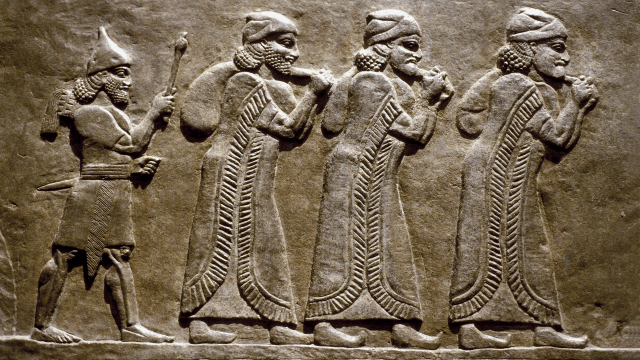
God Is Good, Idols Are Bad (2 Kings 17:7-20)

 An Assyrian solider deporting people from their land (From the Southwest Palace of Tiglath-Pileser III at Nimrud, ca. 730-727 B.C.E.; British Museum.)

The Israelites sinned against the Lord their God, who brought them out of Egypt and rescued them from the power of Pharaoh (the king of Egypt). They worshiped other gods and lived by the customs of the nations that the Lord had forced out of the Israelites’ way. They also did what their kings wanted them to do.The Israelites secretly did things against the Lord their God that weren’t right:

They built for themselves illegal places of worship in all of their cities, from the smallest watchtower to the largest fortified city.

They set up sacred stones and poles dedicated to the goddess Asherah on every high hill and under every large tree.

At all the illegal places of worship, they sacrificed in the same way as the nations that the Lord had removed from the land ahead of them.

They did evil things and made the Lord furious.

They served idols, although the Lord had said, “Never do this.”

The Lord had warned Israel and Judah through every kind of prophet and seer, “Turn from your evil ways, and obey my commands and decrees as I commanded your ancestors in all my teachings, the commands I sent to you through my servants the prophets.” But they refused to listen. They became as impossible to deal with as their ancestors who refused to trust the Lord their God. They rejected his decrees, the promise he made to their ancestors, and the warnings he had given them. They went after worthless idols and became as worthless as the idols. They behaved like the nations around them, although the Lord had commanded them not to do that. They abandoned all the commands of the Lord their God:

They made two calves out of cast metal.

They made a pole dedicated to the goddess Asherah.

They prayed to the entire army of heaven.

They worshiped Baal.

They sacrificed their sons and daughters by burning them alive.

They practiced black magic and cast evil spells.

They sold themselves by doing what the Lord considered evil, and they made him furious.

The Lord became so angry with Israel that he removed them from his sight. Only the tribe of Judah was left. Even Judah didn’t obey the commands of the Lord their God but lived according to Israel’s customs. So the Lord rejected all of Israel’s descendants, made them suffer, handed them over to those who looted their property, and finally turned away from Israel. (God’s Word Translation)

The Flight of the Prisoners, by James Tissot, 1898, depicting the Babylonian exile from Jerusalem

The prophets had warned the northern kingdom of Israel; but they did not listen, nor did they heed the prophetic utterance. Israel then stood as an example and a warning to the southern kingdom of Judah; yet they, too, refused to learn from their brother’s downfall.

And even before the kingdom was split between Israel in the north and Judah in the south, the ancient Israelites had a troubling tendency to buck the Lord’s instructions and find other more and creative ways of expressing themselves spiritually.

Every generation of people are responsible for their own spirituality and their own actions in life. We, in our contemporary time and place, need to learn the lessons of the past – for we also are not an exception in history, as if we can do whatever we want without attending to the common good of all persons and worshiping in any sort of way we want.

The trouble with the ancient worshipers of Yahweh is that they decided to pick and choose whatever commands they wanted to follow, or not. They went through continual times of idolatry and forgot about God and God’s Word to them.

To respect and revere the Lord is to obey God’s instructions. To worship Yahweh is to have an undivided allegiance to God and God’s commands. The failure to obey is really a failure of faith.

The prophets Amos, Hosea, Micah, and Isaiah specifically called out the sinful practices of the people and their negligence in upholding basic social and economic justice for everyone. They condemned violence and oppression of the poor; and expressed the divine displeasure with taking advantage of the disadvantaged.

How to treat people and live well were explicitly spelled out in the entirety of God’s Law. Yet, the leaders and the people, as a whole, decided to go another way. They kept introducing idolatrous and unhealthy forms of worship and living. And it led to their ruin.

The ancient people were continually offered grace if they would only accept it. They could return to the Lord and come back to the true worship and obedience of the God who had rescued them from trouble again and again. Turning from their unholy practices, and turning back to Yahweh, would reverse God’s impending judgment. Yet, tragically, the people did not listen.

Idolatry is a failure to trust God, and to rely instead on something else which is not able to sustain a life. Unfortunately, those who create a god according to their own liking end up becoming like the thing they worship, that is, worthless.

The tragedy of the Israelites is that they were to be God’s people, the Lord’s treasured possession, a kingdom of priests, and a holy nation which brings blessing to the earth. Instead, they traded their meaning and purpose in life to imitate everyone else around them.

Sadly, people have felt throughout history, and even we ourselves today, that there is something else, other than God, that we need in order to be happy – something more important to your heart than the Lord – whether it is human acceptance and approval, social reputation, political power and control, or financial advantage and privilege.

Idolatry creates an ignoring of the divine in our life. We might even have the chutzpah to think we can challenge God, like some small yippee pup who growls and takes on the big dog, who knows that with an effortless paw across the body, could toss the prideful pup away.

Like a mother bird who scours the land for food to sustain the babies, and brings it back to their gaping mouths, God longs to provide us with a good and beautiful life – if we will but only receive it.

Listen, my people, I’m warning you!
    If only you would listen to me, Israel.
There must be no foreign god among you.
    You must not bow down to any strange deity.
I am the Lord your God,
    who brought you up from Egypt’s land.
    Open your mouth wide—I will fill it up! (Psalm 81:8-10, CEB)

O Lord, as you gave us the greatest commandment, to love you with all our heart, soul, strength and mind, help us to love you above all else, putting you above the potential idols in our lives, including success, fame and wealth. May your benevolent kingdom come, and your moral and ethical will be done, here on this earth for this time, as it is always done in your heaven. Amen.

It Just Won’t Do… (Psalm 16)

Protect me, Lord God!
    I run to you for safety,
and I have said,
    “Only you are my Lord!
Every good thing I have
    is a gift from you.”

Your people are wonderful,
    and they make me happy,
but worshipers of other gods
    will have much sorrow.
I refuse to offer sacrifices
of blood to those gods
    or worship in their name.

You, Lord, are all I want!
You are my choice,
    and you keep me safe.
You make my life pleasant,
    and my future is bright.

I praise you, Lord,
    for being my guide.
Even in the darkest night,
    your teachings fill my mind.
I will always look to you,
as you stand beside me
    and protect me from fear.
With all my heart,
I will celebrate,
    and I can safely rest.

I am your chosen one.
You won’t leave me in the grave
    or let my body decay.
You have shown me
    the path to life,
and you make me glad
    by being near to me.
Sitting at your right side,
    I will always be joyful. (Contemporary English Version)

The psalmist is profoundly glad to be with God and God’s people – but not with worshipers of other gods.

We live in an age where there are many people who are glad about God – they have a deep sense of spirituality and rely upon prayer. But they are not at all glad about the church or any sort of organized religion. They want nothing to do with it.

Why? Because they’ve had a bad, even traumatic, experience with gathered worshipers. Their experience has been one of observing worshipers offer blood sacrifices to a god they aren’t familiar with.

Unfortunately, the spiritually wounded are walking among us, too numerous to count. And this is mostly why church attendance in the Western world has dropped precipitously. After all, nobody wants to be a part of something where a pastor or priest preys upon innocent people; where a congregation seeks more people just to get money for their building; or where the people justify hate toward others in the name of religion.

I don’t want that either. Namely, because I have seen and experienced those things myself within various faith communities. Persons who know me well have sometimes expressed, “Why do you keep pastoring churches? Why put yourself in that position again and again?” For me, it’s a simple, yet heartfelt answer. I typically respond with sincerity, “The church is a whore, but I still love her.”

For me, it won’t do to simply retreat into a privatized religion and forget about the church and God’s people; Christianity is communal, not just personal. I can no more forsake the family of God and my spiritual DNA any more than I could deny my family of origin and my biological DNA.

I’m not suggesting that any of us put up with bad behavior and folks acting like a stupid cow instead of a person. Instead, I am insisting that a well-rounded worship of God requires the individual to be intimately connected with a community of redeemed persons.

Holy Scripture knows nothing of a solitary independent believer who has no links to God’s people. And, I might add, it just won’t do to have a virtual social media presence but never actually interact with people in the flesh. That’s not old fashioned; it’s biblical wisdom.

At some point, we must trust God. If we put our life out there by driving on a highway every day; and if we take risks with investing money or starting something new; then it only makes spiritual sense that we also trust God to take care of us and protect us in dealing with not only the world, but also with the church and God’s people.

We might believe that joy comes from getting everything we want, or being alone and living as a hermit in the woods, or surrounding ourselves with animals instead of people; yet, we were created by God for community, and so, we shall only find joy in the context of community.

The path to death is littered with the remains of people who thought that separation from others (or particular persons) was the path to life. The forces of darkness still use the tactic of divide and conquer because it works. But if God’s people focus on what unites us, and we choose to lock arms in love, no matter what, we will learn that the hard path of life is worth it.

It won’t do, for church folk to belittle others who have run from organized religion; and conversely, it won’t do, for those far from the community, to play armchair quarterback and criticize everything the church does.

We really need to open our clenched fists of ensconced hermeneutical approaches, pet preachers, beloved programs, isolationist ways, heady cerebral thoughts, and petty pride, so that we can then hold hands with our sisters and brothers in humble trust and faith.

In this Christian season of Eastertide, we have the perspective of understanding that it takes a cross to have a resurrection, that there must be suffering before glory, and that sorrow always precedes joy. We now need to take the next step, by a willingness to put in the blood, sweat, and tears necessary for both a good relationship with God and a robustly helpful relationship with God’s people.

So, what will you choose? And what will you do?

God of all, we pray as one, that we may be one, just as the Lord Jesus prayed we may be one in him. Your son Jesus compels us to be reconciled to one another. May our spirits be joined to your Holy Spirit, so that we may witness to the visible unity of your Church. May we all recognize that we are truly one with you – Father, Son, and Holy Spirit – and grow together in peace. We ask this in the name of Jesus our risen Lord. Amen.

Listen! (Psalm 81)

Shout for joy to God our defender;
    sing praise to the God of Jacob!
Start the music and beat the tambourines;
    play pleasant music on the harps and the lyres.
Blow the trumpet for the festival,
    when the moon is new and when the moon is full.
This is the law in Israel,
    an order from the God of Jacob.
He gave it to the people of Israel
    when he attacked the land of Egypt.

I hear an unknown voice saying,
“I took the burdens off your backs;
    I let you put down your loads of bricks.
When you were in trouble, you called to me, and I saved you.
    From my hiding place in the storm, I answered you.
    I put you to the test at the springs of Meribah.
Listen, my people, to my warning;
    Israel, how I wish you would listen to me!
You must never worship another god.
I am the Lord your God,
    who brought you out of Egypt.
Open your mouth, and I will feed you.

“But my people would not listen to me;
    Israel would not obey me.
So I let them go their stubborn ways
    and do whatever they wanted.
How I wish my people would listen to me;
    how I wish they would obey me!
I would quickly defeat their enemies
    and conquer all their foes.
Those who hate me would bow in fear before me;
    their punishment would last forever.
But I would feed you with the finest wheat
    and satisfy you with wild honey.” (Good News Translation)

I have a wife and three daughters. They talk – a lot! When my girls were small, it was hard to get their attention long enough for them to hear anything I was saying. So I oftentimes cupped my hands to their little faces so they couldn’t look around and get distracted. Then, I would speak, with them looking me straight in the eye.

It’s hard to listen. And listening seems to be a lost art and a skill we no longer care to develop. Maybe that’s because we’re obsessed with hearing ourselves talk. There’s so much chatter about so many things that we rarely even remember much of what we said; and a lot of those words get uttered before we even think. 

What’s more, when other people talk, most of it seems like a bunch of gibberish, due to our lack of focused attention. Perhaps we need an adult version of the hand-cupping we do with kids.

We really need the wisdom to know when to speak and when to be quiet. Whenever being quiet is required, it’s for the purpose of listening. And whenever words and noise are needed, it’s to praise God with our mouths and our musical instruments.

In this day and age, folks get so worked up to express their opinions, and say what they want to say, that the virtue of listening is not at all valued. However, God puts a premium on taking the stance of listening. 

The more you talk, the more likely you are to sin. If you are wise, you will keep quiet. (Proverbs 10:19, GNT)

Another reason listening is not well-practiced is that we esteem being busy and constant activity, to such a degree, that taking the time for silence long enough to listen is not of value to us. But if God’s people are going to hear the voice of the Lord, we must be still and silent, long enough to listen to what’s being said to us.

And yet another reason we eschew listening is that we are uncomfortable with silence, and seek to fill any quiet space with noise so as to not have to deal with what is really going on inside of us. Since God often speaks within the stillness and quietness of things, we’ll never hear, because our inner dialogue is drowning the words we need to listen to. (1 Kings 19:11-12)

I have a friend (I’ll call him Elmer) who spent eighteen hours in complete silence, without any talking whatsoever, in order to listen to God. You might think that Elmer is a monkish sort of introvert who likes that sort of thing. However, he’s actually an extrovert who lives in the inner city and comes from a large family. 

Elmer simply came to the point of understanding that he was so busy moving from one thing to another, and constantly talking, to the point that he was drowning-out the voice of the Lord. Here’s what Elmer said about his time of silence: 

“Those eighteen hours of silence were the loudest hours I have ever experienced. My mind was so noisy and so filled with stuff that it nearly drove me nuts. But after many hours passed, as the noise started to fade away, I could begin to hear the still small voice of God.” 

Elmer discovered that he was a person who kept pushing and projecting his agenda onto God. His lack of listening led to an inability to obey. After Elmer’s experience, he determined to start including times of solitude and silence into his everyday life, even if for only ten minutes, so he could listen to what God wants rather than tell God what to do.

The Lord came and stood there, and called as he had before, “Samuel! Samuel!” Samuel answered, “Speak; your servant is listening.” (1 Samuel 3:10, GNT)

Any fool can babble on about their gripes and opinions. In Holy Scripture, however, human speech is generally viewed as being overrated. Instead, silence and solitude, listening and learning, are the virtues practiced by Jesus; the kingdom of God cannot operate without them.

Therefore, we must take up the shield of faith with which to extinguish all the flaming arrows of the evil one who wants to keep us trapped in either a cycle of constant chatter without listening, or continual silence without acting upon what we hear from God. 

We must be quiet for the purpose of listening to God. Then, when we hear the Lord speak, we must act in faith to say and do what we are called to.

God of silence and of all sound, help me to listen! Enable me to be patient and wait for your still small voice calling me. Give me attentive ears that can separate the noise from the sounds that are you. Today help me to hear you anew so that I may obey with wisdom and obedience. Amen.