How To Be Honest, Just, and Fair (Proverbs 1:1-7)

Solomon writing Proverbs by Gustave Doré (1832-1883)

The proverbs of Solomon, son of David and king of Israel.

Here are proverbs that will help you recognize wisdom and good advice, and understand sayings with deep meaning. 

They can teach you how to live intelligently and how to be honest, just, and fair. They can make an inexperienced person clever and teach young people how to be resourceful. 

These proverbs can even add to the knowledge of the wise and give guidance to the educated, so that they can understand the hidden meanings of proverbs and the problems that the wise raise.

To have knowledge, you must first have reverence for the Lord. Stupid people have no respect for wisdom and refuse to learn. (Good News Translation)

At the beginning of this year, if you like making new year’s resolutions, or are looking for a good practice to adopt, I have a suggestion: Consider committing yourself to the reading, reflection, and study of the biblical proverbs. At the least, read a chapter of Proverbs every day throughout this month. Since there are 31 chapters, and 31 days in the month of January, you have a guide in what to read every day.

The pursuit of wisdom is a noble aspiration for the New Year. One of the best places to go in that pursuit is the biblical book of Proverbs because it is all about living wisely and not foolishly. To acquire and live by wisdom means learning how to grow in being right, just, and fair in all our interactions and dealings with others.

Honest

“Honest” is “right” or “righteous.” For King Solomon of old, this is a relational term – to be righteous, to have honest and right relationships with God and other people. Righteousness involves experiencing peaceful, harmonious, and fruitful relations. 

For the Christian, right living is to know the wonderful freedom and joy of an unhindered relationship through Jesus Christ in dependence upon the Holy Spirit. When it comes to fellow human relations, a person characterized by righteousness does not, for example, let the sun go down on their anger. It is to know personal peace as well as to be a peacemaker, so that relationships do not remain strained, but enjoy harmony.

Just

“Just” is closely related to “right.” We might tend toward primarily understanding justice as a punitive act – and that is certainly a part of the term. God punishes the wicked with appropriate timing and wisdom; and deals with those who withhold righteousness and love through their uncaring, inattentive, or evil acts. 

Solomon understood justice as mostly concerned with providing a person with the necessities of life. So, for example, if someone is hungry and needs food, or does not have clean water to drink, it is a “just” act for us to provide those critical needs. God is deeply concerned for justice, and expects people to act in this same manner.

Fair

“Fair” is to be egalitarian. Fairness and equity binds righteousness and peace together by avoiding prejudice toward others and their needs. It means to not show favoritism because there is an unshakable belief in the equality of all people, no matter where they are from, what they do, or who they are.

Therefore, if we exercise righteousness and justice exclusively with individuals and groups we like, but ignore others in need, there is no fairness. To give our love and service to all persons without strings attached, or without being concerned to get paid back, is the practice of being fair in everything we do and say.

To live in the way of being honest, just, and fair in all our interactions is to be wise. Conversely, the classic fool is one who judges others, creates discord, and ranks persons according to their own personal standard of who deserves help, and who does not. Trying to have a useful and gracious conversation with a fool is like trying to reason with a toddler – you will get nowhere. 

A good way of pursuing the wise and biblical virtues of honest righteousness, restorative justice, and egalitarian fairness is to ask God to open our eyes to those within our sphere of influence who need both physical and relational needs met. Then, follow through by loving those persons for whom God brings into our lives.

Almighty God, the essence and source of wisdom, you are always right, just, and fair in all things. I praise you for your infinite and abundant wisdom.

Whereas you abound in wisdom, I am lacking. Please help me to grow in wisdom, as I increase in my knowledge and respect of your divine presence.

By means of your Spirit, please increase my depth of insight as I study your Holy Word. Hold me back from leaning on my own understanding and enable me to wholeheartedly embrace the wisdom from above.

Since you are a just God who shows no favoritism, lead me into being like you in my dealings with others through the example of Jesus Christ, in the strength of the Holy Spirit. Amen.

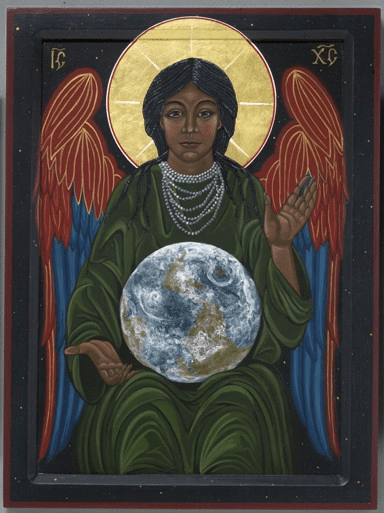
Listen to Lady Wisdom (Proverbs 9:1-12)

Sophia, Divine Wisdom, by Mary Plaster

Wisdom has built her house;
    she has set up its seven pillars.
She has prepared her meat and mixed her wine;
    she has also set her table.
She has sent out her servants, and she calls
    from the highest point of the city,
    “Let all who are simple come to my house!”
To those who have no sense she says,
    “Come, eat my food
    and drink the wine I have mixed.
Leave your simple ways and you will live;
    walk in the way of insight.”

Whoever corrects a mocker invites insults;
    whoever rebukes the wicked incurs abuse.
Do not rebuke mockers or they will hate you;
    rebuke the wise and they will love you.
Instruct the wise and they will be wiser still;
    teach the righteous and they will add to their learning.

The fear of the Lord is the beginning of wisdom,
    and knowledge of the Holy One is understanding.
For through wisdom your days will be many,
    and years will be added to your life.
If you are wise, your wisdom will reward you;
    if you are a mocker, you alone will suffer. (New International Version)

Life is full of choices. Whether we quibble about how much free will or deterministic fate a person actually has, or has not, we are still left with the ability to choose how we shall proceed and/or respond to basic life situations.

The two basic choices in life were often displayed in early film and television cartoons by having an angel on one shoulder and a devil on the other. The stereotypical portrayal helps us see that there is always a choice between good and evil.

Although our choices in life are quite personal and specific to a particular situation, the choice between good and evil is much bigger than this. It is choosing a certain way to look at the world, which then influences and informs the concrete decisions we make in life.

In our lesson for today, wisdom is personified as a lady calling out to us as people. In contrast, foolishness or folly is equally personified. The two ladies are continually speaking to us.

Lady Wisdom leads the community of sages who know how to live a right, just, and good life; she invites others to join her at the table and learn her ways. On the other hand, Lady Folly heads a group of simpletons who are driven by the passions of the moment; she easily attracts those who want cheap and easy solutions.

Wisdom’s message is a passionate appeal to take the path of insight through God’s revealed will. We are encouraged to leave empty-headed ways of thinking, and live with awareness, insight, and direction. The term “wisdom” in Scripture is the ability to apply sound biblical instruction and divine commands to concrete situations in our lives. 

For the spiritual person, especially, it is vital and imperative to daily listen to Lady Wisdom and follow her instructions.

The fact of the matter for too many people is that they are too impatient to let Lady Wisdom teach them her ways. It takes too much time, and is too hard for them. So, they turn to Lady Folly, who makes bogus promises of satisfaction without all the time and effort.

Idolatry (running toward other gods) immorality (running to victimize another) lying (running the mouth without any truth to it) and arrogance (running to get quick power and authority) often results from the inability to wait on the lessons that Lady Wisdom deeply desires to impart to us. 

Wisdom is not gained quickly; her teachings must be learned slowly with careful application over time. We are much too prone to wanting the simple solutions to complex problems that Lady Folly offers. But Lady Wisdom calls us to leave such simplistic thinking and take the high road of authenticity, self-awareness, and attention to the common good of all persons.

Therefore, rather than rushing to Google for answers to our questions; instead of allowing another person to make decisions for us; in place of implementing sheer pragmatic plans; allow Lady Wisdom to penetrate the mind and the heart so that what comes out is thoroughly good, benevolent, just, and helpful. 

And the best place to begin in starting down the road of wisdom is to give the Lord proper place in our lives. The skills for a good life gets its start through respect of God and obedience to the Lord. To truly have understanding and a wise life, one must get to know God. 

Nobody can talk themselves into wisdom, because it takes a reverent spirit, listening ears, and measured words to be able to put Lady Wisdom’s instruction into practice. There are no substitutes.

All-Wise God, the One who is never in a hurry and who is always holy, create in me a wise mind and a wise heart. Help me to sit still long enough for wisdom to bring spiritual growth and maturity to my life, through Jesus Christ my Lord, in the power of the Holy Spirit. Amen.

See the Big Picture (Genesis 41:37-57)

The proposal pleased Pharaoh and all his servants. Pharaoh said to his servants, “Can we find anyone else like this, one in whom is the spirit of God?” So Pharaoh said to Joseph, “Since God has shown you all this, there is no one so discerning and wise as you. You shall be over my house, and all my people shall order themselves as you command; only with regard to the throne will I be greater than you.” And Pharaoh said to Joseph, “See, I have set you over all the land of Egypt.” 

Removing his signet ring from his hand, Pharaoh put it on Joseph’s hand; he arrayed him in garments of fine linen and put a gold chain around his neck. He had him ride in the chariot of his second-in-command, and they cried out in front of him, “Bow the knee!” Thus he set him over all the land of Egypt. 

Moreover, Pharaoh said to Joseph, “I am Pharaoh, and without your consent no one shall lift up hand or foot in all the land of Egypt.” Pharaoh gave Joseph the name Zaphenath-paneah, and he gave him Asenath daughter of Potiphera, priest of On, as his wife. Thus Joseph gained authority over the land of Egypt.

Joseph was thirty years old when he entered the service of Pharaoh king of Egypt. And Joseph went out from the presence of Pharaoh and went through all the land of Egypt. During the seven plenteous years the earth produced abundantly. He gathered up all the food of the seven years when there was plenty in the land of Egypt and stored up food in the cities; he stored up in every city the food from the fields around it. So Joseph stored up grain in such abundance—like the sand of the sea—that he stopped measuring it; it was beyond measure.

Before the years of famine came, Joseph had two sons, whom Asenath daughter of Potiphera, priest of On, bore to him. Joseph named the firstborn Manasseh, “For,” he said, “God has made me forget all my hardship and all my father’s house.” The second he named Ephraim, “For God has made me fruitful in the land of my misfortunes.”

The seven years of plenty that prevailed in the land of Egypt came to an end, and the seven years of famine began to come, just as Joseph had said. There was famine in every country, but throughout the land of Egypt there was bread. 

When all the land of Egypt was famished, the people cried to Pharaoh for bread. Pharaoh said to all the Egyptians, “Go to Joseph; what he says to you, do.” And since the famine had spread over all the land, Joseph opened all the storehouses and sold to the Egyptians, for the famine was severe in the land of Egypt. 

Moreover, all the world came to Joseph in Egypt to buy grain, because the famine became severe throughout the world. (New Revised Standard Version)

Mosaic of Joseph overseeing the gathering of grain during the seven years of plenty, c.1275 C.E., St. Mark’s Basilica, Venice, Italy

It’s easy to get lost and miss the forest for the trees; we may become too involved in the details of a problem to look at the situation as a whole. Whenever we are in the middle of hard times, it can be difficult to see the big picture of what’s really going on.

Joseph had been in a peck of trouble. He literally found himself deep in trouble by being tossed into a dark hole of a well by his jealous brothers. Then, the same brothers turned around and pulled him up, only to sell him in slavery to a caravan heading for Egypt. (Genesis 37)

While in Egypt, Joseph became the head servant in the household of Potiphar, the captain of the guard for Pharaoh. But again, trouble found Joseph, even though the guy was diligent and squeaky clean in his moral living. Mrs. Potiphar had eyes for Joseph – who did not reciprocate her advances. There’s no wrath quite like a woman’s scorn, and off to jail Joseph went. (Genesis 39)

In prison Joseph waited… and waited. It seemed as though he had been forgotten. And although he had come to be in charge of his fellow inmates because the jail keeper trusted him so much, Joseph was still in the place of bondage. (Genesis 40) So, what would you do if you were in similar circumstances?

Blame others. Bellyache. Bully your way around with a chip on your shoulder. Become bitter about the ways you’ve been shafted and the brunt of injustice. Those are things that many of us might do in the throes of one injustice after another. But not Joseph.

Holy Scripture has no record of Joseph responding with complaint nor discouragement. Joseph seemed to have a sense that there were larger forces at work behind the scenes – that God could be trusted to work out the adverse situations for divine purposes.

So, when Joseph went from the bottom slug in a prison to the top dog in Egypt, the big picture became much more clear. From age 17 to age 30, Joseph labored as the right hand servant in charge of Potiphar’s household, and then as the right hand man to the jail keeper in prison. Now, Joseph becomes the right hand to Pharaoh, the administrator over all of Egypt.

All along, the Lord was getting Joseph ready for something supremely large – life and death sort of stuff. It turns out that, with Joseph in charge, tens of thousands of lives may have been spared because of his insight, foresight, and hindsight.

Joseph had divine insight as an interpreter of dreams – a gift which he acknowledged was given to him by God. He had the foresight and wisdom to take that insight and turn it into a solid administrative plan for saving many lives from a terrible famine. And Joseph continually had the benefit of hindsight in knowing who he was and where he came from – believing that he was part of a specially called family whom the Lord had a divine hand upon.

Every experience, each event, and the myriad mundane tasks which Joseph had to endure for 13 long years were like individual bricks being mortared together into a building which would eventually house enough life-learning to accomplish a life-saving governmental administration which kept food on the table for thousands of people.

Perhaps you and I don’t always get to see what’s going on above us, what is truly being worked out to bring help and justice to the world. Yet, we can rest assure that there is a God in heaven who sees, cares, and is planning salvation for people. And we are part of that large divine plan, if we have the faith to understand there is more going on than our present circumstances and physical eyes can see.

Righteous God and Father of all: Raise up among us people who keep faith alive, hope awakened, and love abundant. Guard our daily vocations and set them apart for your good purposes. Grant us the privilege of seeing our daily work accomplish the saving and blessing of many lives. Renew us in your mercy, sanctify us with your Spirit, and redeem our time so that we may serve you and steward well our lives, through Jesus Christ our Lord. Amen.

Listen To Lady Wisdom (Proverbs 3:13-18)

Tree of Life, by Margarita Kriebitzsch, 2013

You’re blessed when you meet Lady Wisdom,
    when you make friends with Madame Insight.
She’s worth far more than money in the bank;
    her friendship is better than a big salary.
Her value exceeds all the trappings of wealth;
    nothing you could wish for holds a candle to her.
With one hand she gives long life,
    with the other she confers recognition.
Her manner is beautiful,
    her life wonderfully complete.
She’s the very Tree of Life to those who embrace her.
    Hold her tight—and be blessed! (The Message)

I like it that the author chose to personify wisdom as a woman. Maybe that’s because I have a wife and three daughters. Perhaps it has something to do with the fact that they, along with most of the women in my life, seem to have an almost mysterious quality of insight and understanding which transcends my very cerebral and logical approaches to life.

What I’m trying to say is that wisdom isn’t measured with a one-dimensional test of a person’s mental reasoning powers, but also requires emotional intelligence, social intelligence, interpersonal and relational intelligence, and spiritual intelligence, just to name a few.

And Lady Wisdom has it all. She’s the perfect combination of all the intelligent factors which make for a complete, fulfilling, and good life.

Everyone desires a good life. Nobody wakes up in the morning, sits on the edge of the bed, and thinks to themselves, “I really hope to have a bad day today!” A person might get up on the wrong side of the bed and grump their way through the first hours of the day, but no one makes a conscious decision to deliberately have a disappointing life. 

Indeed, we all want a good life. Students go to school hoping to have a good experience. Marriages begin with the hope of having a good life together. New employees start with the wish that there will be satisfaction in doing a job well done. Parents dream of their kids growing up to have a good life. 

We want the kind of life that brings contentment, joy, and happiness. So, how does it come?

A good life comes through embracing Lady Wisdom. And she has always been there, as the very Tree of Life:

“I was there when God set the heavens in place,
    when he marked out the horizon on the face of the deep,
when he established the clouds above
    and fixed securely the fountains of the deep,
when he gave the sea its boundary
    so the waters would not overstep his command,
and when he marked out the foundations of the earth.
    Then I was constantly at his side.” (Proverbs 8:27-30, NIV)

A good life has a basic respect and honor for God at the heart of it. Lady Wisdom understands this, first hand. She knows we are prone to being afraid. So, she assures us that the pursuit of true wisdom is worth it. With Lady Wisdom at our side, we have calm and confidence; we know when to take risks and when to be patient.

Most of all, our insecurities and anxieties begin to melt away as we connect with the image of God within us. Trust bubbles up from the depths of our soul, and we are no longer afraid of the unknown and what may happen to us.

The fear of the Lord is the beginning of wisdom, and knowledge of the Holy One is understanding.

Proverbs 9:10, NIV

The fear of the Lord means to honor and obey God, to be loyal and submissive. We know there is a good God from which our own good lives derive.

In a state of trust, of calm and confidence, we are able to listen and hear Lady Wisdom’s sage instruction. So, if you want to live a good life – and not just survive but thrive – then we must adopt a posture of listening.

The prerequisite to any semblance of a good life is to have a teachable spirit, to give focused attention to Wisdom. A fool is a fool, first and foremost, because he does not listen. Instead, he is negative, complains, and spews advice based in partial information.

But the person who hugs Lady Wisdom and does not let go, has learned to be attentive to the voice of God.

Continual fear of people is a death-dealing practice. But the person who fears God by listening to wise counsel discovers a life-giving practice that will serve them well for a lifetime. 

The teachable spirit bends the ear to hear good advice. Such a wise spirit inclines toward acquiring knowledge and learning the skillset needed to live a spiritually abundant life.

For the Christian, therefore, we cannot learn if do not read. The Bible is a book. If the Bible was a car, I would tell us all to learn to be mechanics; if it were a fish or a deer, I would tell us all to learn the best ways to hunt and fish; or if it was a store, I would encourage us to learn about being good shoppers and consumers. 

Yet, the Bible is a book. So, we must read it, memorize it, meditate on it, and learn from it. Becoming familiar with the contents of Holy Scripture, and immersing ourselves in it’s wisdom, will mold us in the ways of humility and form us spiritually for a lifetime of peace, love, and joy. 

Maybe you aren’t a tree hugger. But I encourage you to become one. Embracing Lady Wisdom is the surest way to avoiding unnecessary problems and finding purpose in life. Indeed, because she is good, we become good.

Today, God of Wisdom, let me experience your good and gracious heart. Draw me into your very being, into the core of your love for me, others, and the world. Give me a glimpse of others from your good, right, and just perspective, in loving them, forgiving them, and delighting in the way they give glory to God through their very existence. Help me to discern out of that place of deep affection for humanity, that I, too, might be a useful conduit of your love in the world. Amen.