The Irony of Christ’s Followers (Mark 10:32-34, 46-52)

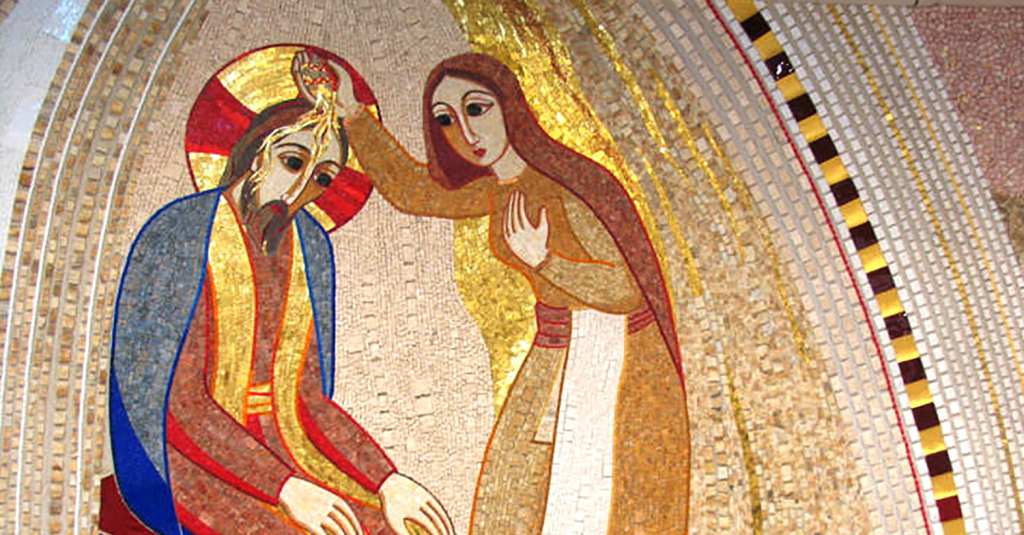
A 10th century depiction of Christ healing a blind man

The disciples were confused as Jesus led them toward Jerusalem, and his other followers were afraid. Once again, Jesus took the twelve disciples aside and told them what was going to happen to him. He said:

We are now on our way to Jerusalem where the Son of Man will be handed over to the chief priests and the teachers of the Law of Moses. They will sentence him to death and hand him over to foreigners, who will make fun of him and spit on him. They will beat him and kill him. But three days later he will rise to life….

Jesus and his disciples went to Jericho. And as they were leaving, they were followed by a large crowd. A blind beggar by the name of Bartimaeus son of Timaeus was sitting beside the road. When he heard that it was Jesus from Nazareth, he shouted, “Jesus, Son of David, have pity on me!” Many people told the man to stop, but he shouted even louder, “Son of David, have pity on me!”

Jesus stopped and said, “Call him over!”

They called out to the blind man and said, “Don’t be afraid! Come on! He is calling for you.” The man threw off his coat as he jumped up and ran to Jesus.

Jesus asked, “What do you want me to do for you?”

The blind man answered, “Master, I want to see!”

Jesus told him, “You may go. Your eyes are healed because of your faith.”

At once the man could see, and he went down the road with Jesus. (Contemporary English Version)

“Irony” and “ironic” are terms describing when an outcome of an event is contrary or different from what would be expected.

Here are a few examples of irony: The firehouse burnt down. The police officer got arrested. When I was a kid, my family physician’s name was Dr. Fail (really!). There is an overarching ironic lesson to our Gospel story today:

The people following Jesus with 20/20 vision were spiritually blind.

Their great need is the same as blind Bartimaeus: To have their eyes opened to Jesus and to what God was doing around them. Bartimaeus was marvelously and miraculously given sight by Jesus – the others, however, remained unchanged and in the dark. 

Irony #1: Many followed Jesus, but only a few were his followers.

All kinds of people physically followed Jesus around for various reasons while he was here on this earth. Some wanted to bask in the latest celebrity buzz that Jesus generated. Others wanted to see the cool stuff Jesus did, like healing people. Some were plain curious. And a few were interested in being like Jesus by showing selfless compassion.

Jesus continually sought to press the crowd following him into spiritual seekers who would learn to follow his teaching.

Many people conform to the group and go with the flow. That’s great if the crowd is good, and not so good if they’re going in a bad direction.

In the Old Testament, a few unruly complainers got the Israelites stirred up. The result was making a golden calf and turning away from God. Sometimes it is right and necessary to go against the crowd.

Irony #2: Out of all Christ’s followers, it is a blind man that sees Jesus for who he is: The Son of David.

Bartimaeus discerned it was Messiah who was walking by him. So, he went against the crowd and shouted to Jesus. Blind Bartimaeus didn’t care how he looked to others; it didn’t matter to him that he stuck out like a sore thumb to all the spiritually blind people.

Jesus often avoided crowds. Most of his earthly life occurred away from the centers of power and influence. Jesus swam upstream of the prevailing notions of righteousness. Christ did not cow-tow to the crowd. Instead, he paid attention to the needy and forgotten.
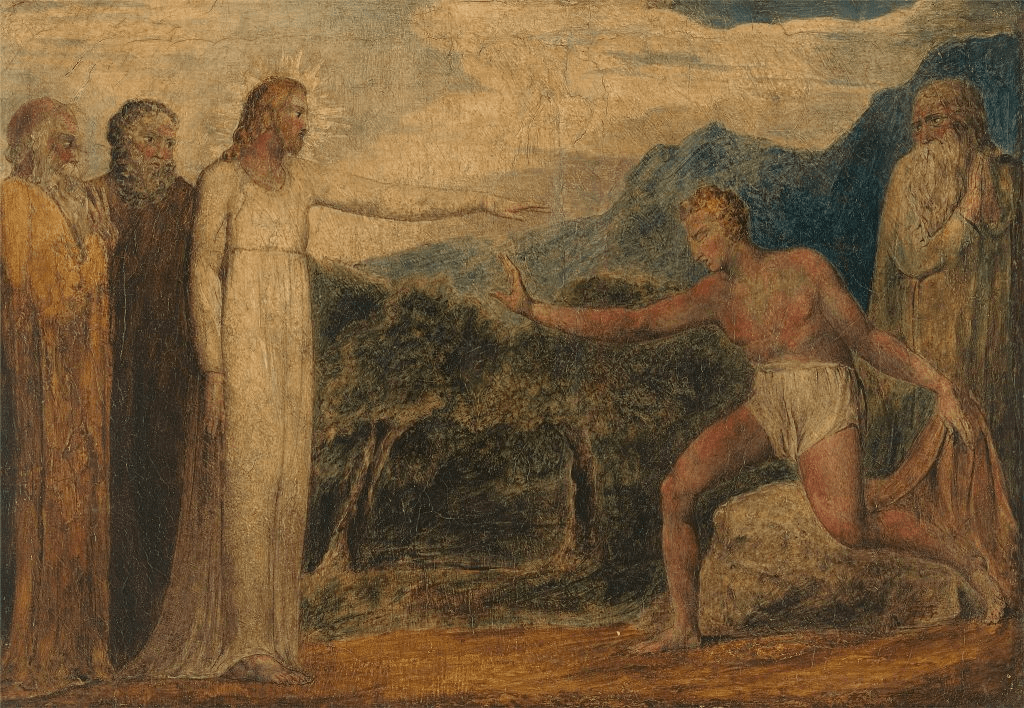
Christ Giving Sight to Bartimaeus, by William Blake (1757-1827)

And while in a large group of people, Jesus did not “work the crowd” to get ahead and further his agenda. He did not cozy-up to the rich and powerful. And Christ deliberately avoided celebrity status. Jesus showed extraordinary love to an overlooked person. He used his immense power for one powerless person.

Irony #3: The ones following Jesus were the ones trying to keep a blind man from Jesus.

One irony of the church is that Christ’s own followers can be the biggest obstacle to others following him.

I can just imagine a group of gossipy church folk shushing Bartimaeus: “Don’t bother Jesus, he is such a busy man! He has important work to do!” I can also picture them standing next to blind Bartimaeus saying, “Just stop, man, you’re embarrassing yourself.” 

But Bartimaeus would not stop. He shouted all the louder. That’s because true and genuine faith is a needy person crying out in desperation for Jesus to help.

Jesus asked a beautiful question: “What do you want me to do for you?”

“I want to see,” Bartimaeus responded. So, Jesus had compassion on him, and gave him his sight. Here we have two men, Jesus and Bartimaeus, ignoring all the people around them, and having a divine encounter.

This encounter raises my curiosity as to why it is so hard for us to simply say what we want.

It could be that we don’t want to buck the crowd, or to look different. Maybe we don’t want to admit our need in front of others. So, we simply stick to superficial conversations and insist that everything is okay, when it isn’t.

Jesus said, concerning the crowd, “Although they see, they don’t really see.” (Matthew 13:13)

If we are concerned about how we are seen by others, we will not be seen by God; we will miss Jesus when he walks by, right in front of us.

Conclusion

How might we raise our ability to see Jesus and truly follow him as he desires us to?

Listen to Jesus

Jesus was headed to Jerusalem and had a lot on his mind and heart with anticipating his passion and death. Christ became attentive to Bartimaeus, out of all the people around him, because he was listening.

If we want to see Jesus and follow him, we must be listeners,  and be attentive to compassion, like Jesus, to the needy and lowly among us. 

I recently read a story from a Christian who lived during Nazi Germany. He said:

“I considered myself a Christian. We heard stories of what was happening to the Jews, but we tried to distance ourselves from it, because what could anyone do to stop it? A railroad track ran behind our small church, and each Sunday morning we could hear the whistle in the distance and then the wheels coming over the tracks.

“We became disturbed when we heard the cries coming from the train as it passed by. We realized it was carrying Jews like cattle in the cars! Week after week the whistle would blow. We dreaded to hear those wheels because we knew we would hear the cries of the Jews in route to a death camp. Their screams tormented us.

“So, when we heard the whistle blow, we began singing hymns. By the time the train came past our church, we were singing at the top of our voices. If we heard the screams, we sang more loudly, and soon we heard them no more.

“Years have passed, and no one talks about it anymore. But I still hear that train whistle in my sleep. God forgive me. Forgive all of us who called ourselves Christians yet did nothing to intervene.” 

Respond to Jesus

Once Jesus listened, he responded by asking a question. Christ took the time to heal Bartimaeus.

Jesus could have simply healed him without even stopping. He could have started a healing factory where everyone with a need just moved through a line and got healed. But Jesus was doing more than giving sight; he was giving a blessing – the blessing of time and relationship.

The gospel is personal, which is why we ought to resist being non-relational in ministry to others.

Christian ministry is about blessing other people with the gift of relationship. It begins with recognizing self as the one who needs Jesus; and it starts with having our own eyes opened to see our own need, and then the great need of people around us.

God of all compassion, I confess that it is natural for me to do things my way. I recognize that I am limited, but that you know all things. I yield my spiritual eyesight to you so that my spiritual vision will be clear. Jesus Christ came to give sight to the blind and to open our eyes. I commit my ways to you so that I can see your ways and not just my own. Amen.


Broken and Poured Out (Matthew 26:6-13)

Jesus was in Bethany at the house of Simon the leper. While he was there, a woman came to him. She had an alabaster jar filled with expensive perfume. She poured the perfume on Jesus’ head while he was eating.

The followers saw the woman do this and were upset at her. They said, “Why waste that perfume? It could be sold for a lot of money, and the money could be given to those who are poor.”

But Jesus knew what happened. He said, “Why are you bothering this woman? She did a very good thing for me. You will always have the poor with you. But you will not always have me. This woman poured perfume on my body. She did this to prepare me for burial after I die. The Good News will be told to people all over the world. And I can assure you that everywhere the Good News is told, the story of what this woman did will also be told, and people will remember her.” (Easy-to-Read Version)

It seems that much of the world’s default response to events right in front of their eyes is to be judgmental, binary, and negative – as if everything is a simple sum of right and wrong, good and bad – and all adjudicated by our perceptions and perspectives on it.

The disciples reflexively moralized the actions of the woman and her jar of expensive perfume. What a waste, they believed. They thought they knew better and could do better.

But there was more going on in today’s Gospel lesson than what meets the eye. In the Apostle John’s account, the woman in the story is identified as Mary, a woman with a sordid background who had her life transformed through meeting Jesus. (John 12:1-11)

Near the end of Christ’s life, as he was about to enter Jerusalem and be arrested, tried, tortured, and killed, this woman, Mary, is aware of what is happening when others are not, even the disciples of Jesus. Her own brokenness cracked open to her the true reality of life.

The surface event itself is a touching and tender moment in history. This woman, whom everyone knew was a damaged person, took a high-end perfume and broke the entire thing open. She then proceeded to anoint Christ’s feet with it. You can imagine the aroma which filled the entire house with expensive perfume for all to smell. 

The woman, Mary, was affirmed by Jesus for seeing the situation as a possibility and opportunity of loving her Lord. Mary alone had the vision amongst all the disciples, and the accompanying action, to enter through the door of risk in order to connect intimately and lovingly with Jesus.

Mary’s love, radiating outward for all to see, reflected the genuine love of God for the world – a love so great that Jesus would soon experience death and burial because of that love for humanity.

The disciples were grumping and cursing about the right way to do things; whereas Jesus blessed the woman with no reference whatsoever to morality or ethics. Mary had no concern for playing the numbers game and counting money, but instead focused on the ultimate value before her.

Giving what she had to Jesus, Mary demonstrated the path of true discipleship. She helps open our eyes to the realities which are right in front of us:

  • The broken jar of perfume shows us her brokenness and our need to be broken. (Matthew 5:3-4)
  • An extraordinary and extravagant amount of perfume was used, picturing her overflowing love for Jesus. (John 20:1-18)
  • The perfume was poured on the head of Jesus, and she herself used her hair as the application (according to John); hair is a rich cultural symbol for submission and respect. (1 Corinthians 11:14)
  • The perfume directs us to the death of Jesus. (John 19:38-42)
  • The perfume highlights for us the aroma of Christ to the world. (2 Corinthians 2:15-17)
  • There is more to the disciples’ response than mere words about perfume; the Apostle John specifically names Judas as questioning this action – the one who is not actually concerned for the poor. (Matthew 26:15)
  • The woman and the disciples (specifically, Judas and Mary) serve as spiritual contrasts: Mary opens herself to the sweet aroma of Christ; Judas just plain stinks.
  • The perfume presents a powerful picture of the upcoming death of Christ, for those with eyes to see; he was broken and poured out for our salvation. (Luke 23:26-27:12)

Christianity was never meant to be a surface religion which only runs skin deep. The follower of Christ is meant to be transformed, inside and out, so that there is genuine healing, spiritual wellness, and authentic concern for the poor and needy. 

Keeping up appearances is what the Judas’s of this world do. However, the Mary’s among us dramatically point to Jesus with their tears, their humility, their openness, and their love.

In this contemporary environment of fragmented human ecology, our first step toward wholeness and integrity begins with a posture of giving everything we have – body, soul, and spirit – to the Lord Jesus. In receiving the love of God, we can then freely give that love to a world locked in the shackles of tunnel vision, judgmentalism, and incessant moralizing.

To take the risk of breaking ourselves open and becoming vulnerable, we find love. In finding love, there we see intimacy. And where there is intimacy, there is the relational connection which transforms the dark and the negative to possibility and light.

Loving Lord Jesus, my Savior, and my friend, you have gone before us and pioneered deliverance from an empty way of life and into a life of grace and gratitude. May I, and all of your followers, emulate the path of Mary and realize the true freedom which comes from emptying oneself out for you. Amen.

Go Up the Mountain (Isaiah 2:1-4)

Jerusalem from the Mount of Olives, by William Simpson (1823-1899)

The word that Isaiah, son of Amoz, saw concerning Judah and Jerusalem.

In days to come
    the mountain of the Lord’s house
shall be established as the highest of the mountains
    and shall be raised above the hills;
all the nations shall stream to it.
    Many peoples shall come and say,
“Come, let us go up to the mountain of the Lord,
    to the house of the God of Jacob,
that he may teach us his ways
    and that we may walk in his paths.”
For out of Zion shall go forth instruction
    and the word of the Lord from Jerusalem.
He shall judge between the nations
    and shall arbitrate for many peoples;
they shall beat their swords into plowshares
    and their spears into pruning hooks;
nation shall not lift up sword against nation;
    neither shall they learn war any more. (New Revised Standard Version)

Mountains make up about one-fifth of the world’s landscape and 12% of the world’s population live on them. They are more than imposing and impressive statues of rock. About 80% of our planet’s fresh water originates in the mountains.

It was on a mountain that Noah’s ark settled; Moses was given the law; and Jesus preached and died. Even the beans from my morning coffee were grown on the side of a mountain. I have everything I need in the mountainous God of all.

The most fundamental truths about God are consistency and constancy in the divine nature. God is forever present with people. 

So, it is no coincidence that the temple of God was built on a mountain at the highest point in the city of Jerusalem. Ascending the temple mount reminded every worshiper of the Lord’s ever-present protection and strength. It pointed them to the source of life. With God, every need is met and satisfied, because on the mountain and in the temple, people learn how to live in this world. They are taught the ways of the Lord.

We learn to live in peace and harmony by ascending the mountain, entering the house of God, and adopting a teachable spirit.

Today’s Old Testament lesson is a vision of the future – the way things will be. Now, things are not as they ought to be. Injustice, unrighteousness, indifference, and impurity leave their mark everywhere. It may cause folks to wonder whether the Lord is truly present, or not.

If God seems or feels aloof or unconcerned, it is not that the Lord is avoiding us or is distracted with other important matters of running the universe. It simply means God chooses to reveal the divine character and the divine will when the appropriate time warrants it, for our benefit.

A mountain looks like it never moves. Yet the slow but steady rains, the creeping of tectonic plates, and undiscernible changes within the earth shift mountain ranges over time. The Lord is most certainly responding to us, our movements and changes, in a way we cannot perceive with the naked eye.

Our responsibility in the entire affair is to engage in consistent rhythms of spirituality which place us in a position to receive grace when God decides to give it. If we are still, we can feel the movements of grace developing within us, and enveloping us with life.

Perhaps we need to become adept at being spiritual mountain goats, using our wide cloven hooves of faith to negotiate the immense crags and rocks of God. After all, we will spend an eternity getting to know God and never exhaust the exploration.

Therefore, we must not despair. Rather, we can anticipate meeting with God, just as the Israelites of old looked forward and upward in ascending the temple mountain. The truth is that God surrounds people, even when we do not always perceive it to be so. 

The sturdiness of God is able to handle and bear the weight of our heaviest burdens.

Throw all your anxiety onto him because he cares about you. (1 Peter 5:7, CEB)

If we will but look up, there is abiding help for the most vexing of problems.


I raise my eyes toward the mountains.
    Where will my help come from?
My help comes from the Lord,
    the maker of heaven and earth.
God won’t let your foot slip.
    Your protector won’t fall asleep on the job. (Psalm 121:1-3, CEB)

There is peace and settled rest when we call upon the God who surrounds us.

I call out to the Lord,
    and he answers me from his holy mountain.

I lie down and sleep;
    I wake again because the Lord sustains me. (Psalm 3:4-5, NIV)

It is through trust that we become mountains ourselves – strong in faith and giving life to those around us. And it is also no coincidence that Jesus ascended a mountain in order to deliver his most important teachings.

When Jesus saw the crowds, he went up the mountain, and after he sat down, his disciples came to him. And he began to speak and taught them, saying:

Blessed are the poor in spirit, for theirs is the kingdom of heaven.

Blessed are those who mourn, for they will be comforted.

Blessed are the meek, for they will inherit the earth.

Blessed are those who hunger and thirst for righteousness, for they will be filled.

Blessed are the merciful, for they will receive mercy.

Blessed are the pure in heart, for they will see God.

Blessed are the peacemakers, for they will be called children of God.

Blessed are those who are persecuted for the sake of righteousness, for theirs is the kingdom of heaven. (Matthew 5:1-10, NRSV)

On the mountain we encounter the Lord. In that place, we find that humility, gentleness, mercy, purity, and peacemaking are the sacred pathways of pushing back on the world’s injustice and establishing a more just and right culture.

All sorts of people, from everywhere, from every nation, will stream to receive gracious teaching. They will become aware of how to live in an egalitarian society. Everyone’s needs shall be met.

Great and mountainous God, help me to keep my heart clean and to live honestly and fearlessly, so that no outward failure can dishearten me or take away my joy of conscious integrity. Open wide the eyes of my soul so that I may see good in all things. Grant me today a vision of your truth. Inspire me with the spirit of gladness and make me to be a cup of strength to suffering souls; in the name of the strong Deliverer, our Lord and Savior, Jesus Christ. Amen.

Pastoral Care (Ezekiel 34:17-23)

“Now then, my flock, I, the Sovereign Lord, tell you that I will judge each of you and separate the good from the bad, the sheep from the goats. Some of you are not satisfied with eating the best grass; you even trample down what you don’t eat! You drink the clear water and muddy what you don’t drink! My other sheep have to eat the grass you trample down and drink the water you muddy.

“So now, I, the Sovereign Lord, tell you that I will judge between you strong sheep and the weak sheep. You pushed the sick ones aside and butted them away from the flock. But I will rescue my sheep and not let them be mistreated any more. I will judge each of my sheep and separate the good from the bad. I will give them a king like my servant David to be their one shepherd, and he will take care of them. (Good News Translation)

“Only through love can we obtain communion with God.”

Albert Schweitzer

I have a zero tolerance for bullying. And, I believe, this is a conviction which must be shared together with everyone. If not, we will continue to see spiritual abuse in the news, so-called Christians and churches throwing their weight around, and a world enveloped in the darkness of mean-spirited persons who only care about themselves and getting their way.

It is most necessary that spiritual folk let compassionate pastoral care have its way in the world.

Pastoral care, for me, is rooted in the compassion of Jesus Christ. It is my connection and relationship with this living Savior, Teacher, Healer, and Lord which enables me to extend genuine care to others. 

I believe that it is the grace and mercy of God in Christ through the enablement of the Holy Spirit which brings comfort, hope, and encouragement to people in need. My philosophy of pastoral care addresses three significant factors, in this order:

  1. Being in a safe environment is paramount. Building trust and connection is important. The caring relationship needs confidence so that the pastor can compassionately encourage and help the person to pursue being in a secure place – whether that is a physical moving away or out, or finding a safe and sacred place within one’s own soul from which healing and holistic health can begin. Bullying can be physical, verbal, emotional, mental, or personal in talking abusively to oneself; and it must be stood up to and stopped.
  2. Grieving is necessary. Mourning and lamenting a significant change or loss must occur to learn to thrive and flourish again in a new situation. This requires being open about one’s feelings, communing freely with God, and being vulnerable with a pastor, therapist, church group, or some other secure human connection. It is common to get “stuck” in grief and believe our situation can never change. But it can, so we must not remain there. 
  3. Reconnecting with the world is vital. Bullying and belligerent people can take a lot out of us and from us. Therefore, we need to find joy in the simple pleasures of life again; to reach out and relate to others who have gone through similar experiences; and, to regain ordinary rhythms and routines of life are all crucial to being alive. The compassionate pastor gently assists, encourages, exhorts, and walks with others toward relating well with the world once again.

Recovery is not an event, and not even a process; it is a way of life. 

All of us are vulnerable to the brokenness of this fallen world. We must learn to navigate troubled times with someone who cares, and not by ourselves. 

We all struggle to live out our faith commitments in a complex web of various family, work, social, and neighborhood relationships.

“If I were to wish for anything, I should not wish for wealth and power, but for the passionate sense of the potential, for the eye which, ever young and ardent, sees the possible. Pleasure disappoints, possibility never. And what wine is so sparkling, what so fragrant, what so intoxicating as possibility!”

Søren Kierkegaard

I am passionate about a biblical understanding of living in the world for its betterment and blessing as a pastoral minister. The following is a kind of manifesto of what I feel called to be and to do….

With God as my help, and with the Old and New Testaments of the Bible as my guide for grateful living, I seek with all my heart, soul, mind, and strength:

  • To foster, support, and realize spiritual healing in the world
  • To cultivate the human spirit and do the work of soul-craft deliberately, carefully, and patiently
  • To consult and collaborate with others who share a spiritual vision for blessing the world
  • To engage in spiritual practices which strengthen faith, enlarge a compassionate heart, and expand the soul’s capacity for growth
  • To walk in the way of Jesus through engrafting silence, solitude, fasting, giving, and prayer into regular and habitual rhythms of life
  • To wed integration of learning with an alignment of head, heart, and gut.
  • To embrace suffering and adversity as sacred Teachers of the soul
  • To continually pursue self-awareness and utilize that awareness for the common good of all persons
  • To liberally use the spiritual tools of faith, hope, and love; and, to sharpen those implements with great care
  • To weep with those who weep
  • To keep vigilant presence with the dying
  • To extend mercy, respect, and hospitality to those considered by society as the least, the last, and the lost
  • To eradicate loneliness in all its forms
  • To extend basic human dignity and divine grace to all with mental illness, cognitive disorders, soul-sucking addictions, and suicidal ideation
  • To embody the Beatitudes of Jesus and live by Christ’s Sermon on the Mount (Matthew 5-7)
  • To embrace humble service as demonstrated and taught by Jesus in his Upper Room Discourse (John 13-17)
  • To picture a world without poverty, racism, patriarchy, gender bigotry, verbal and physical violence, religious wars, and emotional immaturity
  • To imagine a future with an abundance of the Fruit of the Spirit, clean water, creativity, beauty, and equity of resources
  • To promote an egalitarian spirit and social justice, especially for those without power and/or privilege in the world
  • To see the image of God in persons very different from me
  • To grieve and lament my unwanted changes and losses
  • To express daily affirmations of faith
  • To exercise gratitude in all circumstances
  • To live in a healthy rhythm of receiving and giving
  • To encourage the telling and listening of stories
  • To champion women everywhere and alleviate all barriers to their voice in the world
  • To reform and keep reforming
  • To choose vulnerability and courage in life and leadership
  • To perpetuate, in both word and deed, the ancient Scriptures and ecumenical Creeds, paying attention to the worldwide church’s contribution to scriptural understanding
  • To use Holy Scripture for the encouragement of others and the strengthening of faith, and not as a weapon to damage others and create divisions
  • To observe the Christian Year and conform to its liturgical rhythms.
  • To die well, with no regrets and with a legacy of faith