Dealing with Injustice (1 Kings 1:28-48)

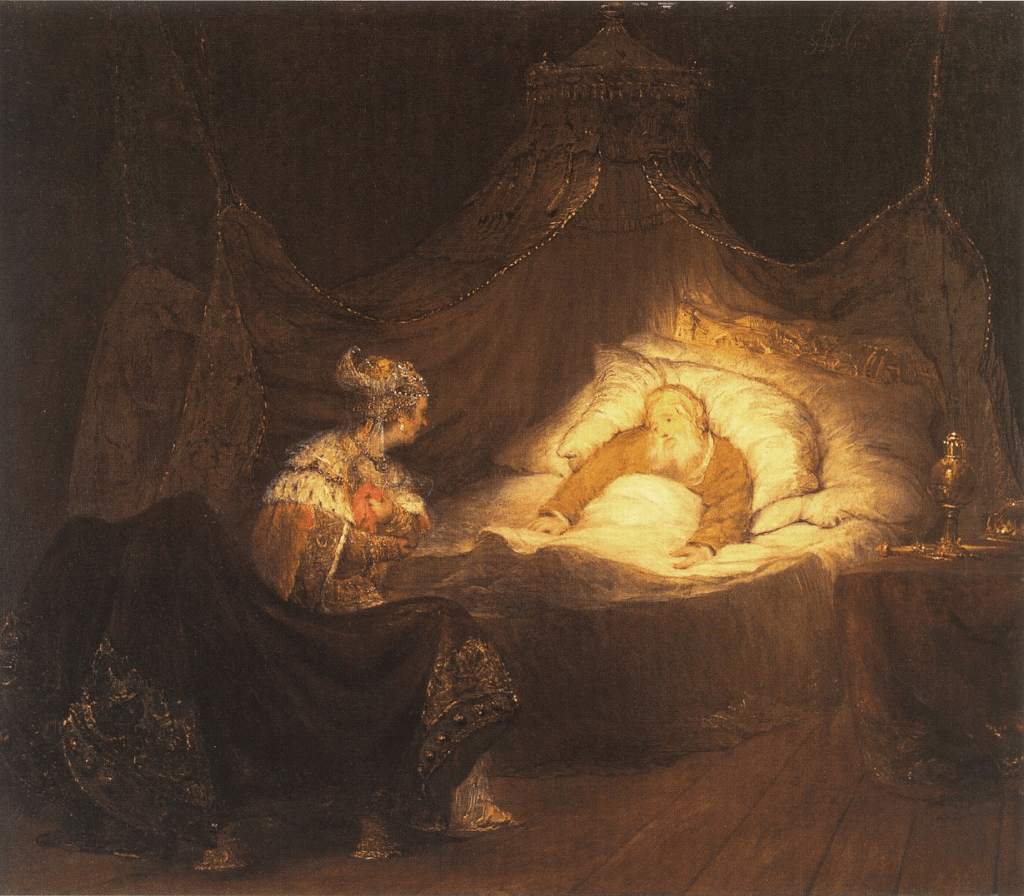
Bathsheba appeals to David, by Arent de Gelder, c.1685

Then King David said, “Call in Bathsheba.” So she came into the king’s presence and stood before him.

The king then took an oath: “As surely as the Lord lives, who has delivered me out of every trouble, I will surely carry out this very day what I swore to you by the Lord, the God of Israel: Solomon your son shall be king after me, and he will sit on my throne in my place.”

Then Bathsheba bowed down with her face to the ground, prostrating herself before the king, and said, “May my lord King David live forever!”

King David said, “Call in Zadok the priest, Nathan the prophet and Benaiah son of Jehoiada.” When they came before the king, he said to them: “Take your lord’s servants with you and have Solomon my son mount my own mule and take him down to Gihon. There have Zadok the priest and Nathan the prophet anoint him king over Israel. Blow the trumpet and shout, ‘Long live King Solomon!’ Then you are to go up with him, and he is to come and sit on my throne and reign in my place. I have appointed him ruler over Israel and Judah.”

Benaiah son of Jehoiada answered the king, “Amen! May the Lord, the God of my lord the king, so declare it. As the Lord was with my lord the king, so may he be with Solomon to make his throne even greater than the throne of my lord King David!”

So Zadok the priest, Nathan the prophet, Benaiah son of Jehoiada, the Kerethites and the Pelethites went down and had Solomon mount King David’s mule, and they escorted him to Gihon. Zadok the priest took the horn of oil from the sacred tent and anointed Solomon. Then they sounded the trumpet and all the people shouted, “Long live King Solomon!” And all the people went up after him, playing pipes and rejoicing greatly, so that the ground shook with the sound.

Adonijah and all the guests who were with him heard it as they were finishing their feast. On hearing the sound of the trumpet, Joab asked, “What’s the meaning of all the noise in the city?”

Even as he was speaking, Jonathan son of Abiathar the priest arrived. Adonijah said, “Come in. A worthy man like you must be bringing good news.”

“Not at all!” Jonathan answered. “Our lord King David has made Solomon king. The king has sent with him Zadok the priest, Nathan the prophet, Benaiah son of Jehoiada, the Kerethites and the Pelethites, and they have put him on the king’s mule, and Zadok the priest and Nathan the prophet have anointed him king at Gihon. From there they have gone up cheering, and the city resounds with it. That’s the noise you hear. Moreover, Solomon has taken his seat on the royal throne. Also, the royal officials have come to congratulate our lord King David, saying, ‘May your God make Solomon’s name more famous than yours and his throne greater than yours!’ And the king bowed in worship on his bed and said, ‘Praise be to the Lord, the God of Israel, who has allowed my eyes to see a successor on my throne today.’” (New International Version)

Solomon at the deathbed of King David, by Giulio Romano (1499-1546)

One of King David’s sons, Adonijah, was a stinker. He tried to pull a fast one on his aging father, in order to try and take the throne. But some of the people caught wind of what was afoot.

Even Nathan the prophet got involved and gave some sage instructions to Bathsheba, Solomon’s mother, so that the king’s wishes could come to fruition – namely, that Solomon would succeed David.

As a result, despite King David’s struggles toward the end of life, he had enough wherewithal to attempt some decisive leadership. He confirmed Solomon as his royal successor.

Despite Adonijah’s attempt to take advantage of his father’s failing capacity and execute a coup d’état, the king immediately took action by anointing and enthroning Solomon without any delay.

The installation of Solomon as king was accomplished so quickly that it caught the conniving Adonijah and his cohorts off guard. King David may have lost several steps in his old age, but he was still someone to be reckoned with. That underestimation would cost the connivers dearly.

To be honest, I don’t like Adonijah. And that’s what the storyteller wants us to feel. We are meant to read the narrative and walk away saying to ourselves that we don’t want to be like Adonijah; we don’t want injustice to have the day; instead, we want King David’s wishes honored, and to see a just and right Ruler ensconced as king.

The Lord is a just God. And since we are people created in God’s image and likeness, we have an inherent sense of justice down deep inside us. So, it drives people nuts whenever there are things happening which are not right nor good.

Everyone faces injustice, and things that are not right, in this life. The trick is to deal with it, without becoming unjust ourselves. It’s not an easy thing to do. It’s tough. So, how do we maintain being just while handling injustice?

The feeling of helplessness is rather uncomfortable, even painful. It doesn’t feel good to think that your efforts at doing right and being just don’t accomplish much of anything, and are only a drop in the bucket of what’s needed. It also doesn’t feel right whenever we see others going through injustice, and we have little to no way in helping the situation.

The first step in dealing with the world’s injustice is to acknowledge it. Don’t purposely ignore it, avoid it, or pretend that it isn’t there. Everything in life must be acknowledged before anything can be done about it – whether it’s dealing with an event, or your own emotions.

So, it is imperative that your care for yourself. And it’s the most important thing in being of service and help to others. Attend to the whole self – body, mind, emotions, and spirit – because it is necessary in order to move through unjust circumstances with health, confidence, and sobriety.

When facing injustice and dealing with it, no matter whether it concerns yourself or another, it’s good to keep in mind that our brains tend to gravitate toward the negative, to the detriment of seeing good and positive things.

Therefore, we must work at keeping our “compassion quotient” high, and not let our compassion turn to fatigue, then burn-out.

It seems that King David continually worked on maintaining a robust spirit and healthy self, so that, even when he was old, his compassionate and wise instincts kicked in – the ones he had spent a lifetime developing.

In contrast, Adonijah appears to have nurtured a self-centered and bitter spirit. He did not attend well to his spiritual and emotional health. His mind turned to the dark thoughts of intrigue and rebellion. Arrogance clouded his right mind. This would not end well for him.

Dealing with injustice is never easy. And it very much requires us to be healthy and just ourselves, so that when we are faced with issues of justice, we can deal with them in a good and right manner.

Almighty God, you have given all peoples one common origin.
It is your will that they be gathered together
as one family in yourself.
Fill the hearts of humanity with the fire of your love
and with the desire to ensure justice for all.
By sharing the good things you give us,
may we secure an equality for all
our brothers and sisters throughout the world.
May there be an end to division, strife and war.
May there be a dawning of a truly human society
built on love and peace. Amen.

Wear the Right Clothes (1 Samuel 2:18-21)

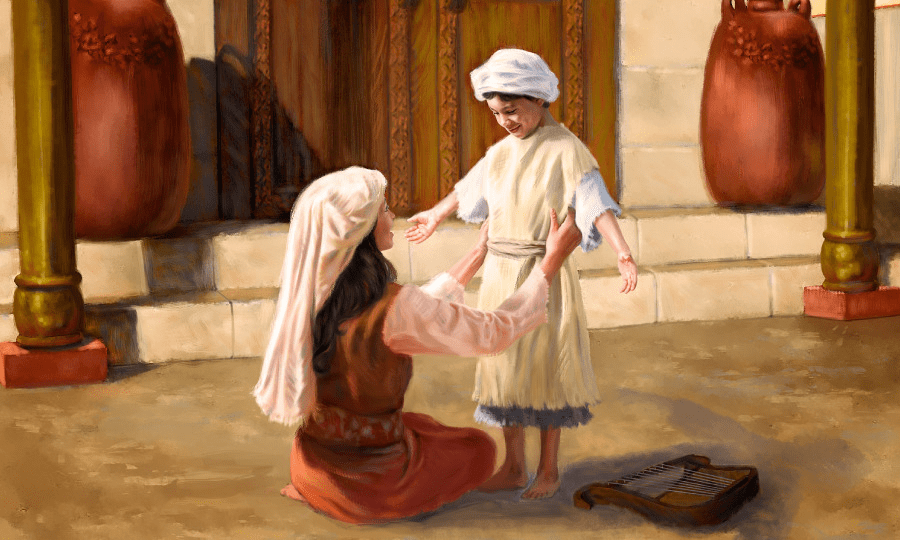
Hannah fits Samuel with a priestly robe, by Unknown artist

But Samuel was ministering before the Lord—a boy wearing a linen ephod. Each year his mother made him a little robe and took it to him when she went up with her husband to offer the annual sacrifice. Eli would bless Elkanah and his wife, saying, “May the Lord give you children by this woman to take the place of the one she prayed for and gave to the Lord.” Then they would go home. And the Lord was gracious to Hannah; she gave birth to three sons and two daughters. Meanwhile, the boy Samuel grew up in the presence of the Lord. (New International Version)

Hannah had to deal with infertility, a rival who taunted her mercilessly, and the societal shame of it all. But the God who is rich in mercy heard Hannah’s prayer at the Tabernacle in Shiloh. She was given a son, Samuel.

And when he was old enough – about 3 or 4 years of age – Hannah and her husband Elkanah presented Samuel to Eli the priest at the Tabernacle. She had vowed to do so if the Lord granted her a son. Hannah made good on that promise.

It turns out that the small boy Samuel was head-and-shoulders above the adult priests. Eli and his two sons, Hophni and Phineas, were no good, too small for the office of priest they occupied. Their service to God was anything but that. They served themselves, especially the two sons.

Eli’s adult children blatantly engaged in sacrilege, aggressively grabbing whatever they wanted from the sacred space of the Tabernacle. They made a mockery of the Lord’s instructions regarding sacrifices and worship in that holy place. The two of them cursed others (which would come back on them soon enough).

In contrast, the boy Samuel was a blessed child. His dear mother Hannah would make him a new priestly robe year after year as he served faithfully. His growing stature, and the need for clothing which suited him, were a light shining in the darkness of two sons who were outfitted in priestly garb that didn’t spiritually fit them at all.

The thing about our clothes is that they can either be an expression of who we truly are; or they can be a covering which hides the true identity. The story makes it plain that Samuel had a beautifully handcrafted robe which suited him perfectly. But Hophni and Phineas inherited priestly threads that seemed like ill-fitting hand-me-downs.

All of us are either revealing who we really are for all to see with unabashed authenticity, or we are concealing ourselves behind a disingenuous false façade, so that our true self is obscured and hidden in the shadows.

We are embodied people living on a physical earth. Our clothes aren’t just mere coverings of the body; they are a material means of communicating important immaterial aspects of ourselves and the world. The elaborate garb of the priest has significance, and ought not to be taken lightly.

In the case of Eli’s sons, they used their clothing to fleece incoming worshipers who were making genuine animal sacrifices to God. The priestly outfits themselves were not the problem; at issue was two people committing sacrilege against the Lord, and injustice toward the Lord’s people.

Material things neither contaminate nor purify a person; the heart does that. We just need to ensure that material objects like clothing are set apart for specific and good purposes. Those clothes ought to be congruent with the person and the task at hand. And clothing ought never to demean or deceive ourselves or others.

Although we aren’t told what sort of clothing Hannah wore, I’m sure that everything she wore spoke to her humility before others, devotion to God, and spirit of doing what is right and just. The Lord gave her clothes fitted for a mother by blessing Hannah with even more children. I can imagine that the biblical writers had women like her in mind when they wrote some of their words:

I want women to enhance their appearance with clothing that is modest and sensible, not with elaborate hairstyles, gold, pearls, or expensive clothes. They should make themselves attractive by doing good, which is appropriate for women who claim to honor God. (1 Timothy 2:9-10, CEB)

It is not fancy hair, gold jewelry, or fine clothes that should make you beautiful. No, your beauty should come from inside you—the beauty of a gentle and quiet spirit. That beauty will never disappear. It is worth very much to God. (1 Peter 3:3-4, ERV)

For all of us, we are encouraged to wear actual and metaphorical clothing that is consistent with what is good:

Right living was my clothing. Fairness was my robe and turban. (Job 29:14, ERV)

Because we belong to the day, we must live decent lives for all to see. Don’t participate in the darkness of wild parties and drunkenness, or in sexual promiscuity and immoral living, or in quarreling and jealousy. Instead, clothe yourself with the presence of the Lord Jesus Christ. And don’t let yourself think about ways to indulge your evil desires. (Romans 13:13-14, NLT)

Therefore, as God’s chosen people, holy and dearly loved, clothe yourselves with compassion, kindness, humility, gentleness and patience. (Galatians 3:12, NIV)

The boy Samuel lived up to the priestly clothes he was wearing; they fit him like a hand in a glove. But the adults who should have known better, Eli and his sons, dressed down their priestly garments and demeaned the office of priest for the people they should have been serving.

It is high time to dress appropriately and clothe ourselves with Christ, so that the very life of Jesus may flow powerfully in us and through us, to the glory of God. Amen.

The Contrast of Good and Bad (1 Samuel 2:11-17)

Top picture: Eli’s sons commit sacrilege; Bottom picture: Hannah and Elkanah bring the boy Samuel to the tabernacle; by William de Brailes, c.1230 C.E.

Elkanah and Hannah went back home to Ramah, but the boy Samuel stayed to help Eli serve the Lord.

Eli’s sons were priests, but they were dishonest and refused to obey the Lord. So, while people were boiling the meat from their sacrifices, these priests would send over a servant with a large, three-pronged fork. The servant would stick the fork into the cooking pot, and whatever meat came out on the fork was taken back to Eli’s two sons. That was how they treated every Israelite who came to offer sacrifices in Shiloh. Sometimes, when people were offering sacrifices, the servant would come over, even before the fat had been cut off and sacrificed to the Lord.

Then the servant would tell them, “The priest doesn’t want his meat boiled! Give him some raw meat that he can roast!”

Usually the people answered, “Take what you want. But first, let us sacrifice the fat to the Lord.”

“No,” the servant would reply. “If you don’t give it to me now, I’ll take it by force.”

Eli’s sons did not show any respect for the sacrifices that the people offered. This was a terrible sin, and it made the Lord very angry. (Contemporary English Version)

Stories in the Old Testament of the Bible typically have two or more contrasting characters within them. One of the characters is good and the other not so much. The narrative is set up without having to tell us who is good and who is bad because the unfolding story makes it patently obvious.

This method of contrast is meant for us to look at the narrative and say to ourselves that we don’t want to go down the bad path but to walk in the good way of helpful obedient service.

In today’s story, we clearly see that, in the case of Eli’s sons, the apple doesn’t fall far from the tree. Old Eli the priest is a contrast to the boy priest-in-residence Samuel.

Eli had many faults, especially when it came to dealing with his sons, who were also priests. Eli seems to have continually had an issue with not listening very well – which ended in making a mess of things.

His sons took the casualness to an entirely new level of bad. They were not only worthless but also interfered in the people’s sincere worship of God. The sons were more than simply incompetent; they were also downright evil.

The Law made it clear how the priests and their portion of the sacrificial animals was to occur. There were detailed instructions on the importance of what part of the animal the priests received; and that the sacrifice needed to have the fat boiled off before it was given to the priest. (Leviticus 7:30-36)

But Eli’s sons took whatever they wanted, and did whatever they wanted, with calloused impunity. They disregarded divine instructions. If they wanted to roast their meat, they did. If they decided to have a different part of the animal, they took it from the worshiper. The sons did not care about anyone, and especially about God. They were bullies of the worst kind.

When sincere worshipers tried to stop the insanity of the priests’ blatant neglect, the servant of the priests threatened them. Although Eli himself did not do this detestable practice, we are meant to see in the narrative that he is an absent father and grossly negligent as a priest.

That entire incompetent and insensitive situation raised the ire of a holy God. It would not end well for Eli and his sons. That particular branch of the Levite priesthood was completely eradicated by the direct judgment of the Lord.

The contrast between Eli and Samuel – both serving as priests – has an unexpected twist. Whereas one would reasonably expect Eli to be the good mentor because of his age and experience, it turns out that the much younger Samuel is the actual mentor to the good and right life of priesthood. Eli needed to take his cues from a child. But, alas, he did not.

Hannah presenting Samuel to Eli, by John Flaxman, 1783

Many adults seem to think that children have nothing to teach them. We who are the big people believe we’re the teachers, leaders, and mentors. Yet, in the kingdom of God, age hasn’t got much to do with it. In fact, generally speaking, children are closer and wiser to knowing how God’s kingdom works, often better than the adults do.

In many respects, I am more like an eight year old boy than the actual father and grandfather that I am. I consider that a good thing. It serves me well in living the spiritual life. And as a boy in an adult body, I say we need to take children more seriously. How can we do that?

Listen carefully. Listen with the intent to understand and learn. The best way of talking to a child is listening to them. Hear both what they’re saying and not saying. Jesus insisted that we must become like little children before we can enter the kingdom of heaven. (Matthew 18:2-5)

Since we are to become like children, there’s no reason not to do your very best in getting on a child’s level and hearing what they have to say. After all, they’re the experts on being kids. The young Samuel is our model: “Speak, Lord, for your servant is listening.” (1 Samuel 3:10)

Validate a child’s emotions, especially their fears. In truth, kids are some of the bravest souls on the planet. They typically have no real hang-ups on connecting with other people, whereas many adults have a lot of anxieties and fears concerning other people.

So, when a child is afraid of something, it’s wise to take notice. They have a special radar to reality that most adults lost a long time ago. I’ll bet the children of the community knew the score of Eli and his sons well before the adults caught on to it.

Observe children’s artworks. For those interested in learning from a child, their drawings with crayons say a lot; their sand sculptures and garbage art speak loads to us if we observe and take notice. Kids are communicating their worldview and how they make sense of things.

Art is about understanding life and the human spirit, connecting to the past and other cultures, and expressing emotions. Becoming open to what children create is a pathway to the divine and to what is important in this world. Eli’s sons removed the art and craft of priesthood; they made it a mere exchange of goods and services. And God was not happy with this arrangement. It took away something significant about connecting with the Lord.

By contrasting the way of Samuel with the way of Eli and his sons, we begin to see the wide chasm between a one-dimensional bullying approach to being a priest, with a multi-dimensional, beautiful, and authentic expression of priesthood that embodies the conduit between heaven and earth.

How will you go about living your life? What does the way you do things say about God?

Holy God, infuse in us your ability to remain present to your people. Help us to be there for the people who need us – for the young, the old, the needy, and the brokenhearted. Enflame our hearts with a spirit of service and obedience. And enable us to be open and ready to love. Amen.

Idolatry Is the Tail Wagging the Dog (Psalm 106:1-6, 19-23)

Praise the Lord!
    O give thanks to the Lord, for he is good,
    for his steadfast love endures forever.
Who can utter the mighty doings of the Lord
    or declare all his praise?
Happy are those who observe justice,
    who do righteousness at all times.

Remember us, O Lord, when you show favor to your people;
    help us when you deliver them,
that we may see the prosperity of your chosen ones,
    that we may rejoice in the gladness of your nation,
    that we may glory in your heritage.

Both we and our ancestors have sinned;
    we have committed iniquity, have done wickedly…

They made a calf at Horeb
    and worshiped a cast image.
They exchanged the glory of God
    for the image of an ox that eats grass.
They forgot God, their Savior,
    who had done great things in Egypt,
wondrous works in the land of Ham,
    and awesome deeds by the Red Sea.
Therefore he said he would destroy them—
    had not Moses, his chosen one,
stood in the breach before him,
    to turn away his wrath from destroying them. (New Revised Standard Version)

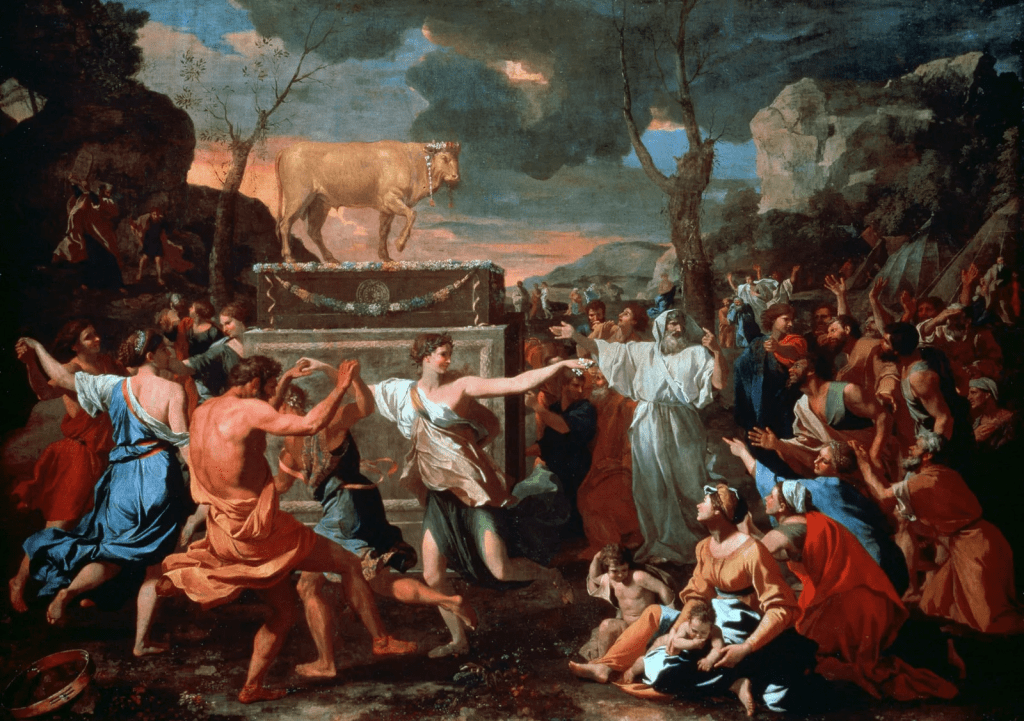
Adoration of the Golden Calf, by Nicolas Poussin (1594-1665)

When it comes to sin, especially the sin of idolatry, it’s imperative that we name it for what it is. It will do no good to fudge on it by saying that so-and-so struggles with it more than me, or that it’s not as bad as assault or murder.

No, we must call sinful idolatry just that, because the problem of idolatry is at the heart of humanity’s spiritual struggle. The first of the Ten Commandments frames it and names it squarely:

“I am the Lord your God who brought you out of slavery; do not worship other gods.” (Exodus 20:2-3, NRSV)

And the second commandment straight up prohibits any manufacturing or worshiping of idols:

“You shall not make for yourself an idol, whether in the form of anything that is in heaven above or that is on the earth beneath or that is in the water under the earth. You shall not bow down to them or serve them….” (Exodus 20:4-5, NRSV)

In the New Testament Gospels, Jesus also drew sharp lines between God and idolatry:

“No one can serve two masters, for a slave will either hate the one and love the other or be devoted to the one and despise the other. You cannot serve God and wealth.” (Matthew 6:24, NRSV)

The early church fathers (and mothers) forsook dependence on anything or anyone other than the one true God. Idolatry is an obsessive and fruitless search to satisfy a legitimate need in an illegitimate manner by giving oneself to someone or something other than the true object of the heart’s longing.

“You have made us for yourself, O Lord, and our heart is restless until it rests in you.”

St. Augustine

None of this means that the material and physical world is somehow bad – that money, possessions, food, books, nature, and other people are objects to avoid – because they are most certainly not! The problem arises whenever we seek to replace God with the things God made, God’s own creation.

By seeking to save our souls and fill the emptiness in our spirits with more and more wealth, or more and better jobs, or more time and expense for reading, or just about any other activity or possession there is, those things which were given for our use and enjoyment and to be stewarded well by us, end up becoming the users and our masters.

Inanimate objects, ideas, and activities begin calling the shots and giving the commands about what we should do and not do. What we own, now owns us. Even the poor can succumb to idolatry through the sin of covetousness by wanting things they do not have in the belief that wealth and possessions will make their lives whole and worthy. But this breaks the tenth commandment:

“You shall not covet your neighbor’s house; you shall not covet your neighbor’s wife, male or female slave, ox, donkey, or anything that belongs to your neighbor.” (Exodus 20:17, NRSV)

Nature and all the earth were formed by the Creator. And, as such, they too, give glory to God and recognize they themselves are not to be worshiped.

The heavens are telling the glory of God,
    and the firmament proclaims his handiwork.
Day to day pours forth speech,
    and night to night declares knowledge. (Psalm 19:1-2, NRSV)

Genuine wealth, prosperity, happiness and peace are found in the Creator of all good things. It is God who will:

  • wipe every tear from our eyes (Isaiah 25:1-9)
  • provide protection and guidance through the hard times of life (Isaiah 54:17)
  • be present with us as we walk through the valley of despair and ascend the mountain of celebration and joy (Psalm 23)

The reason idolatry is so insidious and difficult to name is that our affections are typically on a good thing which God has created and given for us. It’s just that, over time and through an extended process, the tail begins to wag the dog. For example:

  • Humanity serves the Sabbath instead of the Sabbath serving humanity
  • Parishioners venerate a church building instead of the church building being a tool for ministry
  • People are slaves to their hobbies instead of the hobby serving the person
  • Spouses worship one another instead of worshiping the God who brought them together
  • Groups let their traditions hold them with an iron grip, instead of traditions being held loosely by groups

It could (and does) happen to each one of us. And when it does, we need the wisdom and humility to see it for what it has become. Then, confess it as idolatry, and accept the forgiveness which is freely available from the Divine.

Almighty and everlasting God: Not to us, but to your name we give glory, for the sake of your steadfast love and your faithfulness! Yet because of the idolatry in our hearts, we have strayed far from you. We have disobeyed your commandments; we have trusted our own judgement; and we wonder why we feel distant from you. We have worshipped idols of silver and gold—and idols of self and comfort. Forgive us for not loving you as we ought, not obeying you as we were taught, and not trusting that our forgiveness has been bought. Amen.