Give ear, O Shepherd of Israel, you who lead Joseph like a flock! You who are enthroned upon the cherubim, shine forth before Ephraim and Benjamin and Manasseh. Stir up your might, and come to save us!
Restore us, O God; let your face shine, that we may be saved.
O Lord God of hosts, how long will you be angry with your people’s prayers? You have fed them with the bread of tears, and given them tears to drink in full measure. You make us the scorn of our neighbors; our enemies laugh among themselves.
Restore us, O God of hosts; let your face shine, that we may be saved. (New Revised Standard Version)
Restoration is a beautiful thing. I don’t often watch makeover shows on television. But if I’m channel surfing and see an old house, appearing ready for the wrecking ball, getting restored to its original charm and beauty, I’m hooked. We resonate deeply with things being repaired and rejuvenated, as if it is brand new.
For that to occur, someone needs to have a vision to see the old become new. If not, then the drab discouragement of a gray and dreary environment can easily take over. We then forget the original shine of how things once were to the point where we cannot even imagine that it’s worth salvaging.
In the context of today’s psalm, God’s people once enjoyed the covenant and the promises of God. But over time, the relationship was not maintained and cared for. So, the people gradually slid into disrepair. Centuries of sheer neglect brought a situation where it seemed the only recourse was to raze everything and begin again.
The psalms have been the prayer book of God’s people for over three millennia. Suffering and hard circumstances provide the backdrop for many of them. Sometimes the difficulty is external – another nation oppressing the people. Yet other times, like in today’s psalm, the problem is internal – sheer neglect of God’s commands over time. It went on to the point that God’s longsuffering ran out.
I would much rather enjoy God’s favor than God’s disappointing anger. To begin addressing any sort of spiritual neglect, the work of prayer becomes the tool we need. Restoring broken lives and broken communities to their original beauty starts with prayer and praise, offered daily and often.
Seven times a day I praise you for your righteous laws. (Psalm 119:164, NIV)
What’s more, our tears, which seem, at times, to be our daily bread, are a kind of baptismal offering to God – prayers coming through groans which words cannot express. Even with our prayers, the Lord is gracious to help us with the requests themselves and not just the answers.
And the Holy Spirit helps us in our weakness. For example, we don’t know what God wants us to pray for. But the Holy Spirit prays for us with groanings that cannot be expressed in words. (Romans 8:26, NLT)
God is waiting for us to approach the throne of grace with confidence. And we must keep coming to the Lord, again and again.
Jesus understands every weakness of ours because he was tempted in every way that we are. But he did not sin! So whenever we are in need, we should come bravely before the throne of our merciful God. There we will be treated with undeserved kindness, and we will find help. (Hebrews 4:15-16, CEV)
Like the continual routine of using the hammer, pounding nail after nail, so we must offer our prayers morning, noon, and night, day after day, crying out to God with the great cry of the church: Restore us, O God; let your face shine, that we may be saved!
May the hope of Advent, the love of God in Christ, and the encouragement of the Holy Spirit restore your soul and enliven your spirit, now and forever. Amen.
O loving and gracious God, bring restoration to my life, to my church, to my family, to my workplace, and to my community. Things are not as they once were. Send your Holy Spirit so that we might enjoy seasons of blessing again. Restore, renew, revive and rejuvenate our disordered churches. May your face shine upon us once again through the mighty name of Jesus. Amen.
A shoot will come up from the stump of Jesse; from his roots a Branch will bear fruit. The Spirit of the Lord will rest on him— the Spirit of wisdom and of understanding, the Spirit of counsel and of might, the Spirit of the knowledge and fear of the Lord— and he will delight in the fear of the Lord.
He will not judge by what he sees with his eyes, or decide by what he hears with his ears; but with righteousness he will judge the needy, with justice he will give decisions for the poor of the earth. He will strike the earth with the rod of his mouth; with the breath of his lips he will slay the wicked. Righteousness will be his belt and faithfulness the sash around his waist.
The wolf will live with the lamb, the leopard will lie down with the goat, the calf and the lion and the yearling together; and a little child will lead them. The cow will feed with the bear, their young will lie down together, and the lion will eat straw like the ox. The infant will play near the cobra’s den, and the young child will put its hand into the viper’s nest. They will neither harm nor destroy on all my holy mountain, for the earth will be filled with the knowledge of the Lord as the waters cover the sea. (New International Version)
In some quarters of Christianity, the church exists as a mere stump of its former existence. In many Christians’ daily experience the Spirit has been supplanted by individual ingenuity, hard work, and getting ahead through accumulation of more and more. Basic Christian spirituality is a mere shadow of its former influence. If Christians desire the Spirit of the Lord to rest upon them, they will seek Christ as of foremost importance.
Indeed, it is when we are worn down to a stump and have no ability to grow or sustain life anymore that God enters, specializing in giving hope to the hopeless, justice for the poor, wisdom to the confused, and peace to all who desire a harmonious world.
In the awful feelings of helplessness and hopelessness, a faint sign of life can be seen. A fresh shoot becomes discernible. Could there be possibility amidst impossible circumstances? Can there be life again? Do I dare hope again? Will things really change, and do so for the better?
The answer is “yes.” For where the Spirit of the Lord blows there is the force of resurrection power, spiritual energy, and fresh courage. Where others see only the impossible, the believer has a capacity of faith to see the possible. The Spirit’s force generates possibility where none existed before. When the breath of God whispers to the sprout in the stump, pessimistic despair turns to optimistic hope, even joy.
Christ is the Christian’s hope. In Christ, there is security, well-being, and life. With Jesus, there is a vision of justice in which all persons receive what they need to live, thrive, and flourish in God’s world. Christ works for our benefit without the personal greed and indifference of so many earthly rulers. The weak and vulnerable have a champion in Jesus Christ. Renewal and restoration are possibilities.
I have taken a liking to a show called “The Repair Shop,” a British television series in which family heirlooms with sentimental value are restored by experts for their owners. What captivates me about the show is how a few people can take old broken-down items (and by all appearances now a piece of junk) and restore them to their once glorious newness.
Yet, there is more to my captivation. I am struck by the sheer pleasure the restorers take in handling the old object, enjoying the process. Just by the looks on their faces, I can tell they consider it a privilege to be restoring a precious object of the past.
I am sure this is precisely how God feels with us. Rather than envisioning the Lord as some reluctant deity who feels put out with having to rescue a bunch of dumb and wayward people, God is One who takes delight in taking this old stump of fallen damaged humanity and restoring people to their original luster and beauty.
Transformation is God’s specialty, and the Lord goes about the process of restoration with great care and delight.
The Peaceable Kingdom by Malcah Zeldis
The impossible possibility of God’s new creation is poetically described in Isaiah as the peaceful co-existence of animals who are inconceivably together without fear or violence. There is a time coming when death will be no more, and so, the necessity in this life of hunter and prey will be forever negated. No more snakes terrorizing women and children. No more big fishes eating little ones. No more human fat cats preying upon and striking poison on the small and vulnerable.
The presence of the godly Ruler means the world will be governed rightly, detoxified of its sinful impurities – a place where the poor, the weak, and the little lambs will indeed be safe and secure forever. There will be peace because of the Prince of Peace. All creation will be full of God, and so, free of all malice.
Isaiah envisions a deep, radical, limitless transformation in which there will be no more desire to injure another; no need to dominate another; and no motive for selfish power over others.
The Lord will bring about a metamorphosis of human hearts and institutions, a renovation of the animal kingdom, and a radical change down to every blade of grass in creation. The Apostle Paul had this grand prophetic vision of God in mind when he wrote to the Church at Rome:
I believe that the present suffering is nothing compared to the coming glory that is going to be revealed to us. The whole creation waits breathless with anticipation for the revelation of God’s sons and daughters. Creation was subjected to frustration, not by its own choice—it was the choice of the one who subjected it—but in the hope that the creation itself will be set free from slavery to decay and brought into the glorious freedom of God’s children. We know that the whole creation is groaning together and suffering labor pains up until now. And it’s not only the creation. We ourselves who have the Spirit as the first crop of the harvest also groan inside as we wait to be adopted and for our bodies to be set free. We were saved in hope. If we see what we hope for, that isn’t hope. Who hopes for what they already see? But if we hope for what we don’t see, we wait for it with patience. (Romans 8:18-25, CEB)
The implication for us as humanity was voiced by Paul to the Colossian Church:
Each of you is now a new person. You are becoming more and more like your Creator, and you will understand him better. It doesn’t matter if you are a Greek or a Jew, or if you are circumcised or not. You may even be a barbarian or a Scythian, and you may be a slave or a free person. Yet Christ is all that matters, and he lives in all of us.
God loves you and has chosen you as his own special people. So be gentle, kind, humble, meek, and patient. Put up with each other, and forgive anyone who does you wrong, just as Christ has forgiven you. Love is more important than anything else. It is what ties everything completely together.
Each one of you is part of the body of Christ, and you were chosen to live together in peace. So let the peace that comes from Christ control your thoughts. And be grateful. (Colossians 3:10-15, CEV)
The transformation is all-pervasive, thoroughly public, and intimately personal. It is a gift from God; it is the impossible made possible. And it is this precise thing which we acknowledge, celebrate, and long for in the season of Advent. When the angel came to Mary and communicated that Isaiah’s vision was coming to reality through her womb, Mary astonishingly retorted:
“How will this be, since I am a virgin?”
The angel, with supreme confidence, answered Mary as a matter of fact:
“The Holy Spirit will come on you, and the power of the Most High will overshadow you. So, the holy one to be born will be called the Son of God…. For no word from God will ever fail.”
Mary’s response gives voice to our own desires and longings for the new order of things:
“I am the Lord’s servant. May your word to me be fulfilled.” (Luke 1:34-38, NIV)
This is our confession, too. We are the Lord’s servants.
May God’s word to us about the coming of Christ be fulfilled, just as Isaiah said. The hopes and fears of all the years are met in Jesus on a starry night so many years ago.
It is written: “I believed; therefore, I have spoken.” Since we have that same spirit of faith, we also believe and therefore speak, because we know that the one who raised the Lord Jesus from the dead will also raise us with Jesus and present us with you to himself. All this is for your benefit, so that the grace that is reaching more and more people may cause thanksgiving to overflow to the glory of God.
Therefore, we do not lose heart. Though outwardly we are wasting away, yet inwardly we are being renewed day by day. For our light and momentary troubles are achieving for us an eternal glory that far outweighs them all. So, we fix our eyes not on what is seen, but on what is unseen, since what is seen is temporary, but what is unseen is eternal.
For we know that if the earthly tent we live in is destroyed, we have a building from God, an eternal house in heaven, not built by human hands. (New International Version)
We all face seasons and circumstances that stretch our faith and press the limits of what we can handle.
We have no promise from Scripture we will avoid trouble.
Instead, Jesus promises his followers there will be adversity and stressful predicaments.
The pressures of life can sometimes be so overwhelming, we might lapse into losing heart, either by chiding ourselves for the adversity and wishing things were different, or blaming others for our troubles, and believing that if they would just get their act together, all would be well with my soul.
The ancient Corinthian Church had a bevy of relational issues and problems. Some they created themselves. Some came from other people. Other issues arose simply by living in a fallen world, surrounded by the effects of ever-present sinful crud.
Yet, no matter the source or nature of the problem, the Corinthians needed a point of focus to direct their troubled hearts. They needed to be reminded of the grace they possessed in Jesus Christ.
Faith is a gift given by God. It is planted in the heart of the believer so that, over time, it will nurture, grow, and bear spiritual fruit. Out of that belief arises speaking words of hope and love that embrace the work of God in the life of the believer. The Apostle Paul said elsewhere to the Roman Church:
If you openly declare that Jesus is Lord and believe in your heart that God raised him from the dead, you will be saved. For it is by believing in your heart that you are made right with God, and it is by openly declaring your faith that you are saved.(Romans 10:9-10, NLT)
Christ’s resurrection from death is both a spiritual and a physical reality. If we believe this truth in our hearts, we will be raised both spiritually and physically. Faith in Christ gives shape to the hope that, although we might be experiencing the effects of mortality and the fall of humanity, we are, at the same time, being spiritually renewed day by day.
The very same afflictions causing our bodies to degenerate and challenging our spirits, are the same means to achieving a glorious, resurrected existence. There cannot be the glory of spiritual and bodily resurrection without a shameful death. Jesus absorbed the shame of the world’s violent ways onto himself so that we might be raised with him.
However, this does not mean we will never experience difficulty in this present life. In fact, daily spiritual renewal can and does happen through adverse circumstances. There must be suffering before glory, both for Jesus and for us. Deliverance from sin, death, and hell is not an inoculation from trouble. Because it is the troubles of this life which teach us to trust in God, as well as weaning us from everything we previously trusted to deal with those troubles.
“Don’t let your hearts be troubled. Trust in God, and trust in me.”
Jesus (John 14:1, NIV)
So, we need to fix our gaze firmly on the unseen reality of faith and hope. All we see with our physical eyes is temporary. All that is unseen is eternal, especially and namely, God. Therefore, it is imperative we traffic in building heavenly treasure, learning to deal with the intangible and unseen dimensions of life.
We are to allow the physical to serve as a sign and seal of the spiritual realities they represent.
For example, Christians come to the Lord’s Table so that the tangible elements of bread and cup will bolster and fortify our faith with the grace that points to the intangible. The Table is to accomplish for us a spiritual renewal of lifting us up by God’s Spirit and joining us with Jesus. This union with Christ can never be taken away from us, even in death, because we have an eternal building from God which makes this present life look like a camping trip.
When I think of a person who is outwardly wasting away, yet inwardly being renewed, I think of Joni Eareckson Tada. She has been a paraplegic for fifty years, after an accident as a teenager in which she dove into shallow water and broke her neck. Afterwards, lying in a hospital for months unable to move, she had completely lost heart to the point of being suicidal.
Joni could not even kill herself since she could not physically move. Finally, in her darkest moment, she cried to God with what she says was the most significant prayer she ever prayed: “Lord, if I can’t die, show me how to live.” And God did. Joni’s faith is as strong and robust as anyone’s, despite her infirmity and handicaps. She has learned to embrace her troubles as the means of growing her faith.
The path to accept, cope, and transcend our troubles and afflictions begins with acknowledging them. They only have power over us for ill if we ignore them or put up a false front to hide them. The Apostle Paul was open with the Corinthians about his life:
We do not want you to be unaware, brothers and sisters, of the affliction we experienced in Asia; for we were so utterly, unbearably crushed that we despaired of life itself. Indeed, we felt that we had received the sentence of death so that we would rely not on ourselves but on God who raises the dead.(2 Corinthians 1:8-9, NRSV)
Paul faced whippings, beatings, stoning, shipwreck, hunger, poverty, danger, and trouble, not to mention the stress of caring for fledgling churches. Through it all, Paul was transparent, and named his troubles so he could apply the poultice of God’s grace to his afflictions.
It is our brokenness – not having it all together – which shows the grace of God to others.
Paul consistently described his life and ministry in apparent paradoxes: strength in weakness; glory through shame; life through death; riches through poverty.
Although we experience the fallen nature of the world, God bends each situation toward divine purposes so that what seems to be our downfall becomes the means to our spiritual renewal.
Therefore, we do not lose heart.
Holy Scripture encourages us not to give up because of hardship, since those very same troubles are the divine implements used to form us into solid followers of Jesus.
We need some stress. Just like a violin needing its strings adjusted to the right pressure, God will tune us with the right amount of stress we need to produce beautiful melodious music. God is the musician, and we are the instrument, not the other way around.
We are to interpret our stress as God tuning us for good purposes. The pressure we experience becomes the means of glorious music in daily spiritual renewal for the life of the world.
Believers are being renewed daily into a valuable work of God. The stress and trouble we experience is very real and sometimes quite hard. Yet, we have the hope God will bend each circumstance for good purposes so that, even though we seem to be wasting away on the outside, on the inside those experiences are renewing us.
When this present life is over, it is not the end; it is just the beginning.
God Almighty, you reign supreme, including over our stress and pressure in this present life. You have brought us in safety to this day. So, preserve us according to your mighty power, so that we might not fall into sin, nor be overcome by adversity. In all the situations of life, whether good or bad, direct us to the fulfilling of your purposes through Jesus Christ our Lord. Amen.
In the year that King Uzziah died, I saw the Lord, high and exalted, seated on a throne; and the train of his robe filled the temple. Above him were seraphim, each with six wings: With two wings they covered their faces, with two they covered their feet, and with two they were flying. And they were calling to one another:
“Holy, holy, holy is the Lord Almighty; the whole earth is full of his glory.”
At the sound of their voices the doorposts and thresholds shook, and the temple was filled with smoke.
“Woe to me!” I cried. “I am ruined! For I am a man of unclean lips, and I live among a people of unclean lips, and my eyes have seen the King, the Lord Almighty.”
Then one of the seraphim flew to me with a live coal in his hand, which he had taken with tongs from the altar. With it he touched my mouth and said, “See, this has touched your lips; your guilt is taken away and your sin atoned for.”
Then I heard the voice of the Lord saying, “Whom shall I send? And who will go for us?”
And I said, “Here am I. Send me!” (Isaiah 6:1-8, NIV)
Uzziah was a king of Judah who reigned for fifty-two years. For most of his rule, he followed God faithfully. Under Uzziah the Jews had enjoyed the best political stability, economic security, and consistent worship of God since the days of King Solomon, hundreds of years before.
Yet, if one were to look below the surface of Judah, it was also a time of spiritual complacency, apathy in worship, taking prosperity for granted, and self-centered – often oppressing others. The nation needed a fresh experience of God, and it came through the prophet Isaiah.
The essence of worship is a recognition and celebration of the triune God. Worship is a relational rhythm between God and humanity in which God self-reveals and people respond.
Worship is an experience of seeing and hearing divine revelation; repenting from wayward actions; and renewing missional service.
Worshiping the triune God ideally happens every day. It’s a lifestyle – not the result of one cleverly planned hour on Sunday. The people of Isaiah’s day were going through the ritual motions of worship without having their hearts in it. Worship was a kind of rabbit’s foot for them in which, if they had regular attendance within the temple, they believed they could do whatever they wanted with their lives outside the temple.
As a result, the people did not see or hear God in their worship. Authentic worship of God does not have to do with the environment, the fellowship, or the music. True worship of the triune God is a heart desire to see and hear God.
If worship does not happen in the sanctuary, that is because worship fails to occur daily life. Real worship is a life-changing encounter with Father, Son, and Holy Spirit. It experiences God’s revelation and changes our view of him. Bona fide worship leads to repentance and changes our view of self. True worship brings spiritual renewal and changes our view of mission and service.
Revelation: Worship Changes Our View of God
Isaiah saw a vision of God in the majestic divine throne room. It was a grand and transcendent vision of a God who dominates the entire setting. The train of God’s robe filled the temple. This is Isaiah’s way of saying the vision was incredibly large. If the train of his robe fills up the temple, then God is an immense Being. Gaining a vision of God’s hugeness is what causes our human problems to be seen as small.
One time the Assyrian King Sennacherib invaded the land and approached Jerusalem during the reign of Uzziah’s great grandson, Hezekiah. The Assyrians were the dreaded horde of the ancient world, and it seemed no one could withstand them. So, the people prayed:
King Hezekiah and the prophet Isaiah son of Amoz cried out in prayer to heaven about this. And the Lord sent an angel, who annihilated all the fighting men and the commanders and officers in the camp of the Assyrian king… So, the Lord saved Hezekiah and the people of Jerusalem from the hand of Sennacherib king of Assyria and from the hand of all others. God took care of them on every side. (2 Chronicles 32:20-22, NIV)
Isaiah’s vision included seraphs – angels with the job description to glorify God with ceaseless praise. Their physical description symbolizes their function: covering their face symbolizes humility in God’s presence; covering their feet identifies it as holy ground; and flying symbolizes their work to do God’s will.
The seraphs have two-thirds wing power for worship, and one-third wing power for work. If this is any indication how God’s creatures are to conduct their lives, we as humans have a great deal of adjusting to do to accommodate the worship of God.
The sound of worship that came from the seraphs was proclaiming God’s holiness. Isaiah’s view of God changed as a result. As he saw God’s glory, Isaiah saw God as much bigger than he had before. For example, European visitors who come to the United States sometimes have no frame of reference as to how spacious the geography of our country is.
Some have a notion they can make day trips to places like San Francisco, Houston, or New York City because where they live is much more geographically compact. But once they get here, they experience the land in all its glory, and they gain an appreciation for the bigness of America. We all need to experience God’s glory and see God’s holiness because it will cause us to repent of old ways of seeing.
Repentance: Worship Changes Our View of Self
Isaiah was reduced to nothing after seeing a vision of the holy God. Humans cannot see God’s glory without also seeing their sinful selves. Isaiah’s response to God was not praise, but confession. Show me a proud, self-centered, and arrogant person and I will show you a person who has not seen God. Isaiah was unable to cleanse his own sin. Isaiah needed God to purge and purify his uncleanness. The New Testament says:
If we live in the light in the same way as he is in the light, we have fellowship with each other, and the blood of Jesus, his Son, cleanses us from every sin… If we confess our sins, he is faithful and just to forgive us our sins and cleanse us from everything we’ve done wrong. (1 John 1:7, 9, CEB)
Seeing God completely unravels us, for we see our depravity for what it truly is:
When the Apostle Peter saw the Lord’s immensity and power through a miraculous catch of fish he fell at Jesus’ knees and said, “Go away from me, Lord; I am a sinful man.” (Luke 5:8)
When the Apostle John had a vision of Christ’s glory, and heard his voice, he fell at the Lord’s feet as though dead. (Revelation 1:12-17)
When the prophet Ezekiel had a vision of God and saw the appearance of God’s glory, he fell facedown. (Ezekiel 1:25-28)
Even Daniel, perhaps the most righteous prophet of all time, when seeing a vision of God’s glory, fell prostrate with his face to the ground, totally overwhelmed with God’s holiness and his own human sinfulness. (Daniel 8:15-18)
There is wickedness and indifference in the world. People do not see God’s glory and holiness. Because, if they did, they would be totally undone and see the foulness and degradation of hate and injustice. They would turn from apathetic and complacent ways of living. The world and the church need a vision of a holy God that comes from meeting with God. Isaiah saw the Lord. And because he repented, he was then able to hear the voice of God.
Renewal: Worship Changes Our View of Service
God is calling us. God’s voice has gone out. If we do not hear it, it’s because we have not experienced God’s self-revealing and have not responded with repentance. Apart from worship, we are unable to hear God. While Isaiah was worshiping God, he saw, responded, and heard the Lord. The early church heard the voice of God to service and mission:
The church at Antioch had several prophets and teachers…. While they were worshiping the Lord and fasting, the Holy Spirit told them, “Appoint Barnabas and Saul to do the work for which I have chosen them.” Everyone prayed and fasted for a while longer. Next, they placed their hands on Barnabas and Saul to show that they had been appointed to do this work. Then everyone sent them on their way. (Acts 13:1-3, CEV)
Isaiah was willing. He didn’t ask any clarifying questions. He neither inquired what the mission would be nor questioned God as to the plan. Isaiah plainly said, “Here I am, send me.” It was an unconditional response to hearing God. Isaiah made no deals with God, did not try and negotiate terms of service. Isaiah simply told God he was willing to be sent.
Many people fill their lives with stuff and activity. And they are unable to hear the voice of God. There’s just too much noise drowning out God. We have uncritically, without any discernment through prayer and worship, filled our lives to overflowing with never-ending things to do. And we have even sanctified it and called it holy, as if God’s will for us is to be constantly on the go.
Someday, we must give an account of our lives. God will ask why we did not take a risk, get involved, and go out into the world with a deep sense of mission. Too many people will say, “I never heard the call!” Yet, God was calling. “Whom shall I send? And who will go for us?” says the triune God.
Conclusion
God’s glory was revealed to Isaiah. Isaiah responded to that vision with confession and repentance. This brought a renewed sense of mission to his life. Isaiah was then able to hear God’s voice calling him to service. It is not our ability God cares about. Because God can equip anybody for any type of work. Instead, it is our availability God cares about.
We need to put ourselves in a position to see and hear God. The obstacles to visioning God’s glory and hearing God’s voice are legion: inattention to God’s Word and God’s creation; no mindfulness to the Holy Spirit; intense, constant, and prolonged preoccupations; lack of availability to the ways of Jesus; little sleep; unhealthy habits; a dull spiritual sense; lack of personal and divine awareness; a paucity of spiritual practices and disciplines; and a failure to be able to experience a vision of God.
God has graciously revealed himself to us as Father, Son, and Spirit. The Trinity is not so much a doctrine to believe as it is a powerful reality to live into. If we see and hear God today it will cause us to repent and be renewed in mission and service.
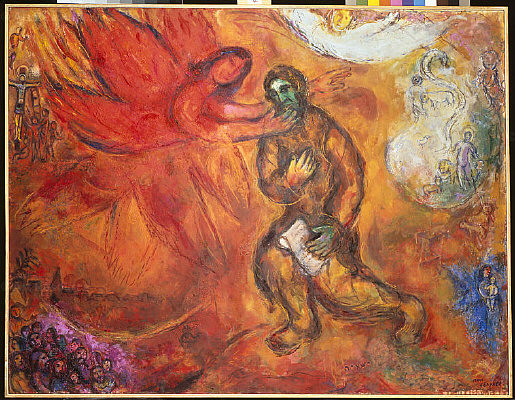
*Above painting of the prophet Isaiah by Marc Chagall, 1968









 Rev. Tim Ehrhardt