Becoming Holy (Isaiah 4:2-6)

And that’s when God’s Branch will sprout green and lush. The produce of the country will give Israel’s survivors something to be proud of again. Oh, they’ll hold their heads high! Everyone left behind in Zion, all the discards and rejects in Jerusalem, will be reclassified as “holy”—alive and therefore precious. God will give Zion’s women a good bath. He’ll scrub the bloodstained city of its violence and brutality, purge the place with a firestorm of judgment.

Then God will bring back the ancient pillar of cloud by day and the pillar of fire by night and mark Mount Zion and everyone in it with his glorious presence, his immense, protective presence, shade from the burning sun and shelter from the driving rain. (The Message)

One of the characteristics of Holy Scripture I deeply appreciate are the wonderful prose sections letting us, the readers and listeners, know that our longings for better days will come. There is a day coming when all of our good imaginings of the future shall be realized; and our present circumstances of hatred, discord, jealousy, and envy of one another shall be a thing of the past.

Unfortunately, we will likely (and biblically!) have to see some devastating and violent loss, and experience some terrible and awful destruction of both body and soul. All of the Old Testament prophets spoke messages of both judgment and grace, suffering and glory. Although hammered with ruin, biblical readers are given glimpses of hope to see the possibility of life beyond all of the carnage.

In other words, there will indeed be restoration and renewal. All shall not be lost forever. Death does not have the last word; resurrection does. It will happen because God has a determined resolve to find resilient ways of restoring the divine/human relationship back to its original and intended peaceful good.

It takes faith to have hope, and hope to have faith, and love to win the day forever. If God can create ex nihilo, out of nothing, then the Lord can reform and renew that which already exists, even though it may be in an awfully deformed state.

The ones who remain, the survivors, are the remnant of true believers, the people who hold onto faith and patience in the face of adversity, hardship, and difficulty. These are the dreamers, the seers, the prophets who foresaw both the need for divine judgment, and equally understood the promise of divine restoration.

The earth will once again be blessed. A rainbow of promise shall rise to remind us all that the storms which ravaged us have passed, never to return again.

But let us also clearly understand that it is because of human stubbornness, of hard-hearted people failing to love mercy and show steadfast love, that got us in this pickle of judgment to begin with. There comes a point when the repeated refusal to change, and use the gifts God has given us, leads to our shelf life on this earth coming to a moldy ruin. To be thrown into the divine incinerator is something brought on by us, not God.

Evil is like a cancer which must be purged from our existence so that we can be clean and healthy. The commands of God are not meant to keep people under a heavy divine thumb, but rather to help people live well in this world in a good healthy way. Living a holy life means that we participate in productive spiritual practices that strengthen faith and support the spirit.

People become “unclean” when they take a different path which is inconsistent with how we were designed by our Creator to live. It would be a bit like believing we can ignore all traffic laws and drive how we want, and then are surprised when we are nearly killed in an accident. Sadly, the unclean perish in their self-preoccupations, with God’s generosity completely off of their spiritual radar.

Yet, no matter where we’ve come from or what we have done, there is always the possibility of rehabilitation, of renewing our relationship to God, experiencing the divine presence, and receiving divine grace.

Getting in sync with the healthy spiritual forces of this universe is like having the ancient provision and protection of God’s pillar of cloud by day and fire by night – reassuring us that we are not alone and belong securely in the merciful arms of a loving Lord.

In Christianity, a holy life and a clean heart results from the person and work of Jesus Christ. God got down to it, taking the judgment we deserved and giving us grace. All of the temporary ritual cleanings merely pointed forward to the once for all scrubbing of the cross.

The blood of goats and bulls and the ashes of a heifer sprinkled on those who are ceremonially unclean sanctify them so that they are outwardly clean. How much more, then, will the blood of Christ, who through the eternal Spirit offered himself unblemished to God, cleanse our consciences from acts that lead to death, so that we may serve the living God!…

 and since we have a great priest over the house of God, let us draw near to God with a sincere heart and with the full assurance that faith brings, having our hearts sprinkled to cleanse us from a guilty conscience and having our bodies washed with pure water. Let us hold unswervingly to the hope we profess, for he who promised is faithful. (Hebrews 9:12-14, 10:21-23, NIV)

May you experience the blessing of becoming clean, and know the blessing of being holy and pure in all your relationships and activities. Amen.


The Restorative Powers of Grace (Jeremiah 31:10-14)

Listen to the Lord’s word, you nations,
    and announce it to the distant islands:
The one who scattered Israel will gather them
    and keep them safe, as a shepherd his flock.
The Lord will rescue the people of Jacob
    and deliver them from the power of those stronger than they are.
They will come shouting for joy on the hills of Zion,
    jubilant over the Lord’s gifts:
        grain, wine, oil, flocks, and herds.
Their lives will be like a lush garden;
    they will grieve no more.
Then the young women will dance for joy;
    the young and old men will join in.
I will turn their mourning into laughter
    and their sadness into joy;
        I will comfort them.
I will lavish the priests with abundance
    and shower my people with my gifts,
        declares the Lord. (Common English Bible)

In the seasons of our lives, when we go through those times of difficulty, it feels like a hard slog uphill that never seems to end. But it will not always be this way. Suffering will eventually give way to rejoicing; sickness will turn to health; estranged relationships will reconcile; and broken spirits will be made whole again.

God is the expert in restoration. Dilapidated communities, broken individuals, and peoples in diaspora can find fresh hope amid challenging circumstances. The initiative, interventions, and actions of God are what make the difference in turning sorrow to joy.

The Lord gathers scattered people together, as well as making the disparate parts of people into a unified whole again. And in this gathering action of God, no one is left behind. Attention is given to the stragglers, to those unable on their own strength or ability to journey on the road back to the Lord.

With the Lord’s movements of mercy, those with unfortunate circumstances are turned into the fortunate ones. The underprivileged become privileged. Grief, lament, and mourning give way to joy and a new lease on life. A great reversal occurs with God’s intervention. Sorrow is transformed into praise. Goodness is found in abundance because the Lord is a good God.

God calls people to action, to a response of experiencing the restorative powers of grace. The Lord encourages such behavior because it helps us never forget that no one and no circumstance is ever beyond the renewing grace of God. The effect of God’s merciful activity in the lives of people is singing, shouting, listening, and proclaiming.

With spiritual renewal, there is no mumbling of words, no timidity about being off tune when lifting a song of praise and thanksgiving. The lonely person, fragmented group, depressed community, polarized neighborhood, or scattered nation who becomes restored by God’s merciful grace is a newly minted exuberant people. Singing organically arises from them.

God’s restorative work causes shouts of joy to emanate deep within the soul. In fact, the Lord’s activity is so wonderful that even the rocks will cry out if the people don’t. A last second win in the sports stadium amongst thousands of fans doesn’t even hold a candle to the celebrative shouts of believers gathered and restored.

Whenever a people hear God’s voice and respond, it results in restoration. The desire to listen is then heightened, and obedience to God’s will becomes the norm, instead of the exception. Increased proclamation of good news happens, as a joyous and privileged response to God’s amazing grace. More and more people are included within the community, and hope rises beyond what anyone thought was possible.

Rescue and redemption are at the heart of God toward lost and wayward humanity. Divine intervention leads to restoration of individuals, neighborhoods, faith communities, even nations. Like a faithful shepherd over a flock of sheep, the Lord actively seeks the lost, brings them home, and continues to stand watch over them as a compassionate guardian.

And just as God redeemed the people out of Egyptian slavery and took them to a good land of abundance, so the Lord shall return those persons exiled from that abundant place and restore them to the peace of settled rest. The restoring action of God gathers the scattered. The lost are found. That which is fragmented is made whole. Those previously disabled become able. The weak become strong, the sick healed, the hungry fed, and the prisoner freed.

In times of famine, disease, poverty, hardship, confusion, and scant resources, there is hope. The Lord knows how to restore fortunes and bring untold abundance amid the most difficult of situations.

True joy comes through hard suffering. The pains of childbirth give way to unspeakable joy.

Christians are about to enter the season of Advent, after the long months of ordinary time. God, in Jesus Christ, is about to enter the world through a woman, in the flesh. The gracious work is about to begin, of ransoming, redeeming, and restoring a sinful world that had exiled itself from peace and abundance. In Christ, our lives are about to become full of blessing.

Praise the God and Father of our Lord Jesus Christ for the spiritual blessings that Christ has brought us from heaven! (Ephesians 1:3, CEV)

“I am the gate. Those who come in by me will be saved; they will come in and go out and find pasture. The thief comes only in order to steal, kill, and destroy. I have come in order that you might have life—life in all its fullness. I am the good shepherd, who is willing to die for the sheep.” (John 10:9-11, GNT)

May you know and experience the restorative grace of God in Christ today and every day. And may this upcoming season bring you fresh hope and a renewed faith. Amen.

Be Renewed (Joshua 24:25-33)

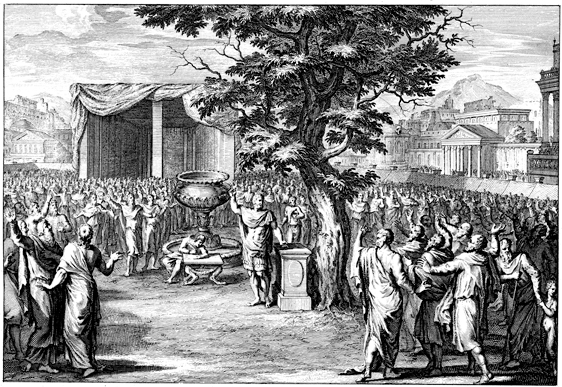
Joshua renews the covenant with the people of Israel, by David Martin (1639-1721)

On that day Joshua made a covenant for the people, and there at Shechem he reaffirmed for them decrees and laws. And Joshua recorded these things in the Book of the Law of God. Then he took a large stone and set it up there under the oak near the holy place of the Lord.

“See!” he said to all the people. “This stone will be a witness against us. It has heard all the words the Lord has said to us. It will be a witness against you if you are untrue to your God.”

Then Joshua dismissed the people, each to their own inheritance.

After these things, Joshua son of Nun, the servant of the Lord, died at the age of a hundred and ten. And they buried him in the land of his inheritance, at Timnath Serah in the hill country of Ephraim, north of Mount Gaash.

Israel served the Lord throughout the lifetime of Joshua and of the elders who outlived him and who had experienced everything the Lord had done for Israel.

And Joseph’s bones, which the Israelites had brought up from Egypt, were buried at Shechem in the tract of land that Jacob bought for a hundred pieces of silver from the sons of Hamor, the father of Shechem. This became the inheritance of Joseph’s descendants.

And Eleazar son of Aaron died and was buried at Gibeah, which had been allotted to his son Phinehas in the hill country of Ephraim. (New International Version)

All things, if they exist for any length of time, require renewal. This is especially true of relationships, and in particular, our relationship with God.

The book of Joshua is closely connected to the book of Exodus. God’s special relationship with Israel was confirmed with a covenant. God’s gave the Law to Moses as the leader of the people. And God brought a mighty deliverance to the Israelites from Egyptian bondage. These are all themes that linger with importance into the leadership and life of Joshua and the Israelites as they entered and inhabited the Promised Land.

Joshua was a faithful attendant to Moses, a model soldier, and an effective spy. After the death of Moses, Joshua was the appointed successor to bring Israel into Canaan and capture it. He was just as faithful to God and the people as Moses had been. In taking the land, Joshua made sure to do the following with the people:

  • Reminded all the Israelite tribes of their covenantal relationship and obligations to God
  • Allocated the land to each of the tribes, as specified by God’s command
  • Circumcised all the males that had been born during the forty years in the desert
  • Established cities of refuge, and cities for the Levites (because they had no land inheritance)
  • Admonished the people to be steadfast in observing the laws given to Moses by God 
  • Made it clear what the consequences are for any break or breach in the covenant agreement

Joshua did all of this by facilitating a covenant renewal ceremony. There were still some Canaanites in the land, and so, the Israelites were at risk of worshipping foreign deities and engaging in intermarriage. The people needed to have a collective memory of God’s deliverance, covenant, and law.

The covenant renewal emphasized obedience to the law and fealty to God because the Israelites are a holy nation, set apart for the Lord’s purposes. They were to serve the Lord with faithfulness and sincerity. There were to be no foreign gods whatsoever. Obedience would bring blessings, whereas disobedience would lead to the land being cursed.

As the mediator between God and Israel, Joshua commanded Israel to make a firm choice about what they were going to do. He was holding them accountable and ensuring they actively participate in the covenantal agreement.

The people declared that they would not forsake the Lord to serve other gods. And Joshua pledged to hold them accountable to their words and commitments.

Just as Israel was to be renewed in loyalty to their God, so we, too, in each generation of believers, must experience a renewal of our relationship to the Lord. We do so through reaffirmation, recording our response, and setting up a remembrance of the renewal.

Reaffirm

To reaffirm is to make a renewed commitment to something, usually verbally. In affirming God as the Lord, we are saying, “I believe!” So reaffirming repeats the belief, and makes it clear that you still feel that way. We make promises and make plans to keep them. We vow to be faithful and restate our love for God and God’s Word.

Joshua repeated, restated, and reaffirmed God’s Law for the people, so that they would know exactly what their responsibilities are, and pledge to keep them always.

Record

To record something is to establish a written record of what was said. Joshua made sure that everything was written down so that nobody in the future could say something contrary, or forget what was said.

One of the most powerful ways we can engage in personal renewal is by actually recording our promises and commitments to the Lord in a journal. The act of writing, in-and-of itself, is a transforming practice. And when we couple the practice with important and impactful words of intention and desire, then we are doubling our chances of actually following through and doing what we say we will do.

Remember

Memory is more than the mind. Remembering is activated with tangible things that we can see, touch, or smell. With the Israelites, Joshua set up a huge stone as a remembrance of what was said and promised. And he engaged the imagination by stating that the stone heard it all – and would hold them all accountable.

Physical objects, such as the cup and the bread in Christian communion, press the remembrance much better and deeper into both our minds and our hearts. Anything in life that is vital to remember ought to have a tangible item which symbolizes the importance of the memory.

Experiencing renewal in life doesn’t simply happen, but is an intentional process of reaffirming, recording, and remembering. Concerning God’s Word, Holy Scripture is something worth putting the effort into in order to realize new life and a renewed relationship with the Lord.

O God, King eternal, your light divides the day from the night and turns the shadow of death into the morning: Drive from us all wrong desires; incline our hearts to keep your law; and guide our feet into the way of peace; so that, having done your will with cheerfulness during the day, we may, when night comes, rejoice to give you thanks, through Jesus Christ our Lord. Amen.

Restoring True Religion (Micah 1:1-5)

The word of the Lord that came to Micah of Moresheth during the reigns of Jotham, Ahaz and Hezekiah, kings of Judah—the vision he saw concerning Samaria and Jerusalem.

Hear, you peoples, all of you,
    listen, earth and all who live in it,
that the Sovereign Lord may bear witness against you,
    the Lord from his holy temple.

Look! The Lord is coming from his dwelling place;
    he comes down and treads on the heights of the earth.
The mountains melt beneath him
    and the valleys split apart,
like wax before the fire,
    like water rushing down a slope.
All this is because of Jacob’s transgression,
    because of the sins of the people of Israel.
What is Jacob’s transgression?
    Is it not Samaria?
What is Judah’s high place?
    Is it not Jerusalem? (New International Version)

What is true religion?

Divine union with God is the whole point of religion.

In saying that, you may have reacted reflexively or viscerally. That’s because it’s likely that your experience of religion has been anything but a mystical and wondrous connection with the Lord. The religious trappings, that you perhaps grew up with, were anything but helpful in knowing God.

That is both unfortunate and sad. In the absence of genuine unity with God, moralism diabolically worms its way into religion to replace spiritual practices of helpful connection, with legalistic rules of unhelpful separation.

Religion gets a bad rap. That’s likely because how we may typically think about it is really no religion, at all. True religion has a singular aim: how to connect us with the divine, that is, how to make one out of two. If we have to keep overcoming man-made obstacles in order to connect with God, this is irreligious, not religious.

How ought we to understand sin?

As a little test to this, as you read today’s Old Testament lesson from the prophet Micah, did you assume that the sins of Israel had to do with disobeying the rules, of breaking the law, of immoral worship? Or did you wonder if the sins of the people had to do with all the ways they created distance and separation between themselves and God?

The word of the Lord to the prophet Micah was not speech directed against the usual supposed devils of secularism or scientism. Instead, God was deeply concerned about the things that widened the gap between God and the people.

A divine/human union, a loving relationship between the Lord and people, an intimate knowing of one another, has always been at the heart of God’s understanding of religion. Anything less is demonic. God desires a mutual knowing and seeing, and not setting up altars which block the connection.

“The eye through which I see God is the same eye through which God sees me; my eye and God’s eye are one eye, one seeing, one knowing, one love.”

Meister Eckhart

Have we become separated?

Israel had lost their connection with God, and so, were no longer participating with the Lord in the divine/human cooperative of love. And God was not letting this happen without a clarion call to come back to the relationship.

The language of coming down from heaven and melting things is a reference to eliminating all the obstacles that stand in the way to true religion. The Lord will cataclysmically level everything in order to smooth the way between God and God’s people.

The capital cities, Samaria of Israel and Jerusalem in Judah, were the offenders in creating the blockage. Their high places of worship will be leveled to pave the road for unhindered fellowship; and a renewed and restored religion, based upon social justice for all, economic equity, and inclusive practices.

The severed connection with God became the fodder for all sorts of unjust thoughts and actions.

Woe to those who plan iniquity,
    to those who plot evil on their beds!
At morning’s light they carry it out
    because it is in their power to do it.
They covet fields and seize them,
    and houses, and take them.
They defraud people of their homes,
    they rob them of their inheritance.

Shall I acquit someone with dishonest scales,
    with a bag of false weights?
Your rich people are violent;
    your inhabitants are liars
    and their tongues speak deceitfully. (Micah 2:1-2; 6:11-12, NIV)

Idolatry, in the guise of alternative forms of worship, is sinful in the sense that it’s humanity’s attempt at having their ultimate needs met outside of the religion given to them. Religion must be a conduit for enabling us to spiritually connect with the Lord. Establishing practices which marginalize God put people at risk of becoming feral worshipers who run about doing everything but discovering their true selves and the one true God.

It is time for us to recognize and celebrate that we are connected to each other by a power greater than all of us, and that our connection to God and each other is grounded in love and compassion.

How do I make a spiritual connection?

There are three dimensions to the spirit: the head (thoughts), the heart (emotions), and the gut (actions).  Each dimension is meant to work together in alignment so that we can move forward toward healing, health, wholeness, integrity, peace, and relationship.

  • The Head deals with questions such as, “Who am I? What is the meaning of life? Who is God?”
  • The Heart considers our emotional selves by asking,“What am I feeling? What is my view of God? How do I give and receive love?”
  • The Gut taps into the embedded image of God within us by contemplating, “What is the good life? To whom will I show compassion? Will I listen to myself and others?”

My friends, we have 15 prophetic books in the Bible because this problem of messed up religion has become an awful impediment to genuine spirituality. It was not only a problem all those millennia ago; it’s still an issue today.

So, let’s take a serious reading of the prophet Micah, and his prophetic biblical companions; and let us restore and renew true religion among ourselves, so that humanity can become the just and good people we were always destined to be by our Creator.

Almighty God our heavenly Father, guide the nations of the world into the way of justice and truth, and establish among them peace, which is the fruit of righteousness, so that they may become the kingdom of our Lord and Savior Jesus Christ. Amen.