Praise the Lord! Because it is good to sing praise to our God! Because it is a pleasure to make beautiful praise!
The Lord rebuilds Jerusalem, gathering up Israel’s exiles. God heals the brokenhearted and bandages their wounds. God counts the stars by number, giving each one a name. Our Lord is great and so strong! God’s knowledge cannot be grasped! The Lord helps the poor, but throws the wicked down on the dirt!
Sing to the Lord with thanks; sing praises to our God with a lyre! God covers the skies with clouds; God makes rain for the earth; God makes the mountains sprout green grass. God gives food to the animals— even to the baby ravens when they cry out. God does not prize the strength of a horse; God does not treasure the legs of a runner. No. The Lord treasures the people who honor him, the people who wait for his faithful love. (CEB)
Early each morning I rise, take the dog for a short walk, make a cup of coffee, then open the life-giving message from the God of the Bible. I read out loud – slowly, mindfully, carefully – allowing the words to seep and make their way down into my soul.
The Holy Spirit of God gently nudges, sometimes forcefully hurls, me toward a verse, phrase, or word from the text. Contemplating, ruminating, thinking about the Holy Scripture begins to set the trajectory of my day. God is throughout the hours, as I move from one to the next. Sometimes the Lord and Scripture are very much at the forefront of my thinking, other times in the background shaping how I speak and act, and always on my heart enlarging it and filling it with his grace.
Most of life is lived in the mundane. The banality of life is the norm, even in times of change. While others run from prayer to prayer looking for miracles and the next big spiritual high, the one who is patient… waits… and honors God… has a treasure within which transcends language or outward fanfare. The settled conviction of the person in continual communion with the God of the universe peacefully waits for faithful, steadfast, committed, divine love.
There is no description for such a divine/human spiritual relation which exists, giving patience to the penitent and joy to the heart of God. Such love exists beyond the plane of daily news crises and the continual hum of the crowd. Indeed, the Lord God Almighty, Creator of heaven and earth, has stooped to cup his hands and treasure the creature formed in the divine image.
“Prayer is an act of love; words are not needed. Even if sickness distracts from thoughts, all that is needed is the will to love.”
Teresa of Ávila
Patience is not a bore. To wait is to be at peace. Because God is there. And it is good to be full of God.
O God of peace, you are the one who has taught us that in returning and rest we shall be saved, in quietness and in confidence shall be our strength: By the might of your gentle Spirit, lift us, we pray, to your loving presence, where we may be still and know that you are God; through Jesus Christ our Lord. Amen.
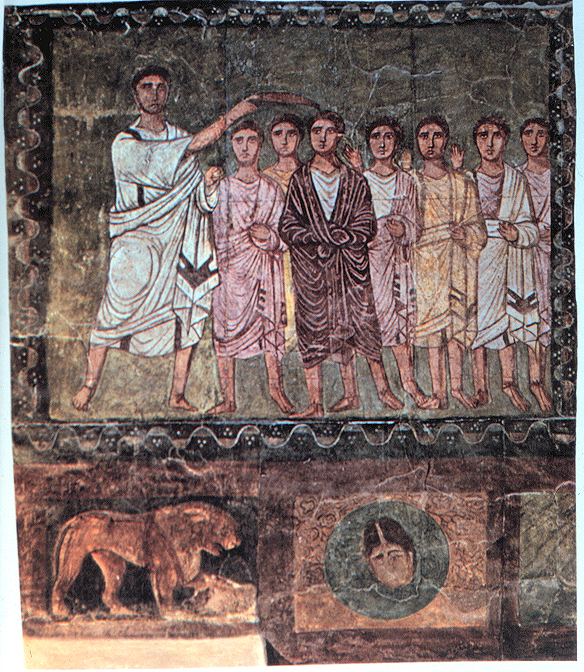
Samuel Anoints David as King, Syrian Orthodox Church, 3rd Century C.E.
The Lord said to Samuel, “How long will you mourn for Saul, since I have rejected him as king over Israel? Fill your horn with oil and be on your way; I am sending you to Jesse of Bethlehem. I have chosen one of his sons to be king.”
But Samuel said, “How can I go? If Saul hears about it, he will kill me.”
The Lord said, “Take a heifer with you and say, ‘I have come to sacrifice to the Lord.’ 3 Invite Jesse to the sacrifice, and I will show you what to do. You are to anoint for me the one I indicate.”
Samuel did what the Lord said. When he arrived at Bethlehem, the elders of the town trembled when they met him. They asked, “Do you come in peace?”
Samuel replied, “Yes, in peace; I have come to sacrifice to the Lord. Consecrate yourselves and come to the sacrifice with me.” Then he consecrated Jesse and his sons and invited them to the sacrifice.
When they arrived, Samuel saw Eliab and thought, “Surely the Lord’s anointed stands here before the Lord.”
But the Lord said to Samuel, “Do not consider his appearance or his height, for I have rejected him. The Lord does not look at the things people look at. People look at the outward appearance, but the Lord looks at the heart.”
Then Jesse called Abinadab and had him pass in front of Samuel. But Samuel said, “The Lord has not chosen this one either.” Jesse then had Shammah pass by, but Samuel said, “Nor has the Lord chosen this one.” Jesse had seven of his sons pass before Samuel, but Samuel said to him, “The Lord has not chosen these.” So, he asked Jesse, “Are these all the sons you have?”
“There is still the youngest,” Jesse answered. “He is tending the sheep.”
Samuel said, “Send for him; we will not sit down until he arrives.”
So, he sent for him and had him brought in. He was glowing with health and had a fine appearance and handsome features.
Then the Lord said, “Rise and anoint him; this is the one.”
So, Samuel took the horn of oil and anointed him in the presence of his brothers, and from that day on the Spirit of the Lord came powerfully upon David. Samuel then went to Ramah. (NIV)
Solitude by Polish artist Piotr Dura
Appearances can be deceiving. One of the best ways to see beyond mere physical sight is to engage in the spiritual practice of solitude. Solitude is not loneliness but a deliberate retreat from normal routines to be alone with the Lord. The faith of both Samuel and David were strengthened through solitude. It prepared them for public service and made them godly. Because they had established patterns of being alone with God, they had an inward solitude even when in a crowd. That is why Samuel could have an interaction with the Lord, even when among lots of people.
Solitude is important because it is the true path to listening well. A person whose faith has been shaped through solitude has an ability to carry on a dialogue with God while, at the same time, having a conversation with others.
Christ’s relationship with the Father was formed through solitude. Jesus was able to have simultaneous conversations with God and people since he practiced solitude on a regular basis. Jesus began his ministry with solitude (Matthew 4:1-11); made major decisions through solitude (Luke 6:12); and taught his disciples to practice solitude (Matthew 17:1-9; 26:36-46).
Solitude is necessary because engaging the world is important. Effective interaction with others requires times of retreat for solitude with God. Solitude as a spiritual discipline:
Gives us freedom from the need for constant noise and activity.
Allows God to shape our faith rather than conform to the world.
Liberates us from other people’s expectations for us.
Helps quiet internal noise and racing thoughts so we can better listen to God.
Provides the opportunity for reflection upon and preparation for future events.
Creates encouraging speech for the benefit of others.
Fuels a desire to keep practicing solitude because of its benefit.
Solitude taught Samuel obedience.
Samuel learned obedience through years of solitude with old Eli the priest. “Speak Lord, for I am listening” became a way of life for Samuel, as he was trained in how to listen well.
Samuel’s greatness as the Judge of Israel did not lie in his original ideas or the initiatives he took, but in simple obedience to the commands of God. Years of obscurity and solitude as a child created the ability to hear and carry-out what the Lord told him to do.
Even Samuel, as godly as he was, could not rely on personal observations about choosing the next king of Israel. Because he had long years of practicing solitude with the Lord, Samuel was able to clearly hear divine speech and anointed the right person as king. Samuel did not trust his own judgment but relied on God’s direction.
Solitude characterizes God.
Christians serve a triune God of Father, Son, and Spirit. God has complete and perfect solitude along with focused engagement with humanity. Through spending time with God, people can simultaneously interact with divinity and humanity. It is a bit like my wife who began her broadcasting career in radio by simulcasting the AM station in one ear of her headphones, and the FM station in the other ear. She could que a record for the FM station while, at the same time, forecasting the weather for the AM station. Her ability was born of practice and commitment to her craft. In the same way, we have been given a vocation to engage the church and world, and the ability to have a solitude of heart while interacting with others.
God, unlike us, sees us completely, inside-and-out – which is why we are dependent upon solitude of heart so that we can make proper judgments. God urged Samuel to not look at the outward appearance because this is how wrong judgments happen.
Solitude formed David into a king.
David was on nobody’s short list to become king. He was so far out there as a candidate for the position that his own family did not even think it necessary to have him present for the sacrificial feast. It is just like God to have a way of choosing the people we think would be the least likely to do anything.
Being in the pasture day after day and night after night by himself was just the right curriculum that trained the next king. Shepherding was not a lonely affair for David. It was a rich experience of solitude which developed a solid relationship with God. Out in the field, away from all the wrong judgments of the world, David learned to discern God’s voice – a skill he carried with him the rest of his life.
Solitude might seem unrealistic for extroverts, and only something for introverts. Yet, solitude is essential to creating a robust faith in God. The following are some steps toward the practice of solitude and allowing it to bring you into a closer walk with the Lord.
Practice “little solitudes” in the day. The early morning cup of coffee or shower, the drive-time to work, the lunch break, the quiet at night when all is dark and everyone in bed are opportunities for solitude with God to reorient and redirect our lives.
Find or create a quiet place designed specifically for solitude. It might be a room, a closet, or a chair. It might be outdoors. It can be anywhere that helps you be free from distraction and invites you to connect deeply with Jesus.
Begin the day by spending at least 10 minutes alone with God in silence. Over time, work your way to even more minutes, even hours. I am a believer in an hour a day keeping the devil away. Eventually, take an entire day away, every few months. Consider taking a weekend or even a week away once a year.
Read Holy Scripture slowly and meditatively. Listen to what the Spirit may be saying in your reading.Keep a journal handy and write down your observations. Allow prayers to arise from what you hear from the Lord.
This might seem optional only for those with discretionary time – but it is no more optional than planting in the Spring to get a harvest in the Fall. Such fruit results in the slaying of giants….
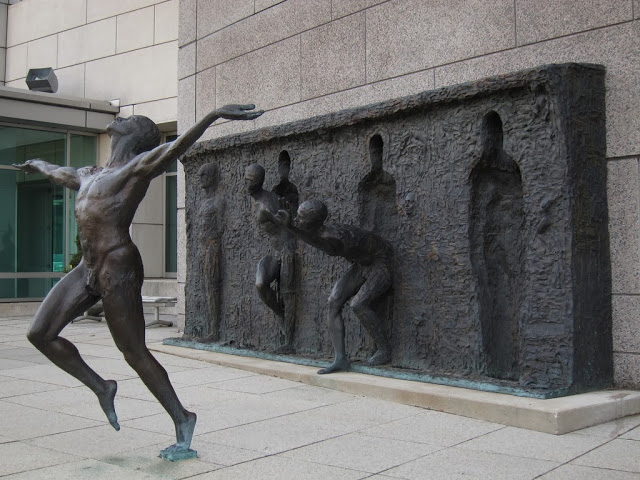
Freedom by Zenos Frudakis in Philiadelphia, Pennsylvania
Jesus said, “When an evil spirit comes out of a person, it travels through dry places looking for a place to rest, but it finds none. So, it says, ‘I will go back to the home I left.’ When it comes back, it finds that home still empty. It is all neat and clean. Then the evil spirit goes out and brings seven other spirits more evil than itself. They all go and live there, and that person has even more trouble than before. It is the same way with the evil people who live today.” (ERV)
Nature abhors a vacuum. A tilled plot of soil will be overtaken with weeds if nothing is planted and nurtured in the turned-over dirt. The pecking order of a brood of chickens cannot handle the death of the top hen without filling the position almost immediately. And, in the spiritual realm, the exorcising of a demon will not simply leave a person empty of evil – his/her life will be filled with something in its place.
Today’s Gospel story, told by Jesus, about the man who is delivered from an unclean spirit, is a powerful and simple narrative on the necessity of true repentance. Genuine freedom is more than getting rid of something bad and destructive; the evil must be replaced with something good and useful. That is, biblical repentance is both a turning away from ungodliness and an embrace of righteousness.
We are delivered from evil so that we can start living into the righteousness and peace intended for us.
For example, the Apostle Paul exhorted the Ephesian believers to not only stop stealing but also to get a job and start sharing with others. They were not only to stop lying and using their tongues for gossip and slander and start using their words to speak truth that builds up others. (Ephesians 4:25-32)
The spiritual principle is the same as the nature principle: A empty vacuum will always be filled. The man who did not fill his life with God ended up having a problem with evil seven times greater than when he started.
If anything, or anyone, is emptied of its unhealthy elements and practices, it is imperative that the hole be immediately filled with healthy disciplines for life.
Whether dealing with addictions, bad habits, or any kind of evil influence, a two-pronged approach is needed for its eradication. We expel the evil by replacing it with godliness. The man struggling with pornography or adultery must not only stop the behavior but take up the mantle of being a champion for women’s issues. The woman who has no healthy boundaries and allows herself to be used and abused must not only separate from the problem or person but adopt her identity in Christ as a precious child of God and enforce righteous limitations.
None of these examples are meant to be simplistic answers to complex situations. Rather, they illustrate why so many people do not experience freedom and continue to have even greater enslavement to their passions and sufferings.
Freedom is realized through replacing old practices with new disciplines that directly attack the old.
We all have needs. How we get those needs met is often a mixed bag of both legitimate and illegitimate ways. In a perfect world, everyone would be aware of their needs and be able to express them to one another without shame, anxiety, or anger. Since we live on a blemished fallen planet, we end up trying to meet our needs indirectly through hustling for love, hoarding resources, and controlling others – all harmful ways which destroys souls and relationships.
So, unless we focus on positively meeting our needs, we must go a step beyond dropping a toxic relationship, cutting up a credit card, or saying “no” to another responsibility. We often get into our mess to begin with because we are out of touch with ourselves and our needs. We need affection and encouragement, and there is no shame in needing this. We need security and safety, and there is no problem in acquiring this. There are some things we need to control, and that is okay.
If we fail to address our needs, we might do the necessary work of deliverance, then turn right around and become worse off than before by filling the empty place of our lives with:
Being all things to all people, as if we were the Messiah.
Being successful so that we stay ahead of being needy.
Pulling inside ourselves and trusting nobody.
Distancing from our needs and pretending they are not there.
Being continually vigilant so that we are never hurt that way again.
Keeping a positive spin on everything, as if there is no negative stuff in the world.
Challenging other’s opinions and behaviors to keep the focus off our needs.
Becoming a wallflower so that we can never be the brunt of someone else’s vitriol or evil.
Instead, we can let Jesus fill the emptiness with love, purpose, peace, joy, attention, and grace. Christ is the Savior who delivers us from evil, and the Holy Spirit is the Sanctifier who carefully applies the work of salvation to our lives.
When our hearts and minds are full of God, there is no place for the demons to get in.
True repentance equally forsakes evil and embraces righteousness; replaces the unhealthy with the healthy; jettisons the illegitimate and seeks the legitimate; and puts away unnecessary suffering and pursues peace and joy in the Spirit.
O God, I no longer want to live with saying I’m sorry and going right back to the old pig slop of sin. I cannot change on my own. I need Jesus to both take away the sin and give me a new life of living for him. Lead me not into temptation but deliver me from evil Help me to make choices that put to death the old way of life, and the courage to live into my forgiveness in the power of the Holy Spirit. Amen.
From time to time, the Lord would choose special leaders known as judges. These judges would lead the Israelites into battle and defeat the enemies that made raids on them. In years gone by, the Israelites had been faithful to the Lord, but now they were quick to be unfaithful and to refuse even to listen to these judges. The Israelites would disobey the Lord, and instead of worshiping him, they would worship other gods.
When enemies made life miserable for the Israelites, the Lord would feel sorry for them. He would choose a judge and help that judge rescue Israel from its enemies. The Lord would be kind to Israel as long as that judge lived. But afterwards, the Israelites would become even more sinful than their ancestors had been. The Israelites were stubborn—they simply would not stop worshiping other gods or following the teachings of other religions.
The Lord was angry with Israel and said:
The Israelites have broken the agreement I made with their ancestors. They won’t obey me, so I’ll stop helping them defeat their enemies. Israel still had a lot of enemies when Joshua died, and I’m going to let those enemies stay. I’ll use them to test Israel, because then I can find out if Israel will worship and obey me as their ancestors did.
That’s why the Lord had not let Joshua get rid of all those enemy nations right away. (CEV)
Listening seems to be a lost art and a forgotten skill. Genuine focused attention on another person through careful listening takes practice. Maybe that is one reason there is a paucity of authentic hearing these days – it is just so doggone hard. Throw into the mix that a lot of folks like hearing their own voice, and you have a recipe for poor communication.
God is good at everything, especially listening.
The Lord is the Master Listener. In fact, God is so good at it that divine ears hear the prayers of people all over the world. The same careful attention is given to both the little girl in the West who intercedes for her parents and teddy bear at night, as well as halfway around the world with the national leader who requests wisdom for decisions in a heated meeting.
The Lord God Almighty is gracious, merciful, and kind, hearing us when we call, and listening when we our hearts long for the divine. God always bends low in a posture of listening to all creation. As creatures in the image of God, we were meant from the very beginning of creation to listen well. Yet, ever since humanity fell into disobedience, people have the tendency to talk more than they listen, to sometimes refuse to hear what another is saying. There are even those who ignore God’s speech.
The ancient Israelites in the book of Judges were fickle in their attention to God. When things were bad, they cried out to the Lord. Because God attentively listens, they were heard, and a merciful divine response came. However, when things were better, the people went about their business and forgot about God’s deliverance.
It was God who sent judges, rulers, and leaders, to the people for their own welfare. Instead of graciously receiving such a gift from God, the people were quick to be unfaithful and to refuse even to listen the divinely sent judges. Listening, really listening, was not a high value to the people. They talked and talked, incessantly droning on, and so could not hear what God through the divinely appointed rulers was saying.
We are to listen well because God listens well.
We are to pay attention and hear because we are designed by our Creator to do so. Perhaps our society would not be so perpetually upset and polarized if we would just take the time to take notice and take advice through a posture of humble hearing.
Try this little exercise of listening: Take just ten minutes and do not talk, read, check your phone, or do anything but just listen to the sounds around you…. What do you hear?… What do you think God is saying to you through those sounds?… How will you to respond?
Stillness reveals the secrets of eternity, allowing us to hear the still small voice of God. Sound is amplified through silence. If we desire a clear word from the Lord, then stillness and silence are the spiritual practices that will allow it to happen. Life’s most precious moments are not all loud or uproarious, for silence and stillness have their own virtues which connect us with the divine. Never underestimate the power of doing nothing.
God of all creation, you have made me with two ears for listening. Help me to so hear and distinguish you through creation and the voices of others so that I will follow Christ with confidence in my daily life. Almighty and everlasting God, you are always more ready to hear than we to pray, and to give more than we either desire or deserve. Pour upon us the abundance of your mercy, forgiving us those things of which our conscience is afraid, and giving us those good things for which we are not worthy to ask, except through the merits and mediation of Jesus Christ our Savior; who lives and reigns with you and the Holy Spirit, one God, forever and ever. Amen.