Acts 1:1-11 – When Will We Engage in Our Ministry?

In my former book, Theophilus, I wrote about all that Jesus began to do and to teach until the day he was taken up to heaven, after giving instructions through the Holy Spirit to the apostles he had chosen. After his suffering, he presented himself to them and gave many convincing proofs that he was alive. He appeared to them over a period of forty days and spoke about the kingdom of God. On one occasion, while he was eating with them, he gave them this command: “Do not leave Jerusalem, but wait for the gift my Father promised, which you have heard me speak about. For John baptized with water, but in a few days you will be baptized with the Holy Spirit.”

Then they gathered around him and asked him, “Lord, are you at this time going to restore the kingdom to Israel?”

He said to them: “It is not for you to know the times or dates the Father has set by his own authority. But you will receive power when the Holy Spirit comes on you; and you will be my witnesses in Jerusalem, and in all Judea and Samaria, and to the ends of the earth.”

After he said this, he was taken up before their very eyes, and a cloud hid him from their sight.

They were looking intently up into the sky as he was going, when suddenly two men dressed in white stood beside them. “Men of Galilee,” they said, “why do you stand here looking into the sky? This same Jesus, who has been taken from you into heaven, will come back in the same way you have seen him go into heaven.”

When will we engage in our ministry? The short answer: Now.

The angels in this story sound a lot like my mom when I was a kid: “Why are you just standing there looking into an empty sky?  You need to quit your gawking and get to work!”

But sometimes we can be confused about what it is we are supposed to be about or when we are supposed to do it. Jesus was quite clear about what the mission of his followers is to be: witnesses.  And the angels essentially tell the disciples to quite their gawking and get to work on being witnesses.

Being a Witness Now

The mission is not simply to do some sort of evangelical job of witnessing, but to be a witness. What we do flows from who we are and what we have seen. If we have seen and experienced the risen Lord, we are witnesses. We then tell of what we have seen and heard, not necessarily because it’s our job, but because we just cannot help it.

A mom nurtures her kids because she is a mom; it isn’t just a job – it’s who she is. To be a witness involves the kind of people we are. The word “witness” is literally the term “martyr.”  A martyr, as the term has been used throughout church history, is:

  • One who chooses to suffer death rather than deny the person and work of Jesus Christ.
  • One who bears testimony to the truth of what they have seen or have experienced with God.
  • One who sacrifices all things to further God’s kingdom.
  • One who is willing to endure anything from anyone to maintain their Christian witness. 

A martyr is someone we are, not a task that gets checked off a to do list.

There is a clear mandate and mission given by Jesus, the Head of the Church: We are witnesses. We are participants in service to Christ the King, and not fans of Jesus only cheering in the bleachers. It’s a very different experience being a fan in the stands than a player on the field.

In baseball, some fans think they know what all the right calls are, then graciously let the umpire know when he is wrong. Being a spectator is significant. Yet, for us here on this earth, it is not yet our time for that. Those who have gone before us, lived in faith, and were martyrs, are testifying to us….

Some faced jeers and flogging, and even chains and imprisonment. They were put to death by stoning; they were sawed in two; they were killed by the sword. They went about in sheepskins and goatskins, destitute, persecuted and mistreated—the world was not worthy of them. They wandered in deserts and mountains, living in caves and in holes in the ground. These were all commended for their faith, yet none of them received what had been promised, since God had planned something better for us so that only together with us would they be made perfect….

Therefore, since we are surrounded by such a great cloud of witnesses [martyrs], let us throw off everything that hinders and the sin that so easily entangles. And let us run with perseverance the race marked out for us, (Hebrews 11:36-40, 12:1, NIV)

The Christian fans in the heavenly stands are witnessing that they have participated in God’s mission. And they are not unruly – spilling their beer on people and getting kicked out of the stadium. Instead, they are encouraging us who are here, right now, on this earth, seeking to fulfill Christ’s mandate.

Those who have gone before us are passing the baton of leadership and the message of good news to us – and they expect us to run with it – not to try and sit in the stands as spectators because it is not yet our time.  They are cheering us on, letting us know it’s all worth it.

Now is the time to be witnesses of what God in Christ has done and is doing. God created a perfect world. Man and woman fell into disobedience and sin. Now, God is in the business of restoring and renewing all creation. So, we are to witness to what God has done, and is doing, because our identity is thoroughly in Jesus Christ. It is our heritage and our privilege.

“Let God be the Judge. Your job today is to be a witness.”

Warren Wiersbe

In the 1990s a Christian prisoner in Cuba was asked to sign a statement containing charges against fellow Christians that would lead to their arrest. He said, “The chain keeps me from signing this.” The communist officer protested, “But you are not in chains!” “I am,” said the Christian. “I am bound by the chain of witnesses who throughout the centuries gave their lives for Jesus Christ. I am a link in this chain. I will not break it.”

Christ’s words are directed to us: “You will be my witnesses,” you and me. If we look at this as merely a task, we will likely give up and whine, saying, “This is too hard. It takes too much time. There’s too much suffering. This isn’t for me!” 

If we understand our identity as being a witness, then we will love God with all our heart, soul, mind, and strength. We willingly abandon our own personal agendas and adopt the will of God for our lives. And the will of God is that we embrace our identity as witnesses to the redemptive events of Jesus – Christ’s incarnation, holy life, compassionate ministry, suffering and death, rising from the grave, and ascending to heaven.

What do you have to witness to? Here is a teenage girl’s witness when he stood glaring at her, his weapon before her face, asking, “Do you believe in God?” She paused because it was a life or death question. “Yes, I believe in God.” “Why?” asked her executioner. But he never gave her the chance to respond. The 17-year-old girl lay dead at his feet. 

This scene could have happened in the Roman coliseum, in the Middle Ages, or in any number of countries around the world today. People are still being imprisoned, tortured, and killed every day because they refuse to deny the name of Jesus. This particular story, though, did not happen in ancient times or in another country. It happened at Columbine High School in Littleton, Colorado on April 20, 1999.

Being a Witness Everywhere to Everyone Now

The original witnesses of Jesus Christ embraced the mandate of being witnesses. Not far into the New Testament book of Acts, 3,000 people in Jerusalem were converted to Christianity through one sermon from Peter’s witness. Philip broke all kinds of taboos by going to Samaria and being a witness to the half-breed Samaritans. Peter broke all convention by going into a Gentile’s house and seeing the Spirit come on them. Saul, who became Paul, was dramatically converted and went on three separate missionary journeys so that he could take the good news of Jesus Christ to the ends of the earth.

We are to be witnesses wherever we go with whomever we encounter. We will be witnesses in Jerusalem (our families); in Judea (our community); in Samaria (other races and people different from ourselves); and, to the ends of the earth (overseas).

Being a Witness Through the Spirit’s Empowerment Now

Only after giving the mission to his followers did Jesus ascend to heaven. The ascended Lord is to be our confidence and our hope. We are not alone. We possess Christ’s authority and the Spirit’s help. The power to be a witness is not generated from within us but comes from God’s Spirit.

Jesus will return. Until then, we are to be his witnesses. It’s not the time to sit in the bleachers. We have been given power to accomplish the mission before the end of this world comes, and before Jesus comes again to judge the living and the dead.

Being a witness is not a one-time, one-size-fits-all work. Our own witness is just that: ours. We all have our own stories of faith and experiences of the risen and ascended Christ. There’s really nothing flashy or sexy about being a witness. Rather, it mostly entails a consistent and patient witness of love. It’s a lifestyle and a way of life in which our love for God pours out of our heart and soul and is expressed with all our mind and strength.

Every Christian can witness to what God is doing in their life – to tell our story of what God has done and is doing with us.

Holy God, you are making all things new through your gracious reconciling and restorative work. Grant us, your people, the vision to see you at work in our world healing our brokenness and making us new. Grant us the wisdom to hear your voice through the noise that surrounds us. And grant us the courage to bring to fruition the world you are creating, through Jesus Christ our Lord, in the power of your Holy Spirit. Amen.

Romans 8:1-11 – Life in the Spirit

Therefore, there is now no condemnation for those who are in Christ Jesus, because through Christ Jesus the law of the Spirit who gives life has set you free from the law of sin and death. For what the law was powerless to do because it was weakened by the flesh, God did by sending his own Son in the likeness of sinful flesh to be a sin offering. And so he condemned sin in the flesh, in order that the righteous requirement of the law might be fully met in us, who do not live according to the flesh but according to the Spirit.

Those who live according to the flesh have their minds set on what the flesh desires; but those who live in accordance with the Spirit have their minds set on what the Spirit desires. The mind governed by the flesh is death, but the mind governed by the Spirit is life and peace. The mind governed by the flesh is hostile to God; it does not submit to God’s law, nor can it do so. Those who are in the realm of the flesh cannot please God.

You, however, are not in the realm of the flesh but are in the realm of the Spirit, if indeed the Spirit of God lives in you. And if anyone does not have the Spirit of Christ, they do not belong to Christ. But if Christ is in you, then even though your body is subject to death because of sin, the Spirit gives life because of righteousness. And if the Spirit of him who raised Jesus from the dead is living in you, he who raised Christ from the dead will also give life to your mortal bodies because of his Spirit who lives in you. (New International Version)

I feel tremendously privileged to be a Christian and enjoy the very Spirit of God. The people of God are spiritual people, possessing God’s own Spirit. The Apostle Paul wanted Christians to know what they truly have as believers in Jesus.

No Condemnation

There is now no condemnation, no judgment, for those who are in Christ. God has pronounced a verdict, and that decision is final. We have been united to Christ by means of God’s Spirit. Since God condemns neither you nor I, there is no need whatsoever to condemn ourselves or other believers.

Since no condemnation is our reality as Christians, we are to believe this promise of God and swim in its wonderful privilege. 

Believe that the sin issue has been taken care of once for all through the life and death of Christ. If you do not feel forgiven, then put yourself in a position to believe. 

It would be silly to go into the bathroom, turn on the shower, and then just stand in the middle of the bathroom without getting under the showerhead. It would be silly because you did not put yourself in a position to actually become clean. You may believe that a shower and using soap and shampoo will make you clean, but if you do not actually avail yourself of the privilege of actually taking the shower but just stand there and look at it, you will not really be clean. 

We must put ourselves in a position to experience the privilege of knowing our wonderful state of cleanliness and no condemnation by actually reading the Word of God on a regular basis; praying in the Spirit on all occasions; and practicing the silence and solitude necessary to receive the cleansing work of the Holy Spirit.

Two people are declared “married” in a formal wedding ceremony. The couple then works out their shared union together over a lifetime. The minister does not pronounce condemnation at the ceremony; he declares a blessing. Yet, from that point forward, the two people must work on their marriage. They must believe their relationship is important enough to warrant putting themselves in a position to grow together. They will intentionally create date nights and conversations on the couch. They’ll seek to learn, appreciate, and participate in the other’s interests and life. 

“Grace is not opposed to effort; it is opposed to earning. Earning is an attitude. Effort is an action. Grace, you know, does not just have to do with forgiveness of sins alone.”

Dallas Willard, The Great Omission

Just as we do not marry ourselves and pronounce ourselves a married couple, so we do not save ourselves. However, having a marriage license does not mean there is no effort to be done in the relationship. A marriage is both a legal reality, and a kind of mystical union between two married persons.

It is a beautiful thing to be in a relationship where there is no condemnation. Because of Jesus Christ we are free to be the people God created us to be – forgiven and no longer burdened by sin’s condemnation.

Freedom from Sin and Death

In Holy Scripture, sin is not only a personal struggle but a present ubiquitous reality in the world. The power and presence of sin is found everywhere. There is personal, institutional, and systemic sin. Because sin is everywhere, death is everywhere. Biblically, death doesn’t only refer to physical death but is also a relational term referring to spiritual death. Death means relational separation from God. Conversely, life is relational connection with God. 

God did all the action necessary to make the union possible. God sent the Son. God became incarnate. God’s Son became a sin-offering, an atoning sacrifice for our sins. God condemned sin in sinful humanity. God met the righteous requirements of the law. God effects holiness in us by means of the Spirit. 

Rather than saving us from sin then simply telling us to live a holy upright life, God the Father and Son sent God the Holy Spirit to indwell us so that we can live like Jesus. 

Therefore, we must put ourselves in a position to experience life through dwelling in the Scriptures and letting the Spirit and the Word work together to effect practical change in our lives. 

Having the Mind of Christ

A problem we all face is that we inhabit a fallen world. Our mindset can easily get screwy. If we want life and peace, we need the mind of Christ and the Spirit. Whatever our minds are occupied with, that’s what determines whether we will have life and peace, or not. 

If the objects of our thoughts, interests, and affections are continually away from Christ and the Spirit, we will experience death, not life. If we put ourselves in a position to indulge the sinful nature, we will miss real life. A loose mind only leads to relational separation.

The addict knows very well that there are two choices, life or death. The first of twelve steps in Alcoholics Anonymous is to admit that I am powerless over alcohol and that my life has become unmanageable. The second step is to believe that a Power greater than myself can restore me to sanity. The third step is to turn my life and my will over to that Power. So, it is the same for us. 

We are powerless over sin, which will, if left unchecked, lead to death. But in the Spirit (and not in the alcoholic spirits) we have life. Sin, like alcohol, is a daily possibility, even after giving my life and my will to God. Yet, there is also the possibility of life. And that hope of life comes with possessing the mind of Christ and the Spirit. 

We have hope that through the Spirit’s power that we will overcome the power of choices that lead to death, and instead, embrace choices that lead to life. So, whatever we put into our minds is vitally important. 

The Spirit Indwelling Us

The Spirit is the sine qua non of the Christian life, that is, the distinguishing mark of the believer in Jesus. The Spirit opposes the sinful nature and expects us to do the same. There’s no need to try and live the Christian life on our own power when we possess spiritual power.

Pentecost by Edgardo De Guzman

There exists an internal struggle within us that desires to do right but has a compulsion to do otherwise. Yet, the indwelling Spirit gives us victory. Jesus lived the life for us that we could not live. His life, as much as his death, achieved salvation from sin for us. 

The very same Spirit that helped Jesus live his life, and raised him from death, is the same Spirit whom we possess.

When I was a kid, I remember my grandmother canning preserves. I would sit on a stool in the kitchen and watch her, looking forward to having some grape preserves on my next piece of toast. I once asked her, “Why are you always melting that wax over the fruit?” I didn’t understand how wax could make my toast taste any better. 

Grandma answered, “The wax seals the jar tightly so the fruit can’t be contaminated. If I didn’t seal it, the fruit would eventually rot.” As an amateur in the canning business, I could see the importance of picking grapes, boiling them, and canning them. But I now know how important sealing and preserving are.

You and I are God’s preserves. God not only chose us, redeemed us, and called us to life in the Son – God also had a plan for preserving us as heirs of eternal life. God gave us the indwelling Spirit so that we can live as we ought, free from sin and doing the will of God through spiritual power working within us. 

I hope today that you have a deep appreciation for the privileges of no condemnation, freedom from sin, possessing the mind of Christ and the power of the indwelling Spirit. And more than that, that you will avail yourselves of this tremendous gift of the Spirit and experience life and peace.

Gracious God, fill us with the knowledge of your will through all spiritual wisdom and understanding. May we live lives worthy of the Lord Jesus and please him in every way; bearing fruit in every good work, growing in the knowledge of God; being strengthened with all power according to your glorious might so that we may have great endurance and patience, joyfully giving thanks to you.  For you have rescued us from the dominion of darkness and have brought us into the kingdom of the Son you love, in whom we have redemption, the forgiveness of sins. Amen.

Numbers 6:22-27 – A Blessing

The Lord spoke to Moses: Tell Aaron and his sons: You will bless the Israelites as follows. Say to them:

The Lord bless you and protect you.
The Lord make his face shine on you and be gracious to you.
The Lord lift his face to you and grant you peace.

They will place my name on the Israelites, and I will bless them. (Common English Bible)

Life operates by blessing, not cursing.

The world cannot stand up under the curse. The new earth will endure forever with a blessing.

People wither without a blessing. They die when cursed. Not necessarily in body. Most definitely in spirit.

Something must be said about the word “blessing.” It gets used and misused a lot, especially by Christians.

As with most words in the Old Testament, “blessing” is a relational word. It means to have God’s stamp of approval on your life. It’s meant to convey that the Lord’s presence is with us. To be blessed by God is a multi-dimensional experience – receiving promises, enjoying peace, having right relationships with both God and other people, and knowing divine comfort and security.

A blessing isn’t simply having money and/or family and a good job. One could have none of those and still be blessed by God. And being blessed is not getting everything you want. Some people continually get what they want and are cursed, not blessed.

Blessing is tied not to human activity but divine initiative. We can’t finagle a blessing out of God. Plenty of folks try to do that, and, like Jacob, they might get away with it in their family – but it will not work with God. The grace of blessing is freely bestowed by a benevolent and merciful Lord.

Everything comes down to God. The Lord is not stingy but generous – not subject to the whimsy of human cajoling but deeply influenced by the unending unity, harmony, and love within the divine godhead.

In other words, divine blessing is a gift – not something earned or cleverly received through trickery or manipulation.

Blessing one another is also a gift. In fact, God clearly communicated to Moses and Aaron how they were to bless the people with powerful words.

I believe we all intuitively know that words and language have the power of life and of death, of blessing and cursing. And withholding words of blessing and keeping silent is to withhold goodness and love from another. Speaking words of blessing and backing up those words with an active commitment, is vital to humanity’s spiritual and emotional health.

Fathers and mothers everywhere across the world stand in a unique and special position as those who have the power of bestowing a blessing on their children – a blessing of being with them, approving of them, affirming their gifts and abilities, envisioning for them a special future of how God can use them. Those words of blessing have the power to help children navigate the world with assurance and confidence. Armed with blessing, they can filter-out the choices in front of them and walk in the way of God.

Notice in the New Testament Gospels how the God the Father blessed the Son:

And when Jesus had been baptized, just as he came up from the water, suddenly the heavens were opened to him and he saw the Spirit of God descending like a dove and alighting on him. And a voice from heaven said, “This is my Son, the Beloved, with whom I am well pleased.” (Matthew 3:16-17, NRSV)

God provided a constant presence and an active commitment through the Spirit; God spoke words of approval and affirmation; God the Father had a special future for Jesus the Son, which helped Jesus to repel the words of Satan. Since Jesus needed and received a blessing from his Father, how much more do we? 

Jesus passed the blessing to his disciples with a promise of presence and commitment:

Jesus came near and spoke to them, “I’ve received all authority in heaven and on earth. Therefore, go and make disciples of all nations, baptizing them in the name of the Father and of the Son and of the Holy Spirit, teaching them to obey everything that I’ve commanded you. Look, I myself will be with you every day until the end of this present age.” (Matthew 28:18-20, CEB)

Jesus informed the disciples his presence would be with them; communicated an active commitment to give them authority to do the job of disciple-making; pictured for them a special future of reaching the nations; affirmed and approved them. “The Great Commission” is really a statement of God’s blessing.

One reality needs to be recognized and affirmed with all confidence: You and I already possess God’s blessing; there is no need to try and earn it. The words of blessing state what is, in fact, already true.

We have the privilege and the ability to reverse the world’s curse and turn it into blessing. Those blessed with money can be a blessing by giving it away. Those blessed by growing up in a loving family can provide love to others who are unloved and need a special blessing. Those blessed with wisdom can mentor and instruct those who need wisdom. Those blessed with the mercy of God can be merciful to others. Those blessed with a wonderful relationship with God can pray people into the kingdom of God.

Parents, it is never too late to bless your children, even if they are adults. Children, it is never too late to bless your parents and your siblings, even if they are prickly and hard. To not bless is to curse. Bless through words that build up, and do not tear down. Use those words to picture a special future of what God can do. Follow through with those words by demonstrating an active commitment to embodying blessing.

I leave you with a blessing:

May God answer you when you are in distress; may the name of Jesus protect you. 

May the Lord send help when you need it and give you support when you cry out to him. 

May the God of heaven remember your good deeds done in faith and accept you just as you are. 

May the Lord give you the desire of your heart and make all your plans succeed.

When the Almighty goes out of the way to answer your prayers, then I will be the first to shout with joy!

I know the Lord is God. There is a special future for you beyond what you can even ask or think. And I will be there on the sidelines, encouraging you all the way.

Some people trust in the political process, others trust in the strength of the economy; but we trust in the name of the Lord our God. 

May God answer when you call.

May God bless you with an everlasting love. 

May you know Christ, and him crucified, risen, and coming again. 

May God’s presence and power be with you now and forever.  Amen.

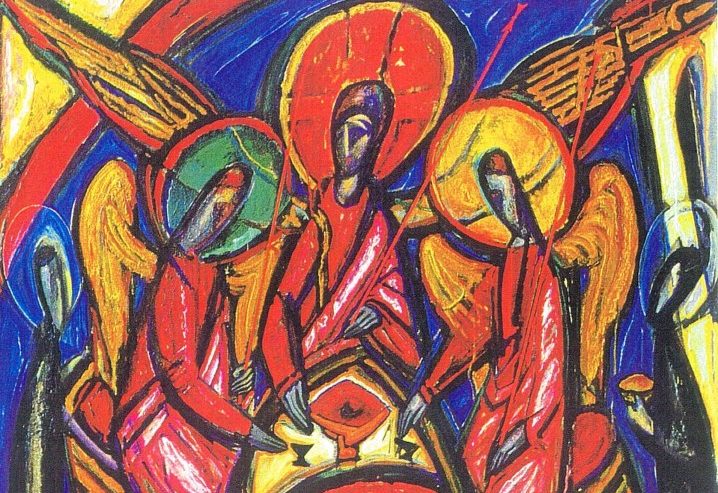
*Above painting of the Trinity by Alek Rapaport, 1994

Psalm 29 – The Power of Words

Ascribe to the Lord, O heavenly beings,
    ascribe to the Lord glory and strength.
Ascribe to the Lord the glory of his name;
    worship the Lord in holy splendor.

The voice of the Lord is over the waters;
    the God of glory thunders,
    the Lord, over mighty waters.
The voice of the Lord is powerful;
    the voice of the Lord is full of majesty.

The voice of the Lord breaks the cedars;
    the Lord breaks the cedars of Lebanon.
He makes Lebanon skip like a calf,
    and Sirion like a young wild ox.

The voice of the Lord flashes forth flames of fire.
The voice of the Lord shakes the wilderness;
    the Lord shakes the wilderness of Kadesh.

The voice of the Lord causes the oaks to whirl,
    and strips the forest bare;
    and in his temple all say, “Glory!”

The Lord sits enthroned over the flood;
    the Lord sits enthroned as king forever.
May the Lord give strength to his people!
    May the Lord bless his people with peace!
(New Revised Standard Version)

I have always felt comforted during thunderstorms. Having grown up in the Midwest of America, strong thunderstorms are a given every summer. When my daughters were small children and frightened by the loud clap of thunder, I said to them, “That’s just God letting us know he is powerful and watching over us.”

God spoke and stirred up a storm… So, they cried out to the Lord in their distress, and God brought them out safe from their desperate circumstances. God quieted the storm to a whisper; the sea’s waves were hushed. (Psalm 107:25, 29-30, CEB)

Yet, there is even more going on in today’s psalm than a reminder of God’s glory and power over all creation. God’s very voice is the source of all the power. In the beginning God created the heavens and the earth – with words. The Lord Almighty spoke the entire world into existence. God’s words are generative, that is, the speech of God creates and gives life. When God’s voice goes forth, things happen.

God said, “Let the waters under the sky come together into one place so that the dry land can appear.” And that’s what happened. (Genesis 1:9, CEB)

The way God gives is through speech. Yes, the mechanism of God’s provision for us is words. This means language is vitally important. The Lord creates, gives, sustains, and blesses us creatures through language. Out of all creation, humans are the only creatures formed in the image and likeness of God.

God said, “Now we will make humans, and they will be like us. (Genesis 1:26, CEV)

People, then, are capable of speech. Even more, we as people with the ability of language have the capacity to form our own generative words. We have the God-given means to give life with our speech.

“Life and death lie in the power of language.”

Helen Keller

I believe we all intuitively know this is true. As we reminisce the history of our lives, we can observe events where another’s words impacted us so significantly that it was as if they gave us the gift of life. We never forget those words. We also have had times when another’s words cut us emotionally and it felt as if a part of us died. We tend to remember those as well, and they hold us back in our own life-giving speech to ourselves and others.

“The godless destroy their neighbors by their words, but the righteous are saved by their knowledge.” (Proverbs 11:9, CEB)

It is necessary for us to listen to the voice of the Lord. God’s speech does not disappoint or destroy. God’s Word is eternal life. The better we listen to God, the better we can have the generative power of words to provide life for others.

It only takes a cursory look at Holy Scripture to realize that words are powerful and are to be used with great care. We are all to continually develop the craft of wordsmithing so that we might ascribe to the Lord the glory due his name as well as bless the world.

“As a tree gives fruit, healing words give life, but dishonest words crush the spirit.” (Proverbs 15:4, NCV)

The language we use—spoken and written words, sign language, facial expressions, bodily gestures, singing—helps us understand ourselves and lets us create relationships with others. Our words give us the power to describe our past, define our present, and dream of our future. 

“Words from wise people are like water bubbling up from a deep well—the well of wisdom.” (Proverbs 18:4, ERV)

We adults may balk at the notion that words are anything more than a creative expression. Yet, as I believe is typical with most things, children are closer to the kingdom of God than us bigger people. Kids effortlessly make connections between words and reality whereas us older folks barely have an idea this even occurs. My grandson once remarked when I was talking to him about being cautious at the playground, “How am I supposed to meet new people if I can’t talk to strangers?”

“When I asked my son (5 years old) how his day was, he said it was awesome. I asked him what made it so awesome – his response was ‘because I wanted it to be.’”

Tanya Niedzwiecki (Huffington Post, November 2015)

The voice of Lord exhibits a mighty God who has the power to create and recreate with but a word. As people in God’s likeness, our words are powerful tools to be used with wisdom and care. Our speech allows us to praise God and encourage one another. Even more, the use of language enables us to speak into existence new realities for ourselves and others. May those words bring forth hope and blessing to a world in need of healing.

Mighty God, King all powerful, I am overwhelmed before such awesome majesty, and my response to your voice is reverent worship through Jesus Christ, your Son, my Lord, who lives and reigns with you and the Holy Spirit, one God, now and forever. Amen.