Stop and Listen (Judges 2:16-23)

Yahweh raised up judges, who saved them out of the hand of those who plundered them. Yet they didn’t listen to their judges; for they prostituted themselves to other gods, and bowed themselves down to them. They quickly turned away from the way in which their fathers walked, obeying Yahweh’s commandments. They didn’t do so. 

When Yahweh raised up judges for them, then Yahweh was with the judge, and saved them out of the hand of their enemies all the days of the judge; for it grieved Yahweh because of their groaning by reason of those who oppressed them and troubled them. 

But when the judge was dead, they turned back, and dealt more corruptly than their fathers in following other gods to serve them and to bow down to them. They didn’t cease what they were doing, or give up their stubborn ways. 

Yahweh’s anger burned against Israel; and he said, “Because this nation transgressed my covenant which I commanded their fathers, and has not listened to my voice, I also will no longer drive out any of the nations that Joshua left when he died from before them; that by them I may test Israel, to see if they will keep Yahweh’s way to walk therein, as their fathers kept it, or not.” So Yahweh left those nations, without driving them out hastily. He didn’t deliver them into Joshua’s hand. (World English Bible)

Listening seems to be a lost art and a forgotten skill. Genuine focused attention on another person through careful listening requires a lot of practice. Maybe that’s one reason there is so little authentic hearing these days – it’s just so doggone hard. Throw into the mix that a lot of folks like hearing their own voice, and you have a recipe for poor communication.

God is good at everything, especially listening. The Lord is the Master Listener. In fact, God is so good at listening, that divine ears hear the prayers of people all over the world. The same careful attention is given to both the little girl in the West who intercedes for her parents and teddy bear at night, as well as halfway around the world with the national leader who requests wisdom for decisions in a heated meeting.

The Lord God Almighty is gracious, merciful, and kind, hearing us when we call, and listening when we our hearts long for the divine. God always bends low in a posture of listening to all creation.

As creatures in the image of God, we were meant from the very beginning of creation to listen well. Yet, ever since humanity fell into disobedience, people have the tendency to talk more than they listen; and to sometimes refuse to hear what another is saying. There are even those who ignore God’s speech.

The ancient Israelites in the book of Judges were fickle in their attention to God. When things were bad, they cried out to the Lord. Because God attentively listens, they were heard, and a merciful divine response came. However, when things were better, the people went about their business, forgot about God’s deliverance, and stopped listening.

For the waywardness of the simple will kill them,
    and the complacency of fools will destroy them;
but whoever listens to me will live in safety
    and be at ease, without fear of harm. (Proverbs 1:32-33, NIV)

God sent judges, rulers, and leaders, to the people for their own welfare. But instead of graciously receiving this gift of leadership from God, the people were quick to be unfaithful; they refused to listen to the divinely sent judges.

Listening, really listening with focused attention, was not a high value to the people. They talked and talked, incessantly droning on, and so could not hear what God through the divinely appointed rulers was saying.

We must learn to listen well because God listens well. We need to pay attention and hear because we are designed by our Creator to do so.

Perhaps our society would not be so perpetually upset and polarized if we would just take the time to notice and receive advice through a posture of humble hearing.

Try this little exercise of listening: Take just ten minutes and do not talk, read, check your phone, or do anything but listen to the sounds around you…. What do you hear?… What do you think God is saying to you through those sounds?… How will you respond?

Stillness reveals the secrets of eternity, allowing us to hear the still small voice of God. Sound is amplified through silence.

If we desire a clear word from the Lord, then stillness and silence are the spiritual practices that allow it to happen. Life’s most precious moments are not always loud or uproarious; silence and stillness have their own virtues which connect us with the divine.

Never underestimate the power of doing nothing, and simple listening.

God of all creation, you have made me with two ears for listening. Help me to so hear and distinguish you through creation, and the voices of others, so that I will follow Christ with confidence in my daily life.

Almighty and everlasting God, you are always more ready to hear than we to pray, and to give more than we either desire or deserve. Pour upon us the abundance of your mercy, forgiving us those things of which our conscience is afraid, and giving us those good things for which we are not worthy to ask, except through the merits and mediation of Jesus Christ our Savior, who lives and reigns with you and the Holy Spirit, one God, forever and ever. Amen.

The Example of John the Baptist (Matthew 14:1-12)

John the Baptist preaching, by George Maurice Cloud (1909-1973)

At that time Herod the ruler heard the news about Jesus. He said to his servants, “This is John the Baptist. He’s been raised from the dead. This is why these miraculous powers are at work through him.” Herod had arrested John, bound him, and put him in prison because of Herodias, the wife of Herod’s brother Philip.

That’s because John told Herod, “It’s against the law for you to marry her.”

Although Herod wanted to kill him, he feared the crowd because they thought John was a prophet. But at Herod’s birthday party Herodias’ daughter danced in front of the guests and thrilled Herod. Then he swore to give her anything she asked.

At her mother’s urging, the girl said, “Give me the head of John the Baptist here on a plate.” Although the king was upset, because of his solemn pledge and his guests he commanded that they give it to her. Then he had John beheaded in prison. They brought his head on a plate and gave it to the young woman, and she brought it to her mother. But John’s disciples came and took his body and buried it. Then they went and told Jesus what had happened. (Common English Bible)

John the Baptist’s murder is not only an ancient story; it’s also a story about our contemporary world – a world of power, sex, and intrigue. Times may change, but people across the ages do not. Humanity is fundamentally the same in every century. And the world is still the world, no matter the historical time. 

The contrast between King Herod and John the Baptist supply us with two types of people who exist throughout every age of humankind, offering us the choice of which way we will go with our lives. The story illustrates for us the reality of living in a fallen world as a devout person.

The Herod in today’s Gospel lesson was a son of Herod the Great, the one who killed all the male babies when Jesus was born in order to try and get rid of any rival king (Matthew 2:1-18). King Herod is displayed in the narrative as a tragic and pathetic figure who is ruled by his own lusts. He seems too proud and wimpy to admit he made a rash promise. He killed a man just to save face with his guests at a party.

This a Jerry Springer worthy family drama: The Herod family was rich, proud, and downright violent. They tended to marry within their own clan to hold their power and possessions for themselves. Herodias married her uncle Herod Philip; Salome was their daughter.

Later, Salome married Philip the tetrarch, half-brother to Herod Philip. Through marriage, Salome became both aunt and sister-in-law to her mother. Then the Herod in our story married Herodias, who had been married to Herod’s half-brother, Herod Philip. Having fallen in love with Herod Antipas, Herodias divorced Herod Philip to marry Herod Antipas.

Sheesh, nothing quite like complicated family drama.

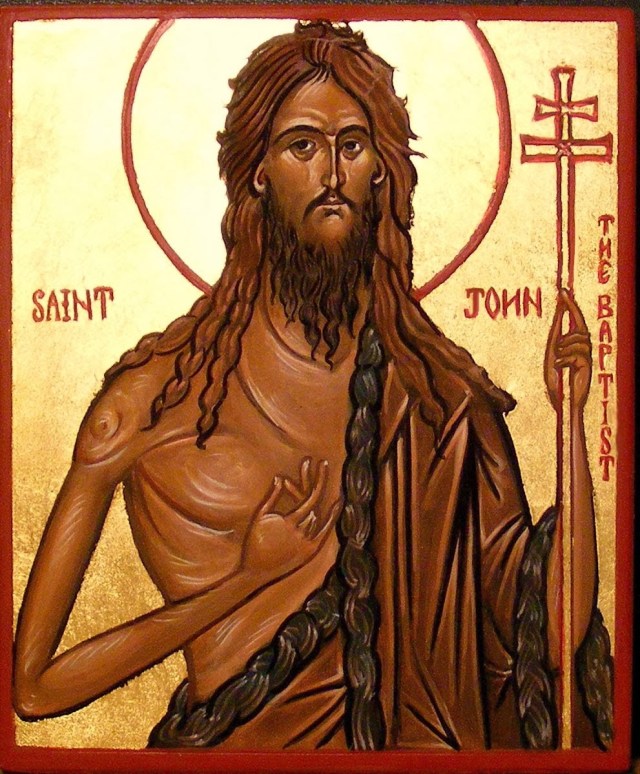
Orthodox icon of John the Baptist

Into this violation of Old Testament marriage laws (the Herod’s were Jewish) came John who made no bones about the fact this was not right (Leviticus 18:16, 20:21). Herodias nursed a grudge against John for speaking out against her and Herod’s choices.

Hell, hath no fury like a woman’s scorn, and when Herodias found an opportunity to get rid of John, she coached her daughter into asking for John the Baptist’s head on a platter. Herod, too insecure to take back his ridiculous promise and look like a fool, consented to the execution of John.

In contrast to all this tragic theater is John the Baptist. John was a messenger of God and a preacher of repentance. As one who was preparing the way for Jesus, his message was simple and to the point: Repent, for the kingdom of God is near.

John got into trouble and lost his life because he spoke truth to power by meddling in the life of King Herod and his family. The Herod’s were the political establishment of the day, and John did not temper his words when dealing with them.

There is a refreshing integrity about John. He was always the same, no matter where he was, and no matter who the people were around him. In contrast to Herod, John was bold, courageous, confident, unafraid, and secure enough in his relationship with God to engage in ministry without thought to the consequences. 

John was unconcerned for what others might think of him, if he proclaimed truth in the public square, and it ended up costing him his life.

John the Baptist Rebuking Herod, by Giovanni Fattori (1825-1908)

The story of John the Baptist’s death speaks about the hostility of this world. And it prefigured and foreshadowed the death of Jesus:

  • Like John, Jesus was executed by the civil authorities.
  • Herod, like Pilate after him, hesitated to execute and was swayed by the crowd.
  • Herodias, like the chief priests toward Jesus, finally got her way through scheming and manipulation.
  • John’s disciples came and took his body and buried it, just like Joseph of Arimathea and Nicodemus did for Jesus.

These stories, on the surface, appear to be only gloom and doom. Yet, there is a message of hope and joy. The absurd is working out itself in deliverance from sin, death, and hell. Through death, Jesus conquered death. We now have no fear of death; its sting has been taken away. Without fear of death, we have no reason to fear life with its troubles and tribulations.

The fork in the road is between the way of John or Herod. It’s a values-based decision. If worth is derived from what we do, what we have, and/or other’s opinion of us, we will likely identify more with Herod and his choices. If there is a preoccupation with hoarding power and control, this is the path of Herod. 

Conversely, if the ultimate value is in knowing Christ crucified and the power of his resurrection, then we identify with John as our spiritual ancestor. If security and worth is derived from being in Christ, then there is boldness to speak truth to power and give grace to the powerless.

Herod saw no further than his immediate needs and safety; he failed to discern his own heart. Because of his spiritual blindness, Herod did not look away from himself and look to God. Faith in Jesus comes when persons look away from themselves and look to Christ who holds the power to free all from spiritual bondage.

Consider the example of John the Baptist. He consistently sought to do the will of God as best as he understood it. Together with all God’s people past and present, we declare that God is with us, the kingdom of God is near, and the love of Christ brings faith and hope.

Almighty God, through your providence John the Baptist was wonderfully born and was sent to prepare the way of your Son, our Savior, by the preaching of repentance. Lead us to repent according to his preaching and, after his example, constantly to speak the truth, boldly to rebuke vice, and patiently to suffer for truth’s sake; through Jesus Christ your Son, our Lord, who is alive and reigns with you, in the unity of the Holy Spirit, one God, now and forever. Amen.

For the Common Good of All (1 Corinthians 12:4-13)

There are different spiritual gifts, but the same Spirit gives them. There are different ways of serving, and yet the same Lord is served. There are different types of work to do, but the same God produces every gift in every person.

The evidence of the Spirit’s presence is given to each person for the common good of everyone. The Spirit gives one person the ability to speak with wisdom. The same Spirit gives another person the ability to speak with knowledge. To another person the same Spirit gives courageous faith. To another person the same Spirit gives the ability to heal. Another can work miracles. Another can speak what God has revealed. Another can tell the difference between spirits. Another can speak in different kinds of languages. Another can interpret languages. There is only one Spirit who does all these things by giving what God wants to give to each person.

For example, the body is one unit and yet has many parts. As all the parts form one body, so it is with Christ. By one Spirit we were all baptized into one body. Whether we are Jewish or Greek, slave or free, God gave all of us one Spirit to drink. (God’s Word Translation)

Being given a gift from someone is rightly associated with joy, celebration, goodness, and the possibility of what the gift is and how it might be used.

Unpacking Our Spiritual Gifts

And this is why we unpack gifts with curiosity and abandon. It would be weird if we were given a gift, then let it sit unopened. Instead, we typically receive the gift, rip it open, and express gratitude for the thoughtfulness. Then, we explore it, enjoy it, and use it.

The Spirit, likewise, has been marvelously given to God’s people. Each individual Christian is specially provided a gift to open, use, and enjoy. Spiritual gifts graciously given to us are meant for the common good of all. And this use for the common good is where the gift is different than Christmas presents or birthday gifts.

Spiritual gifts are designed by God to be acts and words of service, dispersed for the benefit of others. Yes, they are meant for us to enjoy them. Yet, they are not meant solely for personal satisfaction.

Using Our Spiritual Gifts

So, if a person’s spiritual gift is teaching, they do not stand in front of a mirror and talk at themselves. Rather, they jump into the fray of learning and explaining, and do it in such a gracious and loving way that the enablement of the Spirit is evident.

If a person’s gift is faith, they do not merely step out and act with unusual courage for the purpose of personal betterment in a holy belief from God. They also demonstrate faithfulness to God’s people and to God’s world. The gift is for the common good of all persons.

The accumulation of wisdom and knowledge is meant for the strengthening of faith in others. Spiritual gifts are intended by God to be shared freely for the common good of all people so that people are strengthened in faith and supported for the rigors of daily life in the world.

Therefore, we really need to take some initiative in identifying our gift(s), unpacking them, and indiscriminately using them. Spiritual health and wholeness can only truly be realized through everyone’s active participation in distributing their God-given abilities.

Stewarding Our Spiritual Gifts

Spiritual gifts are neither to be hoarded, nor miserly dealt to only people I like or my own little world of groupies and friends. Any and every ability comes from God, and is therefore, given for the benefit of all persons. Underprivileged groups need the giftedness of others, as well as discovering their own resources so that everyone is built up in a society of redeemed persons.

What’s more, spiritual mavericks are not so helpful here. The Lone Ranger is not a good model for us. Christians are the Body of Christ, meant to function as one. Just as the Holy Trinity of divine persons – Father, Son, and Spirit – work together in unity of purpose and harmony of being, so persons of the Church are to unify and act as one in the mission of God.

Diversity of gifts are to be expressed in unity of building up others and extending Christ’s love to the world. When we harmoniously coordinate our joint efforts in utilizing our collective spiritual gifts, the world is turned upside-down with kingdom grace and ethics.

Goodness, joy, and possibility become alive when people unpack their gifts and use them for the common good of everyone.

Spiritual Gift Envy

Sometimes, we might succumb to “gift envy.” We observe the talented gift of another and secretly wish it for ourselves. The proper remedy to such a malady is gratitude. When we give thanks to God for the gift(s) we truly possess, then envy has nowhere to reside and slithers away.

None of God’s gifts are “sexy” in the sense that they come easily without effort and always look appealing. On the contrary, our gifts are meant to be received and developed with lots of daily mundane work so that we live into the special endowment bestowed upon us.

In reality, this takes a lifetime of development. That’s because the Spirit’s gifts are so generously large – much bigger than we originally observe at first glance. Like an engagement ring in a tiny box, receiving the gift and putting it on will involve commitments and challenges we cannot at the time perceive.

Whatever it is you do well, do it to the glory of God. Allow God to activate it and energize it for the prevailing needs of a church and a world which is in want of seeing spiritual fruit manifested in kindness, goodness, and love.

O Lord, you have taught me that without love, whatever I do is worth nothing. Send your Holy Spirit and pour into my heart your greatest gift, which is love, the true bond of peace and of all virtue, without which whoever lives is accounted dead before you. Grant this for the sake of your only Son Jesus Christ, who lives and reigns with you and the Holy Spirit, one God, now and forever. Amen.

The Day of Pentecost (Acts 2:1-21)

Pentecost, by Jennifer Allison

Now when the day of Pentecost had come, they were all together in one place. Suddenly a sound like a violent wind blowing came from heaven and filled the entire house where they were sitting. And tongues spreading out like a fire appeared to them and came to rest on each one of them. All of them were filled with the Holy Spirit, and they began to speak in other languages as the Spirit enabled them.

Now there were devout Jews from every nation under heaven residing in Jerusalem. When this sound occurred, a crowd gathered and was in confusion, because each one heard them speaking in his own language. 

Completely baffled, they said, “Aren’t all these who are speaking Galileans? And how is it that each one of us hears them in our own native language? Parthians, Medes, Elamites, and residents of Mesopotamia, Judea and Cappadocia, Pontus and the province of Asia, Phrygia and Pamphylia, Egypt and the parts of Libya near Cyrene, and visitors from Rome, both Jews and proselytes, Cretans and Arabs—we hear them speaking in our own languages about the great deeds God has done!”

All were astounded and greatly confused, saying to one another, “What does this mean?” But others jeered at the speakers, saying, “They are drunk on new wine!”

But Peter stood up with the eleven, raised his voice, and addressed them: “You men of Judea and all you who live in Jerusalem, know this and listen carefully to what I say. In spite of what you think, these men are not drunk, for it is only nine o’clock in the morning. But this is what was spoken about through the prophet Joel:

And in the last days it will be,’ God says,
that I will pour out my Spirit on all people,
and your sons and your daughters will prophesy,
and your young men will see visions,
and your old men will dream dreams.

Even on my servants, both men and women,
I will pour out my Spirit in those days, and they will prophesy.
And I will perform wonders in the sky above
and miraculous signs on the earth below,
blood and fire and clouds of smoke.

The sun will be changed to darkness
and the moon to blood
before the great and glorious day of the Lord comes.
And then everyone who calls on the name of the Lord will be saved.’ (New English Translation)

The Coming of the Holy Spirit, by Soichi Watanabe, 1996

Tornadoes are powerful. So is fire. They both have an immense potential for awe and destruction.  It’s interesting that when the little band of Christ’s followers experienced the Holy Spirit for the very first time, they likened what they encountered as wind and as fire. 

There is power in the Spirit – for both life and in destruction. It is the Spirit of God who dismantles and rearranges lives to make something different or new altogether. Most certainly, when the Spirit gets involved, nothing is going to be the same again.

On the Day of Pentecost, the Spirit upset the status quo and formed a new band of believers into the community of the redeemed (the Church). The presence of God’s Holy Spirit brings energy, strength, and ability to spread the good news of Jesus, heal broken lives, and bring an egalitarian way of life that sees no distinction based on race, class, gender, or ethnicity. 

The giving of the Spirit to the people of God is a whole lot more than a day set aside on a calendar, or a by-gone ancient thing that happened and has no significance for today. In fact, it is more than true to say that an authentic follower of Jesus Christ is a Pentecostal believer.  The New Testament knows nothing of a Christian who isn’t given the Spirit to accomplish the will of God on this earth.

Therefore, this time of the year is hugely significant when we attune ourselves to Holy Time because it is the age of the Spirit, the time of Pentecostal life and power. 

Ten days after recognizing Christ’s Ascension, and fifty days after our Lord’s resurrection from death, the Christian Calendar observes the day of Pentecost (which literally means “fifty” in Greek).  The day coincides with an established Jewish festival, the Feast of Weeks. Back in the day, Jerusalem would be filled with all kinds of different nationalities and ethnicities during the festival.

“There Appeared To Them Separated Tongues,” by Salvador Dali, 1967

Pentecost is often known as the birthday of the Church. It marks the time when the Holy Spirit came upon the fledgling believers in power. The disciple Peter, once a flaky up-and-down follower, was filled with the Spirit and spoke the Word of God boldly. His bold proclamation of repentance and faith in Jesus led directly to three-thousand persons added to the little band of one-hundred twenty.

And it didn’t stop there.

We live in an age where all believers in Jesus have the same Holy Spirit as our spiritual ancestors did. It’s an era of spiritual empowerment. The Church is called to reach the world with good news of forgiveness and grace through the person and work of Christ. 

So, then, the Church possesses confidence and security in knowing that the Spirit’s enablement and power is available for mission and spiritual care to the nations. It’s an immense calling that befits the bigness of God.

There are a wide range of Christian celebrations of Pentecost. Some churches do not recognize the holiday at all. Most churches at least mention it in prayer, song, or sermon. Other churches go all out, with worship focused on remembering the first Pentecost and praying for a similar outpouring of divine power. Churches that employ liturgical colors generally use red on Pentecost as a symbol of fiery spiritual power.

Pentecost reminds us that Christians are meant to live in the presence and power of the Holy Spirit, all the time. This day is a chance to confess our shortcomings and failures because of fear, apathy, and selfishness; and to ask for a fresh infusing and infilling of God’s wonderful Spirit. 

The Day of Pentecost flings every single believer into a congregational whole, the Church, and lets us know that we are not to be rugged individualists acting alone but are part of the Body of Christ. Therefore, we must renew our commitment to the Church for whom Christ died. 

The Spirit is ready to use us in forging spiritual bonds of kinship and solidarity. Pentecost throws disparate people together in a unified whole, made up of every kind of language, nationality, ethnicity, gender, and race.  We are all to use the gifts of the Spirit given to us for the benefit of building up one another.

We exist because of the Holy Spirit. Without the Spirit, there is no power source because the Spirit is the battery, the generator of the Christian life. We are to do all life and ministry through the power of the Spirit, equipping and encouraging each other, displaying the fruit of the Spirit, and worshiping the person of the Spirit in always being present with us.

Pentecost was (and is!) a watershed event. Worship, community, and outreach are the logical and collective responsibilities of each believer and every church around the globe.

Let us, then, recognize Pentecost and observe this day with heartfelt thanksgiving and a renewed impulse to exercise our spiritual abilities – graciously given to us by the Holy Spirit. Amen.