
How Can I Move Through My Grief? (Lamentations 1:7-15)

The Lamentations of Jeremiah by Marc Chagall (1887-1985)

Her people recall the good life
    that once was theirs;
now they suffer
    and are scattered.
No one was there to protect them
from their enemies who sneered
    when their city was taken.

Jerusalem’s horrible sins
    have made the city a joke.
Those who once admired her
    now hate her instead—
she has been disgraced;
    she groans and turns away.

Her sins had made her filthy,
but she wasn’t worried
    about what could happen.
And when Jerusalem fell,
    it was so tragic.
No one gave her comfort
    when she cried out,
“Help! I’m in trouble, Lord!
    The enemy has won.”

Zion’s treasures were stolen.
Jerusalem saw foreigners
    enter her place of worship,
though the Lord
had forbidden them
    to belong to his people.

Everyone in the city groans
    while searching for food;
they trade their valuables
for barely enough scraps
    to stay alive.

Jerusalem shouts to the Lord,
“Please look and see
    how miserable I am!”
No passerby even cares.
Why doesn’t someone notice
    my terrible sufferings?
You were fiercely angry, Lord,
and you punished me
    worst of all.
From heaven you sent a fire
    that burned in my bones;
you set a trap for my feet
    and made me turn back.
All day long you leave me
    in shock from constant pain.
You have tied my sins
    around my neck,
and they weigh so heavily
    that my strength is gone.
You have put me in the power
    of enemies too strong for me.

You, Lord, have turned back
my warriors and crushed
    my young heroes.
Judah was a woman untouched,
but you let her be trampled
    like grapes in a wine pit. (Contemporary English Version)

“The darker the night, the brighter the stars. The deeper the grief, the closer is God.”

Fyodor Dostoevsky

The only way to the mountain is through the valley. The only way to make the pain go away is to move through it – not by avoiding it, pretending it’s not there, or trying to move around it. Pain and suffering are inevitable; misery is optional.

The reality is that, when experiencing catastrophic loss, you and I will grieve forever. We shall never “get over” it; we only learn to live with it.

Yes, I do believe there is spiritual and emotional healing. Significant change and grinding loss doesn’t need to define who we are. We can rebuild ourselves around the loss we have suffered.

Yes, you and I will be whole again. However, we shall never ever be the same again. It isn’t possible – nor should it be.

The prophet Jeremiah, the exiles in Babylon, and the remaining people of Jerusalem faced a tremendous and heartbreaking adjustment to a new world full of changes and losses. Expressing that grief was central to not becoming stuck in the past, living in the here and now, and moving into the future.

Grief is the normal mental, emotional, spiritual, and/or physical response to any significant change or loss. Grief is not optional but necessary. It is our personhood’s way of facing the pain and moving through it to a place of finding renewed meaning, support, and purpose in life.

How do people move through the grief?

  • Community: Grief needs a witness. It must be expressed. We must tell our stories of life, love, and loss. Otherwise, the grief just sits unmoved deep within and eventually becomes gangrene of the soul.

Help carry each other’s burdens. In this way you will follow Christ’s teachings.

Galatians 6:2, GW
  • Connection: Grief doesn’t so much go away as it morphs into fond memories of remembrance through ritual behavior.

Then Jesus took a loaf of bread, and when he had given thanks he broke it and gave it to them, saying, “This is my body, which is given for you. Do this in remembrance of me.” (Luke 22:19, NRSV)

  • Character: No one is defined by their grief, their disease, their mental disorder, their disability, or their addiction. In many religious traditions, people are identified as carrying the image and likeness of G-d.

God knew what he was doing from the very beginning. He decided from the outset to shape the lives of those who love him along the same lines as the life of his Son. The Son stands first in the line of humanity he restored. We see the original and intended shape of our lives there in him.

After God made that decision of what his children should be like, he followed it up by calling people by name. After he called them by name, he set them on a solid basis with himself. And then, after getting them established, he stayed with them to the end, gloriously completing what he had begun. (Romans 8:29-30, MSG)

  • Care: Practice caring for yourself. Give yourself the grace and the permission to be happy… or sad… or angry – to feel what you need to feel. Treat yourself like you would treat your best friend.

Jesus said, “Come to me, all you who are struggling hard and carrying heavy loads, and I will give you rest. Put on my yoke and learn from me. I’m gentle and humble. And you will find rest for yourselves. My yoke is easy to bear, and my burden is light.” (Matthew 11:28-30, CEB)

  • Compare not: Please do not compare your grief and loss with anyone else’s. The truth is this: The absolute worst loss is your loss, not somebody else’s.

The Lord is close to the brokenhearted and saves those who are crushed in spirit. (Psalm 34:18, NIV)

  • Count: Count your wins. Count your blessings. Say them out loud. Write them down. Share them with a friend or loved one.

Bless the Lord, O my soul,

    and forget not all his benefits,

who forgives all your iniquity,

    who heals all your diseases,

who redeems your life from the pit,

    who crowns you with steadfast love and mercy. (Psalm 103:2-4, ESV)

Sometimes, prayer is the only possible way forward. Maybe the Lord will once again hear us and respond, as of old:

“I have surely seen the affliction of my people… I have heard their cry… for I know their sorrows.” (Exodus 3:7, NET)

May the presence of the Lord melt your fear and discouragement. May God strengthen and help you. May the Lord lift you and hold you in gracious and compassionate hands. Amen.

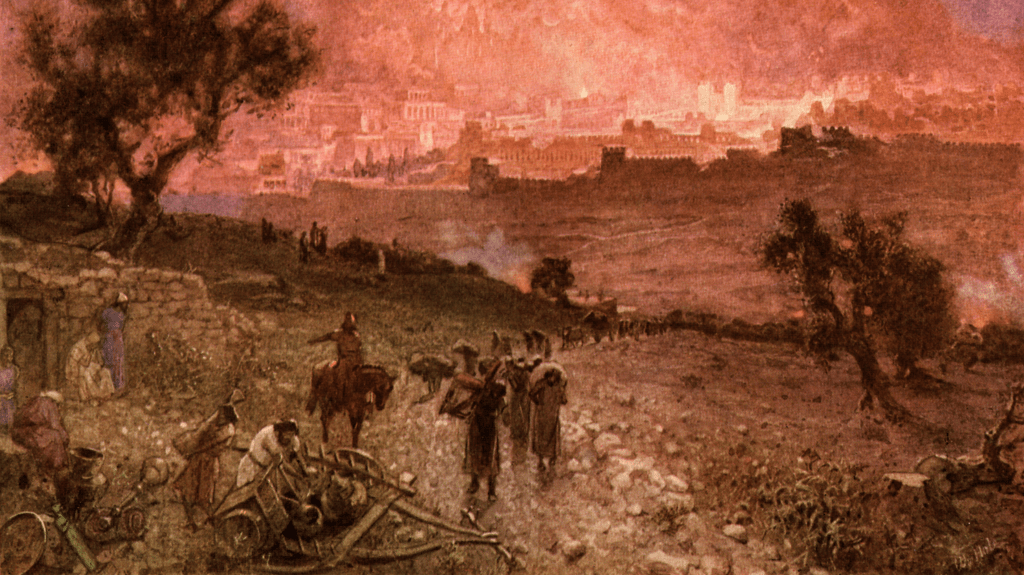
Dealing with Grinding Pain (Psalm 79:1-9)

The Babylonian conquest of Jerusalem, by William Hole (1846-1917)

God, nations have come against your chosen people.
    They have ruined your holy Temple.
    They have turned Jerusalem into ruins.
They have given the bodies of your servants as food to the wild birds.
They have given the bodies of those who worship you to the wild animals.
They have spilled blood like water all around Jerusalem.
    No one was left to bury the dead.
We are a joke to the other nations;
    they laugh and make fun of us.

Lord, how long will this last?
    Will you be angry forever?
    How long will your jealousy burn like a fire?
Be angry with the nations that do not know you
    and with the kingdoms that do not honor you.
They have gobbled up the people of Jacob
    and destroyed their land.
Don’t punish us for our past sins.
    Show your mercy to us soon,
    because we are helpless!
God our Savior, help us
    so people will praise you.
Save us and forgive our sins
    so people will honor you. (New Century Version)

I don’t like evil. And I really don’t like arrogant people who want what they want and leave a path of destruction behind them.

The setting behind today’s Psalm is the destruction of the temple. It was razed by a conquering army who proudly gloated over their victory. This psalm, as all psalms, is a prayer. It’s a bitter and angry cry for God to step in and act on behalf of the humiliated people.

The psalm is more than a simple plea for help; it is a deeply passionate appeal. As a child of the 1960’s, my phrase for the psalmist’s entreaty is, “God, stick it to the man!”

There is no polite knock at the side door of God’s house in the face of such evil. This is a pounding on the front door with the demand for God to do something about this terrible trouble. For the psalmist, the incongruence between who God is and what has happened to God’s people is inconceivable and unacceptable.

To profane God’s temple is to profane God; and to kill and maim God’s people is to flip the middle finger at God. The psalmist is beside himself and overwhelmed with emotion.

There is something very instructive here that we ought not miss. When we have been brutalized, victimized, and/or demoralized, we just want someone, especially the Lord we serve, to take notice and feel what we are feeling.

Never underestimate the power of empathy and solidarity. To feel alone and bereft of help is an awful feeling.

Perhaps the psalmist’s prayer offends some sensibilities. I wonder, for those who find the language difficult, have ever had a daughter raped or a house destroyed by fire or seen a person killed without mercy in front of their own eyes. Methinks they have not. The feelings of helpless despair and sheer anger defy human words. These are not casual affronts but malicious destructions of property and people.

We need someone to affirm the raw ruthlessness of it all, to have some understanding of the impossible place we are in with such wanton cruelty. When our very support is ripped from our lives, the madness within is too much to bear.

Who will rescue us from this body of death?

God is big enough to handle our rage and our hurt. The Lord is available and hears our desperate voice of prayer. Yet, God is not always going to directly and immediately answer on the terms we stipulate. God acts out of God’s own providence and justice, and not from our expectations. And that is a good thing, not a bad thing.

God sees, knows, and feels with us. This realization enables us to recenter and reorient ourselves around faith, hope, and love. New life is never a gift in a vacuum; it comes out of agonizing struggle in reckoning with existing evil.

So, when someone goes through a hellish experience, we are to exercise our capacity to listen and witness their horrible spiritual pain. Healing hurts: it is not a pleasant affair. We are to hang in there and walk alongside another in their hour of need, even when their vitriol seems over the top to us.

For only in telling our story to another will any of us find relief and renewed hope.

The psalms permit us to use language appropriate to what has happened to us. They also allow us to move beyond the venom to the God who restores broken lives.

Lord Jesus Christ, by your patience in suffering you hallowed earthly pain and gave us the example of obedience to your Father’ will.

Be near me in my time of weakness and pain; sustain me by your grace, that my strength and courage may not fail; heal me according to you will; and help me always to believe that what happens to me here is of little account if you hold me in eternal life, my Lord and my God.

As the Lord Jesus cried out on the cross, I cry out to you in pain, O God my Creator. Do not forsake me. Grant me relief from this suffering and preserve me in peace, through the power of the Holy Spirit. Amen.

Psalm 30 – Mourning Has Turned to Joy

I will exalt you, Lord, for you rescued me.
    You refused to let my enemies triumph over me.
O Lord my God, I cried to you for help,
    and you restored my health.
You brought me up from the grave, O Lord.
    You kept me from falling into the pit of death.

Sing to the Lord, all you godly ones!
    Praise his holy name.
For his anger lasts only a moment,
    but his favor lasts a lifetime!
Weeping may last through the night,
    but joy comes with the morning.

When I was prosperous, I said,
    “Nothing can stop me now!”
Your favor, O Lord, made me as secure as a mountain.
    Then you turned away from me, and I was shattered.

I cried out to you, O Lord.
    I begged the Lord for mercy, saying,
“What will you gain if I die,
    if I sink into the grave?
Can my dust praise you?
    Can it tell of your faithfulness?
Hear me, Lord, and have mercy on me.
    Help me, O Lord.”

You have turned my mourning into joyful dancing.
    You have taken away my clothes of mourning and clothed me with joy,
that I might sing praises to you and not be silent.
    O Lord my God, I will give you thanks forever! (New Living Translation)

Life is not only full of the tears which give way to joy; a great deal of life is learning to move through our grief and transform the pain into something beautiful.

Hard circumstances make us either better or bitter.

The psalmist, King David, had his share of adversity, difficulty, and distress. The youngest of seven sons, David was something like the runt of the litter. He was given the grunt work that nobody else wanted to do, since he was the lowest person in the household.

So, off to the fields he went, shepherding the sheep, dealing with hot days and cold nights, fighting off predators, and keeping the sheep healthy and safe. Yet out there where no one was looking, God was watching. And the Lord was developing within David the very qualities needed to one day rule over all Israel and Judah.

Even in-between becoming a member of the king’s court and becoming king himself, David’s life was mostly characterized by misunderstanding and being victimized. In other words, David had intimate first-hand experience of terrible sorrow, buckets of tears, and stress-filled anxiety. Through it all, he did not become bitter. Instead, David learned to transform his mourning to joy.

Many persons, having experienced the sort of things David of old did, come through their difficulties and adversity with a hard heart. They end up hurting people, just like they were hurt. Their verbal and physical acts of violence betray their inability to turn pain into something useful.

So, what makes the difference between those who experience the same sorts of painful events, yet go in the different directions of caring or harming?

I believe the twentieth-century Trappist monk, Thomas Merton, understood the true source of violence and non-violence…

“There is a pervasive form of contemporary violence to which the idealist most easily succumbs: activism and overwork. The rush and pressure of modern life are a form, perhaps the most common form, of its innate violence. To allow oneself to be carried away by a multitude of conflicting concerns, to surrender to too many demands, to commit oneself to too many projects, to want to help everyone in everything, is to succumb to violence. The frenzy of our activism neutralizes our work for peace. It destroys our own inner capacity for peace. It destroys the fruitfulness of our own work, because it kills the root of inner wisdom which makes work fruitful.”

Thomas Merton, Conjectures of a Guilty Bystander

Merton rightly discerned that the false self (the self we project to others and try to maintain as real) is in fact the source of violence – specifically, the false self’s need to gratify impulses for power and control, affection and esteem, security and safety, at all costs.

However, we do not find ourselves in those ways. The cultivation of solitude, silence, and contemplation are non-violent practices which organically produce non-violent ways of being in the world. Those were the very practices which characterized David’s early life as a shepherd.

It’s what we do when no one is watching, and nobody is around, that makes the difference. Our way of being in the world is determined by the way we are with ourselves when we are alone.

How you are, matters.

“If we do not transform our pain, we will most assuredly transmit it.”

Richard Rohr

We need to be present to our pain, to pay attention to it. Our hurts don’t simply vanish if we ignore them, try to go around them, or seek quick fixes to them. The pain is still there, and over time, becomes gangrene of the soul.

Instead, we must dare to go to the unexplored territory of the inner person, to confront and contend with our inner turmoil and be open to hearing from it.

“The endurance of darkness is the preparation for great light.”

St. John of the Cross

Today, like every day, we have the opportunity and even responsibility to bring our whole selves, pain included, to the relationships we have, the work we do, and everywhere we go. The world not only needs our skills and abilities; it needs us.

The path to joy isn’t through perfect circumstances and having all our wants satisfied; joy comes after a season of darkness with all it’s sobbing, tears, and wondering. As we become more comfortable with the shadowy places of our lives, the more open we become to transforming our pain to a beauty which blesses the world.

O God, you are my God, and I will praise you, whether at night’s inky blackness, or in the day’s bright sunshine of happiness. As I endure each difficult situation, help me to see it’s transformative power and it’s potential to make me a better and more godly person, through Jesus Christ my Lord, in the enablement of the Holy Spirit. Amen.

Psalm 31:9-16 – Lord, Have Mercy

Christ in Gethsemane by Michael O’Brien

Have mercy on me, Lord, for I am in distress.
    Tears blur my eyes.
    My body and soul are withering away.
I am dying from grief;
    my years are shortened by sadness.
Sin has drained my strength;
    I am wasting away from within.
I am scorned by all my enemies
    and despised by my neighbors—
    even my friends are afraid to come near me.
When they see me on the street,
    they run the other way.
I am ignored as if I were dead,
    as if I were a broken pot.
I have heard the many rumors about me,
    and I am surrounded by terror.
My enemies conspire against me,
    plotting to take my life.

But I am trusting you, O Lord,
    saying, “You are my God!”
My future is in your hands.
    Rescue me from those who hunt me down relentlessly.
Let your favor shine on your servant.
    In your unfailing love, rescue me. (New Living Translation)

One of my parishioners from years ago had seen hard combat in Italy during World War II. He saw his best friend killed, right next to him. I still remember his story and what he said in conclusion to it, in his own sage way: “In my experience, war is a very poor way of dealing with problems.”

And yet, we sometimes find ourselves embedded in circumstances we neither wanted nor asked for. Just ask the Ukrainians. No one puts their name on a sign-up sheet for suffering. Yet not a one of us can avoid it. 

Pain comes in all kinds of forms. Maybe the worst kind of suffering is the wound inflicted from others looking down at you when you’re already experiencing trouble and damaged emotions. 

Whether it is an ethnic or racial group of people facing ridicule, anger, and even beatings or death; or whether it is refugees trying to survive the ravages of war, the physical effects of pain can oftentimes be secondary to the primary hurt experienced within the spirit. 

“Suffering is part of the human condition, and it comes to us all. The key is how we react to it, either turning away from God in anger and bitterness or growing closer to Him in trust and confidence.”

Billy Graham

The Old Testament character, David, knew first-hand about suffering through hard circumstances. There were times when he felt completely overwhelmed by the evil machinations of people trying to take his life. If we could put ourselves in David’s sandals, we can understand why he was worn-out to the point of not sleeping, not eating well, even with a hint of paranoia. 

David responded to his seemingly impossible situation by entrusting himself to God. He truly believed he was in the Lord’s hands – and that fact was David’s go-to truth. 

Crossing over into the New Testament Gospels, Jesus uttered his last words on the cruel cross from this today’s psalm: “Father, into your hands I commit my spirit” (Luke 23:46). 

The cross was an obvious place of extreme bodily pain. That wretched pain, however, was dwarfed by the great spiritual pain of holding the entire world’s hurts and their curse of separation. The stress of both body and soul must have been crushing for Jesus. 

Yet, there was a strength of assurance, for Jesus, in the eye of that pain – the confidence of knowing he was in good hands, just like David’s confidence a millennium before.

There are times in life when we all struggle with why particular afflictions happen to us, in whatever form they might take in us. 

It is in the situation of being forgotten by others that we are most remembered by God.

It is within the crucible of trouble that God is the expert in deliverance.

It is when others revile us, say terrible things about us, and talk behind our backs that God comes alongside and whispers words of grace and steadfast love to us. 

It is whenever life is downright hard that we see a soft-hearted God standing to help us and hold us. 

While we are feeling our awful suffering, God is carefully crafting within us resilience through the rejection, empathy in our loneliness, purpose because of the trauma, forgiveness out of the shame, courage from having been failed, and self-awareness in the wake of emotional devastation. 

The biblical psalms are the consummate place to go when we are most in need. They provide the means to lift heartfelt prayers whenever our own words fail us. 

The psalms give us structure and meaning when the world around us makes no sense. 

The psalms do not always give us answers to our most vexing questions; they do, however, point us to the God who is attentive to the least, the lost, and the lonely.

Together, as people sharing the human condition of suffering, we cry out, “Lord, have mercy. Christ, have mercy. Lord, have mercy on us and grant us your peace. Amen.”