A Lot of Hurting, Touching, and Healing (Luke 6:12-19)

Jesus calls his twelve disciples, by Sadao Watanabe

One of those days Jesus went out to a mountainside to pray, and spent the night praying to God. When morning came, he called his disciples to him and chose twelve of them, whom he also designated apostles: Simon (whom he named Peter), his brother Andrew, James, John, Philip, Bartholomew, Matthew, Thomas, James son of Alphaeus, Simon who was called the Zealot, Judas son of James, and Judas Iscariot, who became a traitor.

He went down with them and stood on a level place. A large crowd of his disciples was there and a great number of people from all over Judea, from Jerusalem, and from the coastal region around Tyre and Sidon, who had come to hear him and to be healed of their diseases. Those troubled by impure spirits were cured, and the people all tried to touch him, because power was coming from him and healing them all. (New International Version)

Pain is a lot

Touch is important. Humanity needs touch. It’s also one of those things that we likely take for granted. 

Philip Yancey and Dr. Paul Brand co-authored a book, originally published in 1982, entitled “Pain: The Gift Nobody Wants.” It’s largely a biography of Dr. Brand, who pioneered both the diagnosis and prognosis of leprosy. 

He discovered that leprosy occurs because of a lack of feeling – an inability to sense touch. The delicate nerve endings we all have in our fingers and toes are numb to the leper. The lack of sensing pain in the extremities leads to small cuts or injuries, which would be immediately treated by someone who feels pain, becoming gangrene with the losing of fingers and toes.

The ability to feel, to reach out and touch another person, is vitally important to our spiritual and emotional lives. Without touch, the calloused heart and unfeeling soul does not realize the damage that is being done to it.           

One of the gifts we have as people is the ability to feel guilt, sorrow, disappointment, and pain – to be touched mentally, emotionally, and spiritually – as well as physically. And in our ability to feel pain, it brings about attention to prayer and addressing the situation.

Many people are troubled in either mind or spirit, or experience chronic ailments of the body, day in and day out. They just want relief, to be at peace in both body and soul.

Jesus prays… a lot

In today’s Gospel lesson, Luke puts together two stories: one of Jesus choosing and calling his twelve disciples; and then one of Jesus being among the people and healing them of their diseases and their troubles. Let’s observe the relationship between them.

Jesus often withdrew to lonely, isolated places in order to pray (Luke 5:16). On this particular occasion, he went out and spent the entire night in prayer to God. When morning came, we discover the reason for the all-night prayer meeting: Christ chose the people who would be closest to him in his earthly ministry. He called the twelve to follow him and be his disciples.

I find it highly instructive that Jesus spent so much time in prayer before making such big decisions about his ministry. If anyone could size up somebody as a potential follower, it seems to me it would be Jesus. And yet, there was a lot of deliberation and interaction with the Father. Since the Lord Jesus found it necessary to pray with an extending time, and consult with the heavenly Father, I would say that our own prayer life and reaching out to consult and collaborate could probably use an upgrade.

Jesus heals… a lot of people

Then, Jesus and his disciples, together enter the fray of the crowd. And the disciples get their first lesson in following Jesus: Christ-centered ministry is about healing – it’s about restoring people to physical, mental, emotional, and spiritual health.

Healing is at the heart of all real Christian ministry. And healing is really what everyone is to be about, whether they identify as Christian, or not. To be healed is to experience a holistic restoration of body, mind, emotions, and spirit.

Touch is a big part of healing. Physical touch is important, and it’s powerful. Sometimes, bodily healing is needed because a person has been physically abused, or experienced some sort of physical trauma. And it can be very difficult to have others touch them, after such experiences. Yet, part of the healing will be in experiencing redemptive touch – either by surgeons, family, friends, or trusted others. The answer to bad touch and bad pain is to experience good touch and the good pain of healing.

Non-physical touch is no less important. And, I believe, Jesus understood this perhaps more than most. He routinely “touched” people in ways that changed their lives. Christ sought to not only bring physical healing, but also to heal the mental, emotional, and spiritual wounds.

Jesus touches… a lot of lives

Jesus touched a lot of lives through his healing ministry:

  • In healing lepers of their disease, Christ made sure that they were no longer ostracized from the community but were restored to full function in society.
  • In curing persons demonized and tormented by evil spirits, Jesus was concerned to restore them to their right mind and ensure they were included as members of society, as well as restored to their families.
  • In bringing salvation from guilt and shame, Jesus brought reconciliation and restoration between God and sinners.
  • In all his relational interactions, Jesus was intentional about making connections to the lonely and the lost, to those who were emotionally cut off from the mass of society.

So, whenever we feel pain – whether in body, mind, emotion, or spirit – this experience lets us know that we need to pay attention to something. As we do that, it can drive us to the source of healing, wholeness, and restoration. We go to prayer – not out of duty – but because we are convinced that there are divine resources only God can provide.

And we can come, again and again, finding the grace to help us in our time of need. For God’s mercy is inexhaustible; the grace of God will never run out or run dry.

Therefore, let followers of Jesus everywhere be aqueducts of grace, angels of mercy, and agents of healing in a world which so desperately needs the love, care, and attention we can give them.

May God the Father bless you; God the Son heal you; and God the Holy Spirit give you strength. May God the holy and undivided Trinity guard your body, save your soul, protect your mind, and bring you safely to his heavenly country; where he lives and reigns for ever and ever. Amen.

Maundy Thursday (Psalm 116:1-2, 12-19)

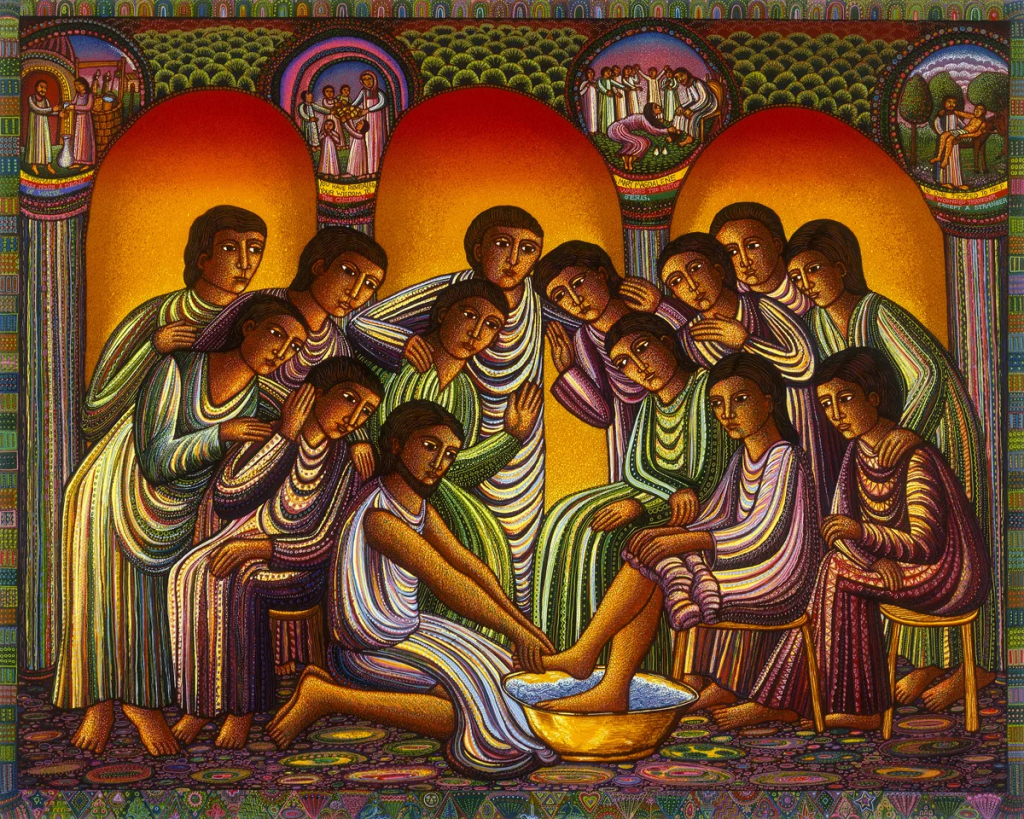
Washing of the Feet, by John August Swanson, 2000

I love the Lord because he has heard
    my voice and my supplications.
Because he inclined his ear to me,
    therefore I will call on him as long as I live….

What shall I return to the Lord
    for all his bounty to me?
I will lift up the cup of salvation
    and call on the name of the Lord;
I will pay my vows to the Lord
    in the presence of all his people.
Precious in the sight of the Lord
    is the death of his faithful ones.
O Lord, I am your servant;
    I am your servant, the child of your serving girl.
    You have loosed my bonds.
I will offer to you a thanksgiving sacrifice
    and call on the name of the Lord.
I will pay my vows to the Lord
    in the presence of all his people,
in the courts of the house of the Lord,
    in your midst, O Jerusalem.
Praise the Lord! (New Revised Standard Version)

“Pain and suffering have come into your life, but remember pain, sorrow, suffering are but the kiss of Jesus — a sign that you have come so close to Him that He can kiss you.”

Mother St. Térèsa of Calcutta (1910-1997)

There is more to the passion of Christ than sheer suffering and sorrow; the Via Dolorosa is, paradoxically, also the road to joy.

Yes, suffering is painful and unpleasant. Yet, since we all must suffer in some way, the real issue is whether our suffering is meaningless or has purpose to it. We are able to bear our suffering if we are confident that a redemptive outcome is at the end of it.

The Lord Jesus submitted to suffering because he knew that all the mockery, torture, and abuse was the pathway to deliverance for humanity.

Because of the joy awaiting him, he endured the cross, disregarding its shame. Now he is seated in the place of honor beside God’s throne. Think of all the hostility he endured from sinful people; then you won’t become weary and give up. (Hebrews 12:2-3, NLT)

Since Jesus has gone before us, enduring shame so that it could be put to death in us, we are able to live free from guilt and the ignominy of sin. What’s more, Christ’s suffering gives shape and meaning to our own suffering.

“I cannot but wonder at the virtue that lies in suffering; we are worth nothing without the cross. I tremble and am in an agony while it lasts, and all my conviction of its salutary effects vanish under the torture, but when it is over, I look back at it with admiration, and am ashamed that I bore it so ill.”

François Fénelon (1651-1715)

On this Maundy Thursday, we remember that in the midst of suffering there is the hope of glory, and in the center of pain there is the confident expectation that it will be used as the fertilizer to help love grow and bloom in the dormant places of this world.

“Love proves itself by deeds, so how am I to show my love? Great deeds have forbidden me. The only way I can prove my love is by scattering flowers and these flowers are every little sacrifice, every glance and word, and the doing of the least actions for love.”

St. Thérèse of Lisieux (1873-1897)

There cannot be love without suffering; to love is to sacrifice on behalf of another.

Because we live in a broken world full of pride and hubris, greed and avarice, hate and envy, we are victims of loveless systems and unjust actions. We need love to rescue and redeem us from the sheer muck of existential guilt and shame, evil and injustice.

Christians around the world are journeying through Holy Week, the most sacred time of the year for followers of Christ. When we think about Holy Week, we are familiar with Good Friday and certainly Easter, but Maundy Thursday? 

On this day, the Church remembers the final evening Jesus shared with his disciples in the upper room before his arrest and crucifixion. The experiences in the upper room were highly significant because this was the last teaching, modeling, and instruction Jesus gave before facing the cross. Jesus was careful and deliberate to communicate exactly what was important to him: to love one another.

“A new command I give you: Love one another. As I have loved you, so you must love one another.  By this everyone will know that you are my disciples if you love one another.” (John 13:34-35, NIV)

Maundy Thursday marks three important events in Christ’s Last Supper with his disciples: 

  1. The washing of the disciples’ feet (the action of loving service)
  2. The instituting of the Lord’s Supper (the remembrance of loving sacrifice)
  3. The giving of a “new” commandment to love one another (the mandate of a loving lifestyle)

The message of Maundy Thursday is this: Jesus Christ loves me just as I am, and not as I should be. He loves me even with my dirty stinky feet, my herky-jerky commitment to him, and my pre-meditated sin. 

Today is a highly significant day on the Church Calendar and in the Christian Year – one which deserves to be observed, and an opportunity to remember the important words and actions of Jesus on our behalf. Through Jesus Christ we are to live always in love, modeling our life and ministry after him. 

“I have found the paradox that if I love until it hurts, then there is no hurt, but only more love.”

Mother Térèsa

In Christ, love is to characterize our life together as we proclaim God’s love in both word and deed. A watching world will take notice and desire to lay down their hate and animosity if the followers of Christ are deeply and profoundly centered in the love of God.

God our Father, you invite us to participate in the life, suffering, death, and resurrection of your Son. Inspire us by his service, and unite us in his love; who lives and reigns with you, in the unity of the Holy Spirit, one God, now and forever. Amen.

How Can the World Change? (Philippians 1:21-30)

For to me, living is Christ and dying is gain. If I am to live in the flesh, that means fruitful labor for me, yet I cannot say which I will choose. I am hard pressed between the two: my desire is to depart and be with Christ, for that is far better, but to remain in the flesh is more necessary for you. Since I am convinced of this, I know that I will remain and continue with all of you for your progress and joy in faith, so that, by my presence again with you, your boast might abound in Christ Jesus because of me.

Only, live your life in a manner worthy of the gospel of Christ, so that, whether I come and see you or am absent and hear about you, I will know that you are standing firm in one spirit, striving side by side with one mind for the faith of the gospel and in no way frightened by those opposing you. For them, this is evidence of their destruction but of your salvation. And this is God’s doing. For he has graciously granted you the privilege not only of believing in Christ but of suffering for him as well, since you are having the same struggle that you saw I had and now hear that I still have. (New Revised Standard Version)

I believe that one of the greatest tragedies of this contemporary age is that millions of people suffer in silence, alone, with nobody knowing what they’re going through. Countless others cry by themselves, even in public. It’s as if someone who is suffering or sad is a pariah whom we cannot get close to.

It is not supposed to be this way. Suffering by oneself is a tragedy. Suffering with others is a privilege. We are not only meant to be one in spirit when things are going well and it’s a joyous occasion; we’re also to maintain that close unity when the world seems to be falling apart and there are those who are profoundly hurting in either mind, spirit, or emotion.

A few years ago, I stood amongst a gathered group of people, most of whom I did not know.  I was there for a memorial service of a fellow colleague. She received the kind of news that no one wants to hear. In a matter of weeks, she was gone. Not every funeral I attend (or even officiate) is beautiful. This one was, and here’s why: It was a collective experience of both joy and sorrow.

I walked away from my friend’s remembrance with a clear conviction – one that had been percolating and forming within me for quite some time.

This conviction might seem exaggerated, yet it by no means is meant to be. It’s just what I have come to believe about the universal human experience.  It comes from the confidence and experience of a lifetime of observation and ministry.

It is neither merely a heartfelt sentiment nor a passing feeling. No, it really is a conviction, a firm principle or persuasion. It is this:

Crying with strangers in person has the power to change the world.

I think I’ve always known this. It just crystalized for me through that experience. After all, I have watched with awe the privilege of walking into a dying patient’s room, full of tearful family, and be with them in their pain.  The sharing of stories is powerful, eliciting both great joy, reminiscent laughter, and profound gratitude; as well as tremendous sorrow, grinding grief, and sad lament. 

Tears and celebration mix in a sacred alchemy producing a kind of care which transcends description.

It’s one thing to observe other’s joy and sorrow on the evening news, or even from afar. It is altogether a different reality to participate up close and personal. It’s something akin to watching a travel documentary on Yellowstone Park versus visiting the place in person; there’s just no comparison. 

Shared human experiences of suffering will nearly always translate into new and emerging capacities for empathy. And where empathy exists, there is hope for all humanity. 

Being with another person or group of people in their suffering creates a Grinch-like transformation in which our hearts suddenly enlarge. A single tear from a singular small little Who girl in Whoville had the power to penetrate years of hardness of heart and change what everyone thought was a shriveled soul full of garlic and gunk.

Said a different way: The spiritual and emotional heart of a human being is able to shrink or expand. It shrinks from spending far too much time alone and/or holding others at bay, at arms-length, while playing the armchair critic to those who are out rubbing shoulders with real flesh and blood people. 

The Grinch never went back to his isolation. Instead, he did what Whoville thought was the unbelievable: The Grinch fully participated in the joy of the community, up close and personal.  It was a full-bore holding of hands, singing, and eating – which illustrates a conviction I’ve held for a long time:

Hospitality, that is, showing love to outright strangers through celebrative participation with food and drink, has the power to change the world.

Hospitality cannot happen from afar. Sitting around the table with strangers and interacting with them is needed. It alters our perspectives so that we live our shared humanity. It is rather difficult to hate someone when you get to know them and discover their loves and joys, hurts and wounds.

This all leads toward asking one of the most fundamental and basic biblical questions that must be asked by every generation and considered by everyone who respects God and/or the Christian Scriptures:

Am I able to see the image of God in someone very different from myself?

The Christian doesn’t have to go very far to answer this one, at least from an objective cerebral perspective.  Jesus saw the humanity in everyone he encountered, from Jew to Gentile, from sinner to saint.  In fact, Jesus saw this image so deeply within another that he sat around the table and ate with people whom others saw as not worthy to eat with.  Jesus’ willingness to participate in the hospitality of strangers was downright scandalous.  It isn’t a stretch to say that it got him killed.

What’s more, Jesus wept. He cried in public with strangers. For followers of Christ who seek to emulate him in his practical ministry, that point ought to be noticed. After all, we choose to remember and participate in the life of Christ through the elements of bread and wine at the Table. God’s radical hospitality toward us is truly meant to translate to an open heart toward those who look and act differently than me.

The great fourteenth century mystic, Julian of Norwich, a female devotee of Christ and an influential theologian in her own right amongst a world of men who tended to see the image of God in women as flawed, understood what it would take to reawake image-bearing humanity. She stated:

“All that is contrary to peace and love — is in us and not in God. God’s saving work in Jesus of Nazareth and in the gift of God’s spirit, is to lessen our wrath in the power of his merciful and compassionate love.”

Julian of Norwich

Don’t think for a minute that suffering with and crying with strangers is an easy thing for me. Truth is, crying is not something I typically do, or even like to do. Yet, constrained by the love of God in Christ, and putting myself in a position to feel with the emotions of others in front of me, I allow those tears to come.

Yes, collective experiences of emotion have the power to change the world. Yet, this occurs only if we show up.  Perhaps that was the reason for the Christian doctrine of the incarnation: Jesus is our Immanuel, God with us, the One who is present.  He showed up, and salvation happened.

And that is what the Philippian Church needed to remember, tap into, and live as one Body of Christ for the life of the world.

Pain, Stress, and Chickens (Psalm 32)

A modern mosaic of a mother hen protecting her chicks—on the altar of Dominus Flevit Church on the Mount of Olives, Jerusalem

Oh, what joy for those
    whose disobedience is forgiven,
    whose sin is put out of sight!
Yes, what joy for those
    whose record the Lord has cleared of guilt,
    whose lives are lived in complete honesty!
When I refused to confess my sin,
    my body wasted away,
    and I groaned all day long.
Day and night your hand of discipline was heavy on me.
    My strength evaporated like water in the summer heat.

Finally, I confessed all my sins to you
    and stopped trying to hide my guilt.
I said to myself, “I will confess my rebellion to the Lord.”
    And you forgave me! All my guilt is gone.

Therefore, let all the godly pray to you while there is still time,
    that they may not drown in the floodwaters of judgment.
For you are my hiding place;
    you protect me from trouble.
    You surround me with songs of victory.

The Lord says, “I will guide you along the best pathway for your life.
    I will advise you and watch over you.
Do not be like a senseless horse or mule
    that needs a bit and bridle to keep it under control.”

Many sorrows come to the wicked,
    but unfailing love surrounds those who trust the Lord.
So rejoice in the Lord and be glad, all you who obey him!
    Shout for joy, all you whose hearts are pure! (New Living Translation)

The body knows the truth of what is happening in the spirit. Our physical selves carry the weight of our mental thoughts and emotional feelings.

Our bodies have their way of making sounds of protest and pain if our spirits are silent. For example, physical weariness and tiredness can be a lighthouse, alerting us to pay attention to our inner suffering.

In other words, stated positively, pain and stress are a gift.

“I imagine one of the reasons people cling to their hates so stubbornly is because they sense, once hate is gone, they will be forced to deal with pain.”

James Baldwin

What is stress?

Stress is any type of change that causes physical, emotional, mental, or spiritual strain. Stress is a normal reaction to everyday pressures. However, stress can become unhealthy when it upsets our daily functioning and ability to live well. Stress itself is neither good nor bad. The issue is the appropriate amount of tension we need to live a healthy life.

Where do you typically carry stress in your body?

Whenever we are under a great deal of stress – and are having difficulty either recognizing it or managing it – the body gives us clues about how to pay attention to that stress. Our mental, emotional, relational, and spiritual issues usually show up in the body as physical problems.

Why do individuals handle stress differently?

The combination of past trauma, abuse, and neglect within families and communities is unique to the individual – as well as variations in personality traits and inherited genetics.  In other words, how we deal with stress is a result of both nature and nurture.

What are some common connections between stress and the body?

  • Shoulders: Feeling overwhelmed through carrying the weight of the world’s problems.
  • Gut (stomach and intestines): Feeling anxious for not letting go of a problem.
  • Vomiting or diarrhea: Feeling emotionally sick about a situation and wanting to be rid of it once and for all.
  • Hemorrhoids or constipation: Straining or working very hard to make something happen in your life and it doesn’t come to pass.
  • Headache: Feeling afraid through overthinking that something bad will happen.
  • Chest/heart: Feeling angry or sad through either trauma or secondary trauma.
  • Lungs: Feeling suffocated, like you cannot breathe, because of difficult circumstances, e.g. asthma
  • Spine/knees/hips: Feeling discouraged and wanting to give up because you cannot take one more step.
  •  

How can I deal with my stress in a healthy way?

  1. Let go. Ask for help. Talk to God, as well as a friend, faith leader, or other about why you are stressed.
  2. Reach out. Connect with family members. Get involved in a faith community. Volunteer in an organization you care about.
  3. Eat well. Make healthy choices about food. Find someone or a group of people who share your nutrition goals.
  4. Meditate. Focus on the present moment because there is only now. Read Scripture. Pray.
  5. Walk. Take daily strolls through nature. Walk the dog. Walk with a friend. Walk with the Lord.
  6. Read. Read or listen to a good book. Do it with a cup of coffee or tea.

“The truth is that stress doesn’t come from your boss, your kids, your spouse, traffic jams, health challenges, or other circumstances. It comes from your thoughts about your circumstances.”

Andrew Bernstein

The psalmist went on to release his silence and give voice to his spiritual stress and emotional pain, thus finding relief.

Who is the stress reliever?

God. The Lord is akin to a mother hen who protects her chicks.

My youngest daughter once had a pet chicken named “Gina” (I have no idea why she named the chicken this). Gina would lay an egg or two and keep them warm and nestled underneath herself. Indeed, the eggs were in a special hiding place, protected from outside forces.

My daughter also sang to Gina (which helped her to lay more eggs) and made sure she had plenty of space to find grubs, worms, shrews, and other delectables from the ground. Gina wasn’t the only pet chicken; there were others, too. Chickens are very social and require other chickens to be happy; a solitary hen is likely to not lay any eggs, at all.

Whenever we are “chicken” and run about with anxiety and fear, God gathers us together with other believers, protects us from trouble, surrounds us with songs of deliverance, and makes sure we have everything we need for life and godliness in this present age.

The Lord will take care of us – no matter the situation, the stress, or the pain it produces.

Blessed heavenly Father and Mother Hen, your Divine presence, power, provision, and protection gives us grace and truth. May this season of Lent – a time of repentance and faith – bring us the blessing of your forgiveness and the joy of salvation, through Jesus Christ our Lord. Amen.