Luke 11:14-28 – Replace the Bad with the Good

Jesus was driving out a demon that was mute. When the demon left, the man who had been mute spoke, and the crowd was amazed. But some of them said, “By Beelzebub, the prince of demons, he is driving out demons.” Others tested him by asking for a sign from heaven.

Jesus knew their thoughts and said to them: “Any kingdom divided against itself will be ruined, and a house divided against itself will fall. If Satan is divided against himself, how can his kingdom stand? I say this because you claim that I drive out demons by Beelzebub. Now if I drive out demons by Beelzebub, by whom do your followers drive them out? So then, they will be your judges. But if I drive out demons by the finger of God, then the kingdom of God has come upon you.

“When a strong man, fully armed, guards his own house, his possessions are safe. But when someone stronger attacks and overpowers him, he takes away the armor in which the man trusted and divides up his plunder.

“Whoever is not with me is against me, and whoever does not gather with me scatters.

“When an impure spirit comes out of a person, it goes through arid places seeking rest and does not find it. Then it says, ‘I will return to the house I left.’ When it arrives, it finds the house swept clean and put in order. Then it goes and takes seven other spirits more wicked than itself, and they go in and live there. And the final condition of that person is worse than the first.”

As Jesus was saying these things, a woman in the crowd called out, “Blessed is the mother who gave you birth and nursed you.”

He replied, “Blessed rather are those who hear the word of God and obey it.” (New International Version)

You have likely heard the old adage that nature abhors a vacuum. That is, when a loss or change leaves a hole in something, that hole will quickly get filled with something else.

To stop doing one thing is only half of a necessary process. To start doing another thing is crucial.

In our Gospel lesson for today, Jesus tells a story about a demon-possessed man. He was delivered of his oppression. However, a problem arose because the man had no replacement for the demon. He simply did nothing after the demonic expulsion.

It didn’t take long for a group of demons, seemingly seeking such a situation as this man, and took full advantage of his vulnerability. In the end, the man was worse off than before – all because of the vacuum created without the hole being filled.

We are meant to hear God’s Word and obey. Both are necessary to the process of deliverance, growth, and spiritual development.

Whenever the process is only half-baked, we have double-minded people, divided in their loyalties between God and money/power or something else.

Getting rid of judgmental spirits is important but it’s only half the process. The other half is to intentionally make space for genuine inquiry, listening, and dialogue. Without the focus on helping one another through mutual discussion, a group of folks will inevitably degenerate into discouragement, even despair, as the demons of judgmentalism come back in full force.

Kicking hate to the curb only truly works if it is replaced with a spirit of love, concern, and compassion for one’s fellow human. An environment in which people feel free to share of themselves and their feelings is the result of deliberately seeking to do so. Simply policing hate in others eventually causes the demons of hate to establish themselves even deeper than before.

Attempting to eliminate a culture of secrecy and shame can only really come through courageous acts and words of creating a climate of openness which carefully and compassionately enables individuals to boldly name their shame and destroy the blood-sucking vampire feeding on them in the demonic shadows of night once-and-for-all.

A zombie apocalypse won’t happen, that is, unless the only thing we’re concerned about is getting rid of zombies. If our end game isn’t the thriving and flourishing of real live people, our planet will be overtaken with the living dead.

“We look forward to the time when the Power of Love will replace the Love of Power. Then will our world know the blessings of peace.”

William Gladstone

We live in a divided world, polarized chiefly around things we are against, rather than crafting a vision together of what we are for. It does little good to kick people out of power either through force or elections, only to have no collective and compelling cause to rally around and place our efforts.

I’m all in for the cause of living Christ’s Great Commission through making disciples, embodying the Great Commandment of loving God and neighbor, and taking up the Great Challenge to act justly, love mercy, and walk humbly. It is these activities which motivate me to put away hate, hubris, and half-baked ideas so that a healthy process of spiritual formation can happen.

If our lives are already filled with a good spirit, there will be no room for any bad spirit to enter. And if we’ve picked up one, let’s make sure to not only expel it but occupy the space with the grace and goodness which comes from knowing a good and gracious God.

Be intentional about replacing the bad with the good. If a hole is created, fill it with mercy.

O God, the source of all health: Fill my heart with faith in your love, that with calm expectancy I may make room for your power to possess me, and gracefully accept your healing; through Jesus Christ our Lord. Amen.

**Above engraving of Jesus healing a demon possessed man, by an Italian artist, 1591.

Genesis 1:1-19 – It Is So, and It is Good

Day When God Created the Flowers by Unknown artist

In the beginning when God created the heavens and the earth, the earth was a formless void and darkness covered the face of the deep, while a wind from God swept over the face of the waters. Then God said, “Let there be light”; and there was light. And God saw that the light was good; and God separated the light from the darkness. God called the light Day, and the darkness he called Night. And there was evening and there was morning, the first day.

And God said, “Let there be a dome in the midst of the waters, and let it separate the waters from the waters.” So, God made the dome and separated the waters that were under the dome from the waters that were above the dome. And it was so. God called the dome Sky. And there was evening and there was morning, the second day.

And God said, “Let the waters under the sky be gathered together into one place, and let the dry land appear.” And it was so.God called the dry land Earth, and the waters that were gathered he called Seas. And God saw that it was good. Then God said, “Let the earth put forth vegetation: plants yielding seed, and fruit trees of every kind on earth that bear fruit with the seed in it.” And it was so. The earth brought forth vegetation: plants yielding seed of every kind, and trees of every kind bearing fruit with the seed in it. And God saw that it was good. And there was evening and there was morning, the third day.

And God said, “Let there be lights in the dome of the sky to separate the day from the night; and let them be for signs and for seasons and for days and years and let them be lights in the dome of the sky to give light upon the earth.” And it was so. God made the two great lights—the greater light to rule the day and the lesser light to rule the night—and the stars. God set them in the dome of the sky to give light upon the earth, to rule over the day and over the night, and to separate the light from the darkness. And God saw that it was good. And there was evening and there was morning, the fourth day. (NRSV)

There is so much which could be said about the opening of Holy Scripture, the first verses of the Old Testament book of Genesis. And much already has been said. I merely want to make one observation of the text and discuss its significant import for us….

God already had within himself everything needed to create.

“Duh,” you might say, “It’s God.” Yes, and we need to unpack what that means. I will phrase it a different way….

God called forth that which is already there.

The opening statement of Genesis is there to communicate a wonderful reality – that the Lord brought order from chaos. God took what was potential and actualized it. And the Lord gave us understanding through creation to discern what is happening….

Seeds are amazing. They have the potential to totally transform from tiny objects to large plants. Perhaps we take seeds for granted because we see the evidence of them everywhere. Yet, like God at creation, a seed already has within itself everything it needs to germinate, take root, break the ground, grow, and produce fruit. The end process of the seed’s maturation looks nothing like when it started as a tiny little kernel.

The seed simply needs to be called forth with the conditions of good soil and proper amounts of sunshine and water. The seed lacks nothing inherent to its very being. It already has everything it needs within itself.

We are creatures, called forth from the earth by God. Each one of us, no matter who we are, where we have come from, whether male or female, rich or poor, black or white, introvert or extrovert, happy or depressed, privileged or underprivileged, already have everything we need within ourselves to grow, thrive, mature, and flourish in this world. In other words, we lack nothing. We are not flawed. We are enough.

We are already spiritual. Our spirituality is as much a part of our DNA as our biological self. We just need the proper conditions to grow.

Sometimes when I meet a person for the first time and it is discovered I’m a pastor and a chaplain, they immediately believe that what I do is put religion into folks – as if people lack something that I must give them.

However, just the opposite is true of what I really do. I simply call forth the spiritual nature which is already present in a person. Many individuals are not aware of who they are, unaware of the magnanimous spirit which resides within them, a resilient and loving spirit which is there to support them just as much as their literal physical spine.

“If you treat people as they appear to be, you make them worse than they are. But if you treat another as if he already were what he potentially could be, you make him what he should be.”

Johann Wolfgang von Goethe

Let there be people who see beyond the five senses and embrace the sixth sense of knowing the inherent worth and majesty of humanity.

Let there be those who discern the potential of chaotic minds and hearts to become calm and rightly ordered around the love of God.

Let there be believers who embody light in all their relational dealings and are unafraid to face the darkness within.

Let there be compassionate ones who awash others with living water.

Let there be leaders who patiently and tediously tend to the garden of people’s souls, providing the proper conditions for spiritual growth and maturation.

Let us all call forth the good in one another, for God created and called us, “good.”

And that is our name: “Good.”

Acts 2:14-24 – From Flaky to Faithful

Preaching of the Apostles (crayon on paper) by Peter Gorban, 1990

Peter stood up with the Eleven, raised his voice and addressed the crowd: “Fellow Jews and all of you who live in Jerusalem, let me explain this to you; listen carefully to what I say. These people are not drunk, as you suppose. It’s only nine in the morning! No, this is what was spoken by the prophet Joel:

“‘In the last days, God says,
    I will pour out my Spirit on all people.
Your sons and daughters will prophesy,
    your young men will see visions,
    your old men will dream dreams.
Even on my servants, both men and women,
    I will pour out my Spirit in those days,
    and they will prophesy.
I will show wonders in the heavens above
    and signs on the earth below,
    blood and fire and billows of smoke.
The sun will be turned to darkness
    and the moon to blood
    before the coming of the great and glorious day of the Lord.
And everyone who calls
    on the name of the Lord will be saved.’

“Fellow Israelites listen to this: Jesus of Nazareth was a man accredited by God to you by miracles, wonders and signs, which God did among you through him, as you yourselves know. This man was handed over to you by God’s deliberate plan and foreknowledge; and you, with the help of wicked men, put him to death by nailing him to the cross. But God raised him from the dead, freeing him from the agony of death, because it was impossible for death to keep its hold on him. (NIV)

In the New Testament Gospels of the Holy Bible, the Apostle Peter was a flake. He sometimes got it, and sometimes didn’t. Peter could discern Jesus was Messiah, but then would turn around and refuse that Christ had to die on a cross. He would get bold and walk on water, then, end up falling short and needing help from drowning. Peter stood tall for Jesus, and then denied him three times.

However, following the Gospels in the Acts of the Apostles, Peter is a completely changed man. He now gets it. He is brave. He confesses Christ with confidence and boldness. And, while the reader might be waiting for the other shoe to drop yet again, all the while Peter does not falter, flinch, or back down. Alright, Peter, way to go!

So, what is the difference between the Gospels and Acts with Peter? Why is there such a turnaround from flaky to faithful? The Scriptures make it plain: The Holy Spirit comes upon Peter. And he is never the same again. Everything falls into place for Peter. He proclaimed the life and death of Jesus in such a way that thousands changed their way of thinking, as well as their way of life, and placed their faith and hope in Christ as Savior and Lord. Not a bad day’s work for a former fisherman.

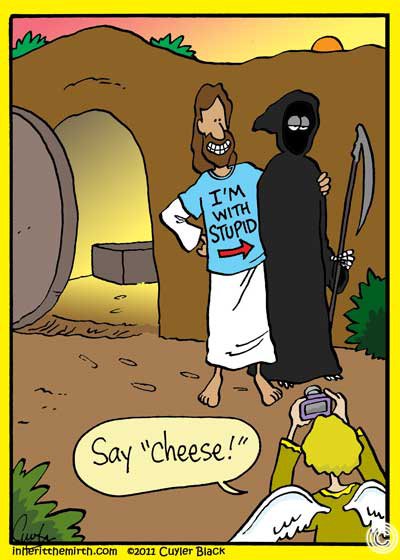
Peter’s message was pointed and straightforward: God raised Jesus up, forever changing the nature of death. Peter was dogmatic about stating that it wasn’t even possible for death to get a grip on Jesus. Oh, death thought it had him, the Grim Reaper believed he had Christ nailed to death for certain. Not so. The grave could not contain the immense and incredible power of divine love for humanity.

Inherit the Mirth

If it was impossible for death to keep its grip on Jesus, then there is absolutely nothing that can deter Jesus or hold him back from accomplishing what he wants to accomplish. Flaky believers are not going to frustrate Jesus or upset his plans; he’ll just send the Holy Spirit. 

We too often imprison ourselves in self-made spiritual jail cells, flaking-out in the Christian life, sometimes getting it right and once-in-a-while hitting upon some right combination we can’t explain, like a golfer who hits an amazing shot but can’t reproduce it no matter how hard he tries. The truth is: Jesus has conquered sin, death, and hell. By faith, we have forgiveness of sins in Christ and have the way opened to a new life in the Spirit. It isn’t a secret; it is a new reality.

The season of Lent is a time of remembering those things which hinder us in our walk with Jesus and repenting of our sins so that we can live anew. As we quickly approach Holy Week, the golf clubs of vulnerability, confession and prayer will keep us in God’s fairway and allow us to shoot par.

Gracious God, who raised Jesus from the dead, may the same power reside in me so that I can do your will in every situation through the power and presence of your Holy Spirit.  Amen.

1 Corinthians 14:20-25 – Becoming Spiritually Mature

To be perfectly frank, I’m getting exasperated with your infantile thinking. How long before you grow up and use your head—your adult head? It’s all right to have a childlike unfamiliarity with evil; a simple no is all that’s needed there. But there’s far more to saying yes to something. Only mature and well-exercised intelligence can save you from falling into gullibility. It’s written in Scripture that God said,

In strange tongues
    and from the mouths of strangers
I will preach to this people,
    but they’ll neither listen nor believe.

So where does it get you, all this speaking in tongues no one understands? It doesn’t help believers, and it only gives unbelievers something to gawk at. Plain truth-speaking, on the other hand, goes straight to the heart of believers and doesn’t get in the way of unbelievers. If you come together as a congregation and some unbelieving outsiders walk in on you as you’re all praying in tongues, unintelligible to each other and to them, won’t they assume you’ve taken leave of your senses and get out of there as fast as they can? But if some unbelieving outsiders walk in on a service where people are speaking out God’s truth, the plain words will bring them up against the truth and probe their hearts. Before you know it, they’re going to be on their faces before God, recognizing that God is among you. (MSG)

Throughout the history of Christianity there have been faithful saints committed to the cause of Christ, and there also has been professing believers who are inconsistent and irresponsible in their observance of faith. In other words, the church always has been a mix of spiritually mature and immature people.

The Apostle Paul wrote his letter to the Church at Corinth precisely because there was a large chunk of people who were just flat out childish. He wanted them to grow up. We anticipate babies are going to cry, poop, sleep, and have others caring for their basic needs. When adults act like babies, it is unacceptable and, well, offensive. We expect better. We need them to pull their weight and be responsible.

Paul addressed the Corinthian’s lack of unity, paucity of wisdom, too much worldliness, inattention to each other, abuse of freedom, and impropriety in worship. To correct this, he pointed them squarely toward love, the one permanent attribute that binds all things together. (1 Corinthians 13)

So, when it came to worshiping together, the church needed a more mature way of handling their meetings. The last thing they needed was worship which made no sense to most people. “I would rather speak five intelligible words that makes sense than ten thousand words in a language other people don’t know,” Paul said. (1 Corinthians 14:19, CEV)

Ministry is to be done guided by love and concern for another’s well-being. Spiritual gifts are not given for one’s own benefit but are provided for the encouragement and edification of others. The exercise of speaking plain truth with exorbitant love to each other does this; and it influences outsiders looking on from the margins. Sensitivity to the needs of those foreign to the church was a premium concern for Paul.

However, there is more to the outsider than simply observing what Christians are doing – the other will speak into the life of the believer. This, of course, ought to surprise no one. After all, God can speak through whomever or whatever, including people from all kinds of ethnic groups (Acts 2:1-12) and even a donkey (Numbers 22:28).

The New Testament lesson for today concerns respecting persons both within the church and outside. For fellow believers, we are to continually speak and act in ways which build up the entire Body of Christ. And, for those who are alien to the church, we are to pay attention to them and have a healthy repartee with them which acknowledges their inherent worth as fellow persons created in the image of God.

Churches and faith communities tend to be full of “insiders.” If they fail to listen to the “outsiders” then ultimately a similar situation to the Corinthian Church will occur. No one group of people have all the answers, so we all need to take a posture of humility and listening with genuine attention and loving focus. This honors the other and demonstrates basic kindness and respect.

Christian maturity is realized when spiritual growth is sustained over time and produces the fruit of wisdom and love. Wherever you find a group of folks who listen well, are attentive to those on the outside, and have an orientation to serving others in a spirit of love and grace, there you will find the Holy Spirit energizing and empowering people toward good deeds on behalf of both church and world.

May it be so, to the glory of God.